

Kirjahaku
Etsi kirjoja tekijän nimen, kirjan nimen tai ISBN:n perusteella.
1000 tulosta hakusanalla Robert R. Duke

Minding the Weather
Robert R. Hoffman; Daphne S. Ladue; H. Michael Mogil; Paul J. Roebber; J. Gregory Trafton
MIT PRESS LTD
2023
pokkari
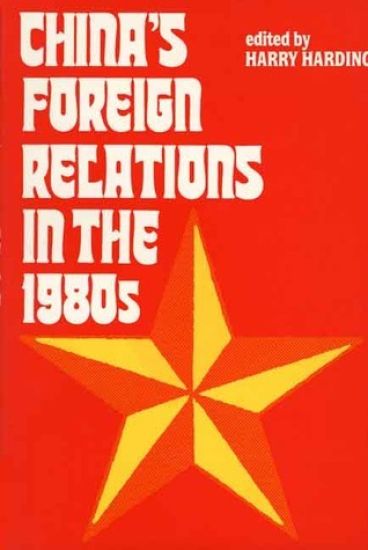
What role will China play in world affairs during the 1980s, now that it has normalized relations with the United States and opened wider its economic doors? In this thoughtful and important book, six respected scholars analyze the major factors that shape the foreign policies of China today. The book begins with an essay by Michael Hunt that puts China’s foreign relations in historical perspective. In subsequent chapters, Kenneth Liberthal discusses the domestic context of China’s foreign policy, Steven Levine analyzes China’s regional policies within Asia, Bruce Reynolds focuses on the role China plays in today’s international economy, and Jonathan Pollack assesses China’s place in the global strategic competition between the Soviet Union and the United States. The book concludes with a chapter by editor Harry Harding on change and continuity in China’s foreign policy since 1949. The authors bring to their analyses varying perspectives and expertise. They all agree however, that the historical, political, and strategic determinants of Chinese foreign policy will probably prevent Peking from maintaining an extremely close association with the United States and the West and that in the future China will increase its level of involvement in Asia. If these projections are correct, Americans must learn to accept a complex relationship with China that contains elements of both tension and cooperation. Such a relationship will require a sophisticated understanding of China—one that this book will help to provide. Published in cooperation with the Asia Society
Billiards, Bowling, Table Tennis, Pinball, and Video Games
Robert R. Craven
Greenwood Press
1983
sidottu
Product information not available.

"Because many readers may simply wish to browse the book or enjoy individual profiles, the volume may be useful in a variety of libraries serving both general users and researchers." Reference Books Bulletin

Concise but thorough profiles of symphony orchestras outside the US make this and its companion volume (Symphony Orchestras of the United States) indispensable for music libraries and many general public libraries as well. . . . Using the widely scattered literature on the subject, orchestral archives, and his own questionnaire, Craven profides information on each organization's history, seasonal activities, administrative structure, cultural impact, recordings, music directors, books and articles written about it, address, and telephone number. . . . Highly recommended for academic and general collections. ChoiceRobert Craven's new book together with his recent work on orchestras of the United States are the first to focus on the major symphonic groups. Designed as a resource for music lovers and collectors as well as those more directly connected with the music world, this reference guide provides profiles of 118 orchestras based in 42 countries. Entries are included on the leading symphonies of Britain and Europe and newer organizations that have achieved prominence in Latin America and Asia. Musicians, musicologists, critics, music historians, and other experts have contributed their rich and diversified musical knowledge to the individual essays, which range from 750 to 3,000 words in length.

This first comprehensive guide to English-language criminal justice materials on Israel covers over 820 sources written between 1948 and 1993. The books, book chapters, articles, and annual and other professional reports have been written by both Israeli and non-Israeli authors. The topic was defined broadly to serve students, teachers, researchers, and professionals in different disciplines and to review the important literature on a score of topics, such as addiction, corrections and probation, correctional treatment, crime and society, homicide, juvenile delinquency, organized crime, law enforcement, rape and violence, suicide, terrorism, and white collar crime. Keywords with each entry and a detailed author, journal, and subject index make the research easily accessible.This first comprehensive guide to English-language criminal justice materials on Israel covers over 820 sources written between 1948 and 1993. The books, book chapters, articles, and annual and other professional reports have been written by both Israeli and non-Israeli authors. The bibliography also points to important works on criminal justice generally by Israeli authors. The topic was defined broadly to serve students, teachers, researchers, and professionals in different disciplines, and a typology was created for this purpose. The bibliography is organized into 21 topical chapters on a score of topics: addiction, corrections and probation, correctional treatment, crime and society, crime by and among the aged, criminal justice, criminology and deviant behavior, fear of crime, homicide-aggression-violence, juvenile delinquency and juvenile justice, law, law enforcement, organized crime, political deviance and violence, rape and violence, social stress, suicide, terrorism, traffic offenses, victimology, and white collar crime. Keywords with each entry and a detailed author, journal, and subject index make the research easily accessible.

A comprehensive look at the entirety of Native American history, focusing particularly on native peoples within the geographic boundaries of the United States.The history of American Indians is an integral part of American history overall—a part that is often overlooked. History of American Indians: Exploring Diverse Roots provides a broad chronological overview of Native American history that challenges readers to grapple with the elemental themes of adaptation, continuity, and persistence. The book enables a deeper understanding of the origins and early history of American Indians and presents new scholarship based on the latest research.Readers will learn a wealth of American Indian history as well as appreciate the key role American Indians played in certain significant stages of American history as a whole. The direct connections between the events in the past and many current hot-button topics—such as race, climate change, water use, and other issues—are clearly identified. The book's straightforward, chronological presentation makes it a helpful and easy-to-read scholarly work appropriate for advanced high school and undergraduate college students.

This book presents a compelling account of atomic development over the last century that demonstrates how humans have repeatedly chosen to ignore the associated impacts for the sake of technological, scientific, military, and economic expediency.In 1945, Albert Einstein said, "The release of atomic power has changed everything except our way of thinking … the solution to this problem lies in the heart of mankind." This statement seems more valid today than ever. Romancing the Atom: Nuclear Infatuation from the Radium Girls to Fukushima presents compelling moments that clearly depict the folly and shortsightedness of our "atomic mindset" and shed light upon current issues of nuclear power, waste disposal, and weapons development.The book consists of ten nonfiction historical vignettes, including the women radium dial painters of the 1920s, the expulsion of the Bikini Island residents to create a massive "petri dish" for post-World War II bomb and radiation testing, the government-subsidized uranium rush of the 1950s and its effects on Native American communities, and the secret radioactive material development facilities in residential neighborhoods. In addition, the book includes original interviews of prominent historians, writers, and private citizens involved with these poignant stories.More information is available online at www.romancingtheatom.com.

Originally published in 1969, this book provides a sustained examination of the idea of the individual person as of supreme worth in the language of analytical philosophy. An important contribution to debates in moral philosophy, it will be of use to students in the philosophy of religion and education and to those who are interested in the contribution which philosophical analysis can make to the understanding of traditional moral and political ideas.

Originally published in 1969, this book provides a sustained examination of the idea of the individual person as of supreme worth in the language of analytical philosophy. An important contribution to debates in moral philosophy, it will be of use to students in the philosophy of religion and education and to those who are interested in the contribution which philosophical analysis can make to the understanding of traditional moral and political ideas.
Originally published in 1971, this book provides a lucid philosophical investigation of the area in which the demands of social and political institutions impinge on individual values and responsibilities, using the concept of a social role to focus attention on the problems and tensions which are necessarily involved. This approach to social and political philosophy will be of interest to students of social sciences as well as of philosophy.
Originally published in 1971, this book provides a lucid philosophical investigation of the area in which the demands of social and political institutions impinge on individual values and responsibilities, using the concept of a social role to focus attention on the problems and tensions which are necessarily involved. This approach to social and political philosophy will be of interest to students of social sciences as well as of philosophy.
Are Museums Irrelevant? Museums are rarely acknowledged in the global discussion of climate change, environmental degradation, the inevitability of depleted fossil fuels, and the myriad local issues concerning the well-being of particular communities – suggesting the irrelevance of museums as social institutions. At the same time, there is a growing preoccupation among museums with the marketplace, and museums, unwittingly or not, are embracing the values of relentless consumption that underlie the planetary difficulties of today.Museums in a Troubled World argues that much more can be expected of museums as publicly supported and knowledge-based institutions. The weight of tradition and a lack of imagination are significant factors in museum inertia and these obstacles are also addressed. Taking an interdisciplinary approach, combining anthropology ethnography, museum studies and management theory, this book goes beyond conventional museum thinking.Robert R. Janes explores the meaning and role of museums as key intellectual and civic resources in a time of profound social and environmental change. This volume is a constructive examination of what is wrong with contemporary museums, written from an insider’s perspective that is grounded in both hope and pragmatism. The book’s conclusions are optimistic and constructive, and highlight the unique contributions that museums can make as social institutions, embedded in their communities, and owned by no one.
Are Museums Irrelevant? Museums are rarely acknowledged in the global discussion of climate change, environmental degradation, the inevitability of depleted fossil fuels, and the myriad local issues concerning the well-being of particular communities – suggesting the irrelevance of museums as social institutions. At the same time, there is a growing preoccupation among museums with the marketplace, and museums, unwittingly or not, are embracing the values of relentless consumption that underlie the planetary difficulties of today.Museums in a Troubled World argues that much more can be expected of museums as publicly supported and knowledge-based institutions. The weight of tradition and a lack of imagination are significant factors in museum inertia and these obstacles are also addressed. Taking an interdisciplinary approach, combining anthropology ethnography, museum studies and management theory, this book goes beyond conventional museum thinking.Robert R. Janes explores the meaning and role of museums as key intellectual and civic resources in a time of profound social and environmental change. This volume is a constructive examination of what is wrong with contemporary museums, written from an insider’s perspective that is grounded in both hope and pragmatism. The book’s conclusions are optimistic and constructive, and highlight the unique contributions that museums can make as social institutions, embedded in their communities, and owned by no one.

Museums throughout the world are under increasing pressure in the wake of the 2008/2009 economic recession and the many pressing social and environmental issues that are assuming priority. The major focus of concern in the global museum community is the sustainability of museums in light of these pressures, not to mention falling attendance and the challenges of the digital world.Museums and the Paradox of Change provides a detailed account of how a major Canadian museum suffered a 40 percent loss in its operating budget and went on to become the most financially self-sufficient of the ten largest museums in Canada. This book is the most detailed case study of its kind and is indispensable for students and practitioners alike. It is also the most incisive published account of organizational change within a museum, in part because it is honest, open and reflexive. Janes is the first to bring perspectives drawn from complexity science into the discussion of organizational change in museums and he introduces the key concepts of complexity, uncertainty, nonlinearity, emergence, chaos and paradox. This revised and expanded third edition also includes new writing on strengthening museum management, as well as reflections on new opportunities and hazards for museums. It concludes with six ethical responsibilities for museum leaders and managers to consider. Janes provides pragmatic solutions grounded in a theoretical context, and highlights important issues in the management of museums that cannot be ignored.
Museums throughout the world are under increasing pressure in the wake of the 2008/2009 economic recession and the many pressing social and environmental issues that are assuming priority. The major focus of concern in the global museum community is the sustainability of museums in light of these pressures, not to mention falling attendance and the challenges of the digital world.Museums and the Paradox of Change provides a detailed account of how a major Canadian museum suffered a 40 percent loss in its operating budget and went on to become the most financially self-sufficient of the ten largest museums in Canada. This book is the most detailed case study of its kind and is indispensable for students and practitioners alike. It is also the most incisive published account of organizational change within a museum, in part because it is honest, open and reflexive. Janes is the first to bring perspectives drawn from complexity science into the discussion of organizational change in museums and he introduces the key concepts of complexity, uncertainty, nonlinearity, emergence, chaos and paradox. This revised and expanded third edition also includes new writing on strengthening museum management, as well as reflections on new opportunities and hazards for museums. It concludes with six ethical responsibilities for museum leaders and managers to consider. Janes provides pragmatic solutions grounded in a theoretical context, and highlights important issues in the management of museums that cannot be ignored.

US Defence Strategy from Vietnam to Operation Iraqi Freedom examines the thirty-year transformation in American military thought and defence strategy that spanned from 1973 through 2003. During these three decades, new technology and operational practices helped form what observers dubbed a 'Revolution in Military Affairs' in the 1990s and a 'New American Way of War' in the 2000s. Robert R. Tomes tells for the first time the story of how innovative approaches to solving battlefield challenges gave rise to non-nuclear strategic strike, the quest to apply information technology to offset Soviet military advantages, and the rise of 'decisive operations' in American military strategy. He details an innovation process that began in the shadow of Vietnam, matured in the 1980s as Pentagon planners sought an integrated nuclear-conventional deterrent, and culminated with battles fought during blinding sandstorms on the road to Baghdad in 2003. An important contribution to military innovation studies, the book also presents an innovation framework applicable to current defence transformation efforts. This book will be of much interest to students of strategic studies, US defence policy and US politics in general.
US Defence Strategy from Vietnam to Operation Iraqi Freedom examines the thirty-year transformation in American military thought and defence strategy that spanned from 1973 through 2003. During these three decades, new technology and operational practices helped form what observers dubbed a 'Revolution in Military Affairs' in the 1990s and a 'New American Way of War' in the 2000s. Robert R. Tomes tells for the first time the story of how innovative approaches to solving battlefield challenges gave rise to non-nuclear strategic strike, the quest to apply information technology to offset Soviet military advantages, and the rise of 'decisive operations' in American military strategy. He details an innovation process that began in the shadow of Vietnam, matured in the 1980s as Pentagon planners sought an integrated nuclear-conventional deterrent, and culminated with battles fought during blinding sandstorms on the road to Baghdad in 2003. An important contribution to military innovation studies, the book also presents an innovation framework applicable to current defence transformation efforts. This book will be of much interest to students of strategic studies, US defence policy and US politics in general.

Trying to understand how the world looks through the eyes of individuals and groups and how it shapes the ways they think and act is something social workers do all the time. It is what social theorists do too. This book identifies and explains in a highly accessible manner the absolute value of social theory for social work. Drawing on the theoretical ideas and perspectives of a wide range of classical and modern social theorists, the book demonstrates the insights their work can bring to bear on a wide range of social work practice scenarios, issues and debates.Departing with the work of the classical theorists, the book covers a diverse range of theoretical traditions including phenomenology, symbolic interactionism, Norbert Elias, Michel Foucault, Pierre Bourdieu, feminism and globalization theory. Putting to work ideas from these different perspectives, a range of social work scenarios, issues and debates are opened up and explored. The final chapter brings together the various theoretical strands, and critically considers the contribution they can make towards realizing core social work values in a rapidly globalizing world.Demonstrating exactly how and in what ways social theory can make important and enduring contributions to social work, Social Theory for Social Work is essentialial reading for social work students, practitioners and professionals alike.