From the host of Hardball with Chris Matthews (now on Substack) and acclaimed Kennedy biographer comes a centennial tribute about why Robert F. Kennedy's revolutionary vision offers the roadmap America needs today. 100 years after his birth, Bobby Kennedy matters more than ever. That is because he led us in pursuit of America's ideals. He took risks for peace and united a fractured country. He showed moral courage and political bravery. In today's bitterly divided nation, his message has the power to help us reimagine a better future. On the historic occasion of Bobby Kennedy's centennial, Chris Matthews, one of America's foremost political commentators and Kennedy biographers, gives us ten electrifying lessons for today drawn from Bobby's life. Take them as a guide. America is great when it tries, at its best, to be good. This special anniversary book also includes a selection of Bobby Kennedy's greatest speeches, which, when read today, offer a renewed and inspiring vision for America.
In the Summer of 1972, 14-year-old Judith Roberts took off for a bike ride within the vicinity of her Staffordshire home. Her body was discovered after a three-day manhunt, concealed from view in a thick privet having been brutally attacked. The community of Tamworth was rocked by the news of her death and an outcry for justice ensued. Within weeks of her murder, an impressionable and troubled soldier, based in the nearby barracks, 17-year-old Andrew Evans, walked into a police station and confessed to the killing. Relentlessly interviewed for hours on end without representation or an appropriate adult present, Andrew was swiftly charged with Judith's murder. Despite attempting to recount his statement and a legal defence at trial that defied the prosecution's arguments that Andrew Evans was guilty, a judge sentenced him to life behind bars. He was eventually acquitted in 1997 in what was, at the time, Britain's longest miscarriage of justice. While Andrew Evans fought for his freedom, another man drove up and down England undetected: Peter William Sutcliffe. Eventually proven capable of inflicting unimaginable horror at any given opportunity, an independent inquiry dubbed him likely responsible for more murders than the 13 he was convicted of and the seven others he attempted between 1975 and 1980. In _The Murder of Judith Roberts_, Chris Clark and Tanita Matthews examine evidence that concludes that Sutcliffe, whose violent criminal history dates back as far as 1969, was the real culprit responsible for Judith's murder. With never before-published dialogue from Andrew Evans' police interviews showing the grave miscarriage of justice, the case file of the five-decade cold case is examined under a new light.
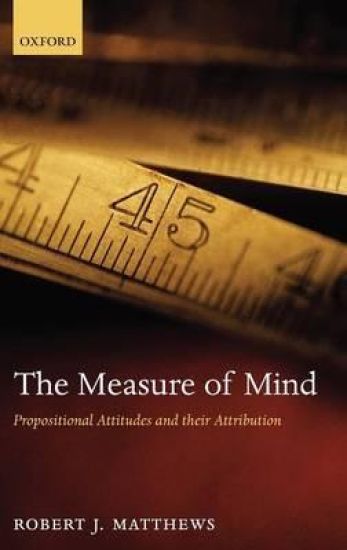
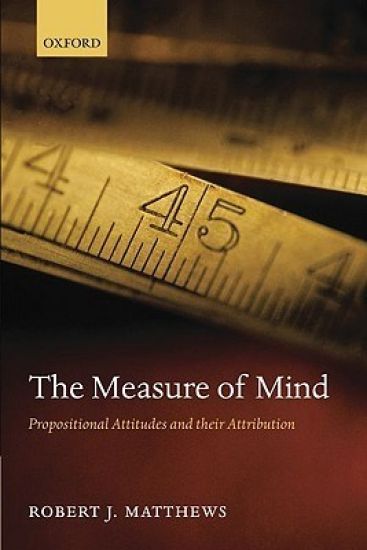
The Measure of Mind provides a sustained critique of a widely held representationalist view of propositional attitudes and their role in the production of thought and behaviour. On this view, having a propositional attitude is a matter of having an explicit representation that plays a particular causal/computational role in the production of thought and behaviour. Robert J. Matthews argues that this view does not enjoy the theoretical or the empirical support that proponents claim for it; moreover, the view misconstrues the role of propositional attitude attributions in cognitive scientific theorizing. The Measure of Mind goes on to develop an alternative measurement-theoretic account of propositional attitudes and the sentences by which we attribute them. On this account, the sentences by which we attribute propositional attitudes function semantically like the sentences by which we attribute a quantity of some physical magnitude (e.g., having a mass of 80 kilos). That is, in much the same way that we specify a quantity of some physical magnitude by means of its numerical representative on a measurement scale, we specify propositional attitude of a given type by means of its representative in a linguistically-defined measurement space. Propositional attitudes turn out to be causally efficacious aptitudes for thought and behaviour, not semantically evaluable mental particulars of some sort. Matthews' measurement-theoretic account provides a more plausible view of the explanatorily relevant properties of propositional attitudes, the semantics of propositional attitude attributions, and the role of such attributions in computational cognitive scientific theorizing.
The Measure of Mind provides a sustained critique of a widely held representationalist view of propositional attitudes and their role in the production of thought and behaviour. On this view, having a propositional attitude is a matter of having an explicit representation that plays a particular causal/computational role in the production of thought and behaviour. Robert J. Matthews argues that this view does not enjoy the theoretical or the empirical support that proponents claim for it; moreover, it misconstrues the role of propositional attitude attributions in cognitive scientific theorizing. He then goes on to develop an alternative measurement-theoretic account of propositional attitudes and the sentences by which we attribute them. On this account, the sentences by which we attribute propositional attitudes function semantically like the sentences by which we attribute a quantity of some physical magnitude (e.g., having a mass of 80 kilos). That is, in much the same way that we specify a quantity of some physical magnitude by means of its numerical representative on a measurement scale, we specify propositional attitudes by means of their representatives in a linguistically-defined measurement space. Matthews argues that, unlike the representationalist view, his account of propositional attitudes draws a clear distinction between propositional attitudes and our natural language representations of them, and does not presume that salient properties of the latter can simply be read back onto the former. On his view, propositional attitudes turn out to be causally efficacious aptitudes for thought and behaviour, and not mental entities of some sort. In defending this approach, Matthews provides a plausible account both of the standard philosophical puzzles about propositional attitudes, and of the role of propositional attitude attributions in cognitive scientific theorizing.
Every week for a year, a professional philosopher and eight children at a school in Edinburgh met to craft stories reflecting philosophical problems. The philosopher, Gareth B. Matthews, believes that children are far more able and eager to think abstractly than adults generally recognize. This engaging book has profound implications for education and for our understating of the range of relationships between adults and children. With the example of these dialogues Matthews invites parents, teachers, and all adults to be open to those moments when they can share with children the pleasures of joint philosophical discovery.
The pattern revealed is one of deliberate ambiguity. On some issues and in some forums, Canada has acted vigorously to promote human rights internationally, as in the United Nations Human Rights Commission, the United Nations Committee on Human Rights, and the Conference on Security and Cooperation in Europe. Canada has been much less forceful about human rights in dealings with the International Labour Organization and has almost completely ignored this issue as it relates to international financial institutions. Canada has been outspoken about the violation of rights in countries ruled by communist regimes, while hesitation and ambiguity are a feature of Canadian policies toward South Africa and Central America, as well as in lending policies to international financial institutions, Canadian development assistance, and Canadian arms sales. Each of these areas is examined in Human Rights in Canadian Foreign Policy. Canada is most vigorous on issues of human rights when the rights in question are civil and political rather than economic and social, and when the offending regime is under Soviet rather than American influence. The contributors include: Frances Arbour, Victoria Berry, John W. Foster, Rhoda E. Howard, Kalmen Kaplansky, T.A. Keenleyside, Allen McChesney, Ronald Manzer, Robert O. Matthews, Stefania Szlek Miller, Cathal J. Nolan, Kim Richard Nossal, Cranford Pratt, Renate Pratt, Ernie Regehr, and H. Gordon Skilling.
This book unites the worlds of physics and depth psychology through analysis of carefully selected existing and new dream materials. Their interpretation by Matthews provides fertile ground for the unifying of the extreme opposites of psyche and matter and forms a continuation of the deep dialogue between acclaimed psychologist Carl Jung and Nobel physicist Wolfgang Pauli.What emerges is an individuation process where inner and outer worlds are intertwined through a succession of dream images, culminating with that of the ring i, the mathematical function at the heart of quantum physics. This mysterious function unites wave and particle and symbolically carries the quality of paradox. The occurrence of the ring i in Pauli’s and the author’s dreams suggests paradox is a necessary psychological state to experience a living union between psyche and matter. Analysis of accompanying materials further indicates the arising of a new world view where inner and outer, mind and matter, may again be seen as a unified whole. This book is an engaging read for academics and researchers in the field of Jungian psychology and will appeal to those interested in the novel application of quantum physics to philosophy, psychology and spirituality.
This book unites the worlds of physics and depth psychology through analysis of carefully selected existing and new dream materials. Their interpretation by Matthews provides fertile ground for the unifying of the extreme opposites of psyche and matter and forms a continuation of the deep dialogue between acclaimed psychologist Carl Jung and Nobel physicist Wolfgang Pauli.What emerges is an individuation process where inner and outer worlds are intertwined through a succession of dream images, culminating with that of the ring i, the mathematical function at the heart of quantum physics. This mysterious function unites wave and particle and symbolically carries the quality of paradox. The occurrence of the ring i in Pauli’s and the author’s dreams suggests paradox is a necessary psychological state to experience a living union between psyche and matter. Analysis of accompanying materials further indicates the arising of a new world view where inner and outer, mind and matter, may again be seen as a unified whole. This book is an engaging read for academics and researchers in the field of Jungian psychology and will appeal to those interested in the novel application of quantum physics to philosophy, psychology and spirituality.