Kirjojen hintavertailu. Mukana 11 244 527 kirjaa ja 12 kauppaa.

Kirjahaku

Etsi kirjoja tekijän nimen, kirjan nimen tai ISBN:n perusteella.

1000 tulosta hakusanalla Rodrick Madison

Andean Sling Braids

Andean Sling Braids

Rodrick Owen; Terry Newhouse Flynn

Schiffer Publishing Ltd
2016
sidottu
Learn to make the decorative braids used in the sling-making traditions of Peru and Bolivia. This detailed guide, including over 400 step-by-step photographs and hundreds of diagrams, teaches the traditional braiding technique of Peru and Bolivia. Over 100 braid designs are included for weavers, craftspeople, jewelry designers, basket weavers, and others interested in using braids for embellishment. In-depth instructions are given, along with clear diagrams, recommended braiding yarns for slings and kumihimo, detailed set-up instructions, and many fascinating contemporary applications. This book introduces a new piece of equipment, the core frame, and gives instructions for making it from wood and dowels. When the core frame is used with a braiding stand and bobbins, a wide variety of core-carrying braids become accessible to kumihimo braiders. Most of the braids, from 4 to 40 strands, can be made on the included 32-slot braiding card designed specifically for Andean braiding, and 50 patterns can be made on the stand without a frame.
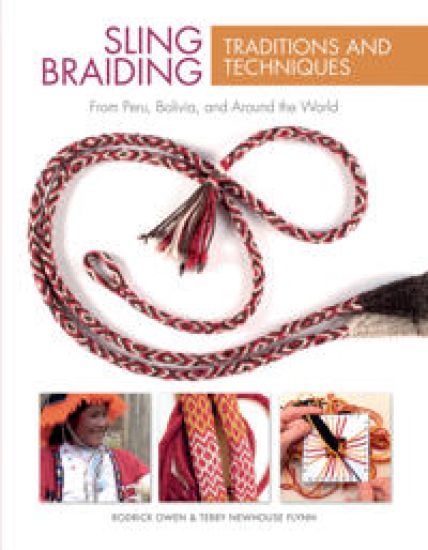
Sling Braiding Traditions and Techniques

Sling Braiding Traditions and Techniques

Rodrick Owen; Terry Newhouse Flynn

Schiffer Publishing Ltd
2017
sidottu
The history of slings as weapons and herding tools, particularly in Andean cultures, along with detailed instructions for making one. This comprehensive, full-color guide features dozens of images of slings from various cultures, both ancient and contemporary. Slings had great significance in many cultures, particularly in the Andes, and were often used as both prehistoric weapons and herding tools. This book shows novice and experienced braiders how to make 50 designs, from 8 to 32 strands, on a braiding card or with a braiding stand and bobbins. Learn step by step how to make an authentic Andean-style sling with braided cords and a tapestry-woven cradle. A range of techniques useful for beginning, ending, and embellishing slings are included, and can enhance a wide variety of other items, like jewelry, garments, and accessories. A key resource for historians, ethnologists, textile artists, weapons experts, and others to learn the practical skills for understanding sling braids' structure, this book includes braiding card and plans to make core stand.
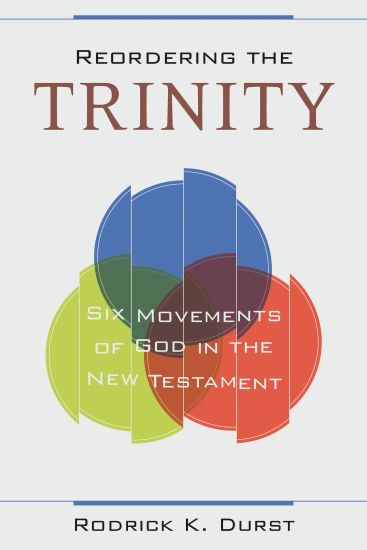
Reordering the Trinity – Six Movements of God in the New Testament
The New Testament writers present the Trinity in surprising ways, which impact our understanding of God and the mission of the churchWe're used to hearing the traditional order of the Trinity, usually used in baptisms: Father, Son, and Holy Spirit. But why does the apostle Paul end his letter to the Corinthians with a benediction naming the triune God in a different order: Son, Father, Spirit? In fact, there are six possible arrangements for naming the Trinity, each of which is used numerous times in the New Testament.Analyzing the 75 New Testament references to the persons of the Godhead, theologian Rodrick Durst demonstrates that the ways the early church thought and talked about the Trinity had a great deal of richness and diversity that has since been lost. From the context of these passages Durst concludes that each order of the three names corresponds to a particular purpose or movement of God that the New Testament author is invoking: mission, salvation, witness to Christ, sanctification, spiritual formation, and Church unity. These six Trinitarian orders reveal God's calling to join Him in six different works.Durst guides the reader through the significance of each formulation and how it can powerfully shape the twenty-first-century church and believers' formation, worship, witness, and work.
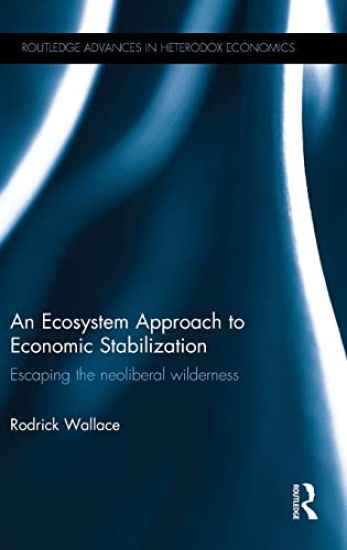
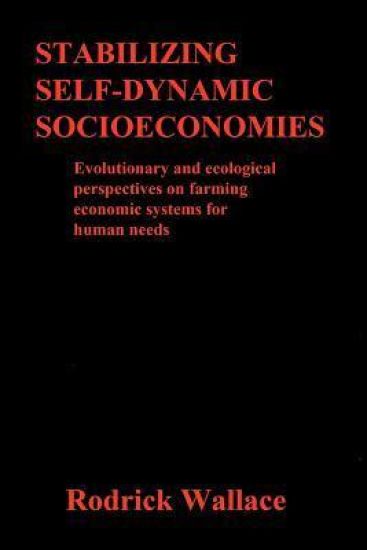
An Ecosystem Approach to Economic Stabilization
The creation of economic institutions that can function well under substantial uncertainties -- Black Swans -- is analogous to the dilemmas confronting our hunter-gatherer forefathers in the face of large-scale ecological unpredictability. The ultimate solution was not the development of a super hunter-gatherer technology that could ride out repeated catastrophe, but rather the invention, in neolithic times, of culturally-adapted 'farmed' ecosystems constructed to maximize food yield and minimize risks of famine. Recent advances in evolutionary and ecosystem theory applied to economic structure and process may permit construction of both new economic theory and new tools for data analysis that can help in the design of more robust economic institutions. This may result in less frequent and less disruptive transitions, and enable the design of culturally-specific systems less affected by those that do occur.This unique and innovative book applies cutting-edge methods from cognitive science and evolutionary theory to the problem of the necessary stabilization of economic processes. At the core of this book is the establishment of a statistics-like toolbox for the study of empirical data that is consistent with generalized evolutionary approaches. This toolbox enables the construction of both new economic theories and methods of data analysis that can help in the design of more robust economic institutions. This in turn will result in less frequent and less disruptive Black Swans, and enable as well the design of culturally-specific systems less affected by those that do occur.
I am What I am

I am What I am

Rodrick Daniels

Lulu.com
2014
nidottu
A story of total redemption. Gangs, drugs, gun battles that left me with five bullet wounds, two in the head and left for dead. Through several prison terms God has had his hand on me. He protected me for such a time as this. To give hope to those struggling with living a life hustling in the streets. It is because of the saving power of Jesus that my life has changed. 1 Corithians 15:10 by the grace of God I Am What I Am.
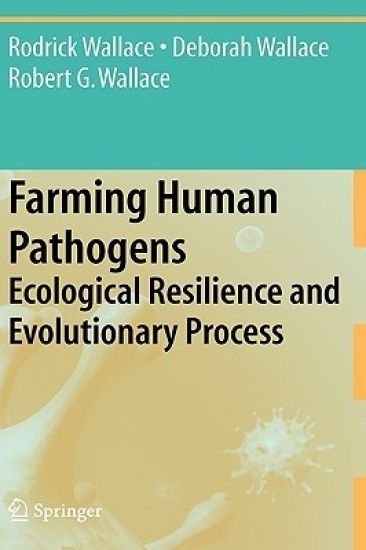
Farming Human Pathogens

Farming Human Pathogens

Rodrick Wallace; Deborah Wallace; Robert G. Wallace

Springer-Verlag New York Inc.
2010
nidottu
Farming Human Pathogens: Ecological Resilience and Evolutionary Process introduces a cutting-edge mathematical formalism based on the asymptotic limit theorems of information theory to describe how punctuated shifts in mesoscale ecosystems can entrain patterns of gene expression and organismal evolution. The authors apply the new formalism toward characterizing a number of infectious diseases that have evolved in response to the world as humans have made it. Many of the human pathogens that are emerging out from underneath epidemiological control are 'farmed' in the metaphorical sense, as the evolution of drug-resistant HIV makes clear, but also quite literally, as demonstrated by avian influenza's emergence from poultry farms in southern China. The most successful pathogens appear able to integrate selection pressures humans have imposed upon them from a variety of socioecological scales. The book also presents a related treatment of Eigen's Paradox and the RNA 'error catastrophe' that bedevils models of the origins of viruses and of biological life itself.
Collective Consciousness and Its Discontents:

Collective Consciousness and Its Discontents:

Rodrick Wallace; Mindy T. Fullilove

Springer-Verlag New York Inc.
2010
nidottu
An earlier book by Rodrick Wallace entitled Consciousness: A Mathematical Treatment of the Global Neuronal Workspace Model, introduced a formal information-theoretic approach to individual consciousness implementing approaches developed previously by the cognitive scientist Bernard Baars and the philosopher Fred Dretske. This book takes a more formal 'groupoid' perspective and generalizes the results of that book to processes of 'distributed cognition' characteristic of large institutions that can entertain several, sometimes many, simultaneous 'global workspaces' which must compete for resources while communicating and cooperating. Equivalence classes of 'states' produce a network of language-analogs characterizing interacting cognitive modules which entertain multiple workspaces. Equivalence classes of these language-analogs produce dynamical manifolds describing temporal processes carried out by multiple-workspace institutions.
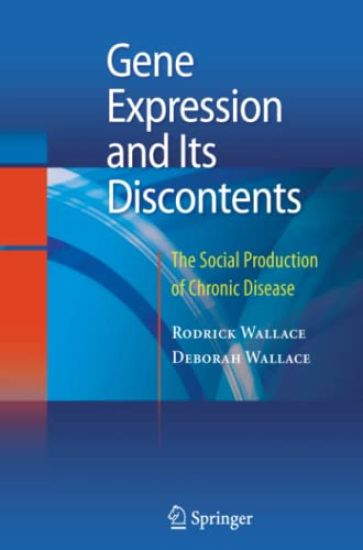
Gene Expression and Its Discontents

Gene Expression and Its Discontents

Rodrick Wallace; Deborah Wallace

Springer-Verlag New York Inc.
2014
nidottu
Gene Expression and its Discontents examines a class of probability models describing how epigenetic context affects gene expression and organismal development, using the asymptotic limit theorems of information theory in a highly formal manner. Taking classic results on spontaneous symmetry breaking abducted from statistical physics in groupoid, rather than group, circumstances, the work suggests that epigenetic information sources act as analogs to a tunable catalyst, directing development into different characteristic pathways according to the structure of external signals. The results have significant implications for epigenetic epidemiology, in particular for understanding how environmental stressors, in a large sense, can induce a broad spectrum of developmental disorders in humans. The authors then apply the perspective to a number of chronic diseases broadly associated with obesity, using data at different scales of observation.
Consciousness

Consciousness

Rodrick Wallace

Springer-Verlag New York Inc.
2014
nidottu
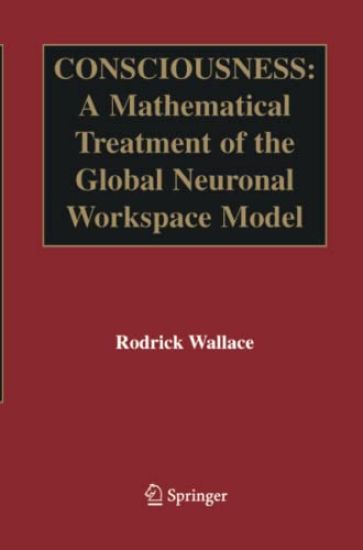
This book is not an intellectual history or popular summary of recent work on consciousness in humans. Bernard Baars (1988), Edelman and Tononi (2000), and many others, have written such, and done it well indeed. This book, rather, brings the powerful analytic machinery of communication theory to bear on the Global Neuronal Workspace (GNW) model of consciousness which Baars introduced, and does so in a formal mathematical manner. It is not the first such attempt. The philospher Fred Dretske (1981), indep- dent of Baars, long ago outlined how information theory might illuminate the understanding of mind. Adapting his approach on the necessary conditions for mental process, we apply a previously-developed information theory analysis of interacting cognitive biological and social modules to Baars' GNW, which has become the principal candidate for a 'standard model' of consciousness. Invoking an obvious canonical homology with statistical physics, the method, when iterated in the spirit of the Hierarchical Linear Model of regression theory, generates a fluctuating dynamic threshold for consciousness which is similar to a tunable phase transition in a physical system. The phenomenon is, however, constrained to a manifold/atlas structure analogous to a retina; an adaptable Rate Distortion manifold, whose 'topology', in a large sense, reflects the hierarchy of embedding constraints acting on consciousness. This view greatly extends what Baars has characterized as 'contexts.
I'm Trying to Help Somebody

I'm Trying to Help Somebody

Rodrick A Smith

Xulon Press
2022
pokkari
Jesus said, "Man shall not live by bread alone, but by every word that comes from the mouth of God." He also taught us to pray, "Give us this day our daily bread." Oftentimes bread is available to us and in our possession, but we can't decide what to eat. Bible reading can sometimes be like that. Our appetites constantly change, and we need and enjoy variety in our spiritual diet. In I'm Trying to Help Somebody, Rodrick A. Smith wants to provide a balanced diet of daily spiritual nourishment. These daily devotions serve as a source of encouragement, inspiration, warning, and rebuke; that's the variety. They are expositional, practical, and portable. One devotional is written from each chapter of John's gospel through the book of Revelation. Prayerfully read and be helped. I'm Trying to Help Somebody is an inspiring read for Bible enthusiasts on every level. To have these carefully written notes is valuable to the shelves of every Christian's library. Tellis Chapman, BA; MACM; DD Galilee Baptist Church Detroit, Michigan RODRICK A. SMITH is the pastor of the Zion Missionary Baptist Church of Saginaw, Michigan. In addition to being in the pastorate for almost 28 years, he has served as Moderator of the Saginaw Valley Baptist District Association, and as a Vice President of the Wolverine State Baptist Convention, Inc. He and his wife, Irma, have one daughter, Angela, and a granddaughter, Noa.