In Napoleon III and the Second Empire, Roger D. Price considers the mid-century crisis which provided Louis-Napoleon Bonaparte with the opportunity to gain elective office as President. The author outlines the objectives of Napoleon III and provides: * A historiographical review of the ruler and his regime * Details of changing historical attitudes to the period * A survey of Napoleon III's economic, social and political impact * An outline of the man's reign and his achievements
International relations theory is witnessing a veritable explosion of works within the areas of modernism and postmodernism, yet there has been no attempt to compare these theories and their sources according to a common criterion or logical form. This author argues that while these pioneering, imaginative and exciting theoretical works are disparate, they also share a common thread that seeks to express emancipatory goals for international relations.This book provides an in-depth critical study of this genre of theorizing that he names ‘Emancipatory International Relations’. Spegele develops a framework to help the reader understand both the differences and commonalities in modernist and postmodernist emancipatory thinking in International Relations. He critically analyzes modernist theories, discourses, narratives and postmodernist theory and practice, feminist emancipatory discourses and postmodernist international discourse and concludes by examining the coherence, viability and plausibility of emancipatory discourses in international relations whether modernist or postmodernist.This challenging and innovative volume will be of interest to students and researchers of international relations.
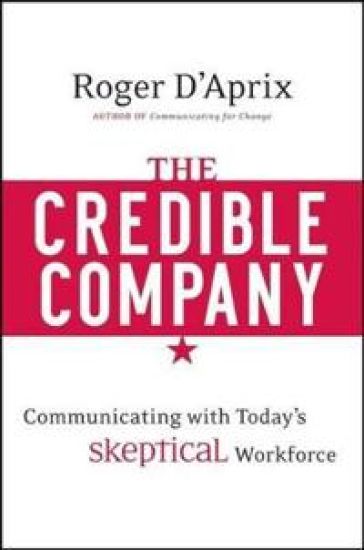
In The Credible Company, communication expert Roger D?Aprix provides a logical and tested strategy to inform skeptical employees in a time of turbulent change. With information being the lifeblood of today?s intellectual-capital assembly line, D?Aprix explains, the internal communication task has taken on an unprecedented importance. Drawing on his experience as a corporate communication executive and consultant, the author offers a practical prescription for effective communication: INFORMS (as in a communication strategy that informs). Based on the principles of Information, Needs on the Job, Face-to-Face Communication, Openness, Research, Marketplace, and Strategy, INFORMS provides a winning formula for those with the insight and motivation to work for greater credibility within companies and other institutional organizations. Throughout the book, D?Aprix provides numerous illustrative examples from his rich consulting experience as lessons in what to do and what not to do in communicating with the workforce.
Prepared under the aegis of the Food and Agriculture Organization of the United Nations (FAO), this text presents a fresh and comprehensive look at agricultural development policy. It provides a clear, systematic review of important classes of policy issues in developing countries and discusses the emerging international consensus on viable approaches to the issues. The text is unique in its coverage and depth and it: Summarises hundreds of references on agricultural development policiesCites policy experiences and applied studies in more than 70 countriesProvides guidance for policy makers giving examples of successes and failuresReviews issues related to the formulation of strategies and the requirements for making them successfulDevelops the conceptual foundations and illustrates policies that have worked, and some that have not, with explanations Topics covered include agriculture’s role in economic development, the objectives and strategies of agricultural policy, linkages between macroeconomic and agricultural policy, policies for the agricultural financial system and agricultural technology development. Upper level undergraduates taking courses in Economic Development and International Development and graduates taking courses in Agricultural Development, International and Economic Development, Natural Resource Management and specialised topics in agriculture will find this text of great interest. It also serves as a reference for professionals and researchers in the field of International Development.
For centuries humanity has engaged in a virtual exploration of space through astronomical observation, aided by astounding scientific and technological advances. In more than sixty years since the launch of Sputnik 1 in 1957, more than 6,000 functioning satellites have been launched into Earth’s orbit and beyond – some to the farthest reaches of the Solar System – and more than 540 people have travelled into space. Unprecedented in its chronological and geographical scope, this book charts the history of space exploration from the first gunpowder rockets through the Moon landings, and into a future of space tourism. Numerous sidebars focus on the key individuals and inventions that brought us closer to the farthest reaches of the universe. Filled with astonishing images from the Smithsonian, NASA archives and other international collections, this is the first in-depth, fully illustrated survey of this universal human journey.
From the Preface:On the frontier, says conventional wisdom, a structured society did not exist and social control was largely absent; law enforcement and the criminal justice system had limited, if any, influence; and danger--both from man and from the elements--was ever present. This view of the frontier is projected by motion pictures, television, popular literature, and most scholarly histories. But was the frontier really all that violent? What was the nature of the violence that did occur? Were frontier towns more violent that cities in the East? Has America inherited a violent way of life from the frontier? Was the frontier more violent than the United States is today? This book attempts to answer these questions and others about violence and lawlessness on the frontier and do so in a new way. Whereas most authors have drawn their conclusions about frontier violence from the exploits of a few notorious badmen and outlaws and from some of the more famous incidents and conflicts, I have chosen to focus on two towns that I think were typical of the frontier--the mining frontier specifically--and to investigate all forms of violence and lawlessness that occurred in and around those towns.
Tropical forests are vanishing at an alarming rate. This book, based on extensive international field research, highlights one solution for preserving this precious resource: empowering local people who depend on the forest for survival. Synthesizing a vast amount of information that has never been brought together in one place, Roger D. Stone and Claudia D'Andrea provide a clearly written and energizing tour of global efforts to empower community-based forest stewards. Along the way, they show the fundamental importance of tropical forest ecosystems and deepen our sense of urgency to save them for the benefit of billions of rural people in tropical and subtropical regions as well as for countless species of plants and animals.In their travels to research this book, the authors saw many remarkable examples of how proficient even the poorest local people can be in stabilizing and recovering formerly destitute forests. With engagingly written case studies from Thailand's Golden Triangle to Mindanao in the Philippines, from Indonesia, India, and Africa to Brazil, Mexico, and Central America, they introduce us to the communities and the individuals, the governments, the loggers, the agencies, and the local groups who vie for forest resources.Contrasting community-based efforts and traditional forest management with government and donor efforts, they discuss the many reasons why international institutions and national governments have been unable and unwilling to stem the accelerating loss of tropical forestland. This book argues that we are paying a terrible price - politically, economically, and environmentally - for allowing tropical forests to be stripped. Community-based forestry is no panacea, but this book clearly shows its effectiveness as a management technique.
Championing Science shows scientists how to persuasively communicate complex scientific ideas to decision makers in government, industry, and education. This comprehensive guide provides real-world strategies to help scientists develop the essential communication, influence, and relationship-building skills needed to motivate nonexperts to understand and support their science. Instruction, interviews, and examples demonstrate how inspiring decision makers to act requires scientists to extract the essence of their work, craft clear messages, simplify visuals, bridge paradigm gaps, and tell compelling narratives. The authors bring these principles to life in the accounts of science champions such as Robert Millikan, Vannevar Bush, scientists at Caltech and MIT, and others. With Championing Science, scientists will learn how to use these vital skills to make an impact.
Championing Science shows scientists how to persuasively communicate complex scientific ideas to decision makers in government, industry, and education. This comprehensive guide provides real-world strategies to help scientists develop the essential communication, influence, and relationship-building skills needed to motivate nonexperts to understand and support their science. Instruction, interviews, and examples demonstrate how inspiring decision makers to act requires scientists to extract the essence of their work, craft clear messages, simplify visuals, bridge paradigm gaps, and tell compelling narratives. The authors bring these principles to life in the accounts of science champions such as Robert Millikan, Vannevar Bush, scientists at Caltech and MIT, and others. With Championing Science, scientists will learn how to use these vital skills to make an impact.
This book seeks to identify the motivations of individual perpetrators of ethnic violence. The work develops four models, labeled Fear, Hatred, Resentment, and Rage, gleaned from existing social science literatures. The empirical chapters apply these four models to important events of ethnic conflict in Eastern Europe, from the 1905 Russian Revolution to the collapse of Yugoslavia in the 1990s. Each historical chapter generates questions about the timing and target of ethnic violence. The four models are then applied to the case, to learn which does the best job in explaining the observed patterns of ethnic conflict. The findings challenge conventional wisdom, in that the Resentment narrative, centered on a sense of unjust group status, provides the best fit for a variety of cases. While Fear, Hatred, and Rage do motivate hostile actions, Resentment pervasively appears to inflame ethnic animosity and drive outcomes in the timing and pattern of action.
Resistance and Rebellion: Lessons from Eastern Europe explains how ordinary people become involved in resistance and rebellion against powerful regimes. The book shows how a sequence of casual forces - social norms, focal points, rational calculation - operate to drive individuals into roles of passive resistance and, at a second stage, into participation in community-based rebellion organization. By linking the operation of these mechanisms to observable social structures, the work generates predictions about which types of community and society are most likely to form and sustain resistance and rebellion. The empirical material centres around Lithuanian anti-Soviet resistance in both the 1940s and the 1987–91 period. Using the Lithuanian experience as a baseline, comparisons with several other Eastern European countries demonstrate the breadth and depth of the theory. The book contributes to both the general literature on political violence and protest, as well as the theoretical literature on collective action.
The questions of how a large population of neurons in the brain functions, how synchronized firing of neurons is achieved, and what factors regulate how many and which neurons fire under different conditions form the central theme of this book. Using a combined experimental-theoretical approach unique in neuroscience, the authors present important techniques for the physiological reconstruction of a large biological neuronal network. They begin by discussing experimental studies of the CA3 hippocampal region in vitro, focusing on single-cell and synaptic electrophysiology, particularly the effects a single neuron exerts on its neighbours. This is followed by a description of a computer model of the system, first for individual cells then for the entire detailed network, and the model is compared with experiments under a variety of conditions. The results shed significant light into the mechanisms of epilepsy, electroencephalograms, and biological oscillations and provide an excellent test case for theories of neural networks. Researchers in neurophysiology and physiological psychology, physicians concerned with epilepsy and related disorders, and researchers in computational neuroscience will find this book an invaluable resource.
This book explains why contemporary liberal democracies are based on historical templates rather than revolutionary reforms; why the transition in Europe occurred during a relatively short period in the nineteenth century; why politically and economically powerful men and women voluntarily supported such reforms; how interests, ideas, and pre-existing institutions affected the reforms adopted; and why the countries that liberalized their political systems also produced the Industrial Revolution. The analysis is organized in three parts. The first part develops new rational choice models of (1) governance, (2) the balance of authority between parliaments and kings, (3) constitutional exchange, and (4) suffrage reform. The second part provides historical overviews and detailed constitutional histories of six important countries. The third part provides additional evidence in support of the theory, summarizes the results, contrasts the approach taken in this book with that of other scholars, and discusses methodological issues.
Conflicts involve powerful experiences. The residue of these experiences is captured by the concept and language of emotion. Indiscriminate killing creates fear; targeted violence produces anger and a desire for vengeance; political status reversals spawn resentment; cultural prejudices sustain ethnic contempt. These emotions can become resources for political entrepreneurs. A broad range of Western interventions are based on a view of human nature as narrowly rational. Correspondingly, intervention policy generally aims to alter material incentives ('sticks and carrots') to influence behavior. In response, poorer and weaker actors who wish to block or change this Western implemented 'game' use emotions as resources. This book examines the strategic use of emotion in the conflicts and interventions occurring in the Western Balkans over a twenty-year period. The book concentrates on the conflicts among Albanian and Slavic populations (Kosovo, Montenegro, Macedonia, South Serbia), along with some comparisons to Bosnia.
The questions of how a large population of neurons in the brain functions, how synchronized firing of neurons is achieved, and what factors regulate how many and which neurons fire under different conditions form the central theme of this book. Using a combined experimental-theoretical approach unique in neuroscience, the authors present important techniques for the physiological reconstruction of a large biological neuronal network. They begin by discussing experimental studies of the CA3 hippocampal region in vitro, focusing on single-cell and synaptic electrophysiology, particularly the effects a single neuron exerts on its neighbours. This is followed by a description of a computer model of the system, first for individual cells then for the entire detailed network, and the model is compared with experiments under a variety of conditions. The results shed significant light into the mechanisms of epilepsy, electroencephalograms, and biological oscillations and provide an excellent test case for theories of neural networks. Researchers in neurophysiology and physiological psychology, physicians concerned with epilepsy and related disorders, and researchers in computational neuroscience will find this book an invaluable resource.
This book addresses several aspects of the law and economics of intellectual property rights (IPRs) that have been underanalyzed in the existing literature. It begins with a brief overview of patents, trade secrets, copyrights, and trademarks, and the enforcement and licensing of IPRs, focusing on the remedies available for infringement (injunctions, various forms of damages, and damages calculation issues); the standard of care (strict liability versus an intent- or negligence-based standard); and the rules for determining standing to sue and joinder of defendant for IPR violations. The authors demonstrate that the core assumption of IPR regimes - that IPRs maximize certain social benefits over social costs by providing a necessary inducement for the production and distribution of intellectual products - have several important implications for the optimal design of remedies, the standard of care, and the law of standing and joinder.
In this 1996 book Roger Spegele argues that in the past international theorists have failed to recognise that there is not one conception of international relations, subdivided into different theories and approaches, but at least three wholly different conceptions of the subject. Though scholars are increasingly prepared to accept this, there is still no consensus about what to call these conceptions, how to describe them, and why they should be studied. This book attempts to fill this gap. The author first examines two conceptions of IR - positivism-empiricism and emancipatory international relations - which challenge political realism. He then defends a revised version of realism, called 'evaluative political realism', from challenges arising from its rivals, with the aim of defining a conception of political realism which is coherent, viable, and attractive.
In this book Roger Spegele argues that in the past international theorists have failed to recognise that there is not one conception of international relations, subdivided into different theories and approaches, but at least three wholly different conceptions of the subject. Though scholars are increasingly prepared to accept this, there is still no consensus about what to call these conceptions, how to describe them, and why they should be studied. This book attempts to fill this gap. The author first examines two conceptions of IR - positivism-empiricism and emancipatory international relations - which challenge political realism. He then defends a revised version of realism, called ‘evaluative political realism’, from challenges arising from its rivals, with the aim of defining a conception of political realism which is coherent, viable, and attractive.
Most readers are familiar with the concept of a monopoly. A monopolist is the only seller of a good or service for which there are not good substitutes. Economists and policy makers are concerned about monopolies because they lead to higher prices and lower output. The topic of this book is monopsony, the economic condition in which there is one buyer of a good or service. It is a common misunderstanding that if monopolists raise prices, then monopsonists must lower them. It is true that a monopsonist may force sellers to sell to them at lower prices, but this does not mean consumers are better off as a result. This book explains why monopsonists can be harmful and the way law has developed to respond to these harms.
Most readers are familiar with the concept of a monopoly. A monopolist is the only seller of a good or service for which there are not good substitutes. Economists and policy makers are concerned about monopolies because they lead to higher prices and lower output. The topic of this book is monopsony, the economic condition in which there is one buyer of a good or service. It is a common misunderstanding that if monopolists raise prices, then monopsonists must lower them. It is true that a monopsonist may force sellers to sell to them at lower prices, but this does not mean consumers are better off as a result. This book explains why monopsonists can be harmful and the way law has developed to respond to these harms.