Kirjojen hintavertailu. Mukana 12 390 323 kirjaa ja 12 kauppaa.

Kirjahaku

Etsi kirjoja tekijän nimen, kirjan nimen tai ISBN:n perusteella.

1000 tulosta hakusanalla Roger Lewis

Arming the Western Front

Arming the Western Front

Roger Lloyd-Jones; M.J. Lewis

Ashgate Publishing Limited
2016
sidottu
The First World War was above all a war of logistics. Whilst the conflict will forever be remembered for the mud and slaughter of the Western Front, it was a war won on the factory floor as much as the battlefield. Examining the war from an industrial perspective, Arming the Western Front examines how the British between 1900 and 1920 set about mobilising economic and human resources to meet the challenge of 'industrial war'. Beginning with an assessment of the run up to war, the book examines Edwardian business-state relations in terms of armament supply. It then outlines events during the first year of the war, taking a critical view of competing constructs of the war and considering how these influenced decision makers in both the private and public domains. This sets the framework for an examination of the response of business firms to the demand for 'shells more shells', and their varying ability to innovate and manage changing methods of production and organisation. The outcome, a central theme of the book, was a complex and evolving trade-off between the quantity and quality of munitions supply, an issue that became particularly acute during the Battle of the Somme in 1916. This deepened the economic and political tensions between the military, the Ministry of Munitions, and private engineering contractors as the pressure to increase output accelerated markedly in the search for victory on the western front. The Great War created a dual army, one in the field, the other at home producing munitions, and the final section of the book examines the tensions between the two as the country strove for final victory and faced the challenges of the transition to the peace time economy.
Arming the Western Front

Arming the Western Front

Roger Lloyd-Jones; M.J. Lewis

CRC Press Inc
2017
nidottu
The First World War was above all a war of logistics. Whilst the conflict will forever be remembered for the mud and slaughter of the Western Front, it was a war won on the factory floor as much as the battlefield. Examining the war from an industrial perspective, Arming the Western Front examines how the British between 1900 and 1920 set about mobilising economic and human resources to meet the challenge of 'industrial war'. Beginning with an assessment of the run up to war, the book examines Edwardian business-state relations in terms of armament supply. It then outlines events during the first year of the war, taking a critical view of competing constructs of the war and considering how these influenced decision makers in both the private and public domains. This sets the framework for an examination of the response of business firms to the demand for 'shells more shells', and their varying ability to innovate and manage changing methods of production and organisation. The outcome, a central theme of the book, was a complex and evolving trade-off between the quantity and quality of munitions supply, an issue that became particularly acute during the Battle of the Somme in 1916. This deepened the economic and political tensions between the military, the Ministry of Munitions, and private engineering contractors as the pressure to increase output accelerated markedly in the search for victory on the western front. The Great War created a dual army, one in the field, the other at home producing munitions, and the final section of the book examines the tensions between the two as the country strove for final victory and faced the challenges of the transition to the peace time economy.

Big Business in Little Rock: How 6 Local Companies Have Found Big Success In This "Little" City
We all can choose where we want to live and do business. So whether we are sitting here in Little Rock, or somewhere else, it's what's inside of us that makes the difference. People want to do business with people they know, like and trust. That is the difference We are here because we want to be in this community. We want to support local business and the community. We want to give back and make Little Rock a better place for everyone. It's not that Little Rock drew us... we came because of relationships, the environment and the community. And now that we're here, we love it and want to see it grow. Our hope is that you'll join us in our optimism. Whether or not Little Rock is recognized by the media as a great place to live and do business, you and I know that it is. As long as we are able, we intend to invest in local business, the schools, the arts and serving those less fortunate. We believe this is the path to making any city a better place to live and work.Having a Big Business in Little Rock is more about treating people right and giving back. It's not the revenue we're talking about, but the avenue of investing our lives into the lives of others. We hope you thoroughly enjoy reading our ramblings. You probably won't see us on the NY Times Best Seller list any time soon, but more important than that, you will see us around town and involved in the community. That's how good cities become great cities - when people get involved. Thanks for reading Big Business in Little Rock. Roger Best Jason EverettMike Davidson J. Ted Lewis Mike BennettMichael DeLon
Manchester and the Age of the Factory

Manchester and the Age of the Factory

Roger Lloyd-Jones; M.J. Lewis

TAYLOR FRANCIS LTD
2026
sidottu
Manchester and the Age of the Factory (originally published in 1988 and now with a new preface by the authors) focuses on Manchester, the world’s first industrial city, and its transformation into ‘Cottonopolis.’ The book explores the contribution of the factory and the firm to the business structure and political economy of ‘Cottonopolis’. The factory is not examined in isolation but in terms of its relation to a range of economic components. A major, and indeed, new emphasis of the work is centred on the relationship between factory and warehouse. These two components are identified as symbolic of two different systems of production, whose political economy at the nodal point of the Industrial Revolution was associated with a struggle over the merits of the mechanised factory as opposed to the manufacturing putting-out system. To investigate the interdependence of economic components, the authors reconstruct Manchester’s business structure for the years 1815 and 1825. The first reconstruction allows for the examination of the city’s variegated business structure at a point midway through the classic Industrial Revolution and the ramifications of the empirical findings provide a focus of discussion in the subsequent chapters. The second reconstruction provides a comparative basis for exploring shifting business trends, identifying conflicting business interests and assessing the direct and indirect impact of the factory on the pattern of business development. For instance, the evolving business relationship between the factory and warehouse after 1815 played a pivotal role in shaping a new political economy, examined at both local and national levels. This transformation prompted cotton firms to develop distinctive business strategies focused on managing the factory’s human and physical resources.
Alfred Herbert Ltd and the British Machine Tool Industry, 1887-1983
At the beginning of the twentieth century Britain was amongst the world leaders in the production of machine tools, yet by the 1980s the industry was in terminal decline. Focusing on the example of Britain's largest machine tool maker, Alfred Herbert Ltd of Coventry, this study charts the wider fortunes of this vital part of the manufacturing sector. Taking a chronological approach, the book explores how during the late nineteenth century the industry developed a reputation for excellence throughout the world, before the challenges of two world wars necessitated drastic changes and reorganisations. Despite meeting these challenges and emerging with confidence into the post-war market place, the British machine tool industry never regained its pre-eminent position, and increasingly lost ground to foreign competition. By using the example of Alfred Herbert Ltd to illuminate the broader economic and business history of the British machine tool industry, this study not only provides a valuable insight into British manufacturing, but also contributes to the ongoing debates surrounding Britain's alleged decline as a manufacturing nation.
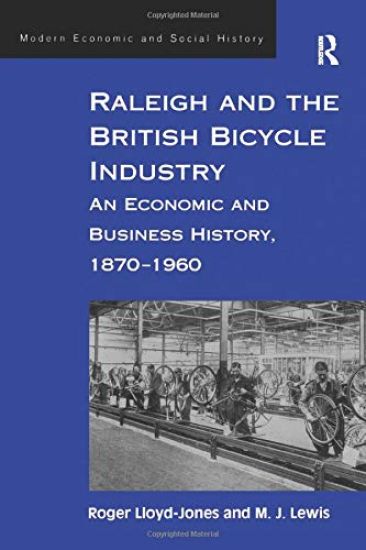
Raleigh and the British Bicycle Industry

Raleigh and the British Bicycle Industry

Roger Lloyd-Jones; M. J. Lewis

Routledge
2017
nidottu
This book is the first comprehensive history of the development of the British bicycle industry from the perspective of business and economic history. Focusing on themes such as entrepreneurship, personal capitalism, and organisational, technological and cultural change, the shifting fortunes of the industry are traced through the business history of one of its leading firms, Raleigh. The history of the company is then set within the context of more general trends in the industry’s evolution over three chronological periods: 1870 to 1914, 1914 to 1939, and 1939 to 1960. In addition to the story of Raleigh, the business activities of other leading bicycle firms such as Rudge-Whitworth, Hercules, BSA, J. A. Phillips and BCC, the bicycle division of Tube Investments, are examined to inform our understanding of the business evolution of the industry. The book demonstrates that the British bicycle industry was both tenacious and dynamic, typified by the personal leadership of entrepreneurs such as Frank and Harold Bowden at Raleigh.
Raleigh and the British Bicycle Industry

Raleigh and the British Bicycle Industry

Roger Lloyd-Jones; M. J. Lewis

Ashgate Publishing Limited
2000
sidottu
This book is the first comprehensive history of the development of the British bicycle industry from the perspective of business and economic history. Focusing on themes such as entrepreneurship, personal capitalism, and organisational, technological and cultural change, the shifting fortunes of the industry are traced through the business history of one of its leading firms, Raleigh. The history of the company is then set within the context of more general trends in the industry’s evolution over three chronological periods: 1870 to 1914, 1914 to 1939, and 1939 to 1960. In addition to the story of Raleigh, the business activities of other leading bicycle firms such as Rudge-Whitworth, Hercules, BSA, J. A. Phillips and BCC, the bicycle division of Tube Investments, are examined to inform our understanding of the business evolution of the industry. The book demonstrates that the British bicycle industry was both tenacious and dynamic, typified by the personal leadership of entrepreneurs such as Frank and Harold Bowden at Raleigh.
Planning and Implementing Assessment

Planning and Implementing Assessment

Richard Freeman; Roger (BP Professor of Learning Development Lewis

Routledge Falmer
1998
sidottu
This title outlines a set of principles and analytical methods that can be adapted to different assessment scenarios designed to enable readers to construct their own effective methods for assessment. Guidelines for design and methods of planning, choosing and implementation are provided.
Planning and Implementing Assessment

Planning and Implementing Assessment

Richard Freeman; Roger (BP Professor of Learning Development Lewis

Routledge Falmer
1998
nidottu
This title outlines a set of principles and analytical methods that can be adapted to different assessment scenarios designed to enable readers to construct their own effective methods for assessment. Guidelines for design and methods of planning, choosing and implementation are provided.
Using Computers in History

Using Computers in History

M.J. Lewis; Roger Lloyd-Jones

Routledge
1996
nidottu
Using Computers in History is designed to introduce students to historical computing through practical workshop exercises. With topics such as the pattern of nineteenth century emigration from the UK, the performance of the American and German economies in the 1930s and the Lancashire cotton industry, Lloyd-Jones and Lewis explain and illustrate the possible uses of the computer for the historian.Using Computers in History:* raises awareness of the use of computers as an important tool for the historian* provides a practical introduction to basic computer terminology* includes high quality diagrams of the screen displays which should appear at each stage* examines the use of spreadsheets and how to design and work with them* discusses the different software packages available, concentrating on Microsoft Excel 4* includes spreadsheet exercises based around a range of historical data sets* explores the use of databases* shows how to construct them* gives guidelines for further study* prompts students to apply the skills they have learnt to a number of examples
Pharmaceutical Experimental Design

Pharmaceutical Experimental Design

Gareth A. Lewis; Didier Mathieu; Roger Phan-Tan-Luu

CRC Press
2019
nidottu
This useful reference describes the statistical planning and design of pharmaceutical experiments, covering all stages in the development process-including preformulation, formulation, process study and optimization, scale-up, and robust process and formulation development.Shows how to overcome pharmaceutical, technological, and economic constraints on experiment design!Directly comparing the advantages and disadvantages of specific techniques, Pharmaceutical Experimental Design· offers broad, detailed, up-to-date descriptions of designs and methods not easily accessible in other books· reviews screening designs for qualitative factors at different levels· presents designs for predictive models and their use in optimization· highlights optimization methods, such as steepest ascent, optimum path, canonical analysis, graphical analysis, and desirability· discusses the Taguchi method for quality assurance and approaches for robust scaling up and process transfer· details nonstandard designs and mixtures· analyzes factorial, D-optimal design, and offline quality assurance techniques· reveals how one experimental design evolves from another· and more!Featuring over 700 references, tables, equations, and drawings, Pharmaceutical Experimental Design is suitable for industrial, research, and clinical pharmaceutical scientists, pharmacists, and pharmacologists; statisticians and biostatisticians; drug regulatory affairs personnel; biotechnologists; formulation, analytical, and synthetic chemists and engineers, quality assurance personnel; all users of statistical experimental design in research and development; and postgraduate and postdoctoral research workers in these disciplines.
Pharmaceutical Experimental Design

Pharmaceutical Experimental Design

Gareth A. Lewis; Didier Mathieu; Roger Phan-Tan-Luu

CRC Press Inc
1998
sidottu
This useful reference describes the statistical planning and design of pharmaceutical experiments, covering all stages in the development process-including preformulation, formulation, process study and optimization, scale-up, and robust process and formulation development.Shows how to overcome pharmaceutical, technological, and economic constraints on experiment design!Directly comparing the advantages and disadvantages of specific techniques, Pharmaceutical Experimental Design· offers broad, detailed, up-to-date descriptions of designs and methods not easily accessible in other books· reviews screening designs for qualitative factors at different levels· presents designs for predictive models and their use in optimization· highlights optimization methods, such as steepest ascent, optimum path, canonical analysis, graphical analysis, and desirability· discusses the Taguchi method for quality assurance and approaches for robust scaling up and process transfer· details nonstandard designs and mixtures· analyzes factorial, D-optimal design, and offline quality assurance techniques· reveals how one experimental design evolves from another· and more!Featuring over 700 references, tables, equations, and drawings, Pharmaceutical Experimental Design is suitable for industrial, research, and clinical pharmaceutical scientists, pharmacists, and pharmacologists; statisticians and biostatisticians; drug regulatory affairs personnel; biotechnologists; formulation, analytical, and synthetic chemists and engineers, quality assurance personnel; all users of statistical experimental design in research and development; and postgraduate and postdoctoral research workers in these disciplines.
Vampirella Archives Volume 9

Vampirella Archives Volume 9

Bruce Jones; Roger McKenzie; Gerry Boudreau; Budd Lewis; Bill DuBay

Dynamic Forces Inc
2014
sidottu
The supernatural sensation Vampirella welcomes you to the latest spine-chilling volume in the Vampirella Archives! Join the iconic horror hostess in over thirty terrifying tales from issues #57 through #64 of the celebrated 1970s Vampirella Magazine. The finest macabre masters of an era (Jose Gonzalez, Carmine Infantino, Dick Giordano, Gonzalo Mayo, and more) deliver vicious vignettes and featured fright-fests like "City of Ghosts", "Little Monsters", and "The Sultana's Revenge", each a vintage classic guaranteed to curdle the blood!
The Analysis and Geometry of Hardy's Inequality

The Analysis and Geometry of Hardy's Inequality

Alexander A. Balinsky; W. Desmond Evans; Roger T. Lewis

Springer International Publishing AG
2015
nidottu
This volume presents advances that have been made over recent decades in areas of research featuring Hardy's inequality and related topics. The inequality and its extensions and refinements are not only of intrinsic interest but are indispensable tools in many areas of mathematics and mathematical physics.Hardy inequalities on domains have a substantial role and this necessitates a detailed investigation of significant geometric properties of a domain and its boundary. Other topics covered in this volume are Hardy- Sobolev-Maz’ya inequalities; inequalities of Hardy-type involving magnetic fields; Hardy, Sobolev and Cwikel-Lieb-Rosenbljum inequalities for Pauli operators; the Rellich inequality.The Analysis and Geometry of Hardy’s Inequality provides an up-to-date account of research in areas of contemporary interest and would be suitable for a graduate course in mathematics or physics. A good basic knowledge of real and complex analysis is a prerequisite.
Archipelago

Archipelago

Andrew McNellie; Norman Ackroyd; John Brannigan; Moya Cannon; Mark Cocker; Peter Davidson; Roger Deakin; Tim Dee; David Douglas; Douglas Dunn; Terry Eagleton; John Eifion Jones; John Elder; Rose Ferraby; Barbara Greg; Ivor Gurney; Alexandra Harris; Seamus Heaney; Geoffrey Hill; Sally Huband; Roger Hutchinson; Mick Imlah; Kathleen Jamie; John Kerrigan; Philip Lancaster; David Lea; Angela Leighton; Gwyneth Lewis; Michael Longley; James Macdonald Lockhart; Robert Macfarlane; Angus Macmillan; Derek Mahon; Gail McNeillie

The Lilliput Press Ltd
2021
nidottu
Archipelago is one of the most important and influential literary magazines of the last twenty years. Running to twelve editions, it was edited by Andrew McNeillie, with the assistance later of James McDonald Lockhart, and began as an attempt to reimagine the relationships between the islands of Ireland and Britain. Archipelago has brought together established and emerging artists in creative conversations that have transformed the study of islands, coasts and waterways. It journeys from the Shetlands to Cornwall, from the Aran Islands to the coast of Yorkshire, tracing the cultures of diverse zones through some of the best in contemporary writing about place and people. This collection gathers poetry, prose and visual art in clusters grouped around the Irish and British archipelago, with contributions from an array of significant artists. It includes newly commissioned work as well as an interview between Andrew McNeillie and Robert Macfarlane on the development of Archipelago across the years.
A history of the 'Old water-colour' society, now the Royal society of painters in water colours
A history of the 'Old water-colour' society, now the Royal society of painters in water colours - With biographical notices is an unchanged, high-quality reprint of the original edition of 1891. Hansebooks is editor of the literature on different topic areas such as research and science, travel and expeditions, cooking and nutrition, medicine, and other genres. As a publisher we focus on the preservation of historical literature. Many works of historical writers and scientists are available today as antiques only. Hansebooks newly publishes these books and contributes to the preservation of literature which has become rare and historical knowledge for the future.