Kirjojen hintavertailu. Mukana 11 244 527 kirjaa ja 12 kauppaa.

Kirjahaku

Etsi kirjoja tekijän nimen, kirjan nimen tai ISBN:n perusteella.

1000 tulosta hakusanalla Roy E. Edwards

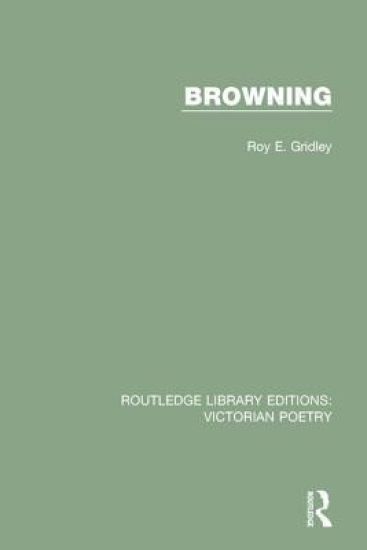
Browning

Browning

Roy E. Gridley

Routledge
2016
sidottu
First published in 1972. Browning was a keen observer and dramatic recorder of nineteenth-century European culture; his poetry reflects a wide range of intellectual, religious and artistic issues of his day. Roy E. Gridley shows here that during the six decades of Browning’s active writing career (1832-89), his poetry is a record and an interpretation of the changing modes of thought, feeling and expression of nineteenth-century life. Browning was a ‘romantic’ who, by virtue of his realistic and often revolutionary poetry, became a ‘modern’, and had considerable influence on writers such as Yeats, Eliot and Pound. While surveying the whole of Browning’s life and work, Gridley focuses closely on the more famous poems, examining them as documents that give the general reader a deeper appreciation of the richness and diversity of life in Victorian Europe.
Browning

Browning

Roy E. Gridley

Routledge
2017
nidottu
First published in 1972. Browning was a keen observer and dramatic recorder of nineteenth-century European culture; his poetry reflects a wide range of intellectual, religious and artistic issues of his day. Roy E. Gridley shows here that during the six decades of Browning’s active writing career (1832-89), his poetry is a record and an interpretation of the changing modes of thought, feeling and expression of nineteenth-century life. Browning was a ‘romantic’ who, by virtue of his realistic and often revolutionary poetry, became a ‘modern’, and had considerable influence on writers such as Yeats, Eliot and Pound. While surveying the whole of Browning’s life and work, Gridley focuses closely on the more famous poems, examining them as documents that give the general reader a deeper appreciation of the richness and diversity of life in Victorian Europe.
Nation, State and Territory

Nation, State and Territory

Roy E H Mellor

Routledge
2015
sidottu
This detailed analysis, originally published in 1989 studies the relationship between nation, state and territory. It explores the evolution of nations and the development of the state idea. Consideration is given to the frontier, s the interface between states, the influence of defence requirements, and the dilemmas involved in organizing the internal territorial-administrative arrangements of state territory. Finally the book reviews the geographical problems of empires, in growth and decline, and the impact of international organizations among states. Throughout the book, the themese are given an historical dimension and are supported by numerous maps and examples.
Nation, State and Territory

Nation, State and Territory

Roy E H Mellor

Routledge
2017
nidottu
This detailed analysis, originally published in 1989 studies the relationship between nation, state and territory. It explores the evolution of nations and the development of the state idea. Consideration is given to the frontier, s the interface between states, the influence of defence requirements, and the dilemmas involved in organizing the internal territorial-administrative arrangements of state territory. Finally the book reviews the geographical problems of empires, in growth and decline, and the impact of international organizations among states. Throughout the book, the themese are given an historical dimension and are supported by numerous maps and examples.
A Modification of the Newman-Keuls Procedure for Multiple Comparisons
This work has been selected by scholars as being culturally important, and is part of the knowledge base of civilization as we know it. This work was reproduced from the original artifact, and remains as true to the original work as possible. Therefore, you will see the original copyright references, library stamps (as most of these works have been housed in our most important libraries around the world), and other notations in the work.This work is in the public domain in the United States of America, and possibly other nations. Within the United States, you may freely copy and distribute this work, as no entity (individual or corporate) has a copyright on the body of the work.As a reproduction of a historical artifact, this work may contain missing or blurred pages, poor pictures, errant marks, etc. Scholars believe, and we concur, that this work is important enough to be preserved, reproduced, and made generally available to the public. We appreciate your support of the preservation process, and thank you for being an important part of keeping this knowledge alive and relevant.
Geotechnical Investigation Methods

Geotechnical Investigation Methods

Roy E. Hunt

CRC Press Inc
2006
sidottu
The investigation phase is the most important segment of any geotechnical study. Using the correct methods and properly interpreting the results are critical to a successful investigation. Comprising chapters from the second edition of the revered Geotechnical Engineering Investigation Handbook, Geotechnical Investigation Methods offers clear, concise, and hands-on guidance for choosing and executing a variety of field investigations. This practical guide provides an affordable alternative to larger handbooks and condenses the essential elements of a geotechnical investigation into an easily digestible and readily accessible format. Renowned expert Roy E. Hunt discusses preliminary study to predict geologic conditions, applying information from geologic and topographic maps as well as remotely sensed imagery, proper test boring procedures, the various geophysical methods and when each is appropriate, and a variety of methods for determining materials' engineering properties in the lab and in situ. Hunt also covers field instrumentation for surface movements, subsurface deformations, and in situ pressures and stresses, as well as instrument arrays for typical problems such as structure settlement and fault movements. Eliminate the need to search through narrow volumes or large handbooks with Geotechnical Investigation Methods: A Field Guide for Geotechnical Engineers, a convenient and complete guide to the techniques you need.
Characteristics of Geologic Materials and Formations
Properly understanding and characterizing geologic materials and formations is vital for making critical engineering decisions. Identifying and classifying rock masses and soil formations allows reasonable estimation of their characteristic properties. Comprising chapters from the second edition of the revered Geotechnical Engineering Investigation Handbook, Characteristics of Geologic Materials and Formations provides a basis for recognizing, identifying, and classifying the various rock and soil types. With clear, concise, and hands-on guidance, this book describes these rock and soil types in terms of their origin, mode of occurrence, and structural features in situ and presents the typical characteristics that are of engineering significance. It also explains the elements that affect surface and subsurface water engineering in terms of controlling floods, erosion, subsurface flow, and seepage, as well as for water conservation. Supplying important correlations used to estimate engineering and geologic properties, the book presents correlations for intact rock, rock masses, and soil formations throughout the chapters and condenses this information into a convenient summary table in an appendix. Eliminate the need to search through narrow volumes or large handbooks with Characteristics of Geologic Materials and Formations: A Field Guide for Geotechnical Engineers, a convenient and complete guide to the techniques you need.
Geologic Hazards

Geologic Hazards

Roy E. Hunt

CRC Press Inc
2007
sidottu
Geologic hazards pose the greatest threat to human safety for any geotechnical undertaking, but it is ultimately the engineer's ability to recognize and cope with these hazards that will determine the safety of life and property. Armed with Geologic Hazards: A Field Guide for Geotechnical Engineers you will be able to properly recognize, understand various geologic hazards, and provide safe and economical construction. Eminent expert Roy E. Hunt thoroughly examines the potential for slope failures, earthquakes, ground subsidence, collapse, and expansion. Using a clear conceptual approach, he explains what measures are available to minimize or eliminate the risks associated with each of these geologic hazards. The book sets forth the basis for recognizing, understanding, and treating geologic hazards, using general concepts rather than rigorous mathematical analyses. The author covers the prediction of slope failures through recognition of geologic and other factors that govern failure, the treatment of slopes that are potentially unstable and pose a danger to some existing development, the design and construction of stable cut slopes and sidehill fills, and the stabilization of failed slopes. He provides the foundation for determining the potential for surface movements and for preventing or controlling their effects. A section on earthquakes summarizes and links all of the aspects of earthquakes including their causes, characteristics, and surface effects. It provides a thorough grounding in how to recognize hazard potential and minimize the consequences. There is no field within geotechnical engineering in which the state of the art is changing so rapidly. Providing the latest information, this resource is a useful tool for designing new projects and redesigning old ones.