Kirjojen hintavertailu. Mukana 12 357 391 kirjaa ja 12 kauppaa.

Kirjahaku

Etsi kirjoja tekijän nimen, kirjan nimen tai ISBN:n perusteella.

1000 tulosta hakusanalla Samuel W McCall

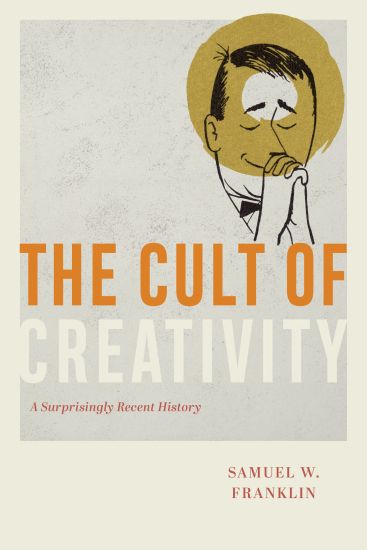
The Cult of Creativity

The Cult of Creativity

Samuel W. Franklin

THE UNIVERSITY OF CHICAGO PRESS
2023
sidottu
A history of how, in the mid-twentieth century, we came to believe in the concept of creativity. Named a best book of 2023 by the New Yorker and a notable book of 2023 by Behavioral Scientist. Creativity is one of American society’s signature values, but the idea that there is such a thing as “creativity”—and that it can be cultivated—is surprisingly recent, entering our everyday speech in the 1950s. As Samuel W. Franklin reveals, postwar Americans created creativity, through campaigns to define and harness the power of the individual to meet the demands of American capitalism and life under the Cold War. Creativity was championed by a cluster of professionals—psychologists, engineers, and advertising people—as a cure for the conformity and alienation they feared was stifling American ingenuity. It was touted as a force of individualism and the human spirit, a new middle-class aspiration that suited the needs of corporate America and the spirit of anticommunism. Amid increasingly rigid systems, creativity took on an air of romance; it was a more democratic quality than genius, but more rarified than mere intelligence. The term eluded clear definition, allowing all sorts of people and institutions to claim it as a solution to their problems, from corporate dullness to urban decline. Today, when creativity is constantly sought after, quantified, and maximized, Franklin’s eye-opening history of the concept helps us to see what it really is, and whom it really serves.
The Cult of Creativity

The Cult of Creativity

Samuel W. Franklin

THE UNIVERSITY OF CHICAGO PRESS
2024
nidottu
A history of how, in the mid-twentieth century, we came to believe in the concept of creativity. Named a best book of 2023 by the New Yorker and a notable book of 2023 by Behavioral Scientist. Creativity is one of American society’s signature values, but the idea that there is such a thing as “creativity”—and that it can be cultivated—is surprisingly recent, entering our everyday speech in the 1950s. As Samuel W. Franklin reveals, postwar Americans created creativity, through campaigns to define and harness the power of the individual to meet the demands of American capitalism and life under the Cold War. Creativity was championed by a cluster of professionals—psychologists, engineers, and advertising people—as a cure for the conformity and alienation they feared was stifling American ingenuity. It was touted as a force of individualism and the human spirit, a new middle-class aspiration that suited the needs of corporate America and the spirit of anticommunism. Amid increasingly rigid systems, creativity took on an air of romance; it was a more democratic quality than genius, but more rarified than mere intelligence. The term eluded clear definition, allowing all sorts of people and institutions to claim it as a solution to their problems, from corporate dullness to urban decline. Today, when creativity is constantly sought after, quantified, and maximized, Franklin’s eye-opening history of the concept helps us to see what it really is, and whom it really serves.
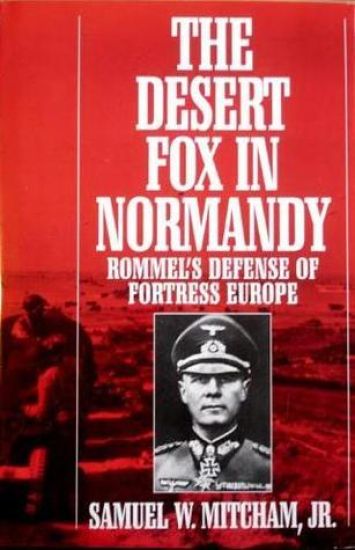
The Desert Fox in Normandy

The Desert Fox in Normandy

Samuel W. Mitcham Jr.

Praeger Publishers Inc
1997
sidottu
Perhaps the most famous and admired soldier to fight in World War II was Field Marshal Erwin Rommel, who achieved immortality as the Desert Fox. Rommel's first field command during the war was the 7th Panzer Division-also known as the Ghost Division-which he led in France in 1940. During this campaign, the 7th Panzer suffered more casualties than any other division in the German Army. During the process, it inflicted a disporoportionate amount of casualties upon the enemy. It took 97,486 prisoners, captured 458 tanks and armored vehicles, 277 field guns, 64 anti-tank guns and 4,000 to 5,000 trucks. It captured or destroyed hundreds of tons of other military equipment, shot down 52 aircraft, destroyed 15 more aircraft on the ground, and captured 12 additional planes. It destroyed the French 1st Armored Division and the 4th North African Division, punched through the Maginot Line extension near sSivry, and checked the largest Allied counteroffensive of the campaign at Arras. When France surrendered, the Ghost Division was within 200 miles of the Spanish border. No doubt about it-Rommel had proven himself a great military leader who was capable of greater things. His next command, in fact, would be the Afrika Korps, where the legend of the Desert Fox was born. Rommel had a great deal of help in France-and much more than his published papers suggest. His staff officers and company, battalion and regimental commanders were an extremely capable collection of military leaders, which included 12 future generals (two of them SS), and two colonels who briefly commanded panzer divisions but never reached general rank. They also included Colonel Erich von Unger, who would no doubt have become a general had he not been killed in action while commanding a motorized rifle brigade on the Eastern Front in 1941, as well as Kark Hanke, a Nazi gauleiter who later succeeded Heinrich Himmler as the last Reichsfuehrer-SS. No historian has ever recognized the talented cast of characters who supported the Desert Fox in 1940. No one has ever attempted to tell their stories. This book remedies this deficiency. In the weeks prior to D-Day, Rommel analyzed Allied bombing patterns and concluded that they were trying to make Normandy a strategic island in order to isolate the battlefield. Rommel also noticed that the Allies had mined the entire Channel coast, while the naval approaches to Normandy were clear. Realizing that Normandy would be the likely site of the invasion, he replaced the poorly-equipped 716th Infantry Division with the battle-hardened 352nd Infantry Division on the coastal sector. But his request for additional troops was denied by Hitler. Mitcham offers a remarkable theory of why Allied intelligence failed to learn of this critical troop movement, and why they were not prepared for the heavier resistance they met on Omaha Beach. He uses a number of little-known primary sources which contradict previously published accounts of Rommel, his officers, and the last days of the Third Reich. These sources provide amazing insight into the invasion of Normandy from the German point of view. They include German personnel records, unpublished papers, and the manuscripts of top German officers like general of Panzer Troops Baron Leo Geys von Schweppenburg, the commander of Panzer Group West. This book also contains a thorough examination of the virtually ignored battles of the Luftwaffe in France in 1944.
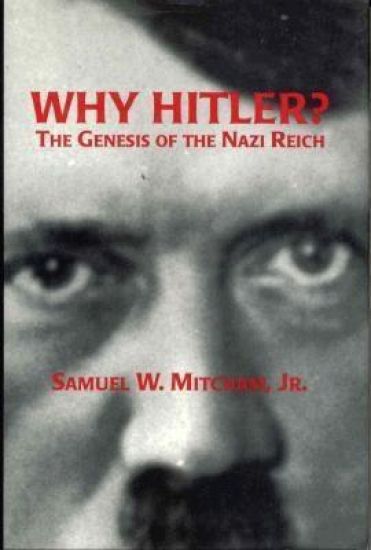
Why Hitler?

Why Hitler?

Samuel W. Mitcham Jr.

Praeger Publishers Inc
1996
sidottu
Adolf Hitler attained power in 1933 as the result of a complex set of factors, some of which were complementary and some of which were mutually exclusive. This book describes and analyzes the reasons Hitler became chancellor of Germany, which included the harsh Treaty of Versailles that ended World War I; the Germans' lack of faith in democracy and the reasons behind it; the corruption and political and economic mismanagement which characterized the Weimar Republic; the hyperinflation of the early 1920s, when the cost of a dollar exploded to 4.2 trillion marks and the German currency lost 99.3% of its value; the Great Depression, during which nearly a quarter of the German work force was unemployed; the political and economic instability of the times, in which the Nazis thrived; and the evil genius of Hitler, the master politician. This book transports the reader back to the Germany of the 1920s and 1930s, so he or she can experience what it was like to be there as Hitler and his cronies grasped for power and the foundations of the Weimar Republic crumbled. How did an Austrian tramp named Adolf Hitler become chancellor of Germany, in a position to launch the most infamous reign of terror experienced in the 20th century? Why Hitler? explains the Nazi rise to power in captivating prose and uncompromising detail. Why Hitler^ focuses on the issue of why and how Hitler and his party attained power in Germany, a question asked by all reflective Americans. Author Samuel Mitcham presents new information, dispensing with the hackneyed theory—presented by Hitler in Mein Kampf and repeated by historians as illustrious as William Shirer and Alan Bullock—that the heroic young Fuehrer struggled to survive against poverty and incredible odds, working as a day laborer and living in a flop house, hunger his constant companion. In fact, Hitler's income from his father's pension was higher than that of a junior postal employee, a teacher with less than five years' service, or a court lawyer with one year's salary.
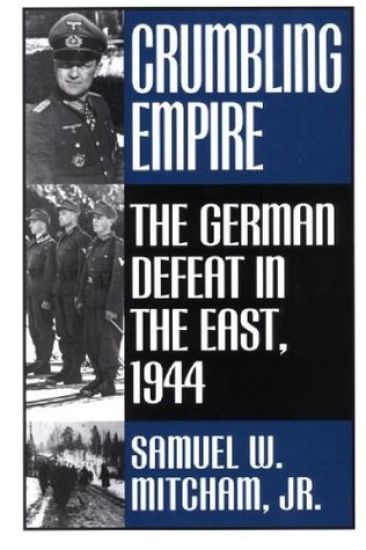
Crumbling Empire

Crumbling Empire

Samuel W. Mitcham Jr.

Praeger Publishers Inc
2001
sidottu
The last place a German soldier wanted to be in 1944 was the Russian front. That summer, Stalin hurled into battle more than six million men and 9,000 tanks, supported by 16,000 fighters and bombers and more than 12,800 guns and rocket launchers. Despite this massive effort and the resulting decimation of German forces, events on the Eastern Front are largely neglected by historians who focus instead on German defeats in Normandy and the Ardennes. This account details the massive battles on the Eastern Front from the summer of 1944 until the fall of Budapest in early 1945, a period when Hitler lost the majority of his conquered Eastern territories and many of his best remaining divisions. To destroy the Third Reich, the Allies needed to defeat the German Wehrmacht militarily, and the decisive victories of this period occurred on the Russian Front. More German soldiers were lost in White Russia than at Stalingrad; more troops were lost in Rumania in a brief ten days than in the entire Normandy campaign; and German losses in Hungary were greater than the Battle of the Bulge. The most mobile army in the world in 1940, the German Army was the least mobile by 1944, and Hitler's stand fast and fortified place policies imposed a paralysis that neither senior German generals nor the High Command of the Army were able to overcome. Outnumbered 3 to 1 in men, 5 to 1 in tanks, and 20 to 1 in airplanes, the German Army was slaughtered, as casualties mounted and the empire crumbled.
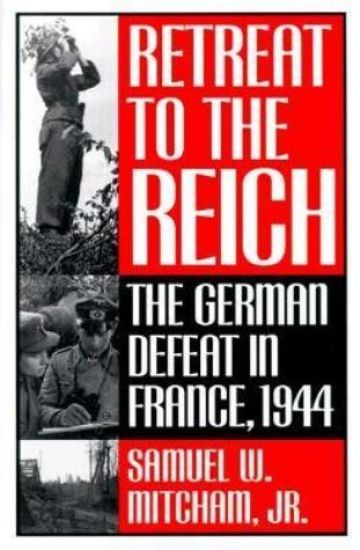
Retreat to the Reich

Retreat to the Reich

Samuel W. Mitcham Jr.

Praeger Publishers Inc
2000
sidottu
The Allied landings in Normandy on June 6, 1944, marked the beginning of the German defeat in the West. Military historian Samuel W. Mitcham, Jr. vividly recaptures the desperation of the Wehrmacht as the thin gray line in Normandy finally snapped, the 5th Panzer and 7th Armies collapsed, and the survivors fled the Allied steamroller in a mad dash back to the Reich. From the reactions of soldiers in the field to military decisions at the highest levels, this is the story of the Reich's unraveling told from a German perspective. Fighting hedgerow to hedgerow in the pitted Normandy landscape would delay the Allied Advance and make each small victory a costly one. Western forces would achieve their first strategic objective, the port of Cherbourg, but they would find it reduced to rubble, a result of the best-planned demolition in history. Still, the Allies did benefit from an ongoing anti-Hitler conspiracy that relayed false information to Berlin. While German forces would finally bring the Allied juggernaut to a halt on the borders of the Reich itself, this brief success would only delay the inevitable. With colorful descriptions and informative details, Mitcham recounts the German military retreat and the erosion of Germany's stronghold on Europe—as viewed through the eyes of a defiant, but ultimately defeated Wehrmacht.
Panzers in Winter

Panzers in Winter

Samuel W. Mitcham Jr.

Praeger Publishers Inc
2006
sidottu
The Battle of the Bulge was the last hurrah for the German Army on the Western Front. With the help of various unpublished sources, Samuel Mitcham sets out to tell the story of that battle and of the Ardennes Offensive from the German point of view. The greatest military disaster the United States suffered in the European Theater of Operations in World War II occurred in the Ardennes Offensive, when most of the U.S. 106th Infantry Division was destroyed in the Schnee Eifel (Snow Mountains). Mitcham covers the Battle of the Schnee Eifel from the German point of view in greater depth than any book has ever done, using unpublished German after-action reports and manuscripts, especially those of Lieutenant Colonel Dietrich Moll, the chief of operations of the 18th Volksgrenadier. Similar unpublished works, as well as the papers of Theodor-Friedrich von Stauffenberg, contribute to a unique account of the Battle of the Bulge.
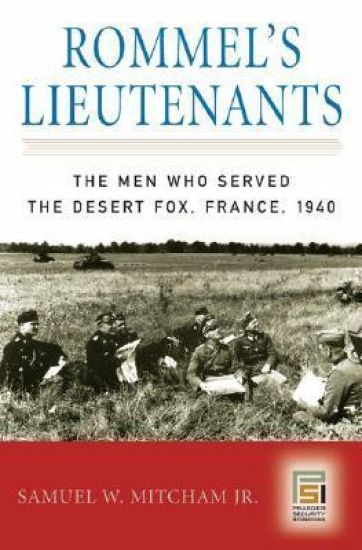
Rommel's Lieutenants

Rommel's Lieutenants

Samuel W. Mitcham Jr.

Praeger Publishers Inc
2006
sidottu
Perhaps the most famous soldier to fight in World War II was Field Marshal Erwin Rommel, who achieved immortality as the Desert Fox. He is also one of the most admired. Rommel's first field command during the war was the 7th Panzer Division, also known as the Ghost Division, which he led in France in 1940. Rommel had a great deal of help in France—much more than his published papers suggest. His staff officers and company, battalion and regimental commanders were an extremely capable collection of military leaders that included 12 future generals (two of them SS), and two colonels who briefly commanded panzer divisions but never reached general rank. They also included Karl Hanke, a Nazi gauleiter who later succeeded Heinrich Himmler as the last Reichsfuehrer-SS. No historian has ever recognized the talented cast of characters who supported the Desert Fox in 1940. No one has ever attempted to tell their stories. This book will surely remedy that oversight. During the Desert Fox campaign, the 7th Panzer suffered more casualties than any other division in the German Army, at the same time inflicting a disproportionate number of casualties upon the enemy. It took 97,486 prisoners, captured 458 tanks and armored vehicles, 277 field guns, 64 anti-tank guns and 4,000 to 5,000 trucks, and destroyed dozens of others in each category. It captured or destroyed hundreds of tons of other military equipment, shot down 52 aircraft, destroyed 15 more on the ground, and captured 12 more. It destroyed the French 1st Armored Division and the 4th North African Division, punched through the Maginot Line extension near Sivry, and checked the largest Allied counteroffensive of the campaign at Arras. When France surrendered, the Ghost Division was within 200 miles of the Spanish border. No doubt about it—Rommel had proven himself a great military leader who was capable of greater things. His next command, in fact, would be the Afrika Korps, where the legend of the Desert Fox was born.
Rommel's Desert Commanders

Rommel's Desert Commanders

Samuel W. Mitcham Jr.

Praeger Publishers Inc
2007
sidottu
Perhaps the most famous and admired soldier to fight in World War II was Field Marshal Erwin Rommel, who achieved immortality as the Desert Fox. Rommel's first field command during the war was the 7th Panzer Division—also known as the Ghost Division—which he led in France in 1940. During this campaign, the 7th Panzer suffered more casualties than any other division in the German Army, at the same time inflicting a disproportionate number of casualties upon the enemy. It took 97,486 prisoners, captured 458 tanks and armored vehicles, 277 field guns, 64 anti-tank guns and 4,000 to 5,000 trucks. It captured or destroyed hundreds of tons of other military equipment, shot down 52 aircraft, destroyed 15 more aircraft on the ground, and captured 12 additional planes. It destroyed the French 1st Armored Division and the 4th North African Division, punched through the Maginot Line extension near Sivry, and checked the largest Allied counteroffensive of the campaign at Arras. When France surrendered, the Ghost Division was within 200 miles of the Spanish border. No doubt about it—Rommel had proven himself a great military leader who was capable of greater things. His next command, in fact, would be the Afrika Korps, where the legend of the Desert Fox was born. Rommel had a great deal of help in France—much more than his published papers suggest. His staff officers and company, battalion, and regimental commanders were an extremely capable collection of military leaders that included 12 future generals (two of them SS), and two colonels who briefly commanded panzer divisions but never reached general rank. They also included Colonel Erich von Unger, who would no doubt have become a general had he not been killed in action while commanding a motorized rifle brigade on the Eastern Front in 1941, as well as Karl Hanke, a Nazi gauleiter who later succeeded Heinrich Himmler as the last Reichsfuehrer-SS. No historian has ever recognized the talented cast of characters who supported the Desert Fox in 1940. No one has ever attempted to tell their stories. This book remedies that deficiency.
The Panzer Legions

The Panzer Legions

Samuel W. Mitcham Jr.

Greenwood Press
2000
sidottu
Hitler's tank divisions were some of his most feared troops and most lethal weapons in the taking and securing of territory during World War II. From success to failure, in victory and in defeat, each division played a role in Hitler's campaign against the Allies. This is the first guide to chronicle the history of each division from its inception to its destruction. With painstaking research and attention to detail, Mitcham describes the formation and organization of each, then discusses its overall combat history. He also includes a career sketch of every panzer divisional commander. While this reference will serve as a valuable research tool, it contains more than facts and figures. Mitcham assesses the performance and quality of each division, including how and why it changed over time. He evaluates strengths and weaknesses during different phases of the conflict in terms of manpower, vehicles, and armor quality. He also analyzes commander performance and its impact on overall efforts. The story follows the panzer legions until their ultimate disposition-destruction or disbanding. Includes a comprehensive index of individuals, units, battles and campaigns.
Fragile Alliances

Fragile Alliances

Samuel W. White

Praeger Publishers Inc
2005
sidottu
How did the alliance between labor and the Democratic Party develop after the First World War? What role does Evansville play in an examination of this alliance? What was the impact of the alliance on U.S politics and society? These are some of the questions that Samuel W. White tackles in his book Fragile Alliances: Labor and Politics in Evansville, Indiana, 1919-1955.Focusing on Evansville, Indiana, as a case study, White challenges traditional assumptions in the field, such as the following: labor has one political voice; labor is monolithic in electoral politics; the New Deal successfully reordered American society and politics. White examines the roles played by political repression, opposition by employers, and anticommunist forces within the community as well as the labor movement in undermining the labor-Democratic Party alliance in Evansville. He contends that by the 1950s, the impact of these forces blunted the potential of the labor movement and the Democratic Party to transform the political system by giving workers and their allies a permanent political space in electoral politics.How did the alliance between labor and the Democratic Party develop after the First World War? What role does Evansville play in an examination of this alliance? What was the impact of the alliance on U.S politics and society? These are some of the questions that White tackles in his book Fragile Alliances: Labor and Politics in Evansville, Indiana, 1919-1955. Focusing on Evansville, Indiana, as a case study, White challenges traditional assumptions in the field, such as the following: labor has one political voice; labor is monolithic in electoral politics; the New Deal successfully reordered American society and politics. White examines the roles played by political repression, opposition by employers, and anticommunist forces within the community as well as the labor movement in undermining the labor-Democratic Party alliance in Evansville. He contends that by the 1950s, the impact of these forces blunted the potential of the labor movement and the Democratic Party to transform the political system by giving workers and their allies a permanent political space in electoral politics.Much of the published literature on labor and politics in the U.S. is focused on national events and organizations that make labor appear as a monolith in electoral politics. White diverges from the national focus of the majority of this literature, instead looking at labor and politics at the local level. While much of the published literature argues that the alliance between labor and the Democratic Party in the 1930s was a formidable force that reordered American society and politics, White shows that in Evansville, the alliance was anything but that. Racked by political repression, opposition by employers, and anticommunist forces within the community and the labor movement itself, the alliance was remarkably fragile and incapable of sustaining the momentum it had established in the 1930s.
Germany Tried Democracy

Germany Tried Democracy

Samuel W. Halperin

WW Norton Co
2007
nidottu
This book takes a good long look at that chaotic brand of democracy that characterized the Weimar Republic. It opens with a chapter on Bismarck’s empire of 1871-1914, when Wagner was glorifying everything German, Nietzche was developing the German power complex, and depressions were already being blamed on the Jews. From that point there is a play-by-play description of the political happenings: the formation of innumerable parties; the influence of dozens of leaders from the right, the left, and the center; the making of the peace; the dictates of Wilson; the establishing of the Republic; civil war; Versailles; the first sounds from Adolf Hitler; the Dawes Plan; the presidency of von Hindenburg; the Young Plan; the Great Depression; the first major triumph of the Nazis; Hitler’s Dusseldorf speech; von Hindenburg’s re-election and the advance of the Nazi tide; and finally the advent of Adolf Hitler himself.
Capital Offenses: Business Crime and Punishment in America's Corporate Age
If "corporations are people too," why isn't anyone in jail?A serious defect in a GM car causes accidents; Enron scams investors out of their money; banks bet on the housing market crash and win. In the race to maximize profits, corporations can behave in ways that are morally outrageous but technically legal.In Capital Offenses, Samuel Buell draws on the unique pairing of his expertise as a Duke University law professor and his personal experience leading the investigation into Enron--the biggest white-collar crime case in U.S. history--to present an in-depth examination of business crime todayAt the heart of it sits the limited liability corporation, simultaneously the bedrock of American prosperity and the reason that white-collar crime is difficult to prosecute--a brilliant legal innovation that, in its modern form, can seem impossible to regulate or even manage. By shielding employees from legal responsibility, the corporation encourages the risk-taking that drives economic growth. But its special legal status and its ever-expanding scale place daunting barriers in the way of federal and local investigators.Detailing the complex legal frameworks that govern both corporations and the people who carry out their missions, Buell shows that deciphering business crime is rarely black or white. In lucid, thought-provoking prose, he illuminates the depths of the legal issues at stake--delving into fraudulent practices like Ponzi schemes, bad accounting, insider trading, and the art of "loopholing"--showing how every major case and each problem of law further exposes the ambivalence and instability at the core of America's relationship with its corporations.An expert in criminal law, Buell masterfully examines the limits of too permissive or overzealous prosecution of business crimes. Capital Offenses invites us to take a fresh look at our legal framework and learn how it can be used to effectively discipline corporations for wrongdoing, without dismantling the corporation.