
Kirjahaku
Etsi kirjoja tekijän nimen, kirjan nimen tai ISBN:n perusteella.
1000 tulosta hakusanalla Sarah E. Ladd
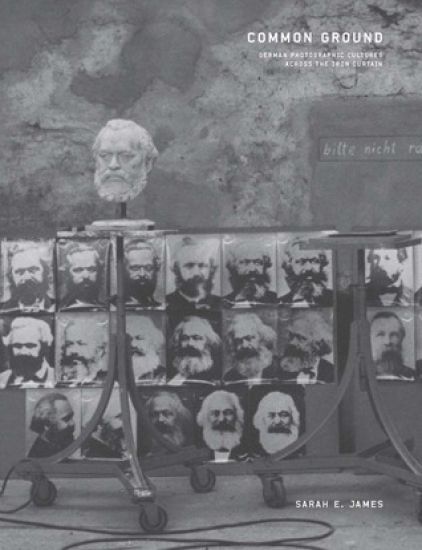
A groundbreaking examination of post-war photography in East and West GermanyThis ambitious publication is the first book to thoroughly evaluate the photography that emerged during Germany’s geopolitical division from the 1950s to the 1980s. With richly illustrated and exhaustively researched analyses of photographic projects from East and West Germany, including exhibitions, photo-essays, private archives, and photo-books, Common Ground constructs a comparative perspective, examining how sequence, seriality, and repetition were mobilized to produce forms of solidarity and political agency.Author Sarah James places German postwar photography in the context of Soviet, American, and European photographic developments; the specific cultural experiences of the Cold War; and the shifting politics of German identity. By reconsidering the relationship between divergent cultures of the pre-war Weimar period and the Cold War era, Common Ground prompts new readings of major figures such as Bernd and Hilla Becher, Karl Blossfeldt, and August Sander, as well as historically neglected figures such as Karl Pawek, Evelyn Richter, and Rudolf Schäfer. The result is a groundbreaking study of the political and pedagogical functions of documentary photography.

Historian Sarah E. Bond retells the traditional story of Ancient Rome, revealing how groups of ancient workers unified, connected, and protested as they helped build an empire “First-rate. . . . A sterling example of historical revisionism.”—Publishers Weekly From plebeians refusing to join the Roman army to bakers withholding bread, this is the first book to explore how Roman workers used strikes, boycotts, riots, and rebellion to get their voices—and their labor—acknowledged. Sarah E. Bond explores Ancient Rome from a new angle to show that the history of labor conflicts and collective action goes back thousands of years, uncovering a world far more similar to our own than we realize. Workers often turned to their associations for solidarity and shared identity in the ancient world. Some of these groups even negotiated contracts, wages, and work conditions in a manner similar to modern labor unions. As the world begins to consider the value—and indeed the necessity—of unionization to protect workers, this book demonstrates that we can learn valuable lessons from ancient laborers and from attempts by the Roman government to limit their freedom.
A popular genre from colonial times to 1900, the conduct book provides the youthful reader with authoritative guidance about right moral, religious, and gender role behavior. With the aim of teaching the young what they need to know--and believe--about society's expectations for the ideal young man and woman, the genre codified true American manhood and womanhood. Until now, conduct books have been mixed in and cataloged with books on manners, etiquette, education, religion, or success. This guide provides an analytic and historical overview of the conduct book as a genre and its cultural work in America. With an annotated bibliography of over 500 books, it is the first work to provide scholars interested in studying the cultural stance, intent, and importance of conduct-of-life texts with easy access to conduct books.The book provides an extensive overview of the conduct book, with separate chapters on the development of conduct books for children, men, and women. The fully annotated bibliography, which lists the conduct books by their intended audience, includes 196 conduct books for children, 142 texts for young men, 188 titles for young women, and 57 texts for adults of either sex. In addition, the work includes a short selected bibliography of secondary sources and an index. This guide opens the genre for further study.

Originally published in 1988, this second edition of The Construction of Personality has been substantially revised and updated. The author provides an introduction to current theory and research in the psychology of personality at the time and examines this work from the perspective of constructivism. As a consequence of this constructivist approach, the book covers topics from social psychology (e.g. person perception, impression formation) as well as more conventional areas of personality.In this new edition the constructivist perspective is emphasized by the addition of a new chapter in which the constructivist approach to personality is presented, and the chapters on the lay and self perspectives have been extensively re-written. All the other chapters have been revised to include recent material.

Originally published in 1988, this second edition of The Construction of Personality has been substantially revised and updated. The author provides an introduction to current theory and research in the psychology of personality at the time and examines this work from the perspective of constructivism. As a consequence of this constructivist approach, the book covers topics from social psychology (e.g. person perception, impression formation) as well as more conventional areas of personality.In this new edition the constructivist perspective is emphasized by the addition of a new chapter in which the constructivist approach to personality is presented, and the chapters on the lay and self perspectives have been extensively re-written. All the other chapters have been revised to include recent material.

Feminist Speculations and the Practice of Research-Creation provides a unique introduction to research-creation as a methodology, and a series of exemplifications of research-creation projects in practice with a range of participants including secondary school students, artists, and academics.In conversation with leading scholars in the field, the book outlines research-creation as transdisciplinary praxis embedded in queer-feminist anti-racist politics. It provides a methodological overview of how the author approaches research-creation projects at the intersection of literary arts, textuality, artistic practice, and pedagogies of writing, drawing on concepts related to the feminist materialisms, including speculative thought, affect theories, queer theory, and process philosophy. Further, it troubles representationalism in qualitative research in the arts. The book demonstrates how research-creation operates through the making of or curating of art or cultural productions as an integral part of the research process. The exemplification chapters engage with the author’s research-creation events with diverse participants all focused on text-based artistic projects including narratives, inter-textual marginalia art, postcards, songs, and computer-generated scripts.The book is aimed at graduate students and early career researchers who mobilize the literary arts, theory, and research in transdisciplinary settings.

Feminist Speculations and the Practice of Research-Creation provides a unique introduction to research-creation as a methodology, and a series of exemplifications of research-creation projects in practice with a range of participants including secondary school students, artists, and academics.In conversation with leading scholars in the field, the book outlines research-creation as transdisciplinary praxis embedded in queer-feminist anti-racist politics. It provides a methodological overview of how the author approaches research-creation projects at the intersection of literary arts, textuality, artistic practice, and pedagogies of writing, drawing on concepts related to the feminist materialisms, including speculative thought, affect theories, queer theory, and process philosophy. Further, it troubles representationalism in qualitative research in the arts. The book demonstrates how research-creation operates through the making of or curating of art or cultural productions as an integral part of the research process. The exemplification chapters engage with the author’s research-creation events with diverse participants all focused on text-based artistic projects including narratives, inter-textual marginalia art, postcards, songs, and computer-generated scripts.The book is aimed at graduate students and early career researchers who mobilize the literary arts, theory, and research in transdisciplinary settings.

This is a clinical reference data pocket book. It contains the data most frequently used by dietitians and others in practice and is invaluable for dietetic students during their clinical placements. It is both practical and comprehensive. Data is readily accessible from clearly set out tables, clear diagrams and tabbed sections. As well as the core reference data there are useful appendices on various subjects including the nutritional compositions of foods, a weaning guide, a guide to religious influences on diet, useful addresses for relevant organisations and web sites.User-friendly, accessible layout enables quick assimilation of relevant data Tabbed sections help to locate information quickly Clear diagrams help to illustrate important concepts Useful addresses, websites, references and further reading A section on clinical placements (structure, duration, hospital procedures) acts as a "survival' guide for student dietitians. All data revised/updated Section on clinical training structure to be revised as recently changed New standards/protocols have been included New more durable cover.

Digital Visions for Fashion + Textiles
Sarah E. Braddock Clarke; Jane Harris
Thames Hudson Ltd
2012
sidottu
The invention of the Jacquard loom in eighteenth-century France paved the way for computing and revolutionary change. From its punch-card origins, code has evolved to define and enable new methods in design, making, visualization, production and communication, achieving the previously unimaginable. Digital Visions for Fashion + Textiles: Made in Code considers how computing has reinvented image, material and structural processes, highlighting newly advancing 2D, 3D and interactive output. Pioneering shifts of practice have developed from hybrid technical and creative collaborations. Digital and analogue fusions are defining new contexts for the innovative fabrication of surfaces, products and environments. Twenty-two of the most forward-thinking practitioners, established and emerging, who have embraced developing digital technologies are profiled. Featured are household names, such as Hussein Chalayan, Prada and Issey Miyake, early pioneers (Vibeke Riisberg, Peter Struycken) and more independent, avant-garde individuals (Iris van Herpen, Casey Reas, Tom Gallant). Complete with a reference section and bibliographic information, this unique and richly illustrated book is the perfect resource and inspiration for designers, students, industry professionals, and anyone looking for an exploration of how computer technology has creatively permeated fashion, textiles and related digital sectors. • A richly illustrated exploration of how computer technology has creatively permeated fashion, textiles and related digital sectors. • Features profiles of 22 of the most forward-thinking creative practitioners at the vanguard of these developments. • Includes essential list of key biographies and bibliography.

Seven Financial Conspiracies Which Have Enslaved the American People
Sarah E. V. Emery
Kessinger Pub
2007
sidottu



English Problems in the Solving, for the Junior and Senior High Schools
Sarah E Simons
Trieste Publishing
2018
nidottu

Americans today “know” that a majority of the population supports the death penalty, that half of all marriages end in divorce, and that four out of five prefer a particular brand of toothpaste. Through statistics like these, we feel that we understand our fellow citizens. But remarkably, such data—now woven into our social fabric—became common currency only in the last century. Sarah Igo tells the story, for the first time, of how opinion polls, man-in-the-street interviews, sex surveys, community studies, and consumer research transformed the United States public.Igo argues that modern surveys, from the Middletown studies to the Gallup Poll and the Kinsey Reports, projected new visions of the nation: authoritative accounts of majorities and minorities, the mainstream and the marginal. They also infiltrated the lives of those who opened their doors to pollsters, or measured their habits and beliefs against statistics culled from strangers. Survey data underwrote categories as abstract as “the average American” and as intimate as the sexual self. With a bold and sophisticated analysis, Igo demonstrates the power of scientific surveys to shape Americans’ sense of themselves as individuals, members of communities, and citizens of a nation. Tracing how ordinary people argued about and adapted to a public awash in aggregate data, she reveals how survey techniques and findings became the vocabulary of mass society—and essential to understanding who we, as modern Americans, think we are.

A Washington Post Book of the YearWinner of the Merle Curti AwardWinner of the Jacques Barzun PrizeWinner of the Ralph Waldo Emerson Award“A masterful study of privacy.”—Sue Halpern, New York Review of Books“Masterful (and timely)…[A] marathon trek from Victorian propriety to social media exhibitionism…Utterly original.”—Washington PostEvery day, we make decisions about what to share and when, how much to expose and to whom. Securing the boundary between one’s private affairs and public identity has become an urgent task of modern life. How did privacy come to loom so large in public consciousness? Sarah Igo tracks the quest for privacy from the invention of the telegraph onward, revealing enduring debates over how Americans would—and should—be known. The Known Citizen is a penetrating historical investigation with powerful lessons for our own times, when corporations, government agencies, and data miners are tracking our every move.“A mighty effort to tell the story of modern America as a story of anxieties about privacy…Shows us that although we may feel that the threat to privacy today is unprecedented, every generation has felt that way since the introduction of the postcard.”—Louis Menand, New Yorker“Engaging and wide-ranging…Igo’s analysis of state surveillance from the New Deal through Watergate is remarkably thorough and insightful.”—The Nation

Winner of the 2020 Victor Turner Prize in Ethnographic WritingNearly 1,600 Americans are still unaccounted for and presumed dead from the Vietnam War. These are the stories of those who mourn and continue to search for them.For many families the Vietnam War remains unsettled. Nearly 1,600 Americans—and more than 300,000 Vietnamese—involved in the conflict are still unaccounted for. In What Remains, Sarah E. Wagner tells the stories of America’s missing service members and the families and communities that continue to search for them. From the scientists who work to identify the dead using bits of bone unearthed in Vietnamese jungles to the relatives who press government officials to find the remains of their loved ones, Wagner introduces us to the men and women who seek to bring the missing back home. Through their experiences she examines the ongoing toll of America’s most fraught war.Every generation has known the uncertainties of war. Collective memorials, such as the Tomb of the Unknowns in Arlington National Cemetery, testify to the many service members who never return, their fates still unresolved. But advances in forensic science have provided new and powerful tools to identify the remains of the missing, often from the merest trace—a tooth or other fragment. These new techniques have enabled military experts to recover, repatriate, identify, and return the remains of lost service members. So promising are these scientific developments that they have raised the expectations of military families hoping to locate their missing. As Wagner shows, the possibility of such homecomings compels Americans to wrestle anew with their memories, as with the weight of their loved ones’ sacrifices, and to reevaluate what it means to wage war and die on behalf of the nation.

Soviet foreign policy changed dramatically in the 1980s. The shift, bitterly resisted by the country's foreign policy traditionalists, ultimately contributed to the collapse of the Soviet Union and the end of the Cold War. In Changing Course, Sarah Mendelson demonstrates that interpretations that stress the impact of the international system, and particularly of U.S. foreign policy, or that focus on the role of ideas or politics alone, fail to explain the contingent process of change. Mendelson tells a story of internal battles where "misfit" ideas--ones that severely challenged the status quo--were turned into policies. She draws on firsthand interviews with those who ran Soviet foreign policy and the war in Afghanistan and on recently declassified material from Soviet archives to show that both ideas and political strategies were needed to make reform happen. Focusing on the Soviet decision to withdraw from Afghanistan, Mendelson details the strategies used by the Gorbachev coalition to shift the internal balance of power in favor of constituencies pushing new ideas--mutual security, for example--while undermining the power of old constituencies resistant to change. The interactive dynamic between ideas and politics that she identifies in the case of the Soviet withdrawal from Afghanistan is fundamental to understanding other shifts in Soviet foreign policy and the end of the Cold War. Her exclusive interviews with the foreign policy elite also offer a unique glimpse of the inner workings of the former Soviet power structure. Originally published in 1998. The Princeton Legacy Library uses the latest print-on-demand technology to again make available previously out-of-print books from the distinguished backlist of Princeton University Press. These editions preserve the original texts of these important books while presenting them in durable paperback and hardcover editions. The goal of the Princeton Legacy Library is to vastly increase access to the rich scholarly heritage found in the thousands of books published by Princeton University Press since its founding in 1905.

Soviet foreign policy changed dramatically in the 1980s. The shift, bitterly resisted by the country's foreign policy traditionalists, ultimately contributed to the collapse of the Soviet Union and the end of the Cold War. In Changing Course, Sarah Mendelson demonstrates that interpretations that stress the impact of the international system, and particularly of U.S. foreign policy, or that focus on the role of ideas or politics alone, fail to explain the contingent process of change. Mendelson tells a story of internal battles where "misfit" ideas--ones that severely challenged the status quo--were turned into policies. She draws on firsthand interviews with those who ran Soviet foreign policy and the war in Afghanistan and on recently declassified material from Soviet archives to show that both ideas and political strategies were needed to make reform happen. Focusing on the Soviet decision to withdraw from Afghanistan, Mendelson details the strategies used by the Gorbachev coalition to shift the internal balance of power in favor of constituencies pushing new ideas--mutual security, for example--while undermining the power of old constituencies resistant to change. The interactive dynamic between ideas and politics that she identifies in the case of the Soviet withdrawal from Afghanistan is fundamental to understanding other shifts in Soviet foreign policy and the end of the Cold War. Her exclusive interviews with the foreign policy elite also offer a unique glimpse of the inner workings of the former Soviet power structure. Originally published in 1998. The Princeton Legacy Library uses the latest print-on-demand technology to again make available previously out-of-print books from the distinguished backlist of Princeton University Press. These editions preserve the original texts of these important books while presenting them in durable paperback and hardcover editions. The goal of the Princeton Legacy Library is to vastly increase access to the rich scholarly heritage found in the thousands of books published by Princeton University Press since its founding in 1905.