Kirjojen hintavertailu. Mukana 12 419 614 kirjaa ja 12 kauppaa.

Kirjahaku

Etsi kirjoja tekijän nimen, kirjan nimen tai ISBN:n perusteella.

1000 tulosta hakusanalla Scott Walter

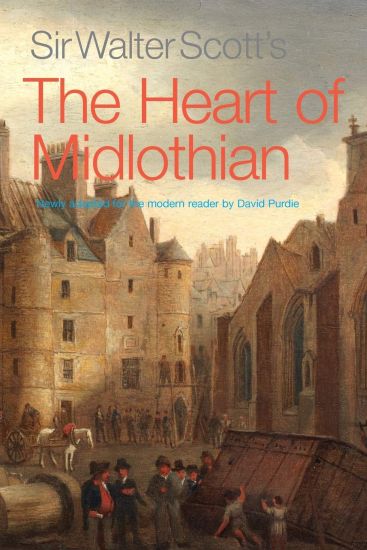
Sir Walter Scott's The Heart of Midlothian
Edinburgh, 1736: an indignant crowd has gathered in the Grassmarket to watch the execution of a smuggler. Opening with the start of the Porteous Riots, The Heart of Midlothian is one of Walter Scott’s most famous historical novels, featuring murder, madness and seduction. Following his brutal suppression of the spectators, John Porteous, Captain of the Guard, is charged with murder and locked up in Edinburgh’s Tolbooth prison, also known as the Heart of Midlothian. When news comes that he has been pardoned, an angry mob breaks into the jail, liberating its inmates and bringing Porteous to its own form of justice. But one prisoner who fails to take this opportunity to flee is Effie Deans, who, wrongly convicted of infanticide, has been sentenced to death. Jeanie, her older sister, sets off to London on foot to beg for her pardon from the queen. A tale of religious piety, filial devotion and legal loopholes, this edition of The Heart of Midlothian has been expertly reworked for modern audiences by David Purdie.
Oeuvres de Walter Scott. Tome 30

Oeuvres de Walter Scott. Tome 30

Scott-W

Hachette Livre - BNF
2022
pokkari
Oeuvres de Walter Scott. Tome 30, 3Date de l'edition originale: 1830-1832Ce livre est la reproduction fidele d'une oeuvre publiee avant 1920 et fait partie d'une collection de livres reimprimes a la demande editee par Hachette Livre, dans le cadre d'un partenariat avec la Bibliotheque nationale de France, offrant l'opportunite d'acceder a des ouvrages anciens et souvent rares issus des fonds patrimoniaux de la BnF.Les oeuvres faisant partie de cette collection ont ete numerisees par la BnF et sont presentes sur Gallica, sa bibliotheque numerique.En entreprenant de redonner vie a ces ouvrages au travers d'une collection de livres reimprimes a la demande, nous leur donnons la possibilite de rencontrer un public elargi et participons a la transmission de connaissances et de savoirs parfois difficilement accessibles.Nous avons cherche a concilier la reproduction fidele d'un livre ancien a partir de sa version numerisee avec le souci d'un confort de lecture optimal. Nous esperons que les ouvrages de cette nouvelle collection vous apporteront entiere satisfaction.Pour plus d'informations, rendez-vous sur www.hachettebnf.fr
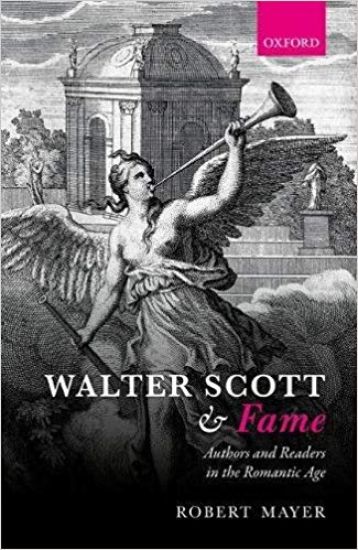
Walter Scott and Fame

Walter Scott and Fame

Robert Mayer

Oxford University Press
2017
sidottu
Walter Scott and Fame is a study of correspondences between Scott and socially and culturally diverse readers of his work in the English-speaking world in the early nineteenth century. Examining authorship, reading, and fame, the book is based on extensive archival research, especially in the collection of letters to Scott in the National Library of Scotland. Robert Mayer demonstrates that in Scott's literary correspondence constructions of authorship, reading strategies, and versions of fame are posited, even theorized. Scott's reader-correspondents invest him with power but they also attempt to tap into or appropriate some of his authority. Scott's version of authorship sets him apart from important contemporaries like Wordsworth and Byron, who adhered, at least as Scott viewed the matter, to a rarefied conception of the writer as someone possessed of extraordinary power. The idea of the author put in place by Scott in dialogue with his readers establishes him as a powerful figure who is nevertheless subject to the will of his audience. Scott's literary correspondence also demonstrates that the reader can be a very powerful figure and that we should regard reading not just as the reception of texts but also as the apprehension of an author-function. Thus, Scott's correspondence makes it clear that the relationship between authors and readers is a dynamic, often fraught, connection, which needs to be understood in terms of the new culture of celebrity that emerged during Scott's working life. Along with Byron, the study shows, Scott was at the centre of this transformation.
Gendering Walter Scott

Gendering Walter Scott

C.M. Jackson-Houlston

Routledge
2019
nidottu
Employing gender as a unifying critical focus, Caroline Jackson-Houlston draws on the full range of Walter Scott’s novels to propose new links between Scott and Romantic-era authors such as Sophia Lee, Jane Porter, Jane Austen, Sydney Owenson, Elizabeth Hands, Thomas Love Peacock, and Robert Bage. In Scott, Jackson-Houlston suggests, sex and violence are united in a central feature of the genre of romance, the trope of raptus—the actual or threatened kidnapping of a woman and her subjection to physical or psychic violence. Though largely favouring the Romantic-period drive towards delicacy of subject-matter and expression, Scott also exhibited a residual sympathy for frankness and openness resisted by his publishers, especially towards the end of his career, when he increasingly used the freedoms inherent in romance as a mode of narrative to explore and critique gender assumptions. Thus, while Scott’s novels inherit a tradition of chivalric protectiveness towards women, they both exploit and challenge the assumption that a woman is always essentially definable as a potential sexual victim. Moreover, he consistently condemns the aggressive male violence characteristic of older models of the hero, in favour of restraint and domesticity that are not exclusively feminine, but compatible with the Scottish Enlightenment assumptions of his upbringing. A high proportion of Scott’s female characters are consistently more rational than their male counterparts, illustrating how he plays conflicting concepts of sexual difference off against one another. Jackson-Houlston illuminates Scott’s ambivalent reliance on the attractions of sex and violence, demonstrating how they enable the interrogation of gender convention throughout his fiction.
Walter Scott's Books

Walter Scott's Books

J.H. Alexander

Routledge
2019
nidottu
Scott's Books is an approachable introduction to the Waverley Novels. Drawing on substantial research in Scott's intertextual sources, it offers a fresh approach to the existing readings where the thematic and theoretical are the norm. Avoiding jargon, and moving briskly, it tackles the vexed question of Scott's 'circumbendibus' style head on, suggesting that it is actually one of the most exciting aspects of his fiction: indeed, what Ian Duncan has called the 'elaborately literary narrative', at first sight a barrier, is in a sense what the novels are primarily 'about'.The book aims to show how inventive, witty, and entertaining Scott's richly allusive style is; how he keeps his varied readership on board with his own inexhaustible variety; and how he allows proponents of a wide range of positions to have their say, using a detached, ironic, but never cynical narrative voice to undermine the more rigid and inhumane rhetoric.The Introduction outlines this approach and sets the book in the context of earlier and current Scott criticism. It also deals with some practical issues, including forms of reference and the distinctive use of the term 'Authorial'. The four chapters are designed to zoom in progressively from the general to the particular. 'Resources' explores the printed material available to Scott in his library and gives an overview of the way he uses it in his fiction. 'Style' confronts objections to the 'circumbendibus' Scott and shows how his Ciceronian style with its penchant for polysyllables enables him to embrace a wide range of rhetoric relayed in a detached but not cynical Authorial voice. 'Strategies' explores how he keeps his very wide audience on board by a complex bonding between characters, readers, and Author, and stresses the extraordinary variety of exuberant inventiveness with which he handles intertextual allusions. 'Mottoes' examines the most remarkable of Scott's intertextual devices, the chapter epigraphs, bringing i
Walter Scott

Walter Scott

Routledge
1995
sidottu
The Critical Heritage gathers together a large body of critical sources on major figures in literature. Each volume presents contemporary responses to a writer's work, enabling students and researchers to read for themselves, for example, comments on early performances of Shakespeare's plays, or reactions to the first publication of Jane Austen's novels.The carefully selected sources range from landmark essays in the history of criticism to journalism and contemporary opinion, and little published documentary material such as letters and diaries. Significant pieces of criticism from later periods are also included, in order to demonstrate the fluctuations in an author's reputation.Each volume contains an introduction to the writer's published works, a selected bibliography, and an index of works, authors and subjects.
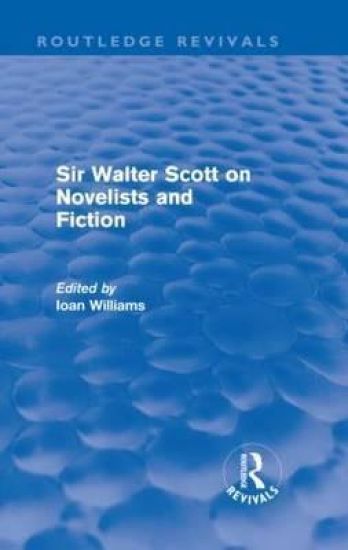
Sir Walter Scott on Novelists and Fiction (Routledge Revivals)
First published in 1968, this collection of essays and reviews represents all that Sir Walter Scott wrote on the subject of novels and novelists, and will be invaluable for the study of Scott, both as novelist and critic. The work provides a survey of the novel at an important period of its development and offers an historical perspective not normally available in one volume.
Sir Walter Scott on Novelists and Fiction (Routledge Revivals)
First published in 1968, this collection of essays and reviews represents all that Sir Walter Scott wrote on the subject of novels and novelists, and will be invaluable for the study of Scott, both as novelist and critic. The work provides a survey of the novel at an important period of its development and offers an historical perspective not normally available in one volume.