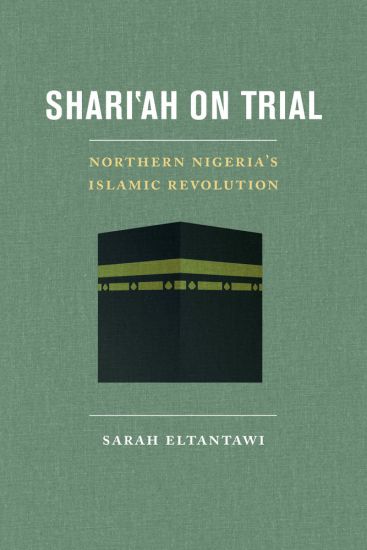
In November of 1999, Nigerians took to the streets demanding the re-implementation of shari'ah law in their country. Two years later, many Nigerians supported the death sentence by stoning of a peasant woman for alleged sexual misconduct. Public outcry in the West was met with assurances to the Western public: stoning is not a part of Islam; stoning happens "only in Africa"; reports of stoning are exaggerated by Western sensationalism. However, none of these statements are true. Shari'ah on Trial goes beyond journalistic headlines and liberal pieties to give a powerful account of how Northern Nigerians reached a point of such desperation that they demanded the return of the strictest possible shari'ah law. Sarah Eltantawi analyzes changing conceptions of Islamic theology and practice as well as Muslim and British interactions dating back to the colonial period to explain the resurgence of shari'ah, with implications for Muslim-majority countries around the world.
In recent years, Islamic law, or Shari'a, has been appropriated as a tool of modernity in the Muslim world and in the West and has become highly politicised in consequence. Wael Hallaq's magisterial overview of Shari'a sets the record straight by examining the doctrines and practices of Islamic law within the context of its history, and by showing how it functioned within pre-modern Islamic societies as a moral imperative. In so doing, Hallaq takes the reader on an epic journey tracing the history of Islamic law from its beginnings in seventh-century Arabia, through its development and transformation under the Ottomans, and across lands as diverse as India, Africa and South-East Asia, to the present. In a remarkably fluent narrative, the author unravels the complexities of his subject to reveal a love and deep knowledge of the law which will inform, engage and challenge the reader.
In recent years, Islamic law, or Shari'a, has been appropriated as a tool of modernity in the Muslim world and in the West and has become highly politicised in consequence. Wael Hallaq's magisterial overview of Shari'a sets the record straight by examining the doctrines and practices of Islamic law within the context of its history, and by showing how it functioned within pre-modern Islamic societies as a moral imperative. In so doing, Hallaq takes the reader on an epic journey tracing the history of Islamic law from its beginnings in seventh-century Arabia, through its development and transformation under the Ottomans, and across lands as diverse as India, Africa and South-East Asia, to the present. In a remarkably fluent narrative, the author unravels the complexities of his subject to reveal a love and deep knowledge of the law which will inform, engage and challenge the reader.
The first theoretical and practical guide to the application and operation of shari'ah-based structures and Islamic venture capital in the private equity industry. Case studies and examples of business financial appraisals are used to give an in-depth view of areas including the Islamic banking industry; its use as a source of funding in the biotechnology industry, pharmaceuticals, ICT, agriculture and fisheries; and its utility by investment companies as part of their asset management strategies. Key Features *Begins with an overview of the industry before focusing on key areas within it including profit sharing, valuation, risk mitigation, exit strategies, trust, monitoring methods and due diligence *Looks at private equity and venture capital in the MENA and ASEAN regions, the UK, Europe and the USA *Case studies are accompanied by questions appropriate for classroom discussion or assignments
The first theoretical and practical guide to the application and operation of shari'ah-based structures and Islamic venture capital in the private equity industry. Case studies and examples of business financial appraisals are used to give an in-depth view of areas including the Islamic banking industry; its use as a source of funding in the biotechnology industry, pharmaceuticals, ICT, agriculture and fisheries; and its utility by investment companies as part of their asset management strategies. Key Features *Begins with an overview of the industry before focusing on key areas within it including profit sharing, valuation, risk mitigation, exit strategies, trust, monitoring methods and due diligence *Looks at private equity and venture capital in the MENA and ASEAN regions, the UK, Europe and the USA *Case studies are accompanied by questions appropriate for classroom discussion or assignments
This is an in-depth and insightful study of Shari'ah governance from a theoretical and practical perspective. Shari'ah governance has a profound influence on the day-to-day practice of Islamic Financial Institutions (IFIs) and each jurisdiction has adopted a different approach to developing a governance framework. Hasan Zulkifli reviews these pluralistic approaches and identifies best practice. It comes with examples, case studies and practical discussions based on IFIs in the UK, Malaysia and the GCC countries of Bahrain, UAE, Qatar, Kuwait and Saudi Arabia. The topics covered include: the theory behind corporate and Shari'ah governance; the regulatory framework for Shari'ah governance; Shari'ah governance approaches; the Shari'ah Board's role and how it retains its independence, transparency and competence; the operational procedures of Shari'ah governance; and, the effectiveness of the Shari'ah Board and how it could be improved.
This is an in-depth and insightful study of Shari'ah governance from a theoretical and practical perspective. Shari'ah governance has a profound influence on the day-to-day practice of Islamic Financial Institutions (IFIs) and each jurisdiction has adopted a different approach to developing a governance framework. Hasan Zulkifli reviews these pluralistic approaches and identifies best practice. It comes With examples, case studies and practical discussions based on IFIs in the UK, Malaysia and the GCC countries of Bahrain, UAE, Qatar, Kuwait and Saudi Arabia. The topics covered include: the theory behind corporate and Shari'ah governance; the regulatory framework for Shari'ah governance; Shari'ah governance approaches; the Shari'ah Board's role and how it retains its independence, transparency and competence; the operational procedures of Shari'ah governance; and, the effectiveness of the Shari'ah Board and how it could be improved.
This volume exposes some of the various issues raised in relation to Muslim communities in Europe by putting the intellectual and legal traditions into dialogue. It brings together a number of scholars of Shari’a and Islamic law with counterparts from the parallel European disciplines of hermeneutics, philosophy and jurisprudence, to explore how the processes of theological-legal thinking have been expressed and are being expressed in a more or less common intellectual framework. It provides a valuable reference for all those interested in exploring how Muslims and non-Muslims view Shari’a law, looking at ways the European legal systems can provide some form of accommodation with Muslim customs.
This volume presents ten leading scholars' writings on contemporary Islamic law and Muslim thought. The essays examine a range of issues, from modern Muslim discourses on justice, natural law, and the common good, to democracy, the social contract, and "the authority of the preeminent jurist." Changes in how Shari'a has been understood over the centuries are explored, as well as how it has been applied in both Sunni and Shi'i Islam. Debates on the nature, interpretation, reform, and application of Shari'a lie at the core of all Islamist revivalist ideologies and movements of the past two centuries. The demand for the implementation of Shari'a is one of the hallmarks of Islamic fundamentalism, and Shari'a has become one of the most controversial and politicized concepts in Muslim-majority countries today. This is one of the first books to examine how Muslims understand and apply Shari'a in contemporary societies.
This volume presents ten leading scholars' writings on contemporary Islamic law and Muslim thought. The essays examine a range of issues, from modern Muslim discourses on justice, natural law, and the common good, to democracy, the social contract, and "the authority of the preeminent jurist." Changes in how Shari'a has been understood over the centuries are explored, as well as how it has been applied in both Sunni and Shi'i Islam. Debates on the nature, interpretation, reform, and application of Shari'a lie at the core of all Islamist revivalist ideologies and movements of the past two centuries. The demand for the implementation of Shari'a is one of the hallmarks of Islamic fundamentalism, and Shari'a has become one of the most controversial and politicized concepts in Muslim-majority countries today. This is one of the first books to examine how Muslims understand and apply Shari'a in contemporary societies.
For almost half a century, celebrated ventriloquist and entertainer Shari Lewis delighted generations of children and adults with the help of her trusted sock puppet sidekick Lamb Chop. For decades, the beloved pair were synonymous with children's television, educating and entrancing their young audience with their symbiotic personalities and their proclivity for song, dance, and the joy of silliness. But as iconic as their television personas were, relatively little inside knowledge has been revealed about Lewis herself and the life-changing moments that led her to the entertainment industry and perhaps, most importantly, to Lamb Chop. Renowned for her skills as a performer, Lewis was an equally skilled businesswoman. Operating in an era when women were largely left out of the conversation, she was one of the few women to run her own television production company. Whether it was singing, dancing, conducting, writing, drawing, or ventriloquism—a skill in which she was virtually unmatched – Lewis spent the entirety of her 65 years in pursuit of performative perfection. Constantly innovating and adapting to the needs of her audience and the market, Lewis extended the longevity of her career decade after decade. Her contributions, and that of Lamb Chop, and the rest of her puppet pals forever changed the history of children's television. Now, two decades after Lewis and Lamb Chop last graced television with their presence, Lewis' daughter Mallory and author Nat Segaloff have set the record straight about the iconic pair in Shari Lewis and Lamb Chop: The Team that Changed Children's Television. In this seminal biography, the pair pull the veritable wool from the eyes of audiences who adored the legendary entertainer to examine the joys, sorrows, triumphs, and sheer hard work that gave Lewis and Lamb Chop their enduring star power.
Written by the Qadi (judge) of the Shari'a Court of Jerusalem and former director of the Shari'a Court system in Israel, this book offers a unique perspective on the religious law of Muslim minorities living in the West. Specifically, it explores the fiqh al-aqalliyyat doctrine of religious jurisprudence developed by modern Islamic jurists to resolve the challenges of maintaining cultural and religious identity in majority non-Muslim societies. The author examines possible applications across numerous cultural and geographical contexts, answering such questions as: what are the rules for assuming political and public roles, and should one deposit money that incurs interest? Building on a growing scholarship, this book aims to resolve points of view and facets of religious law that have been neglected by previous studies. Accessibly written, Shari'a in the Modern Era is designed to promote cross-cultural understanding among readers of all faiths.
Written by the Qadi (judge) of the Shari'a Court of Jerusalem and former director of the Shari'a Court system in Israel, this book offers a unique perspective on the religious law of Muslim minorities living in the West. Specifically, it explores the fiqh al-aqalliyyat doctrine of religious jurisprudence developed by modern Islamic jurists to resolve the challenges of maintaining cultural and religious identity in majority non-Muslim societies. The author examines possible applications across numerous cultural and geographical contexts, answering such questions as: what are the rules for assuming political and public roles, and should one deposit money that incurs interest? Building on a growing scholarship, this book aims to resolve points of view and facets of religious law that have been neglected by previous studies. Accessibly written, Shari'a in the Modern Era is designed to promote cross-cultural understanding among readers of all faiths.
Western analysts have long denigrated Islamic states as antagonistic, even antithetical, to the rule of law. Mark Fathi Massoud tells a different story: for nearly 150 years, the Somali people have embraced shari'a, commonly translated as Islamic law, in the struggle for national identity and human rights. Lawyers, community leaders, and activists throughout the Horn of Africa have invoked God to oppose colonialism, resist dictators, expel warlords, and to fight for gender equality - all critical steps on the path to the rule of law. Shari'a, Inshallah traces the most dramatic moments of legal change, political collapse, and reconstruction in Somalia and Somaliland. Massoud upends the conventional account of secular legal progress and demonstrates instead how faith in a higher power guides people toward the rule of law.
Western analysts have long denigrated Islamic states as antagonistic, even antithetical, to the rule of law. Mark Fathi Massoud tells a different story: for nearly 150 years, the Somali people have embraced shari'a, commonly translated as Islamic law, in the struggle for national identity and human rights. Lawyers, community leaders, and activists throughout the Horn of Africa have invoked God to oppose colonialism, resist dictators, expel warlords, and to fight for gender equality - all critical steps on the path to the rule of law. Shari'a, Inshallah traces the most dramatic moments of legal change, political collapse, and reconstruction in Somalia and Somaliland. Massoud upends the conventional account of secular legal progress and demonstrates instead how faith in a higher power guides people toward the rule of law.
This volume exposes some of the various issues raised in relation to Muslim communities in Europe by putting the intellectual and legal traditions into dialogue. It brings together a number of scholars of Shari’a and Islamic law with counterparts from the parallel European disciplines of hermeneutics, philosophy and jurisprudence, to explore how the processes of theological-legal thinking have been expressed and are being expressed in a more or less common intellectual framework. It provides a valuable reference for all those interested in exploring how Muslims and non-Muslims view Shari’a law, looking at ways the European legal systems can provide some form of accommodation with Muslim customs.
This book provides an analysis of how commercial and banking disputes can be settled under the Islamic regime for arbitration. The work focuses on the Saudi legal system as representative of Shari'a law in commercial and banking arbitration, and where relevant, makes comparisons with the settlement of banking disputes in Egypt and the UAE. Shari'a Law in Commercial and Banking Arbitration provides a general introduction to the Saudi law and to the main principles and sources of Islamic Shari'a, on which Saudi law is based. It explores uncertainties resulting from the current system, such as the payment of interest, and examines possible alternative remedies for both domestic and international banking arbitration. It will be key reading for anyone interested in business and commercial law.
In the recent past, Islamic finance has made an impressive case on the banking scene by becoming an alternative to the popular conventional financial systems, spurring a lively academic debate on how the Islamic finance industry can expand its services to cover the poor. Several propositions have been aired which suggest that the Islamic finance industry should consider developing an efficient Shari‘a compliant microfinance model. This book brings together original contributions from leading authorities on the subject of Shari‘a Compliant Microfinance (Islamic Microfinance) to propose innovative solutions and models by carefully studying experiments conducted in various countries. Where critiques of the current microfinance concepts, methods, regulatory measures and practices have often revolved around its practice of charging very high interest, this book discusses the several models that draw on both theory and case studies to provide a sustainable Shari‘a compliant alternative. Arguing that while Islamic finance might have made a remarkable contribution in the financial markets, there remains a big question with regards to its social relevance, the book provides new perspectives and innovative solutions to issues facing the Islamic microfinance industry. A comprehensive reference book for anyone wanting to learn more about Shari‘a Compliant Microfinance, this book will also be of use to students and scholars of microfinance, Islamic finance, and to anyone interested in learning about ethical and socially responsible businesses.
The Shari Lewis Puppet Book is a guide to creating and performing with puppets, written by the legendary puppeteer Shari Lewis. In this book, Lewis shares her years of experience and expertise in the art of puppetry, offering step-by-step instructions for making a variety of puppets, including hand puppets, marionettes, and shadow puppets. She also provides tips on puppet manipulation, voice acting, and staging, as well as advice on how to create engaging and entertaining puppet shows for audiences of all ages. The book is filled with colorful illustrations and photographs, making it a visually appealing and practical guide for aspiring puppeteers and seasoned professionals alike. With its comprehensive coverage of all aspects of puppetry, The Shari Lewis Puppet Book is an essential resource for anyone interested in this timeless and captivating art form.This scarce antiquarian book is a facsimile reprint of the old original and may contain some imperfections such as library marks and notations. Because we believe this work is culturally important, we have made it available as part of our commitment for protecting, preserving, and promoting the world's literature in affordable, high quality, modern editions, that are true to their original work.