Kirjojen hintavertailu. Mukana 11 244 527 kirjaa ja 12 kauppaa.

Kirjahaku

Etsi kirjoja tekijän nimen, kirjan nimen tai ISBN:n perusteella.

54 tulosta hakusanalla Stashower Daniel

The Specter of Hypocrisy

The Specter of Hypocrisy

Raphael Sassower

Springer Nature Switzerland AG
2020
sidottu
Raphael Sassower examines the concept of hypocrisy for its strategic potential as a means of personal protection and social cohesion. Given the contemporary context of post-truth, the examination of degrees or kinds of hypocrisy moves from the Greek etymology of masks worn on the theater stage to the Hebrew etymology of the color adjustment of chameleons to their environment. Canonical presuppositions about the uniformity of the mind and the relation between intention and behavior that warrant the charge of hypocrisy are critically reconsidered in order to appreciate both inherent inconsistencies in personal conduct and the different contexts where the hypocrisy appears. Sassower considers the limits of analytic moral and political discourses that at times overlook the conditions under which putative hypocritical behavior is existentially required and where compromises yield positive results. When used among friends, the charge of hypocrisy is a useful tool with which to build trust and communities.
The Specter of Hypocrisy

The Specter of Hypocrisy

Raphael Sassower

Springer Nature Switzerland AG
2021
nidottu
Raphael Sassower examines the concept of hypocrisy for its strategic potential as a means of personal protection and social cohesion. Given the contemporary context of post-truth, the examination of degrees or kinds of hypocrisy moves from the Greek etymology of masks worn on the theater stage to the Hebrew etymology of the color adjustment of chameleons to their environment. Canonical presuppositions about the uniformity of the mind and the relation between intention and behavior that warrant the charge of hypocrisy are critically reconsidered in order to appreciate both inherent inconsistencies in personal conduct and the different contexts where the hypocrisy appears. Sassower considers the limits of analytic moral and political discourses that at times overlook the conditions under which putative hypocritical behavior is existentially required and where compromises yield positive results. When used among friends, the charge of hypocrisy is a useful tool with which to build trust and communities.

Prescriptions

Prescriptions

Gayle Ormiston; Raphael Sassower

Praeger Publishers Inc
1990
sidottu
The essays brought together in this volume are the product of a University of Colorado, Colorado Springs, Colloquium on Science, Technology, and Society devoted to foundations of health care practices. Prescriptions contributes to the philosophy of medicine by redefining, redrawing, and resetting the respective domains of philosophy, medicine, and healthcare. It provides a conceptual point of departure, a point from which the radical changes that will be required of health care in the next century can be envisioned and acted upon.Part I consists of three essays that provide critical analyses of the conceptual apparatus that informs the many dimensions of health care practices. In general, the contributors challenge the fundamental relationships of authority that exist between patients and health care practitioners, question the tradition of using classical ethical theories within the domain of health care, and suggest a set of different directions in which health care should develop. These essays demonstrate why a reevaluation of the culture of health care, and not just specific practices, is necessary. The two essays in Part II explore the economic, technical, legal, and public policy dimensions of contemporary medicine. The novelty of these essays lies in their response to the challenges already posed by the three preceding essays: each essay attempts to provide a specific contextual analysis for articulating and testing the broad conceptual and axiological problems raised therein. Part III provides a more specific context for exploring the issues and themes articulated in Parts I and II. Drawing attention to the techniques used to diagnose and, supposedly, cure, the contributors directly attack the view that psychoanalysis can be understood in medical or scientific terms. Those interested in the philosophical aspects of health care will find this volume provocative reading.
Religion and Sports in American Culture

Religion and Sports in American Culture

Jeffrey Scholes; Raphael Sassower

Routledge
2013
sidottu
Religion and Sports in American Culture explores the relationship between religion and modern sports in America. Whether found in the religious purpose of ancient Olympic Games, in curses believed to plague the Chicago Cubs, or in the figure of Tim Tebow, religion and sports have been and are still tightly intertwined. While there is widespread suspicion that sports are slowly encroaching on the territory historically occupied by religion, Scholes and Sassower assert that sports are not replacing religion and that neither is sports a religion. Instead, the authors look at the relationship between sports and religion in America from a post-secular perspective that looks at both discourses as a part of the same cultural web. In this way each institution is able to maintain its own integrity, legitimacy, and unique expression of cultural values as they relate to each other. Utilizing important themes that intersect both religion and sports, Scholes and Sassower illuminate the complex and often publicly contentious relationship between the two.Appropriate for both classroom use and for the interested non-specialist, Religion and Sports in American Culture brings pilgrimage, sacrifice, relics, and redemption together in an unexpected cultural continuity.
Religion and Sports in American Culture

Religion and Sports in American Culture

Jeffrey Scholes; Raphael Sassower

Routledge
2013
nidottu
Religion and Sports in American Culture explores the relationship between religion and modern sports in America. Whether found in the religious purpose of ancient Olympic Games, in curses believed to plague the Chicago Cubs, or in the figure of Tim Tebow, religion and sports have been and are still tightly intertwined. While there is widespread suspicion that sports are slowly encroaching on the territory historically occupied by religion, Scholes and Sassower assert that sports are not replacing religion and that neither is sports a religion. Instead, the authors look at the relationship between sports and religion in America from a post-secular perspective that looks at both discourses as a part of the same cultural web. In this way each institution is able to maintain its own integrity, legitimacy, and unique expression of cultural values as they relate to each other. Utilizing important themes that intersect both religion and sports, Scholes and Sassower illuminate the complex and often publicly contentious relationship between the two.Appropriate for both classroom use and for the interested non-specialist, Religion and Sports in American Culture brings pilgrimage, sacrifice, relics, and redemption together in an unexpected cultural continuity.
Narrative Experiments

Narrative Experiments

Ormiston Gayle L.; Sassower Raphael

UNIVERSITY OF MINNESOTA PRESS
1989
nidottu
Narrative Experiments was first published in 1989. Minnesota Archive Editions uses digital technology to make long-unavailable books once again accessible, and are published unaltered from the original University of Minnesota Press editions.In Narrative Experiments, Gayle Ormiston and Ralph Sassower bring a refreshing perspective to the domains of inquiry we call "science" and "technology," asserting that traditional definitions (like classical idealism and materialism) fail to suggest the rich and complex cultural/linguistic interplay occurring between them. This context is not merely a background, nor is Ormiston and Sassower's just one more interdisciplinary approach to the subject. Instead, their book argues, science, technology, and the humanities developed in concert with one another, and their reciprocity obliterates all traditional disciplinary boundaries.Ormiston and Sassower build their case by devoting a chapter to each of the four themes emerging from the etymological introduction. First, they look at the role fiction and other literary modes play in developing our attitudes toward science and technology -- how the visions of Bacon, Hobbes, Galileo, Rousseau, Mary Shelley, and Orwell evoke both anxiety and hope. Next, they examine a series of eighteenth-century "fictions" -- the Enlightenment texts of Kant, Rousseau, and Hume -- and the elevated (but ambiguous) status science and technology associated with them. The last two chapters evaluate modes of discursive authority and its dissemination -- classical and modern extralinguistic approaches; the contemporary-linguistic view espoused by Rorty, Quine, and others; and their own avowedly experimental journey through the labyrinths of cultural and linguistic usage.
Digital Exposure

Digital Exposure

R. Sassower

Palgrave Pivot
2013
sidottu
This book adopts an explicitly postmodernist perspective of the digital revolution. While exploring issues relating to the re-creation of social life in the digital world, its main focus is on the political economy and in particular the extent to which the paradigms of capitalism and socialism can be mapped as postcapitalism onto this new world.
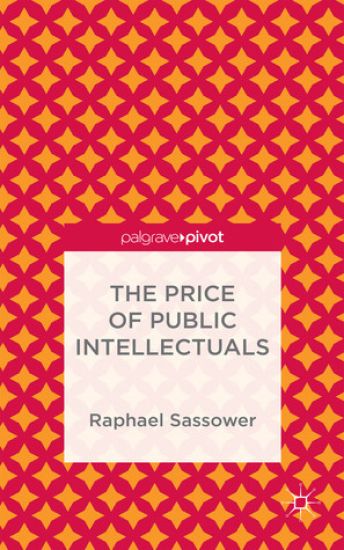
The Price of Public Intellectuals

The Price of Public Intellectuals

R. Sassower

Palgrave Pivot
2014
sidottu
This book provides a historically-informed survey critically outlining sociological, psychological, political, and economic approaches to the role of public intellectuals. Sassower suggests how the state might financially support the essential work of public intellectuals so as to critically engage the public and improve public policies.
Compromising the Ideals of Science

Compromising the Ideals of Science

R. Sassower

Palgrave Pivot
2015
sidottu
This books examines the conditions under which scientists compromised the ideals of science, and elucidates these with reference to the challenges of profit motives and national security concerns. The book also offers suggestions for changing the political and economic conditions under which the integrity of science and its ethos can be practiced.
Democratic Problem-Solving

Democratic Problem-Solving

Justin Cruickshank; Raphael Sassower

Rowman Littlefield
2017
sidottu
To what extent is neoliberalism undermining democracy and distorting the values of science? Can and should science be treated as an exemplar for a more dialogic democracy? Are universities and public intellectuals able to develop a more dialogically engaged public? What role should there be for ‘experts’ in a more dialogic democracy? Does information and communications technology present a potential to enhance democracy or increase the control and manipulation of knowledge and the public by corporations? This timely volume explores these pressing questions, in a dialogue based on developing and applying the recovery of the ‘critical Popper’, which highlights his contemporary relevance to the critique of neoliberal political economy in the age of technocapitalism. This book will be discussed in an online roundtable on the Social Epistemology Review and Reply Collective. Information about the SERRC can be found here: https://social-epistemology.com/
Democratic Problem-Solving

Democratic Problem-Solving

Justin Cruickshank; Raphael Sassower

Rowman Littlefield
2017
nidottu
To what extent is neoliberalism undermining democracy and distorting the values of science? Can and should science be treated as an exemplar for a more dialogic democracy? Are universities and public intellectuals able to develop a more dialogically engaged public? What role should there be for ‘experts’ in a more dialogic democracy? Does information and communications technology present a potential to enhance democracy or increase the control and manipulation of knowledge and the public by corporations? This timely volume explores these pressing questions, in a dialogue based on developing and applying the recovery of the ‘critical Popper’, which highlights his contemporary relevance to the critique of neoliberal political economy in the age of technocapitalism. This book will be discussed in an online roundable on the Social Epistemology Review and Reply Collective. Information about the SERRC can be found here: https://social-epistemology.com/
Ethical Choices in Contemporary Medicine

Ethical Choices in Contemporary Medicine

Mary Ann Gardell Cutter; Raphael Sassower

Acumen Publishing Ltd
2007
sidottu
"Ethical Choices in Contemporary Medicine" jettisons the standard medical ethics models of "rights" language and shows how the bioethical problems that receive attention from the media and the public are related to and are explicable in terms of the epistemological foundations of science and medicine. These epistemological concerns include how medical knowledge is established (scientific validity), how medical protocols are administered (checks and balances), how medical certainty is evaluated (probability) and medical responsibility is framed (personal or collective), and how medical knowledge is transmitted (popular media versus professional journals) and how medical care is allocated (insurance policies and government subsides). The book examines the present predicaments of medicine within a broad cultural context and suggests that rational discourse and parochial ethical dialogue may be futile in the face of competing and incommensurable frameworks and agendas, attitudes and wishes. The authors show that, in the postmodern age, two interrelated issues surface when it comes to medicine. On the one hand, there is a strong critique of science and the privileges associated with the scientific discourse and, on the other, there is still a deep-seated quest for certainty in all medical matters.
Ethical Choices in Contemporary Medicine

Ethical Choices in Contemporary Medicine

Mary Ann Gardell Cutter; Raphael Sassower

Acumen Publishing Ltd
2007
nidottu
"Ethical Choices in Contemporary Medicine" jettisons the standard medical ethics models of "rights" language and shows how the bioethical problems that receive attention from the media and the public are related to and are explicable in terms of the epistemological foundations of science and medicine. These epistemological concerns include how medical knowledge is established (scientific validity), how medical protocols are administered (checks and balances), how medical certainty is evaluated (probability) and medical responsibility is framed (personal or collective), and how medical knowledge is transmitted (popular media versus professional journals) and how medical care is allocated (insurance policies and government subsides). The book examines the present predicaments of medicine within a broad cultural context and suggests that rational discourse and parochial ethical dialogue may be futile in the face of competing and incommensurable frameworks and agendas, attitudes and wishes. The authors show that, in the postmodern age, two interrelated issues surface when it comes to medicine. On the one hand, there is a strong critique of science and the privileges associated with the scientific discourse and, on the other, there is still a deep-seated quest for certainty in all medical matters.