Kirjojen hintavertailu. Mukana 11 627 463 kirjaa ja 12 kauppaa.

Kirjahaku

Etsi kirjoja tekijän nimen, kirjan nimen tai ISBN:n perusteella.

1000 tulosta hakusanalla Stefanie Rogg

Crimes of Josef Fritzl

Crimes of Josef Fritzl

Stefanie Marsh; Bojan Pancevski

HARPERCOLLINS PUBLISHERS
2009
nidottu
The only inside account of the Fritzl case - Josef Fritzl's horrific incarceration of his daughter in a windowless dungeon for 24 years and the seven children he fathered with her - from the journalists who helped to break the story.
The Vow

The Vow

Stefanie London

HARPERCOLLINS PUBLISHERS
2025
nidottu
It’s the wedding of the year – for all the wrong reasons… I vow to make you pay for what you did. Twelve years ago, school friends Sofia, Ellie and Rose made a vow. They promised never to talk about that fateful night. Never to tell anyone what they did. Since then, they’ve all followed very different paths but as they come together to celebrate Ellie’s destination wedding it promises to be a weekend to remember… It is meant to be the event of the season, but as things start to go wrong, they suspect someone is trying to punish them. But if the women took a vow of silence, how can anyone know? And what lengths will they be willing to go to, to get their revenge? Praise for The Vow 'Revelation follows devastating revelation and I had to pick my jaw up off the floor at least twice… an absolute must read.' – Sarah Goodwin 'Twisty and layered, exploring themes of sisterhood and complex female friendships, The Vow had me glued to my seat… it had everything I look for in a thriller. It's the perfect summertime read!' – Sara Ochs 'Weddings, jealousy, secrets, murder, betrayal… The Vow has it all in spades! I was hooked from the start. You won't be able to put it down.' – Rachel Wolf
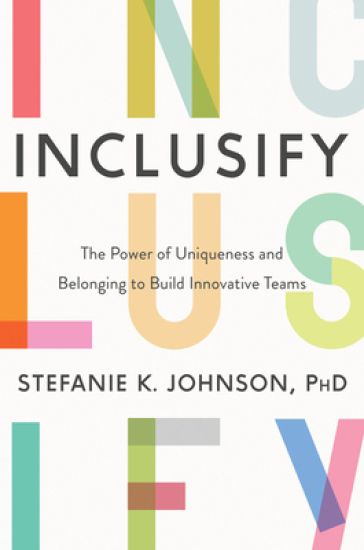
Inclusify

Inclusify

Stefanie K. Johnson

HarperCollins Publishers
2020
sidottu
Wall Street Journal BestsellerIn this groundbreaking guide, a management expert outlines the transformative leadership skill of tomorrow—one that can make it possible to build truly diverse and inclusive teams which value employees’ need to belong while being themselves. Humans have two basic desires: to stand out and to fit in. Companies respond by creating groups that tend to the extreme—where everyone fits in and no one stands out, or where everyone stands out and no one fits in. How do we find that happy medium where workers can demonstrate their individuality while also feeling they belong?The answer, according to Stefanie Johnson, is to Inclusify. In this essential handbook, she explains what it means to Inclusify and how it can be used to strengthen any business. Inclusifying—unlike “diversifying” or “including”— implies a continuous, sustained effort towards helping diverse teams feel engaged, empowered, accepted, and valued. It’s no use having diversity if everyone feels like an outsider, she contends.In her research, Johnson found common problems leaders exhibit which frustrate their attempts to create diverse and cohesive teams. Leaders that underestimated the importance of group coherence and dynamics often have employees who do not feel like they belong; leaders that ignore the benefits of listening to different perspectives leave some people feeling like they cannot be their authentic selves.By contrast, leaders who Inclusify can forge strong relationships with their teams, inspire greater productivity from all of their workers, and create a more positive environment for everyone. Having a true range of different voices is good for the bottom line—it allows for the development of the best, most innovative, and creative solutions that are essential to success. Inclusify reveals the unexpected ways that well-intentioned leaders undermine their teams, explains how to recognize the myths and misperceptions that drive these behaviors, and provides practical strategies to become an Inclusifyer. By learning why uniqueness and belonging are so imperative, leaders can better understand what makes their employees tick and find ways to encourage them to be themselves while ensuring they feel like they are fully part of the group. The result is a fully engaged team filled with diverse perspectives—the key to creating innovative and imaginative ideas that drive value.
In the Shadow of Gotham

In the Shadow of Gotham

Stefanie Pintoff

Penguin Books Ltd
2010
pokkari
At the dawn of the twentieth century, a deranged killer is on the prowl.New York, 1905.After losing his fiancee in the General Slocum ferry disaster, Detective Simon Ziele transferred to a country town north of Manhattan in the hope of escaping his grief. But only months later he's faced with the shocking murder of a young girl - battered to death in her bedroom on a cold winter's afternoon. And when Alistair Sinclair, one of Columbia University's most noted criminologists learns about the case, he realises it bears an uncanny resemblance to the deranged mutterings of one his research subjects. Ziele must work with Sinclair to determine whether his patient - with a terrifying history of violent behaviour and brutal fantasies - did indeed seek out this innocent young victim ... before the vicious murderer strikes again.In the Shadow of Gotham tells the atmospheric and gripping tale of a haunted man who must search for a killer, while on the run from his own demons ...
The Child in You: The Breakthrough Method for Bringing Out Your Authentic Self
The breakthrough three-million-copy international bestseller about how to befriend your inner child to find happiness "Compassionate, clear-eyed, and insightful . . . The Child in You is like your own personal therapist that you can carry around with you." --Lori Gottlieb, New York Times bestselling author of Maybe You Should Talk to Someone Nominated for Malcolm Gladwell, Susan Cain, Adam Grant, and Daniel H. Pink's Next Big Idea Club We all want to be loved and to feel safe to express who we really are. But over time we grow estranged from what brings us our purest happiness--because everyday traumas, unyielding societal expectations, and the judgment of our parents and peers submerge our true self beneath layers of behaviors rooted in fear and shame and mistrust. In The Child in You, psychologist Stefanie Stahl guides you, step-by-step, through her therapeutic method that has helped millions to peel away these layers and reconnect with their inner child--both the shadow child, representing our deepest insecurities and the part of our self-esteem that is injured and unstable, and the sun child, representing our greatest joys and the part of our self-esteem that remains positive and intact. The many examples and exercises in this book will help you discover your shadow child and sun child, identify which of the shadow child's dozen self-protection strategies are at work in you, and put into practice the array of proven self-reflection strategies to overcome negative influences and beliefs. Because it's never too late to have a happy childhood, or to bring your authentic self out from the shadows so you can embody your radiant individuality. A PENGUIN LIFE TITLE
Personal but Not Private

Personal but Not Private

Stefanie Duguay

OXFORD UNIVERSITY PRESS INC
2022
sidottu
Privacy has become a pressing concern for many users of digital platforms who fear legal or social liability for sharing personal details online. Yet for queer women and others, an emphasis on privacy fails to reflect the creativity and struggles of everyday people seeking to represent themselves and form meaningful connections through social media. Personal but Not Private explores how queer women share and maintain their identities through digital technologies despite overlapping technological, social, economic, and political concerns. Focusing on representations of sexual identity through Tinder, Instagram, and Vine, this volume uncovers how queer women are continuously engaging in identity modulation, or the process through which people and platforms adjust or modify personal information, to form relationships, increase their social and economic participation, and counter intersecting forms of oppression. While queer women's representations of sexual identity give rise to publics and counterpublics through intimate and collective self-representation, platform-specific elements like design and governance place limitations on queer women's agency and often make them targets of censorship, harassment, and discrimination. This book also considers how identity modulation can be applied to a range of people negotiating digital contexts and promotes tangible changes to digital platforms and their broader social, economic, and political structures to empower individuals and their personal sharing on social media. Bringing together personal interviews and empirical research, Personal but Not Private offers a new lens for examining digitally mediated identities and highlights how platforms act as complicated sites of transformation.
Personal but Not Private

Personal but Not Private

Stefanie Duguay

OXFORD UNIVERSITY PRESS INC
2022
nidottu
Privacy has become a pressing concern for many users of digital platforms who fear legal or social liability for sharing personal details online. Yet for queer women and others, an emphasis on privacy fails to reflect the creativity and struggles of everyday people seeking to represent themselves and form meaningful connections through social media. Personal but Not Private explores how queer women share and maintain their identities through digital technologies despite overlapping technological, social, economic, and political concerns. Focusing on representations of sexual identity through Tinder, Instagram, and Vine, this volume uncovers how queer women are continuously engaging in identity modulation, or the process through which people and platforms adjust or modify personal information, to form relationships, increase their social and economic participation, and counter intersecting forms of oppression. While queer women's representations of sexual identity give rise to publics and counterpublics through intimate and collective self-representation, platform-specific elements like design and governance place limitations on queer women's agency and often make them targets of censorship, harassment, and discrimination. This book also considers how identity modulation can be applied to a range of people negotiating digital contexts and promotes tangible changes to digital platforms and their broader social, economic, and political structures to empower individuals and their personal sharing on social media. Bringing together personal interviews and empirical research, Personal but Not Private offers a new lens for examining digitally mediated identities and highlights how platforms act as complicated sites of transformation.
Mixed Messages

Mixed Messages

Stefanie Mollborn

Oxford University Press Inc
2017
sidottu
Sex is bad. Unprotected sex is a problem. Having a baby would be a disaster. Abortion is a sin. Teenagers in the United States hear conflicting messages about sex from everyone around them. How do teens understand these messages? In Mixed Messages, Stefanie Mollborn examines how social norms and social control work through in-depth interviews with college students and teen mothers and fathers, revealing the tough conversations teeangers just can't have with adults. Delving into teenagers' complicated social worlds Mollborn argues that by creating informal social sanctions like gossip and exclusion and formal communication such as sex education, families, peers, schools, and communities strategize to gain control over teens' behaviors. However, while teens strategize to keep control, they resist the constraints of the norms, revealing the variety of outcomes that occur beyond compliance or deviance. By proving that the norms existing today around teen sex are ineffective, failing to regulate sexual behavior, and instead punishing teens that violate them, Mollborn calls for a more thoughtful and consistent dialogue between teens and adults, emphasizing messages that will lead to more positive health outcomes.
Mixed Messages

Mixed Messages

Stefanie Mollborn

Oxford University Press Inc
2017
nidottu
Sex is bad. Unprotected sex is a problem. Having a baby would be a disaster. Abortion is a sin. Teenagers in the United States hear conflicting messages about sex from everyone around them. How do teens understand these messages? In Mixed Messages, Stefanie Mollborn examines how social norms and social control work through in-depth interviews with college students and teen mothers and fathers, revealing the tough conversations teeangers just can't have with adults. Delving into teenagers' complicated social worlds Mollborn argues that by creating informal social sanctions like gossip and exclusion and formal communication such as sex education, families, peers, schools, and communities strategize to gain control over teens' behaviors. However, while teens strategize to keep control, they resist the constraints of the norms, revealing the variety of outcomes that occur beyond compliance or deviance. By proving that the norms existing today around teen sex are ineffective, failing to regulate sexual behavior, and instead punishing teens that violate them, Mollborn calls for a more thoughtful and consistent dialogue between teens and adults, emphasizing messages that will lead to more positive health outcomes.
Measuring Judicial Activism

Measuring Judicial Activism

Stefanie Lindqquist; Frank Cross

Oxford University Press Inc
2009
sidottu
Measuring Judicial Activism supplies empirical analysis to the widely discussed concept of judicial activism at the United States Supreme Court. Complaints about activist Court decisions are common within contemporary political discourse, but these objections often have little substantive meaning beyond the speaker's disagreement with particular case outcomes. Frequently debated by legal scholars, judicial activism is shaped by the participants' ideological perspectives as well as by their subjective views regarding ambiguous constitutional provisions. Although no study can be perfectly objective, Measuring Judicial Activism seeks to move beyond these more subjective debates by conceptualizing activism in non-ideological terms, identifying specific empirical dimensions to the concept, and measuring those dimensions using systematic social scientific techniques. In so doing, the book allows the authors to assess the relative "activism" of recent justices on the Court. Stefanie Lindquist and Frank B. Cross's work is guided theoretically by the notion that, at its core, the concept of activism involves concerns over the judiciary's institutional aggrandizement at the expense of the elected branches. An important corollary idea is that such efforts are particularly "activist" when they further the justices' own policy or ideological objectives. From these core theoretical ideas, the authors identify specific empirical manifestations that reflect the expansion of judicial power. In particular, the authors evaluate the Court's exercise of judicial review to invalidate legislative and executive action. Lindquist and Cross also analyze the justices' willingness to expand the Court's power by granting litigants increased access to the courts and overruling the Court's own precedents. In these contexts, Measuring Judicial Activism considers the extent to which these actions are consistent with the justices' ideological predilections.
Oberbrechen: A German Village Confronts its Nazi Past

Oberbrechen: A German Village Confronts its Nazi Past

Stefanie Fischer; Kim Wünschmann

OXFORD UNIVERSITY PRESS INC
2024
nidottu
Oberbrechen: A German Village Confronts Its Nazi Past is a new title in OUP's Graphic History Series that chronicles the events of the Holocaust and its aftermath in a small village in rural Germany. Based on meticulous research and using powerful visual storytelling, the book provides a multilayered narrative that explores the experiences of both Jewish and non-Jewish villagers from the First World War to the present. Its focus on how "ordinary" people experienced this time offers a new and illuminating insight into everyday life and the processes of violence, rupture, and reconciliation that characterized the history of the twentieth century in Germany and beyond. The graphic narrative is accompanied by source documents published in English translation for the first time, an essay on the wider historical context, and an incisive reflection on the writing of this book--and of history more broadly.
Deploying Feminism

Deploying Feminism

Stéfanie von Hlatky

OXFORD UNIVERSITY PRESS INC
2023
sidottu
A detailed account, based on fieldwork and interviews, of how Women, Peace and Security norms are militarized and put at the service of operational effectiveness. International organizations and governments want to increase women's participation in military operations and peacebuilding. Gender equality is increasingly seen as the antidote to conflict, a key factor in achieving stability. While feminist activism inspired the emergence of these norms on gender and conflict, they were institutionalized through the Women, Peace and Security (WPS) agenda, with the military at the forefront of those changes. In Deploying Feminism, Stéfanie von Hlatky tells the story of how the military has been delegated authority to advance gender equality as part of their activities, while simultaneously tackling increasingly complex threats. Drawing upon fieldwork and interviews, she illustrates how NATO, the world's foremost alliance, has even embedded these ideas in the planning and execution of its missions. For troops deployed on NATO missions, this often means seeking out women in their operating area to improve intelligence gathering activities. While this helps the mission, does it help women and conflict-affected communities? Because of the military's focus on operational effectiveness above all else, von Hlatky argues that there is a distortion of WPS norms, as gender equality concerns fade into the background. Looking at NATO's ongoing operations in Iraq, Kosovo, and the Baltics, Deploying Feminism details the process by which Women, Peace and Security norms are militarized and put at the service of operational effectiveness. Further, it shows why an adjustment is necessary for gender equality to become a true planning priority.
Deploying Feminism

Deploying Feminism

Stéfanie von Hlatky

OXFORD UNIVERSITY PRESS INC
2026
nidottu
A detailed account, based on fieldwork and interviews, of how Women, Peace and Security norms are militarized and put at the service of operational effectiveness. International organizations and governments want to increase women's participation in military operations and peacebuilding. Gender equality is increasingly seen as the antidote to conflict, a key factor in achieving stability. While feminist activism inspired the emergence of these norms on gender and conflict, they were institutionalized through the Women, Peace and Security (WPS) agenda, with the military at the forefront of those changes. In Deploying Feminism, Stéfanie von Hlatky tells the story of how the military has been delegated authority to advance gender equality as part of their activities, while simultaneously tackling increasingly complex threats. Drawing upon fieldwork and interviews, she illustrates how NATO, the world's foremost alliance, has even embedded these ideas in the planning and execution of its missions. For troops deployed on NATO missions, this often means seeking out women in their operating area to improve intelligence gathering activities. While this helps the mission, does it help women and conflict-affected communities? Because of the military's focus on operational effectiveness above all else, von Hlatky argues that there is a distortion of WPS norms, as gender equality concerns fade into the background. Looking at NATO's ongoing operations in Iraq, Kosovo, and the Baltics, Deploying Feminism details the process by which Women, Peace and Security norms are militarized and put at the service of operational effectiveness. Further, it shows why an adjustment is necessary for gender equality to become a true planning priority.

The Victorian Verse-Novel

The Victorian Verse-Novel

Stefanie Markovits

Oxford University Press
2017
sidottu
The Victorian Verse-Novel: Aspiring to Life considers the rise of a hybrid generic form, the verse-novel, in the second half of the nineteenth century. Such poems combined epic length with novelistic plots in the attempt to capture not a heroic past but the quotidian present. Victorian verse-novels also tended to be rough-mixed, their narrative sections interspersed with shorter, lyrical verses in varied measures. In flouting the rules of contemporary genre theory, which saw poetry as the purview of the eternal and ideal and relegated the everyday to the domain of novelistic prose, verse-novels proved well suited to upsetting other hierarchies, as well, including those of gender and class. The genre's radical energies often emerge from the competition between lyric and narrative drives, between the desire for transcendence and the quest to find meaning in what happens next; the unusual marriage plots that structure such poems prove crucibles of these rival forces. Generic tensions also yield complex attitudes towards time and space: the book's first half considers the temporality of love, while its second looks at generic geography through the engagement of novels in verse with Europe and the form's transatlantic travels. Both well-known verse-novels (Elizabeth Barrett Browning's Aurora Leigh, Arthur Hugh Clough's Amours de Voyage, Coventry Patmore's The Angel in the House) and lesser-known examples are read closely alongside a few nearly related works (Tennyson's Idylls of the King, Robert Browning's The Ring and the Book). An Afterword traces the verse-novel's substantial influence on the modernist novel.
The Politics of Bad Options

The Politics of Bad Options

Stefanie Walter; Ari Ray; Nils Redeker

Oxford University Press
2020
sidottu
This is an open access title available under the terms of a CC BY-NC-ND 4.0 International licence. It is free to read at Oxford Academic and offered as a free PDF download from OUP and selected open access locations. Why was the Eurozone crisis so difficult to resolve? Why was it resolved in a manner in which some countries bore a much larger share of the pain than other countries? Why did no country leave the Eurozone rather than implement unprecedented austerity? Who supported and opposed the different policy options in the crisis domestically, and how did the distributive struggles among these groups shape crisis politics? Building on macro-level statistical data, original survey data from interest groups, and qualitative comparative case studies, this book argues and shows that the answers to these questions revolve around distributive struggles about how the costs of the Eurozone crisis should be divided among countries, and within countries, among different socioeconomic groups. Together with divergent but strongly held ideas about the 'right way' to conduct economic policy and asymmetries in the distribution of power among actors, severe distributive concerns of important actors lie at the root of the difficulties of resolving the Eurozone crisis as well as the difficulties to substantially reform EMU. The book provides new insights into the politics of the Eurozone crisis by emphasizing three perspectives that have received scant attention in existing research: a comparative perspective on the Eurozone crisis by systematically comparing it to previous financial crises, an analysis of the whole range of policy options, including the ones not chosen, and a unified framework that examines crisis politics not just in deficit-debtor, but also in surplus-creditor countries.