Kirjojen hintavertailu. Mukana 11 627 363 kirjaa ja 12 kauppaa.

Kirjahaku

Etsi kirjoja tekijän nimen, kirjan nimen tai ISBN:n perusteella.

1000 tulosta hakusanalla Stephen F Kelly

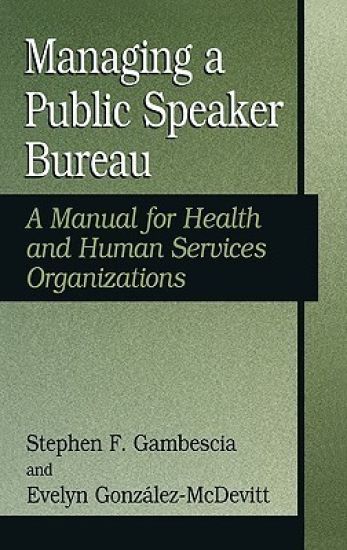
Managing A Public Speaker Bureau

Managing A Public Speaker Bureau

Stephen F. Gambescia; Evelyn Gonzalez

Kluwer Academic/Plenum Publishers
2004
sidottu
When health and human services organizations (new, established, or mature) engage in a strategic planning process, invariably the suggestion is made to offer a public speaker bureau to support their mission. As a pro­ fessional in the health and human services field, you probably have encoun­ tered, to some degree, the services provided by an organization's speak­ ers bureau. You have heard speakers representing organizations or you may have been a staff or volunteer speaker for an organization. Public speaker bureaus are ubiquitous. Providing a public speaker bureau usually makes sense. It provides an easy and relatively inexpensive way to impart useful information to your constituents or the public, or serve as a marketing or fundraising tool. A public speaker bureau can increase your visibility in the communities that you serve or would like to serve. Throughout our score of years of experience in the health and human services fields, we were struck by the lack of attention given tomost organ­ izations' public speaker bureaus. Again, while most organizations felt the need to have a speakers bureau, relatively little attention was given to the management and evaluation of this service. In fact, few organizations spent quality time determining whether or not a public speaker bureau was, indeed, needed and, if so, what should be its strategic purpose in serving the mission of the organization.
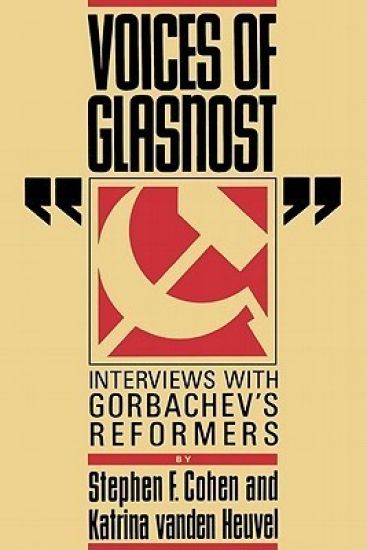
Voices of Glasnost

Voices of Glasnost

Stephen F. Cohen; Katrina Vanden Heuvel

WW Norton Co
1991
nidottu
An inside account of the events unfolding in the Soviet Union under Mikhail Gorbachev. In a series of interviews, 14 leaders of Gorbachev's reforms talk about their personal and political struggles to change the Soviet Union. They include the Politburo member often called Gorbachev's right-hand man; three other members of the powerful Central Committee; leaders of the revolt against the old cultural bureaucracy, including Russia's most outspoken actor, poet and film-maker; and equally prominent reformers in economics, science, journalism and foreign policy. Other works by Stephen F.Cohen include "Bukharin and the Bolshevik Revolution", "An End to Silence" and "Sovieticus".
Failed Crusade

Failed Crusade

Stephen F. Cohen

WW Norton Co
2001
nidottu
Failed Crusade is a deeply informed and passionate call for a fundamentally different American-Russian relationship in the post-Yeltsin era. Author Stephen Cohen shows that what US officials and other experts call "reform" has for most Russians been a catastrophic development—namely the unprecedented demodernization of a twentieth-century country—and for the United States the worst foreign policy disaster since Vietnam. What emerges is an alarming analysis of nuclear-laden Russia after 1991, representing an even greater threat to our national security than during the Cold War, and an indictment of American journalists and policy makers who failed to see or report the truth about the complicity of U.S. policy in a great human tragedy.
Marine Electronic Navigation

Marine Electronic Navigation

Stephen F. Appleyard

Routledge
1988
sidottu
A classic reference text for both nautical students and for all who have a professional involvement with marine electronic navigation systems, this second edition has been substantially enlarged to include all of the electronic systems now encountered by navigation / communication personnel.
Nineteenth-Century Art

Nineteenth-Century Art

Stephen F. Eisenman; David Phillips

Thames Hudson Ltd
2020
nidottu
Written by a group of highly respected art historians, the fifth edition of this classic book now features full-colour artworks throughout, new chapter introductions, examinations of key ideas, and other helpful pedagogical support. Emphasizing the vitality of 19th-century art, the authors demonstrate how paintings, sculptures, prints and drawings by David, Géricault, Turner, Homer, Cassatt, Rodin, Van Gogh and many others remain relevant today. Using evocative and lucid prose, the authors reveal how concerns about class and gender, race and ethnicity, modernity and tradition, and popular and elite culture – ideas that arose in the course of the 19th century – motivated artists and propelled the movements under review.
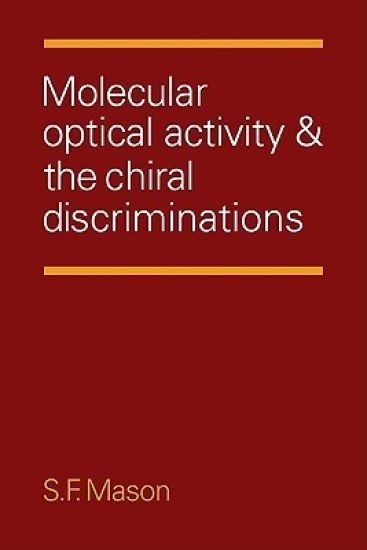
Molecular Optical Activity and the Chiral Discriminations

Molecular Optical Activity and the Chiral Discriminations

Stephen F. Mason

Cambridge University Press
2009
pokkari
This book, first published in 1982, presents a comprehensive introduction to studies of the singular chemical and physical properties of chiral molecules, both organic and inorganic. The topics discussed include the physical basis of the optical activity and the selective interactions of chiral molecules, and the general principles underlying enantiomer separation and asymmetric synthesis. In addition, the successive stages in the development of structural theory that were dependent upon the study of optically active materials are briefly surveyed.
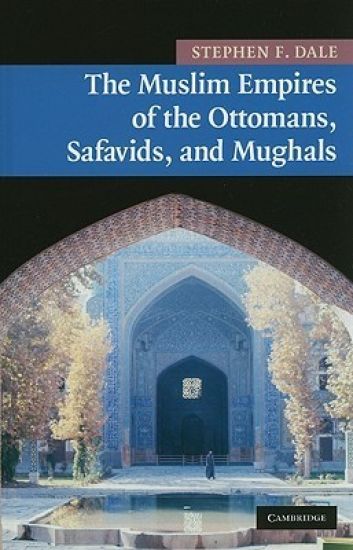
The Muslim Empires of the Ottomans, Safavids, and Mughals

The Muslim Empires of the Ottomans, Safavids, and Mughals

Stephen F. Dale

Cambridge University Press
2009
sidottu
Between 1453 and 1526 Muslims founded three major states in the Mediterranean, Iran and South Asia: respectively the Ottoman, Safavid, and Mughal empires. By the early seventeenth century their descendants controlled territories that encompassed much of the Muslim world, stretching from the Balkans and North Africa to the Bay of Bengal and including a combined population of between 130 and 160 million people. This book is the first comparative study of the politics, religion, and culture of these three empires between 1300 and 1923. At the heart of the analysis is Islam, and how it impacted on the political and military structures, the economy, language, literature and religious traditions of these great empires. This original and sophisticated study provides an antidote to the modern view of Muslim societies by illustrating the complexity, humanity and vitality of these empires, empires that cannot be reduced simply to religious doctrine.
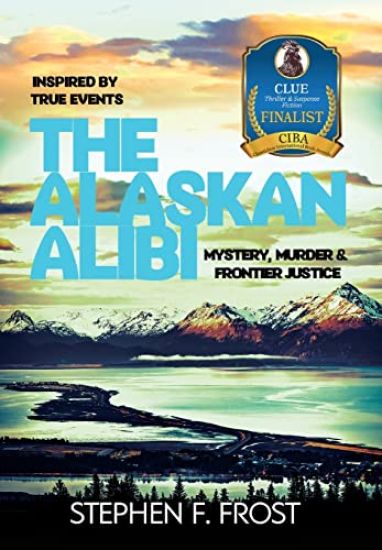
The Alaskan Alibi

The Alaskan Alibi

Stephen F Frost

FrostMysteryBooks, LLC
2021
sidottu
Between 1978 and 1983, over 40 young girls vanished from the streets of Anchorage during the wild Alyeska Pipeline construction years. Their gruesome deaths at the hands of a serial killer and the consequences of the false alibi given by a cabinet maker and his wife, drive the plot. That alibi enabled the killer to abduct at least ten more girls and fly them into the Alaskan wilds where, at gunpoint, he forced them to flee nude across the dark icy tundra before executing them as prey. The aftermath is this fictionalized legal thriller. PETER FOSTER was one victim's father. He blamed the couple's alibi for his daughter's death. When he was later accused of murdering the cabinet maker, he called his friend and former law partner, Logan, to defend him. Logan, a law professor in Arizona, agreed to help. He enlists LACEY CARPENTER, a woman he can't commit to, nor live without, to be his co-counsel. Widely respected as a trial attorney in Alaska, Lacey was also a skilled bush pilot and commercial fisherman during the summer season. As Logan struggles with the PTSD suffered by him as a teenager after the 1964 Good Friday Earthquake, and much later, the death of his mother, he and Lacey uncover a network of corruption in the Anchorage Police Department. and a powerful evangelical church that concealed JACK JANSEN'S killings to rid the streets of prostitutes. The story depicts Alaska's beautiful, unforgiving landscape and the fierce independence of its residents. The Alaskan Alibi ends with a twist, as the final pages reveal the cabinet maker's killer.
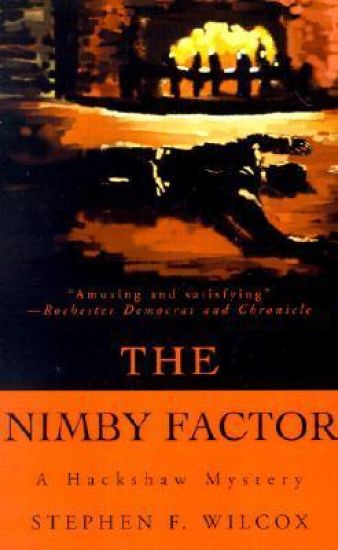
The NIMBY Factor

The NIMBY Factor

Stephen F Wilcox

iUniverse
2001
pokkari
Stephen Wilcox's second upstate New York mystery series, featuring rascal reporter Elias "Hack" Hackshaw, debuted last year to rave reviews. Now Hack is back - and in quite a mess - as he becomes embroiled in a real estate controversy that turns ugly indeed. Kirkville's NIMBY (Not-in-my-backyard) brigade is up in arms about the county's plans to install a landfill in a remote corner of their town; and, as always, Hack - chief opinionator for the Triton Advertiser and town gadfly - finds himself caught squarely in the middle. Wouldn't it be better, he reasons in an editorial, to accept the inevitable? Wouldn't it indeed, his loyal detractors shout back, when you yourself stand to make a tidy sum of cash out of the deal? In a generous gesture to hear both sides of the issue, Hack agrees to interview one of the landfill's opponents, Elton Venable. But when Hack arrives at the abandoned home that stands in the way of the landfill, he finds that not only those old walls had been left to rot. Elton Venable himself lies dead on the floor - leaving Hack the prime suspect. Hack is a fast talker - he's juggling suspicious cops, two or three doomed relationships, and newspaper deadlines, all at once - but The Nimby Factor promises to vex him more than anything that has come before.
The Jericho Flower

The Jericho Flower

Stephen F Wilcox

iUniverse
2002
pokkari
Returning for his fourth misadventure, small-town newspaperman and social gadfly Elias Hackshaw finds himself immersed in a mystery involving a dead con man and a missing gypsy princess with the improbable name of Bimbo Wanka. Through no fault of his own -- well, almost none -- Hack becomes a suspect in the case when the cops mistakenly conclude that he was an acquaintance of the murdered con artist. Meanwhile, Bimbo's parents turn up on Hack's doorstep demanding he turn over their missing daughter, or face a gypsy curse. To add to the mayhem, a local industrialist is badgering Hackshaw to oversee a major renovation to his monstrosity of a house, and Hack's sister Ruth is hectoring him to forget everything else and see to his duties as editor of The Triton Advertiser. Trapped by circumstance, Hack begins poking into things and soon discovers a circus assortment of off-beat characters: gypsies in cowboy hats, a con man with a conscience, a sheriff's investigator without a heart -- or a brain -- ham-fisted townies, and much, much more. Only a strong survival instinct, and his usual portion of dumb luck, can save Hackshaw this time around. Earlier Praise for Stephen F. Wilcox and the Elias Hackshaw series: “Hilarious . . . This is a wonderful (series) debut, a clever and comic mystery filled with engaging, quirky characters and colorful descriptions of rural life.” --San Francisco Chronicle, on The Twenty-Acre Plot “Hack delivers the laughs with trenchant observations on small-town life and wry acknowledgment of his own shortcomings . . . hilarious.” --Murder & Mayhem, on The Painted Lady “Hack is, as always, the proverbial pearl before swine, a romantic hiding in pessimism, a jewel of a journalist buried beneath the dreary society columns.” --Publishers Weekly, on The Painted Lady