

Kirjahaku
Etsi kirjoja tekijän nimen, kirjan nimen tai ISBN:n perusteella.
1000 tulosta hakusanalla Stephen H. Webb
The Four Gospels; Arranged As A Practical Family Commentary, For Every Day in the Year. by the Author of The Peep of Day, Etc. Ed., With An introductory Preface, by Stephen H. Tyng ...
Favell Lee Mortimer
University of Michigan Library
2006
pokkari

Sonnets from the Portuguese by Elizabeth Barrett Browning: plus Sonnets from the Porte-Cochere by S. H. Bass
Stephen H. Bass; Elizabeth Barrett Browning
Createspace Independent Publishing Platform
2013
nidottu

James's Account of S. H. Long's Expedition, 1819-1820, Part 2
Edwin James; Stephen H (Stephen Harriman) Long; Thomas Say
Anson Street Press
2025
pokkari

James's Account of S. H. Long's Expedition, 1819-1820, Part 2
Edwin James; Stephen H (Stephen Harriman) Long; Thomas Say
Anson Street Press
2025
sidottu
Stephen Daniel presents a study of the philosophy of George Berkeley in the intellectual context of his times, with a particular focus on how, for Berkeley, mind is related to its ideas. Daniel does not assume that thinkers like Descartes, Malebranche, or Locke define for Berkeley the context in which he develops his own thought. Instead, he indicates how Berkeley draws on a tradition that informed his early training and that challenges much of the early modern thought with which he is often associated. Specifically, this book indicates how Berkeley's distinctive treatment of mind (as the activity whereby objects are differentiated and related to one another) highlights how mind neither precedes the existence of objects nor exists independently of them. This distinctive way of understanding the relation of mind and objects allows Berkeley to appropriate ideas from his contemporaries in ways that transform the issues with which he is engaged. The resulting insights--for example, about how God creates the minds that perceive objects--are only now starting to be fully appreciated.
One week, red wine is good for the heart. The next week, new reports say it's bad for the health. So which is true? Anyone who's ever read science news with fascination, or who's ever been confounded by conflicting stories will appreciate this book. Taking a look at some true to life contemporary news stories, the author assesses recent studies on topics ranging from vitamin C and caffeine to pollution and cancer. With straight talk and a passion for the whole project of science, he demysifies the cult of the expert and sheds light on the nitty-gritty details of scientific processes. Any scientist loves a challenge, but the biggest challenge of all, observes Jenkins, is shared by scientists and nonscientitsts alike: how to make practical decisions in light of ambiguous evidence. Promising no simple answers, this book does offer excellent food for thought for people pondering that next glass of wine.
One week, red wine is good for the heart. The next week, new reports say it's bad for the health. So which is true? Anyone who's ever read science news with fascination, or who's ever been confounded by conflicting stories will appreciate this book. Taking a look at some true to life contemporary news stories, the author assesses recent studies on topics ranging from vitamin C and caffeine to pollution and cancer. With straight talk and a passion for the whole project of science, he demysifies the cult of the expert and sheds light on the nitty-gritty details of scientific processes. Any scientist loves a challenge, but the biggest challenge of all, observes Jenkins, is shared by scientists and nonscientitsts alike: how to make practical decisions in light of ambiguous evidence. Promising no simple answers, this book does offer excellent food for thought for people pondering that next glass of wine.
Specialized Justice addresses the question of the desirability of specialization in the administration of justice. Should there be more, rather than less, sub-division of the judiciary into specialized tribunals? What is most desirable in terms of efficiency, speed, true justice, and cost? The author attempts to answer these questions both by examining theoretical paradigms and also by describing the results of an empirical study which he has undertaken. He concludes by examining variables that apply in different jurisdictions and which should, if accounted for properly, allow generalized lessons to be extracted from the individual studies.
The Federal Reserve System--the central bank of the United States, better known as The Fed--has never been more controversial. Criticism has reached such levels that Congressman Ron Paul, contender for the Republican presidential nomination in 2012, published End the Fed, with blurbs from musician Arlo Guthrie and actor Vince Vaughn. And yet, amid a slow economy and partisan gridlock, the Fed has never been more important. Stephen H. Axilrod explains this influential agency-its powers, operations, how it sets policy-in The Federal Reserve, a timely addition to Oxford's acclaimed series What Everyone Needs to Know. Of the two major governmental tools for shaping the economy, Congress controls fiscal policy-taxation and spending-and the Fed makes monetary policy-influencing how much money circulates in the economy, and how quickly. Traditionally the Fed has relied on three instruments: open-market operations (buying and selling U.S. bonds), lending to banks, and setting reserve requirements on bank deposits. It also helps to regulate the financial system. Drawing on years of experience inside the Federal Reserve System, Axilrod shows how these tools actually work, and answers a series of increasingly detailed questions in the series format. He asks, for instance, if the system of regional Fed banks needs modification for today's technological landscape; if there is corruption in the Fed's governance; what happens to profits from its operations; the impact of political pressure; the extent of Congressional oversight; and just how independent it truly is. Whether discussing the Fed's balance sheet through the financial crisis of 2008 and beyond, the federal funds rate, or the international context, Axilrod displays a mastery of his subject Coming in time for the Fed's 100th anniversary in 2013, this book deftly explains an institution that every American needs to understand.
The Federal Reserve System--the central bank of the United States, better known as The Fed--has never been more controversial. Criticism has reached such levels that Congressman Ron Paul, contender for the Republican presidential nomination in 2012, published End the Fed, with blurbs from musician Arlo Guthrie and actor Vince Vaughn. And yet, amid a slow economy and partisan gridlock, the Fed has never been more important. Stephen H. Axilrod explains this influential agency-its powers, operations, how it sets policy-in The Federal Reserve, a timely addition to Oxford's acclaimed series What Everyone Needs to Know. Of the two major governmental tools for shaping the economy, Congress controls fiscal policy-taxation and spending-and the Fed makes monetary policy-influencing how much money circulates in the economy, and how quickly. Traditionally the Fed has relied on three instruments: open-market operations (buying and selling U.S. bonds), lending to banks, and setting reserve requirements on bank deposits. It also helps to regulate the financial system. Drawing on years of experience inside the Federal Reserve System, Axilrod shows how these tools actually work, and answers a series of increasingly detailed questions in the series format. He asks, for instance, if the system of regional Fed banks needs modification for today's technological landscape; if there is corruption in the Fed's governance; what happens to profits from its operations; the impact of political pressure; the extent of Congressional oversight; and just how independent it truly is. Whether discussing the Fed's balance sheet through the financial crisis of 2008 and beyond, the federal funds rate, or the international context, Axilrod displays a mastery of his subject Coming in time for the Fed's 100th anniversary in 2013, this book deftly explains an institution that every American needs to understand.
The American Association for the Advancement of Science's report on Vision and Change in Undergraduate Biology Education suggests that instructors "can no longer rely solely on trying to cover a syllabus packed with topics" but rather should "introduce fewer concepts but present them in greater depth." They further suggest that the principles embodied in a set of core concepts and competencies should be the basis for all undergraduate biology courses, including those designed for nonmajors. The theme of Tools for Critical Thinking in Biology will be the first and most fundamental of these competencies: the ability to apply the process of science. Biology courses and curricula must engage students in how scientific inquiry is conducted, including evaluating and interpreting scientific explanations of the natural world. The book uses diverse examples to illustrate how experiments work, how hypotheses can be tested by systematic and comparative observations when experiments aren't possible, how models are useful in science, and how sound decisions can be based on the weight of evidence even when uncertainty remains. These are fundamental issues in the process of science that are important for everyone to understand, whether they pursue careers in science or not. Where other introductory biology textbooks are organized scientific concepts, Tools for Critical Thinking in Biology will instead show how methods can be used to test hypotheses in fields as different as ecology and medicine, using contemporary case studies. The book will provide students with a deeper understanding of the strengths and weaknesses of such methods for answering new questions, and will thereby change the way they think about the fundamentals of biology.

The Geography of the Middle East
Stephen H. Longrigg; James Jankowski
AldineTransaction
2009
nidottu
Much of the Middle East is in a continuing state of visible, often revolutionary, change in almost every field--social, cultural, economic, political. Although time will have greatly modified the conditions here presented, the author emphasizes those aspects which, being the least ephemeral, were likely to remain valid for some years and indicates the areas in which the most change can be expected. Therefore, in evaluating any change that has occurred, the reader will at least be informed of the conditions out of which--or because of which--such an event occurred.In some cases Longrigg passes over important aspects of the Middle Eastern region and its component countries, almost or entirely in silence: among such aspects being those of military resources, prominent personalities, constitutional or legal issues, budgets and balances of trade. And even on matters upon which he has said something fairly specific--topography, races and languages, religions, climates, natural resources and agronomy, industry, communications--there may be too little detailed information to satisfy a reader desirous of a full picture of a given aspect of things in this or that territory. For most of such detail, and not less for an appreciation which may be widely different from the author's, the student can very easily look elsewhere: the literature of these countries is abundant and accessible.Longrigg's attempt has been to offer an objective but informed account of the different nationalities and social forces found in Middle Eastern environments, urban and rural, in terms of the particular circumstances, problems and hopes of the dozen separate and more or less divided states of the region. The non-specialist reader may from all this learn something true and perhaps suggestive, while the expert may find not too much to offend him.
Chaos theory has captured scientific and popular attention. What began as the discovery of randomness in simple physical systems has become a widespread fascination with "chaotic" models of everything from business cycles to brainwaves to heart attacks. But what exactly does this explosion of new research into chaotic phenomena mean for our understanding of the world? In this timely book, Stephen Kellert takes the first sustained look at the broad intellectual and philosophical questions raised by recent advances in chaos theory--its implications for science as a source of knowledge and for the very meaning of that knowledge itself.
Chaos theory has captured scientific and popular attention. What began as the discovery of randomness in simple physical systems has become a widespread fascination with "chaotic" models of everything from business cycles to brainwaves to heart attacks. But what exactly does this explosion of new research into chaotic phenomena mean for our understanding of the world? In this timely book, Stephen Kellert takes the first sustained look at the broad intellectual and philosophical questions raised by recent advances in chaos theory—its implications for science as a source of knowledge and for the very meaning of that knowledge itself.
What happens to scientific knowledge when researchers outside the natural sciences bring elements of the latest trend across disciplinary boundaries for their own purposes? Researchers in fields from anthropology to family therapy and traffic planning employ the concepts, methods, and results of chaos theory to harness the disciplinary prestige of the natural sciences, to motivate methodological change or conceptual reorganization within their home discipline, and to justify public policies and aesthetic judgments.Using the recent explosion in the use (and abuse) of chaos theory, "Borrowed Knowledge and the Challenge of Learning across Disciplines" examines the relationship between science and other disciplines as well as the place of scientific knowledge within our broader culture. Stephen H. Kellert's detailed investigation of the myriad uses of chaos theory reveals serious problems that can arise in the interchange between science and other knowledge-making pursuits, as well as opportunities for constructive interchange. By engaging with recent debates about interdisciplinary research, Kellert contributes a theoretical vocabulary and a set of critical frameworks for the rigorous examination of borrowing.

American and British appeasement of Nazism during the early years of the Third Reich went far beyond territorial concessions. In Prologue to Annihilation: Ordinary American and British Jews Challenge the Third Reich, Stephen H. Norwood examines the numerous ways that the two nations' official position of tacit acceptance of Jewish persecution enabled the policies that ultimately led to the Final Solution and how Nazi annihilationist intentions were clearly discernible even during the earliest years of Hitler's rule. Further, Norwood looks at the nature and impact of American and British Jewish resistance to Nazi persecution and the efforts of Jews at the grassroots level to press Jewish organizations to respond more forcefully to the Nazi menace. He examines the worldwide protest and boycott movements against Germany and German goods as well as mass demonstrations by working-class and lower-middle-class Jews in many American and British cities. Prologue to Annihilation details how the events of 1930-1936 tested American and British societies' willingness to accept Nazism and its anti-Jewish philosophy and illuminates the divisions that existed even within the Jewish community about how best to challenge Nazi antisemitic policies and atrocities.

American and British appeasement of Nazism during the early years of the Third Reich went far beyond territorial concessions. In Prologue to Annihilation: Ordinary American and British Jews Challenge the Third Reich, Stephen H. Norwood examines the numerous ways that the two nations' official position of tacit acceptance of Jewish persecution enabled the policies that ultimately led to the Final Solution and how Nazi annihilationist intentions were clearly discernible even during the earliest years of Hitler's rule. Further, Norwood looks at the nature and impact of American and British Jewish resistance to Nazi persecution and the efforts of Jews at the grassroots level to press Jewish organizations to respond more forcefully to the Nazi menace. He examines the worldwide protest and boycott movements against Germany and German goods as well as mass demonstrations by working-class and lower-middle-class Jews in many American and British cities. Prologue to Annihilation details how the events of 1930-1936 tested American and British societies' willingness to accept Nazism and its anti-Jewish philosophy and illuminates the divisions that existed even within the Jewish community about how best to challenge Nazi antisemitic policies and atrocities.
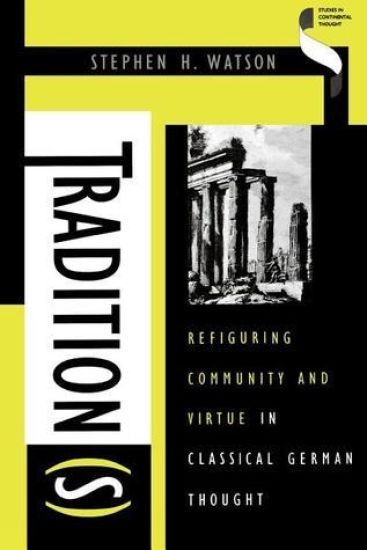
Tradition(s) Refiguring Community and Virtue in Classical German Thought Examining the work of Foucault, Kant, Heidegger, Hobbes, and Hegel, Stephen H. Watson tackles the questions: What is the origin of the concept of tradition? How does the notion of tradition affect our understanding of the present and the past? What exactly is tradition? Studies in Continental Thought—John Sallis, general editor 1998. 336 pages, 6 1/8 x 9 1/4 cloth0-253-33328-8$39.95 L / £30.50 paper0-253-21152-2$18.95 s / £14.50