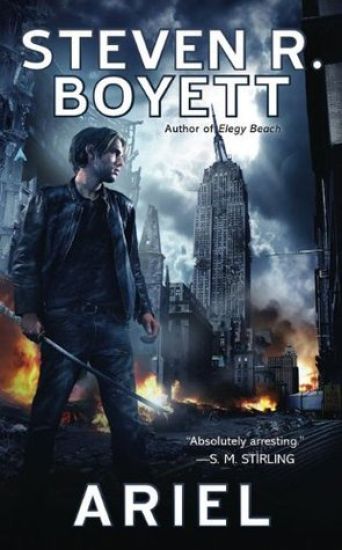
It's been five years since the lights went out, cars stopped in the streets, and magical creatures began roaming Earth. Pete Garey survived the Change, trusting no one but himself until the day he met Ariel?a unicorn who brought new meaning and adventure to his life.
Twenty-seven years ago, technology died. The fundamental laws of the universe had inexplicably changed. Now, Fred Garey's best friend Yan believes he's found a way to reverse the Change. But Fred fears the repercussions of such drastic, irreversible steps.
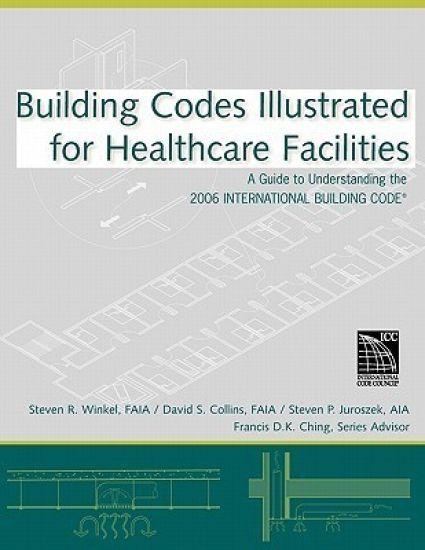
Now more than ever, architects need an interpretive guide to understand how the building code affects the early design of specific projects. This easy-to-use, illustrative guide is part of a new series covering building codes based on the International Building Code for 2006. This book presents the complex code issues inherent to healthcare facility design in a clear, easily understandable format.
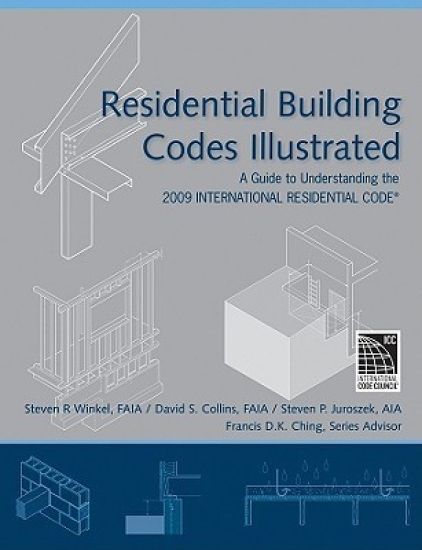
An easy-to-use illustrated guide to building codes for residential structures As the construction industry moves to a single set of international building codes, architects and construction professionals need an interpretive guide to understand how the building code affects the early design of specific projects. This newest addition to Wiley’s series of focused guides familiarizes code users with the 2009 International Residential Code® (IRC) as it applies to residential buildings. The book provides architects, engineers, and other related building professionals with an understanding of how the International Residential Code was developed, and how it is likely to be interpreted when applied to the design and construction of residential buildings. • User-friendly visual format that makes finding the information you need quick and easy • The book’s organization follows the 2009 International Residential Code itself • Nearly 900 illustrations, by architectural illustrator Steven Juroszek in the style of noted illustrator and author Frank Ching, visualize and explain the codes • Text written by experienced experts who have been instrumental in gaining acceptance for the new unified building code This book is an essential companion to the IRC for both emerging practitioners and experienced practitioners needing to understand the new IRC.
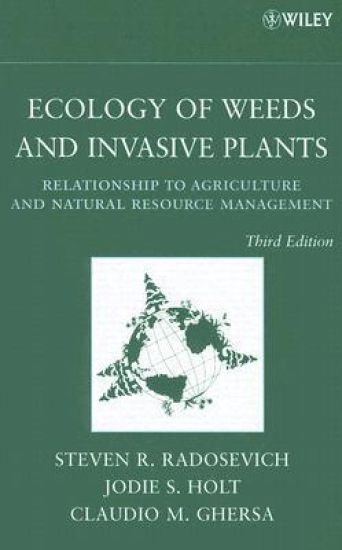
The classic reference on weeds and invasive plants has been revised and updated. The Third Edition of this authoritative reference provides an in-depth understanding of how weeds and invasive plants develop and interact in the environment so you can manage and control them more effectively. The guide includes an introduction to weeds and invasive plants in various environments and an overview of their ecology and evolution. With extensive examples, this book: Focuses on the biological features of weeds and invasive plants, especially as they exist in agriculture, forests, rangelands, and natural ecosystems.Includes coverage of exotic invasive plants.Discusses a variety of methods and tools for managing weeds and invasive plants, including physical, cultural, biological, and chemical approaches.Examines systems approaches for management, including modern Integrated Pest Management.Addresses future challenges for scientists, farmers, and land managers. This is the definitive, hands-on reference if you're a land manager or professional in plant sciences, agronomy, weed science, and horticulture. The book is also an excellent textbook for senior undergraduate or graduate students studying agriculture, ecology, natural resources management, environmental management, or related fields.
When this book was first published in 1978, it was only recently that researchers had begun to focus on children's peer relationships and the impact of these relationships on their development. The contributors to this volume view friendship as an important context for the study of a variety of cognitive and affective processes - from the perspectives of a wide range of disciplines. The volume poses an array of fascinating theoretical questions, and offers varied methodological tools for answering them. Some contributors present and review applied research addressed to conceptualizing and ameliorating peer relationship problems, whilst others reflect applied or policy-orientated concerns in chapters on racial integration and the integration of mentally retarded children into regular classrooms. A chapter on the scientific, political and social history of the interest in children's friendships and two summary chapters add to the usefulness of the book for students.
Famous mathematical constants include the ratio of circular circumference to diameter, pi=3.14 …, and the natural logarithmic base, e=2.178 … Students and professionals usually can name at most a few others, but there are many more buried in the literature and awaiting discovery. How do such constants arise, and why are they important? Here Steven Finch provides 136 essays, each devoted to a mathematical constant or a class of constants, from the well known to the highly exotic. Topics covered include the statistics of continued fractions, chaos in nonlinear systems, prime numbers, sum-free sets, isoperimetric problems, approximation theory, self-avoiding walks and the Ising model (from statistical physics), binary and digital search trees (from theoretical computer science), the Prouhet-Thue-Morse sequence, complex analysis, geometric probability and the traveling salesman problem. This book will be helpful both to readers seeking information about a specific constant, and to readers who desire a panoramic view of all constants coming from a particular field, for example combinatorial enumeration or geometric optimization. Unsolved problems appear virtually everywhere as well. This is an outstanding scholarly attempt to bring together all significant mathematical constants in one place.
Mechanism design is the field of economics that treats institutions and procedures as variables that can be selected in order to achieve desired objectives. An important aspect of a mechanism is the communication among its participants that it requires, which complements other design features such as incentives and complexity. A calculus-based theory of communication in mechanisms is developed in this book. The value of a calculus-based approach lies in its familiarity as well as the insight into mechanisms that it provides. Results are developed concerning (i) a first order approach to the construction of mechanisms, (ii) the range of mechanisms that can be used to achieve a given objective, as well as (iii) lower bounds on the required communication.
When Jack Hammer, night watchman at Auerbach's Department Store and part-time private investigator, discovers his first serious client, Yasa Cvito, beaten to death and floating in her own bathtub, he fears that his career as a private eye might be over before it can even get started. Murders like this one gather attention, and a single skewed news article mentioning his name could kill his reputation. Both the police and the FBI warn him to stay clear of the case-to let sleeping dogs lie, even as a cryptic message bearing his name makes that impossible: "Bring me Cvito device or lady will end up like Yasa. Saturday. No policeman." But what is a Cvito device? Who is the lady they're threatening? And how is it connected to recently murdered Yasa? Chasing clues through basement pool halls and the downtown cafes of post-World War II Salt Lake City, Jack follows a lead to a nearby mining town, home to one of the largest copper mines in the world. And as time runs down, he makes a bombshell discovery- a revelation that pulls him from a simple murder case into a shadowy mix of Russian spies, FBI obstruction, and quite possibly the best idea that Nikola Tesla ever had.
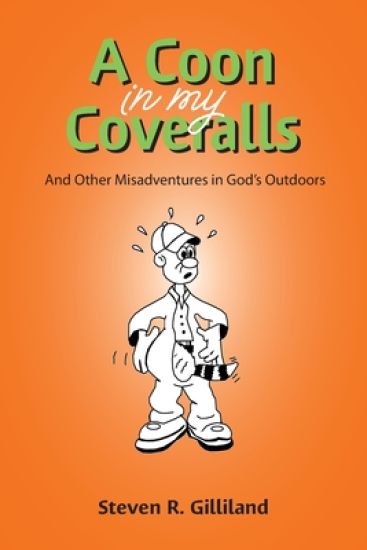
Steve was blessed from his childhood with a vivid imagination, an enjoyment of laughter and a love of the outdoors. he is best known for the weekly outdoor column "Exploring Kansas Outdoors" that today is carried in a dozen newspapers throughout Kansas. The stories in A Coon in my Coveralls come from "Outrageously Outdoors," an outdoor humor column he writes for The Territorial Magazine, published in Dodge City, Kansas. Steve is also handy in the kitchen and, when not writing, can be found experimenting with new and better recipes for Skunk Skillet Stew or rack of Raccoon.
At a time when the incidence of Alzheimer's Disease is increasing dramatically, this accessible account revolutionises our stereotypes of Alzheimer's patients and their care.
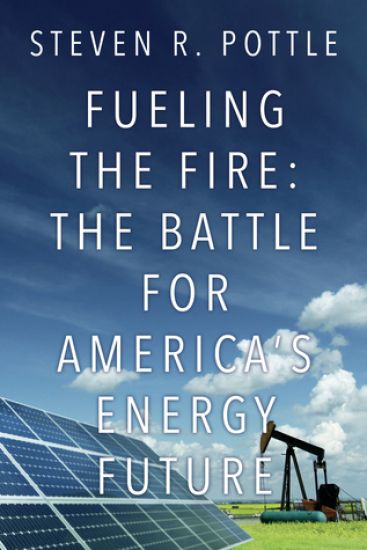
The United States is at a pivotal point in our nation's economic and political history and this opens up several questions about our future. -Is America facing an unavoidable decline in prosperity, competitiveness, and military strength? -After the success of World War II and the Cold War, will we become the first generation to leave our descendants a weaker, less-affluent country? -What role will energy play in restoring us to competitive strength and vitality? America is in the midst of an epic battle within its energy sector. It is the oil and gas industry's shale energy revolution versus the renewable energy sector. The stakes are huge: trillions of dollars of investment, future job growth, climate health, and the strength of the United States' economic competitiveness. Fueling the Fire: The Battle for America's Energy Future has been written not only for energy professionals, but also for anyone seeking to better understand this great economic and technological battle. The book addresses the following issues: -What core innovation sparked the shale energy revolution? -Is OPEC becoming increasingly irrelevant? -How will the shale revolution change electric utility, LNG and pipeline companies? -Is America's coal industry dying? -Should "fracking" be considered controversial? -What is the outlook for America's solar, wind and hydroelectric sectors? -Is America ready to fight a war against climate change? -Can we compete effectively with China? A key theme of this book is that innovation will continue to accelerate in both the conventional and renewable energy arenas. It is, therefore, far too early to handicap who will win the battle for America's energy future. America is on the cusp of becoming the leading global energy producer. In order to ensure our success, however, industry executives, capital providers, environmentalists, legislators, academics and ordinary citizens must begin a vigorous dialogue around key energy issues. This book will be critically important to anyone seeking to understand the issues impacting America's trillion dollar energy sector as it changes rapidly over the next ten years and beyond.