Analysing Talk in Educational Research is the go-to guide for all educational researchers collecting data in the form of talk. Offering practical and helpful approaches alongside explanations of relevant theories, it is a thorough yet concise guidebook providing all the advice necessary to effectively analyse talk data.Examining talk analysis through the lens of three theoretical approaches – Systemic Functional Linguistics, Positioning Theory and Interpersonal Behaviour Theory – the book offers detailed summaries and analyses of these theories and also covers topics including: How to begin collecting talk data The ethical issues surrounding collecting talk data Appropriate strategies for transcription and coding Checking for trustworthiness and credibility of talk data.Each chapter includes provocation exercises and illustrative examples, as well as links to websites and further reading suggestions to deepen understanding. Guiding readers from the necessary practical considerations required during data collection through to final evaluations, Analysing Talk in Educational Research is essential reading for graduate students and academic researchers completing studies involving talk and looking for a quick and helpful introduction to the rigorous methods with which to analyse their data.
Over the last few years there has been a raft of initiatives involving the use of information communication technology (ICT) in various learning environments. The use of ICT to transfer and support the construction of knowledge in schools and tertiary institutions has received a lot of investment and a certain degree of thought. Many of the initiatives are aimed at developing more flexible systems of learning with a core aim to provide the learner with more choice, in terms of what, where and how they learn. A key aim of this book is to signal some of the challenges and opportunities that we face in designing and using appropriate technologies within various learning environments. A key intention of the book is to report on the work of several researchers and product developers engaged in investigating the potential of ICT in learning environments in terms users, computers and organisations. There are two key themes within the book: the influence of learning theory on design and the influence of design on learning. The first section of the book discusses some implications for design of e-learning environments. The second section of the book concentrates on the influence of design on learning, and reports on investigations into the nature of interactivity and its impact on student learning.
Teacher professional development is usually directed and governed by three agents: politics, pedagogy and innovation. For example, the responsibility for teacher professional development has shifted over the decades as politicians, policy makers and political activists decide on the nature and location of review and determine who should have and hold the authority to accredit and evaluate. Research on pedagogy now advocates pedagogical practice that moves away from concentrating on core content/skills/teaching strategies, to promoting the development of reflective, proficient thinkers and communicators, who are self-directed and well informed responsible citizens. Likewise, although innovation in education is constant, the introduction of various technologies for school use has seen the innovation challenge in science education step up a gear. The book begins by considering existing literature and ideas on teacher professional development. Chapter 2 briefly outlines some of the issues in science education that are of relevance to primary school science. The literature in the area of Teacher Professional Development and issues of relevance to primary science were used to inform the PIPS model of teacher professional development. The rationale for the model can be found in Chapter 3. Subsequent chapters focus on the methodology employed by the project including details of the evaluation, as the data collected was instrumental in determining influential facets of the project. The following chapters explore the notion of readiness, risk, reflection, recognition, resource and relevance. These were deemed to be key elements that contributed to the success of the project in terms of promoting professional development and in terms of seeing tangible change in classroom practice. There is a short chapter which outlines some of the other project findings and the book concludes with a chapter on the need and challenge for dynamic teacher professional development programmes that work in partnership with teachers rather than deliver things for teachers.
WINNER OF THE GEORGE R. TERRY ACADEMY OF MANAGEMENT BOOK AWARD 2009 "This superb study of a Brazilian state company's transition to private ownership is marvellously comprehensive in its coverage of the firm's entire life span and the full spectrum of its interactions with all aspects of its environment. The outstanding quality of this volume's contribution to co-evolutionary thinking and institutional and political theory has invaluable implications for culture, politics, identity, learning, and adaptation, making it an absolute 'must read' for all organization, management and strategy scholars." —Christine Oliver, Professor and Henry J. Knowles Chair in Organizational Strategy, Schulich School of Business, York University "This book by Suzanna B. Rodrigues and John Child is destined to become a classic study for several reasons. It is an exemplary study of co-evolutionary case study research, it is one of a very few longitudinal studies that focus on the interdependencies between firm evolution and the macro political and institutional environment and it provides a comprehensive and integrated state of the art framiing of current co-evolutionary theories and empirical research, It is a must read for scholars in Organization Science." —Arei Y. Lewin, Duke University, Fuqua School of Business, Durham NC "Corporate Co-evolution is a valuable contribution to the small but precious collection of studies of long-term change in business organizations. Tracking the evolution of a telecommunications company in Brazil over a 27 year period, Rodrigues and Child perform a delicate balancing act, according equal attention to the constraining/empowering effects of a changing institutional environment and to the strategic decisions and actions of the company's leaders." —W. Richard Scott, Stanford University Corporate Co-Evolution is a work of major scholarship that develops broad macro-economic principles of corporate strategy by examining and analyzing the history and growth of Telemig, a major Brazilian telecommunications company. Analyzes the different domains of the corporate environment - economic, social, cultural and political - that impact on the evolution of companiesTraces the multi-level changes in a major Brazilian telecommunications company, uncovering the dynamics of change over the course of 30 yearsDevelops a broader contextual and historical perspective that enriches our understanding of today’s international corporate environmentIncludes a general introduction to the complex political factors in the corporate environment that impact the growth of companiesCo-authored by internationally-renowned author and business consultant, John Child
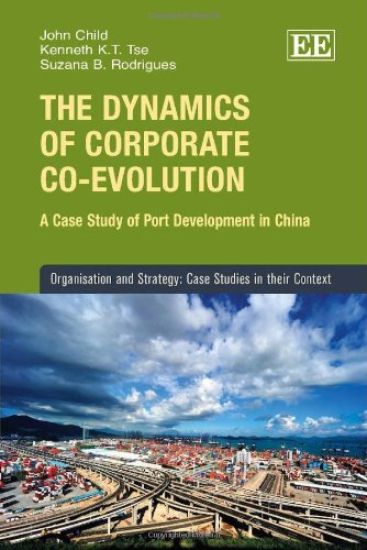
Offering insights of unusual richness, this book examines one of the world's most important business environments to determine the way that organizations can develop through interaction with their environments. It fills a gap in our understanding of the evolution of the Chinese business environment and throws light on the theory of co-evolution in order to inspire management practice.Written on the basis of a collaboration between a leading business manager and renowned university scholars, this groundbreaking book makes a significant contribution both to theory and practice of competitive strategy.Contents: Part I: Introduction, Perspective and Method 1. Introduction 2. The Co-evolutionary Perspective 3. Research Design and Methodology Part II: Environment, Evolution and Managerial Initiative 4. Yantian Port and its Changing Environment 5. The Evolution of a World-Class Port 6. Innovations in Management Practice 7. Relationship Management - Creating a Relational Framework Part III: Co-evolution: Theory and Practice 8. Forms of Co-evolution 9. The Political Dynamics of Corporate Co-evolution 10. Lessons for Managers Operating in a Complex Environment Index
Offering insights of unusual richness, this book examines one of the world's most important business environments to determine the way that organizations can develop through interaction with their environments. It fills a gap in our understanding of the evolution of the Chinese business environment and throws light on the theory of co-evolution in order to inspire management practice.Written on the basis of a collaboration between a leading business manager and renowned university scholars, this groundbreaking book makes a significant contribution both to theory and practice of competitive strategy.Contents: Part I: Introduction, Perspective and Method 1. Introduction 2. The Co-evolutionary Perspective 3. Research Design and Methodology Part II: Environment, Evolution and Managerial Initiative 4. Yantian Port and its Changing Environment 5. The Evolution of a World-Class Port 6. Innovations in Management Practice 7. Relationship Management - Creating a Relational Framework Part III: Co-evolution: Theory and Practice 8. Forms of Co-evolution 9. The Political Dynamics of Corporate Co-evolution 10. Lessons for Managers Operating in a Complex Environment Index
Susana's Struggle is based on a true story of bullying and its painful consequences. The "Susana Rescue Missions" included in this workbook are designed to help teens gain important insights not only into bullying, but human nature. Through thought-provoking discussions and practical strategies, this workbook also challenges a teen's understanding of leadership and provides insights and actions that will allow him or her to become a more effective leader. Based on academic research in education and psychology, this workbook is a valuable leadership-building tool for parents and educators, working either in the classroom - as part of an integrated curriculum - or one-on-one.
A trav s de su personal elaboraci n a partir del yoga y la pl stica griega, Susana Rivara de Milderman logra plasmar gracias a una reinterpretaci n a partir de su experimentaci n y la de numerosos disc pulos, una gimnasia r tmica expresiva que lleva a una superaci n de las propias limitaciones y un real dominio de las posibilidades de uno mismo, sin sujeci n a ning n esquema pasado predeterminado o internalizado como caracter stico y determinante. Cada individuo logra a trav s de la pr ctica de esta gimnasia su liberaci n, sin ataduras a antiguas cadenas alcanzadas por la cultura y la herencia, la vinculaci n social, los traumas y marcas obtenidas en el pasado, el estr s y/o cualquier otra limitaci n adquirida.
Mientras Susana caminaba hacia la escuela, admir el cielo azul. En el rea de juegos ella pregunta a sus amigos uno a la vez, " No te parece hermoso el cielo azul del d a de hoy?". Para su sorpresa, cada uno de sus amigos ve a el cielo de un color distinto, dependiendo del lugar de donde ellos eran. Pero otros ni os pensaban que esto era raro. Cambiar la forma en que Susana vea al cielo y a sus amigos?El Cielo de Susana utiliza la met fora sutil del cielo para animar a los j venes lectores a aceptar las perspectivas de otros sobre el mundo que les rodea.