Kirjojen hintavertailu. Mukana 11 244 527 kirjaa ja 12 kauppaa.

Kirjahaku

Etsi kirjoja tekijän nimen, kirjan nimen tai ISBN:n perusteella.

1000 tulosta hakusanalla THOMAS JEFFERSON

The Papers of Thomas Jefferson, Volume 11

The Papers of Thomas Jefferson, Volume 11

Thomas Jefferson

Princeton University Press
1955
sidottu
Volumes 11 and 12, cover the period from January 1787 through March 1788 and deal with Jefferson's stay in France, as American Minister there. This is a rich period of personal correspondence and important documents, revealing, particularly, Jefferson's interest in agriculture and architecture, his extended trade negotiations, his reports on the adoption of the U.S. Constitution, and his skilled efforts to establish friendly relations between Europe and his own nation.
The Papers of Thomas Jefferson, Volume 12

The Papers of Thomas Jefferson, Volume 12

Thomas Jefferson

PRINCETON UNIVERSITY PRESS
1955
sidottu
Volumes 11 and 12 cover the period from January 1787 through March 1788 and deal with Jefferson's stay in France, as American Minister there. This is a rich period of personal correspondence and important documents, revealing, particularly, Jefferson's interest in agriculture and architecture, his extended trade negotiations, his reports on the adoption of the U.S. Constitution, and his skilled efforts to establish friendly relations between Europe and his own nation.
The Papers of Thomas Jefferson, Volume 13

The Papers of Thomas Jefferson, Volume 13

Thomas Jefferson

Princeton University Press
1956
sidottu
From 1784 to 1789 Jefferson was in France, first as commissioner to negotiate peace treaties and then as American minister. Volume 13 continues the account of these years (which are covered in Volumes 7 to 14) and includes material on his travels through Holland, Germany, and northern France; on his study of wine cultivation, whale fishing, and the tobacco trade; on the consular convention with France; on the news from the United States concerning the beginnings of the Federal Government under the new Constitution.
The Papers of Thomas Jefferson, Volume 15

The Papers of Thomas Jefferson, Volume 15

Thomas Jefferson

Princeton University Press
1958
sidottu
In Volume 15 Jefferson, a veteran of the councils of his own country's revolution, becomes an eyewitness of the opening events of the great upheaval in France in 1789. The Archbishop of Bordeaux and his colleagues of the National Assembly ask Jefferson's aid and counsel in drafting a new constitution; he declines in July but gives a private dinner in August for Lafayette and the moderates who wish to form a coalition and thus avoid civil war. He is catapulted into the limelight by Mirabeau's attack on Necker for the shortage of grain and flour. He advises Lafayette about the latter's proposed draft of a Declaration of Rights and proposes a compromise charter for France in order to gain time, to consolidate the advances already made, and to allow public opinion to ripen. Jefferson dines with De Corny and learns at first hand what happened at the fall of the Bastille. Three days later he is among the crowds with Dugald Stewart, the young Scottish philosopher, as Louis XVI is "led in triumph by his people thro' the streets of the capital." He writes long dispatches to Jay and private letters to Thomas Paine and Richard Price, among others, detailing the events that he regarded as "the first chapter of the history of European liberty." Early in September Jefferson becomes ill and, treated by a philosopher-physician, is possessed by the idea that "the earth belongs in usufruct to the living." He urges Madison to develop this concept and to apply it to American legislation--but his ostensible purpose is supported by arguments addressed wholly to the situation in France, whereby he furnishes justification for the abolition of ancient debts, the public appropriation of feudal grants, the wiping out of hereditary privileges, and the eradication of monopolies. Late in September, with Polly, Patsy, Petit, and two servants, Jefferson leaves Paris for a six months' leave, unaware that the same day the United States Senate confirmed his nomination as Secretary of State. Four weeks later he lands in Norfolk, where he is greeted by the officials--and finds that politics and anti-federalism are far from inactive in Virginia.
The Papers of Thomas Jefferson, Volume 18

The Papers of Thomas Jefferson, Volume 18

Thomas Jefferson

PRINCETON UNIVERSITY PRESS
1972
sidottu
Volume 18, covering part of the final session of the First Congress, shows Jefferson as Secretary of State continuing his effective collaboration with James Madison in seeking commercial reciprocity with Great Britain by threatening--and almost achieving--a retaliatory navigation bill. During these few weeks Jefferson produced a remarkable series of official reports on Gouverneur Morris' abortive mission to England, on the first case of British impressment of American seamen to be noticed officially, on the interrelated problems of Mediterranean trade and the American captives in Algiers, and on the French protest against the tonnage acts. All of these state papers reflected the consistency of Jefferson's aim to bolster the independence of the United States, to promote national unity, and even, as his report on the Algerine captives indicates, to lay the foundations for American maritime power. This volume reveals Jefferson's continuing interest in a unified system of weights and measures, his effort to create a mint, and his concern over executive proceedings in the Northwest Territory. It contains also his suggestions for the President's annual message and his first encounter, at the hands of Noah Webster, with Federalist ridicule of his interest in science. Despite his heavy official duties and the confusion into which his household was thrown when 78 crates of books, wines, and furniture arrived from France, Jefferson never failed to write his promised weekly letter to his daughters and son-in-law under the alternating plan which obligated each of them to write only once every three weeks. The record of this time of extraordinary pressure shows that Jefferson retained his usual equanimity except when, after a full two months, he failed to receive any scrap of writing from the little family at Monticello.
The Papers of Thomas Jefferson, Volume 19

The Papers of Thomas Jefferson, Volume 19

Thomas Jefferson

Princeton University Press
1974
sidottu
Volume 19, covering the final critical weeks of the First Congress, reveals Washington and Jefferson in the closest and most confidential relationship that existed at any time during their official careers. It opens with the proclamation announcing the exact location of the Federal District, an unexplained choice made in the utmost secrecy by the President in consultation with the Secretary of State some weeks before Washington toured the upper Potomac in an ostensible journey to inspect rival sites and to encourage competition for the location of the national capital. It includes the politically related question of the chartering of the Bank of the United States, on which Jefferson delivered his famous opinion challenging its constitutionality. But the conflict with Hamilton over the Bank, important as it was, did not bring the two men on the public stage as contestants. Instead, the first focusing of public attention on the breach in the administration occurred with the publication of Jefferson's report on the whale and cod fisheries. This widely disseminated report is here presented in a context showing that, after Hamilton declined to cooperate in reciprocating the favors France had granted to American trade, Jefferson deliberately and publicly challenged the Hamiltonian opposition. In unusually blunt language, his report called for commercial retaliation against Great Britain, thus causing a sensation both in the ...ministry. This volume shows Jefferson's concern over the growing discontent in the South and West over fiscal and other policies of the national government, his resistance to interested promotion of consular appointments in business circles, his grappling with the political and constitutional questions concerning the admission of Kentucky and Vermont, his involvement in the political consequences of the death of Franklin that affected even the proceedings of the American Philosophical Society, his cautious relationship with Tench Coxe as a source of statistical information which the Secretary of the Treasury failed to supply, and his report to Washington on a judicial appointment that brought on both embarrassment and constitutional questions. Once Congress had dispersed, Jefferson was able to turn his attention to long-neglected private concerns and to the correspondence that gave him most satisfaction, that with the family at Monticello.
The Papers of Thomas Jefferson, Volume 20

The Papers of Thomas Jefferson, Volume 20

Thomas Jefferson

PRINCETON UNIVERSITY PRESS
1982
sidottu
This volume documents exhaustively for the first time Edmond Charles Genet's dramatic challenges to American neutrality and Jefferson's diplomatic and political responses. After welcoming Genet's arrival as the harbinger of closer relations between the American and French republics, Jefferson becomes increasingly distressed by the French minister's defiance of the Washington administration's ban on the outfitting of French privateers in American ports, the enlistment of American citizens in French service, and the exercise of admiralty jurisdiction by French consuls in American ports. Although the Supreme Court declines to advise the executive branch on neutrality questions that Jefferson prepares with the President and the Cabinet, he helps to formulate a set of neutrality rules to meet Genet's challenge.Unable to convince the impetuous French envoy to adopt a more moderate course, Jefferson works in the Cabinet to bring about Genet's recall so as to preserve friendly relations with France and minimize political damage to the Republican party, in which he takes a more active role to prevent the Federalists from capitalizing on Genet's defiance of the President. Grappling with the threat of war with Spain, Jefferson involves himself equivocally in a diplomatically explosive plan by Genet to liberate Louisiana from Spanish rule. In this volume Jefferson also plays a decisive role in resolving a dispute over the design of the Capitol and plans agricultural improvements at Monticello in preparation for his retirement to private life.
The Papers of Thomas Jefferson, Volume 22

The Papers of Thomas Jefferson, Volume 22

Thomas Jefferson

PRINCETON UNIVERSITY PRESS
1986
sidottu
The months covered by this volume illustrate the variety of topics characteristic of the Jefferson Papers. Subjects range from Jefferson's continued overseeing of the planning of the Federal District that became Washington, D.C., to his worries over his debts and his exchange of correspondence with the free black Benjamin Banneker. This period, an unusually significant time for Jefferson as Secretary of State, saw the opening of a new phase of diplomacy. When Jefferson returned to the capital after a stay at Monticello in the fall, the first British minister to the United States had arrived, and the new representative from France had been in the city since August. During this time Jefferson began keeping private notes on important political conversations, notes that he later collected and bound. These notes were published after his death as Jefferson's Anas, a work never closely examined until now and often extended beyond Jefferson's evident intention. Ascertaining that Jefferson collected and intended only those documents from his tenure as Secretary of State to be used to challenge the Federalist interpretation of Washington's administration, the present editors publish the Anas notes not as compiled late in Jefferson's life or as amplified by others, but in chronological order, in the context in which they were written. Also discovered during the preparation of this volume was a new, later date or that portion of Jefferson's famous Espistolary Record written in his own hand.
The Papers of Thomas Jefferson, Volume 24

The Papers of Thomas Jefferson, Volume 24

Thomas Jefferson

Princeton University Press
1990
sidottu
This volume finds Thomas Jefferson grappling with problems arising from the radicalization of the French Revolution in Europe and the polarization of domestic politics in the United States. The overthrow of the French monarchy leads the Secretary of State to suspend debt payments to that nation and to formulate a diplomatic recognition policy that will long guide American diplomacy. After an abortive effort to initiate negotiations with the British minister in Philadelphia on the execution of the Treaty of Paris, Jefferson deflects a British proposal to establish a neutral Indian barrier state in the Northwest Territory. As he awaits the start of negotiations on major diplomatic issues with Spain, he deals with a Spanish effort to incite hostilities between the Southern Indians and the United States. The conflict between Jefferson and Alexander Hamilton reaches a new stage when the Secretary of the Treasury brings the cabinet struggle into full public view with four series of pseudonymous newspaper attacks on Jefferson. In letters to President Washington, Jefferson insists that Hamiltonian policies pose a fundamental threat to American republicanism, and in other documents he sets forth remedies for the defects he sees in Hamilton's system. During this period he also finds time to investigate the ravages of the Hessian fly on American wheat and to make plans to remodel Monticello.
The Papers of Thomas Jefferson, Volume 25

The Papers of Thomas Jefferson, Volume 25

Thomas Jefferson

Princeton University Press
1993
sidottu
The dramatic escalation in the conflict between Thomas Jefferson and Alexander Hamilton to determine the future course of the new American nation is the main theme of this volume. Under pressure from other Republicans, Jefferson decides to continue as Secretary of State instead of retiring to Monticello at the end of President Washington's first term. At the same time he begins to play a more active role as a Republican party leader, involving himself secretly in a major effort by House Republicans to have Hamilton dismissed from office by censuring his management of public finances. France's declaration of war on Great Britain and the Netherlands leads Jefferson into a serious conflict with Hamilton over how to protect American neutrality in the face of the widening European war. After persuading Washington to preserve the treaties of alliance and commerce with France, Jefferson must then confront the first in a series of French violations of American neutrality that will sorely test the relationship between the two republics. Testifying to the catholicity of Jefferson's interests, this volume also deals with his efforts to promote a voyage of western exploration by the noted French botanist Andr Michaux, his observation of the first manned balloon flight in America by the celebrated French aeronaut Jean Pierre Blanchard, and his concern for expediting work on the new national capital.
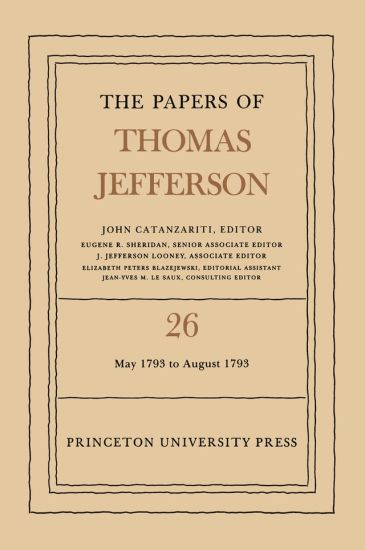
The Papers of Thomas Jefferson, Volume 26

The Papers of Thomas Jefferson, Volume 26

Thomas Jefferson

Princeton University Press
1995
sidottu
This volume documents exhaustively for the first time Edmond Charles Genet's dramatic challenges to American neutrality and Jefferson's diplomatic and political responses. After welcoming Genet's arrival as the harbinger of closer relations between the American and French republics, Jefferson becomes increasingly distressed by the French minister's defiance of the Washington administration's ban on the outfitting of French privateers in American ports, the enlistment of American citizens in French service, and the exercise of admiralty jurisdiction by French consuls in American ports. Although the Supreme Court declines to advise the executive branch on neutrality questions that Jefferson prepares with the President and the Cabinet, he helps to formulate a set of neutrality rules to meet Genet's challenge. Unable to convince the impetuous French envoy to adopt a more moderate course, Jefferson works in the Cabinet to bring about Genet's recall so as to preserve friendly relations with France and minimize political damage to the Republican party, in which he takes a more active role to prevent the Federalists from capitalizing on Genet's defiance of the President. Grappling with the threat of war with Spain, Jefferson involves himself equivocally in a diplomatically explosive plan by Genet to liberate Louisiana from Spanish rule. In this volume Jefferson also plays a decisive role in resolving a dispute over the design of the Capitol and plans agricultural improvements at Monticello in preparation for his retirement to private life.
The Papers of Thomas Jefferson, Volume 27

The Papers of Thomas Jefferson, Volume 27

Thomas Jefferson

Princeton University Press
1997
sidottu
This volume brings to a close Jefferson's increasingly stormy tenure as Secretary of State, documenting, among many things, his epochal duel with Treasury Secretary Alexander Hamilton over the conduct of American foreign policy. Against the background of the deadly yellow fever in Philadelphia, he copes with obstreperous French consuls and informs Edmond Charles Genet that the American government has requested his recall. After resuming his work on the definition of U.S. maritime limits, Jefferson prevails upon President Washington to inform Congress not only of Genet's recall but also of the British refusal to carry out the disputed provisions of the Treaty of Paris. In a final effort to implement his policy of commercial retaliation against Great Britain, Jefferson submits to Congress in December his long-awaited Report on Commerce, vividly detailing the various forms of discrimination imposed on American trade by the British. The volume presents the early and final versions of the in all their textual complexity. Disappointed by Washington's tepid response to his criticisms of Hamilton's fiscal policies, frustrated by the Treasury Secretary's rising influence over American foreign policy, and eager to enjoy uninterruptedly the pleasures of domestic life, Jefferson retires from office on 31 December 1793, determined never again to suffer the torments of public life. Volume 27 contains a supplement that covers some 270 documents for the period 1764-93 that have been found or reclassified since the publication of the last supplement in Volume 15.
The Papers of Thomas Jefferson, Volume 28

The Papers of Thomas Jefferson, Volume 28

Thomas Jefferson

PRINCETON UNIVERSITY PRESS
2000
sidottu
This volume brings Jefferson into retirement after his tenure as Secretary of State and returns him to private life at Monticello. He professes his desire to be free of public responsibilities and live the life of a farmer, spending his time tending to his estates. Turning his attention to the improvement of his farms and finances, Jefferson surveys his fields, experiments with crop rotation, and establishes a nailery on Mulberry Row. He embarks upon an ambitious plan to renovate Monticello, a long-term task that will eventually transform his residence. Although Jefferson is distant from Philadelphia, the seat of the federal government, he is not completely divorced from the politics of the day. His friends, especially James Madison, with whom he exchanges almost sixty letters in the period covered by this volume, keep him fully informed about the efforts of Republican county and town meetings, the Virginia General Assembly, Congress, and the press to counter Federalist policies. An emerging Republican opposition is taking shape in response to the Jay Treaty, and Jefferson is keenly interested in its progress. Although in June, 1795, he claims to have "proscribed newspapers" from Monticello, in fact he never entirely cuts himself off from the world. At the end of that year, he takes pains to ensure that he will have two full sets of Benjamin Franklin Bache's Aurora, the influential Republican newspaper, one set to be held in Philadelphia for binding and one to be sent directly to Monticello.
The Papers of Thomas Jefferson, Volume 29

The Papers of Thomas Jefferson, Volume 29

Thomas Jefferson

Princeton University Press
2001
sidottu
In the twenty-two months covered by this volume, Jefferson spent most of his time at Monticello, where in his short-lived retirement from office he turned in earnest to the renovation of his residence and described himself as a "monstrous farmer." Yet he narrowly missed being elected George Washington's successor as president and took the oath of office as vice president in March 1797. In early summer he presided over the Senate after President John Adams summoned Congress to deal with the country's worsening relations with France. As the key figure in the growing "Republican quarter," Jefferson collaborated with such allies as James Monroe and James Madison and drafted a petition to the Virginia House of Delegates upholding the right of representatives to communicate freely with their constituents. The unauthorized publication of a letter to Philip Mazzei, in which Jefferson decried the former "Samsons in the field and Solomons in the council" who had been "shorn by the harlot England," made the vice president the uncomfortable target of intense partisan attention. In addition, Luther Martin publicly challenged Jefferson's treatment, in Notes on Virginia, of the famous oration of Logan. Jefferson became president of the American Philosophical Society and presented a paper describing the fossilized remains of the megalonyx, or "great claw." At Monticello he evaluated the merits of threshing machines, corresponded with British agricultural authorities, sought new crops for his rotation schemes, manufactured nails, and entertained family members and visitors.