Thomas' 100 Cat TalesImagine an intelligent, no nonsense cat whose goal in life is to be fed regularly. Anything blocking his humans from providing his nourishment are subject to intervention. His home and occupants are protected night and day. The Thomas stories provide an entertaining perspective from a cat's point of view on adopting a home and preserving the status quo. His antics provide for hours of entertainment. Each chapter presents a unique situation requiring Thomas' to resolve.
This is the most essential information from the first six volumes of "Taunton's Complete Illustrated Guide" series. Now in paperback, this step-by-step shop reference, culled from the first six volumes of "Taunton's Complete Illustrated Guides", covers all of the fundamental techniques every woodworker needs to know. Organised for quick access, this book makes it easy to find the information you are looking for. Over 1,200 photos and drawings illustrate how to accomplish essential woodworking tasks from setting up a shop to finishing. This book helps woodworkers of all levels choose the right method and tools to bring great results, pleasure and satisfaction to working with wood.
Reclaiming fun as a meaningful concept for understanding games and play."Fun" is somewhat ambiguous. If something is fun, is it pleasant? Entertaining? Silly? A way to trick students into learning? Fun also has baggage-it seems inconsequential, embarrassing, child's play. In Fun, Taste, & Games, John Sharp and David Thomas reclaim fun as a productive and meaningful tool for understanding and appreciating play and games. They position fun at the heart of the aesthetics of games. As beauty was to art, they argue, fun is to play and games-the aesthetic goal that we measure our experiences and interpretations against. Sharp and Thomas use this fun-centered aesthetic framework to explore a range of games and game issues-from workplace bingo to Meow Wolf, from basketball to Myst, from the consumer marketplace to Marcel Duchamp. They begin by outlining three elements for understanding the drive, creation, and experience of fun: set-outsideness, ludic forms, and ambiguity. Moving from theory to practice and back again, they explore the complicated relationships among the titular fun, taste, and games. They consider, among other things, the dismissal of fun by game journalists and designers; the seminal but underinfluential game Myst, and how tastes change over time; the shattering of the gamer community in Gamergate; and an aesthetics of play that goes beyond games.
This work has been selected by scholars as being culturally important, and is part of the knowledge base of civilization as we know it. This work was reproduced from the original artifact, and remains as true to the original work as possible. Therefore, you will see the original copyright references, library stamps (as most of these works have been housed in our most important libraries around the world), and other notations in the work.This work is in the public domain in the United States of America, and possibly other nations. Within the United States, you may freely copy and distribute this work, as no entity (individual or corporate) has a copyright on the body of the work.As a reproduction of a historical artifact, this work may contain missing or blurred pages, poor pictures, errant marks, etc. Scholars believe, and we concur, that this work is important enough to be preserved, reproduced, and made generally available to the public. We appreciate your support of the preservation process, and thank you for being an important part of keeping this knowledge alive and relevant.
Flower o' the Vine; Romantic Ballads and Sospiri di Roma... is an unchanged, high-quality reprint of the original edition of 1892. Hansebooks is editor of the literature on different topic areas such as research and science, travel and expeditions, cooking and nutrition, medicine, and other genres. As a publisher we focus on the preservation of historical literature. Many works of historical writers and scientists are available today as antiques only. Hansebooks newly publishes these books and contributes to the preservation of literature which has become rare and historical knowledge for the future.
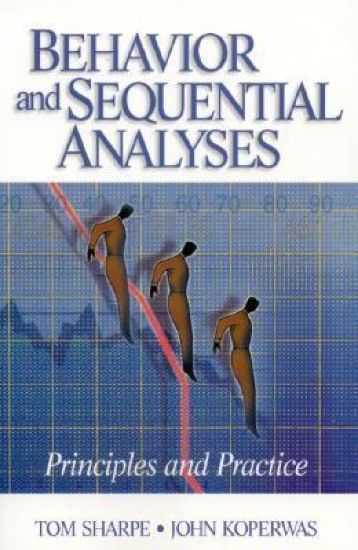
"Sharpe and Koperwas provide a methodological framework that objectifies the complexity of behavior. This book's quantitative and multiple-event approach to data collection and analysis is essential for effective descriptions and explanations of the behavior of humans and nonhumans. Of particular note is the multidisciplinary applicability of the methodology and that the methods can be used by basic, applied, and clinical researchers. Human service providers are being increasingly pressured to take objective measures; practitioners should find much in this book to help them satisfactorily meet these demands. The authors' sensitivity to clarity of presentation makes the book an excellent primary or supplementary text for any course in behavior methodology." -- Dennis J. Delprato, Eastern Michigan University "I think the author did a very thoughtful, informed analysis and presentation of his view of research methodology." -Richard W. Malott, Western Michigan University "This text dispels the myth that the principles and practices of behavioral research are context-free. It describes how they are integral to a modern science of behavior. This is not only a "how to" text, but an historical "where from" and a modern "what for" treatment of behavioral methodology and research design." -Edward K. Morris, University of Kansas Modern computer-based data collection and analysis techniques have given researchers unprecedented ability to collect, analyze, and visually represent complex, multi-event configurations of behavior interaction, yet most applied behavior analysis textbooks have failed to embrace the many significant technological advances. Behavior and Sequential Analyses: Principles and Practice provides a step-by-step approach to such computer-facilitated behavior analysis research and evaluation procedures. Tom Sharpe and John Koperwas emphasize methods designed to collect and analyze both the multiple characteristics of behaviors and events of interest and the time-based or sequential characteristics of behavior and event relationships. Intended for an interdisciplinary audience, this is the only text to guide readers through development and implementation of technologically supported multiple-event, multiple measure, discrete and sequential analysis of behavior. Designed for highly interactive applied settings, this user-friendly volume includes Procedures for observation system construction Data recording methods and research design types Visual and statistical data analysis procedures Recommended research, evaluation, and instructional applications for psychology, education, and other social science settings Suggestions for reliability and treatment fidelity issues References to technological innovations including the BEST and BESTPCC data collection and analysis software package Behavior and Sequential Analyses presents a comprehensive summary of applied behavior analysis methods and introduces numerous up-to-date systems and sequential methodologies. To facilitate student learning, the authors include lists of key terms, study guide questions, practical illustrations, and important references. Developed as an introductory to intermediate level methodology text for advanced undergraduate and graduate students in social and behavioral sciences and education, Behavior and Sequential Analyses is also a unique and indispensable reference for the experienced researcher.
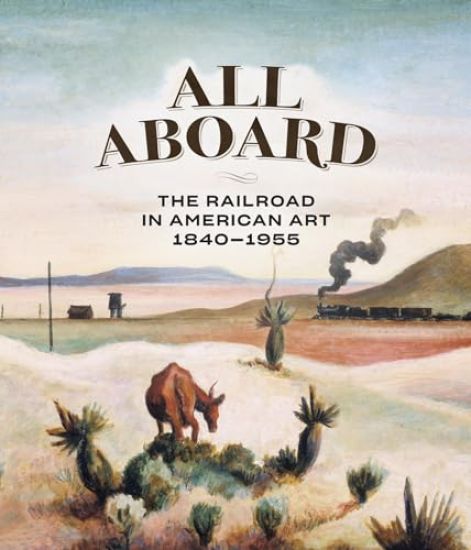
All Aboard is a ground-breaking book. Presented thematically the authors cover the environmental impact of the railroad both on the flora and fauna, and on the social landscape; the role of the railroad on the western expansion of the USA, and the lasting and hugely detrimental impact of this on Native American populations. A wide array of comparative images includes archival and historic views, other related artworks and ephemera, as well as a railroad map. In the early years of the nineteenth century artists including Thomas Cole and George Inness, of the Hudson River School, feared the impact of the railroad on the natural landscape; later artists were inspired by the newly opened-up landscapes of the West, including Albert Bierstadt and Theodore Kaufmann; others like Edward Hopper, Jacob Lawrence, Reginald Marsh, George Bellows, and John Sloan, were fascinated by movement of freight and people across the railroad network. Ben Shahn, Tomas Hart Benton, and Joe Jones's portrayals of railroad workers become emblems of the very backbone of America on which the country's social and industrial expansion was built. Such industrial expansion is captured in the dramatic views of Pittsburgh and mid-west industry in paintings by Otto Kuhler, George Luks, and Charles Sheeler. And finally, there are a raft of artists for whom the railroad was both at the heart of a great new machine age, celebrated in paintings by Georgia O'Keeffe, John Marin, Joseph Stella, and Charles Goeller, but also the creator of a more lonely and alienated urban industrial world, most strongly captured in Edward Hopper's railroad landscapes.
Poems, Supposed to Have Been Written at Bristol - Vol.1 is an unchanged, high-quality reprint of the original edition of 1794. Hansebooks is editor of the literature on different topic areas such as research and science, travel and expeditions, cooking and nutrition, medicine, and other genres. As a publisher we focus on the preservation of historical literature. Many works of historical writers and scientists are available today as antiques only. Hansebooks newly publishes these books and contributes to the preservation of literature which has become rare and historical knowledge for the future.