In recent decades Washington has seen an alarming rise in the number of “revolving door lobbyists”—politicians and officials cashing in on their government experience to become influence peddlers on K Street. These lobbyists, popular wisdom suggests, sell access to the highest bidder. Revolving Door Lobbying tells a different, more nuanced story. As an insider interviewed in the book observes, where the general public has the “impression that lobbyists actually get things done, I would say 90 percent of what lobbyists do is prevent harm to their client from the government.”
This guidebook provides an overview to the proven Applied Strategic Planning process. Written for the planning team and other key members who will participate in the process, this important resource offers encouragement for the team who must provide data for the planning process and helps to identify questions for further discussion. The Applied Strategic Planning approach helps organizations identify their ideal future and develop a plan to achieve that future. ASP is highly responsive to environments undergoing rapid change, where the very rules of doing business are constantly shifting. The companion The Applied Strategic Planning Consultant’s Toolkit—written by the consultants who created the process—includes the tools, techniques and processes that can help guide an organization through the strategic planning process.
Taking an informal approach, Hagle presents a review of the basic mathematical concepts that underlie most quantitative analysis in the social sciences. After an algebra review featuring sets and combinations, Hagle discusses limits and continuity. Calculus is presented next, with an introduction to differential calculus. Multivariate functions, partial derivatives and integral calculus are discussed; the author concludes with a discussion of matrix algebra. Aimed at readers who have taken one or two courses in algebra, this volume is packed with helpful definitions, equations, and examples as well as alternative notations. A useful appendix of common math symbol and Greek letters is also included.
Aimed at providing readers who want a quick "refresher course" in mathematics with an informal review, Timothy M. Hagle's volume offers dozens of worked-out examples of such mathematical concepts as algebra sets, limits, continuity, differential calculus, multivariate functions, partial derivatives, integral calculus, and matrix algebra. In addition, Hagle provides problem sets so that readers can practice their grasp of standard mathematical procedures (answers to these problem sets are contained in the appendixes). Written in a friendly style, Basic Math for Social Scientists: Problems and Solutions provides readers with an informal approach to mathematical procedures without proofs.
During the summer of 1992, the United Nations Conference on Environment and Development in Rio de Janeiro was hailed as a watershed moment in the ecology movement. Over 100 nations signed a new international treaty intended to conserve biological diversity. Yet, every day, species-many not even discovered-are driven into extinction and the ecological crisis continues to be a pressing global problem.Stressing the need to build bridges between the scientific community and international policymakers, Timothy Swanson here develops a new theory of the interplay between human society and the biological world. Biodiversity regulation, he argues, must focus specifically on the regulation of the global economic forces driving species into extinction. As the global development process becomes increasingly sophisticated, the spectre of a homogenized biosphere looms large.Yet, while biological diversity is responsible for a host of global benefits, it confers few tangible gains onto individual nations that offset the financial advantages of exploiting these same natural resources.The same economic rationale that drives farmers to grow coca leafs instead of grain compels countries to exploit natural resources, rather than conserve them. In order to stave off the decline of biological diversity, Swanson proposes the creation of specific policies that will internalize the benefits of biodiversity on a national level.
Since the end of World War II, the United States has come to dominate the world economically and politically, leading many to describe the United States as an empire. Scholars have analyzed how the US government has worked through international financial institutions, its Central Intelligence Agency, and outright warfare to achieve its will. In this book, Timothy M. Gill spotlights how the US government also worked through democracy promotion to undermine governments abroad, including in Venezuela. President Hugo Chávez, who ruled from 1999 until his death in 2013, was among the democratically elected Latin American state leaders who embraced socialism and challenged the idea of US global power. Gill shows how US government agencies funded and trained opposition parties and activists, and how such intervention often was justified in neocolonial and racist terms. Through analysis of documents obtained through Freedom of Information Act requests, embassy cables, and interviews with US government and Venezuelan nonprofit members, Gill details such operations and the imperial thinking behind them.
Father Timothy Gallagher, loved for his popular guides to Ignatian spirituality, shares in this informative, inspiring volume his own experiences and insights into the daily prayer of the Liturgy of the Hours, which he has prayed daily for the last 40 years. All around the world, everyday, for hundreds of years, Catholics pray the psalms, and readings from the bible and from tradition, in a formal way called the Liturgy of the Hours. And like in any meditative practice there are blissful days and others that are just a dry challenge. What does it all mean? Can the Liturgy of the Hours, with its hymns, psalms, readings, and intercessions, become the prayer of every Christian--priest, religious, and layperson? Can it bring new energy into our spiritual lives? Fr. Tim shares his experiences praying the Liturgy of the Hours for the last four decades and invites the reader into the beauty and possibilities of this simple way of praying.
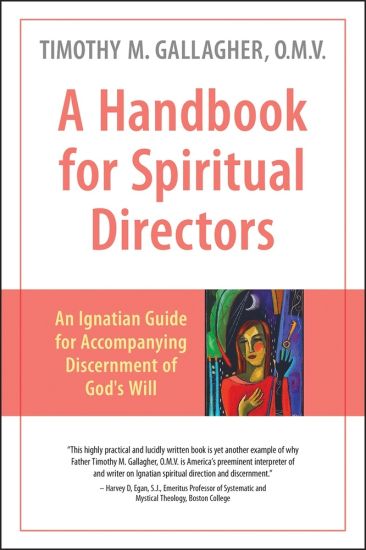
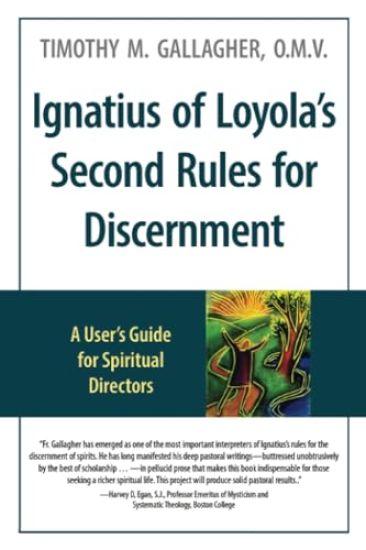
Timothy Gallagher has focused his entire adult life to studying and teaching Ignatian spirituality. For decades he has made it the focus of his work to guide spiritual directors in the rich Ignatian discipline which currently is experiencing a remarkable renaissance far beyond the Catholic realm. Out of this work grew the Handbook for Spiritual Directors which will make Fr. Gallagher's extraordinary teaching available to Fr. Gallagher's growing audience around the world. This book helps spiritual directors guide the process of Ignatian discernment in a very practical and yet profoundly spiritual way. Spiritual directors receive few requests more often, and more demanding than that of helping a person discern God's will in life's taxing decisions. With this handbook, Fr. Gallagher has provided the means necessary for responding to and helping with this request. For those spiritual directors trained in Ignatian spirituality this book offers to become an essential companion, and for those who want to learn this form of discernment this book will provide the foundation for understanding and learning this age-old, proven process for discerning the will of God.
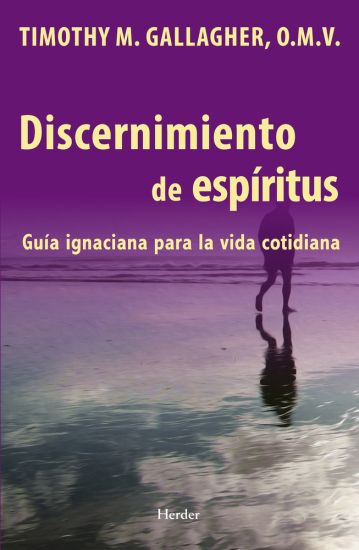
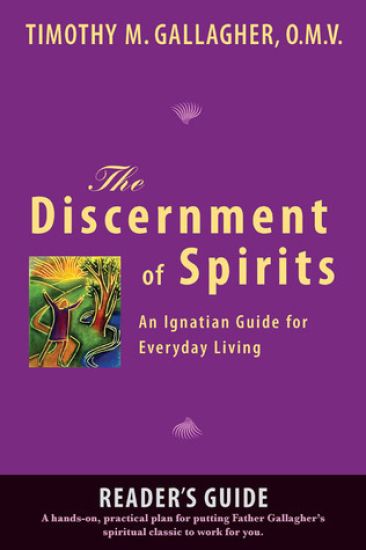
This Spanish edition of the bestselling title The Discernment of Spirits , is part of a widely used and recognized program of guides (including books, audio and video courses) to understanding and practicing Ignatian spirituality. Discernimiento de los espiritos is the first book of this program. St. Ignatius Loyola, founder of the Jesuits, is one of the most influential spiritual leaders of all time, yet many readers find his Rules for Discernment hard to understand. What can Ignatius teach us about the discernment of spirits that lies at the very heart of Christian life? In The Discernment of Spirits , Fr. Timothy Gallagher, a talented teacher, retreat leader, and scholar, helps us understand the Rules and how their insights are essential for our spiritual growth today. By integrating the Rules and the experience of contemporary people, Gallagher shows the precision, clarity, and insight of Ignatius's Rules, as well as the relevance of his thought for spiritual life today. When we learn to read Ignatius correctly, we discover in his remarkable words our own struggles, joys, and triumphs. This book is for all who desire greater awareness of God's action in their daily spiritual lives, and is essential reading for retreat directors, spiritual directors, priests, and counselors.
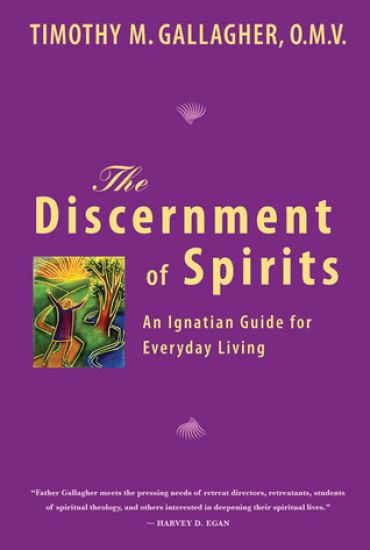
St. Ignatius Loyola, founder of the Jesuits, is one of the most influential spiritual leaders of all time, yet many readers find his Rules for Discernment hard to understand. What can Ignatius teach us about the discernment of spirits that lies at the very heart of Christian life? In The Discernment of Spirits , Fr. Timothy Gallagher, a talented teacher, retreat leader, and scholar, helps us understand the Rules and how their insights are essential for our spiritual growth today. By integrating the Rules and the experience of contemporary people, Gallagher shows the precision, clarity, and insight of Ignatius's Rules, as well as the relevance of his thought for spiritual life today. When we learn to read Ignatius correctly, we discover in his remarkable words our own struggles, joys, and triumphs. This book is for all who desire greater awareness of God's action in their daily spiritual lives, and is essential reading for retreat directors, spiritual directors, priests, and counselors.
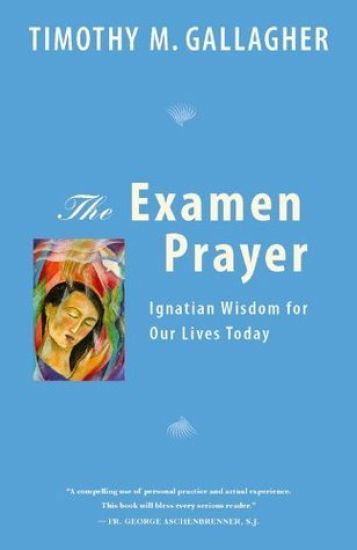
The examen prayer is a transforming and ever-growing practice in Christian spirituality. In The Examen Prayer, Fr. Timothy Gallagher draws from real-life stories and his experience as a spiritual director to explain the core principles of the examen prayer: What is the examen and how can we begin to pray it? How can we adapt it to our individual lives? What are its fruits?
The third volume in the acclaimed and best-selling Ignatian Trilogy, by international speaker and retreat leader, Fr. Timothy M. Gallagher. In Spiritual Consolation , Fr. Gallagher introduces us to the teachings of Ignatius of Loyola through the use of real-life examples and principles from Ignatius's Second Rules for discernment. Fr. Gallagher, author of The Discernment of Spirits and The Examen Prayer , shows how all of us, especially those with busy religious lives, can learn to listen to and follow God's leading.
This is a book for those who desire to pray with Sacred Scripture. Following the spiritual itinerary of the Spiritual Exercises by Ignatius of Loyola, forty reflections offer a great resource for those beginning to pray with Scripture. They provide accompaniment in the first, tentative steps of such blessed prayer. For those who already practice prayer with Scripture, and who seek new depth in that prayer, these emotionally rich reflections can provide an opportunity for such growth. They are also useful for spiritual directors, retreat directors, small groups in parishes, and in the home.
The cornerstones of Ignatius of Loyola's spiritual practice--meditation and contemplation--are clearly explained in this simple guide to the Ignatian method with examples from the experience of practitioners and quotations from Catholic spiritual teachers. In the process, the deeper structure of the spiritual practice is illuminated, and advice about adapting it to individual needs is offered. Topics include methods of praying, struggles and growth, and the importance and role of grace. Individuals who desire to pray with scripture, spiritual directors, and all who teach prayer with scripture will benefit from the counsel in this resource.
Every Chrstian has a Mission. What's Yours? "Is it time to change jobs?" "Should I marry?" "Am I called to religious life?" Sooner or later, every thoughtful Christian asks such questions. For everyone ready to make the shift from "What do I want for my life?" to "what does God want for my life?" Fr. Gallagher offers this new book to help you make sense of your major life decisions. Drawing from the timeless methods of Ignatius Loyola and richly illustrated with examples and stories, this book offers practical wisdom for aligning your will to God's will. Fr. Gallagher takes you through each step of the process, including opening your heart to whatever God wants; making use of silence, the Eucharist, Scripture, and spiritual direction; and finding clarity (and what to do when you lack clarity). While this book focuses on the major decisions such as marriage and career and vocation choices, the insights gained here can be adapted to other significant life decisions as well. Fr. Gallagher's clear style makes this book an important resource for all who want to discover where God is leading them, as well as for spiritual directors, retreat directors, and counselors
This handy, easy-to-use workbook is chock full of probing questions, real-life stories, and practical tips on how to apply the profound spiritual insights from the Ignatian tradition of patient, prayerful self-examination. Acclaimed interpreter of Saint Ignatius, author Father Gallagher provides clear explanations of the centuries-old Jesuit method of discerning God's will in one's life--and avoiding evil. A practical guide and journaling tool, it includes ample space on every page for notes, reflections, and journaling, all to help readers track their progress toward a closer, more loving union with God.
Cuando una persona embarca en un viaje espiritual surgen preguntas y obst culos. La espiritualidad y las pr cticas ignacianas encierran un tesoro de respuestas, y nadie puede explicar el estilo de vida ignaciano como el P. Timothy Gallagher. - Este peque o volumen de directrices claras y pr cticas tiene un valor incalculable para todos que deseen crecer espiritualmente. En este nuevo volumen, el P. Gallagher explora comprensiones y aplicaciones adicionales de las reglas ignacianas. Estas reflexiones personales han surgido del placer -y el trabajo- de aprender y compartir las reglas, siendo testigos de la alegr a y la esperanza. Estas pautas ignacianas liberan a los cautivos del des nimo y la tristeza de la desolaci n espiritual. Ofrecen esperanza precisamente donde las personas pueden haber sentido que la esperanza no era posible, y as liberan nueva energ a para el camino espiritual.