Kirjojen hintavertailu. Mukana 11 477 063 kirjaa ja 12 kauppaa.

Kirjahaku

Etsi kirjoja tekijän nimen, kirjan nimen tai ISBN:n perusteella.

1000 tulosta hakusanalla Turing Sara

Turing Machine Universality of the Game of Life

Turing Machine Universality of the Game of Life

Paul Rendell

Springer International Publishing AG
2016
nidottu
This book presents a proof of universal computation in the Game of Life cellular automaton by using a Turing machine construction. It provides an introduction including background information and an extended review of the literature for Turing Machines, Counter Machines and the relevant patterns in Conway's Game of Life so that the subject matter is accessibly to non specialists.The book contains a description of the author’s Turing machine in Conway’s Game of Life including an unlimited storage tape provided by growing stack structures and it also presents a fast universal Turing machine designed to allow the working to be demonstrated in a convenient period of time.
Turing’s Revolution

Turing’s Revolution

Birkhauser Verlag AG
2018
nidottu
This book provides an overview of the confluence of ideas in Turing’s era and work and examines the impact of his work on mathematical logic and theoretical computer science. It combines contributions by well-known scientists on the history and philosophy of computability theory as well as on generalised Turing computability. By looking at the roots and at the philosophical and technical influence of Turing’s work, it is possible to gather new perspectives and new research topics which might be considered as a continuation of Turing’s working ideas well into the 21st century.The Stored-Program Universal Computer: Did Zuse Anticipate Turing and von Neumann?” is available open access under a Creative Commons Attribution 4.0 International License via link.springer.com
Turing Machines with Sublogarithmic Space

Turing Machines with Sublogarithmic Space

Andrzej Szepietowski

Springer-Verlag Berlin and Heidelberg GmbH Co. K
1994
nidottu
This comprehensive monograph investigates the computational power of Turing machines with sublogarithmic space. The studies are devoted to the Turing machine model introduced by Stearns, Hartmanis, and Lewis (1965) with a two-way read-only input tape and a separate two-way read-write work tape. The book presents the key results on space complexity, also as regards the classes of languages acceptable, under the perspective of a sublogarithmic number of cells used during computation. It originates from courses given by the author at the Technical University of Gdansk and Gdansk University in 1991 and 1992. It was finalized in 1994 when the author visited Paderborn University and includes the most recent contributions to the field.
Turing Computability

Turing Computability

Robert I. Soare

Springer-Verlag Berlin and Heidelberg GmbH Co. K
2016
sidottu
Turing's famous 1936 paper introduced a formal definition of a computing machine, a Turing machine. This model led to both the development of actual computers and to computability theory, the study of what machines can and cannot compute. This book presents classical computability theory from Turing and Post to current results and methods, and their use in studying the information content of algebraic structures, models, and their relation to Peano arithmetic. The author presents the subject as an art to be practiced, and an art in the aesthetic sense of inherent beauty which all mathematicians recognize in their subject. Part I gives a thorough development of the foundations of computability, from the definition of Turing machines up to finite injury priority arguments. Key topics include relative computability, and computably enumerable sets, those which can be effectively listed but not necessarily effectively decided, such as the theorems of Peano arithmetic. Part IIincludes the study of computably open and closed sets of reals and basis and nonbasis theorems for effectively closed sets. Part III covers minimal Turing degrees. Part IV is an introduction to games and their use in proving theorems. Finally, Part V offers a short history of computability theory.The author has honed the content over decades according to feedback from students, lecturers, and researchers around the world. Most chapters include exercises, and the material is carefully structured according to importance and difficulty. The book is suitable for advanced undergraduate and graduate students in computer science and mathematics and researchers engaged with computability and mathematical logic.
Turing Computability

Turing Computability

Robert I. Soare

Springer-Verlag Berlin and Heidelberg GmbH Co. K
2018
nidottu
Turing's famous 1936 paper introduced a formal definition of a computing machine, a Turing machine. This model led to both the development of actual computers and to computability theory, the study of what machines can and cannot compute. This book presents classical computability theory from Turing and Post to current results and methods, and their use in studying the information content of algebraic structures, models, and their relation to Peano arithmetic. The author presents the subject as an art to be practiced, and an art in the aesthetic sense of inherent beauty which all mathematicians recognize in their subject. Part I gives a thorough development of the foundations of computability, from the definition of Turing machines up to finite injury priority arguments. Key topics include relative computability, and computably enumerable sets, those which can be effectively listed but not necessarily effectively decided, such as the theorems of Peano arithmetic. Part IIincludes the study of computably open and closed sets of reals and basis and nonbasis theorems for effectively closed sets. Part III covers minimal Turing degrees. Part IV is an introduction to games and their use in proving theorems. Finally, Part V offers a short history of computability theory.The author has honed the content over decades according to feedback from students, lecturers, and researchers around the world. Most chapters include exercises, and the material is carefully structured according to importance and difficulty. The book is suitable for advanced undergraduate and graduate students in computer science and mathematics and researchers engaged with computability and mathematical logic.
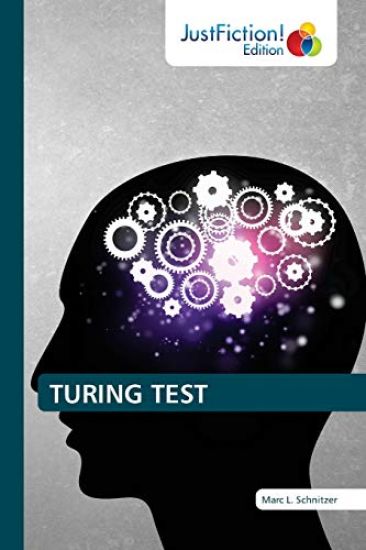
Turing Test

Turing Test

Marc L Schnitzer

Justfiction Edition
2020
pokkari
Turing Test is the story of a neuropsychologist who works on the relationship between language and the brain. He meets and falls in love with a beautiful artist with whom he has intense discussions on various subjects, most importantly, the nature of creativity. She reveals that her paintings as seen in art galleries are only an outward manifestation of her creative work, which is totally internal and known only to herself. They disagree as to whether a person can be engineered: she believes that it is only a matter of time before artificial intelligence can produce a being indistinguishable from a human; he believes that persons must either be created or evolve naturally. The story unfolds in a multi-universe tale of creators and androids, in which it becomes increasingly unclear who is human and who is robotic, and what constitutes a mind.
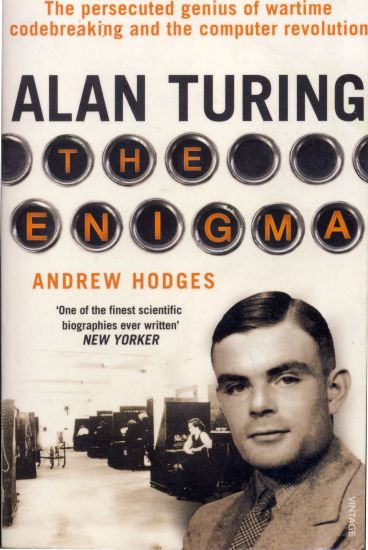
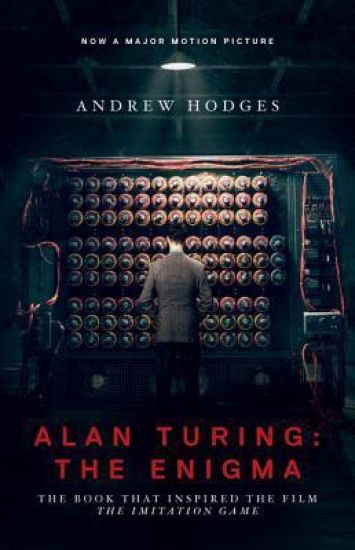
Alan Turing: The Enigma

Alan Turing: The Enigma

Andrew Hodges

Vintage
1992
pokkari
Includes a new foreword by the author and a preface by Douglas Hofstadter. Alan Turing was the extraordinary Cambridge mathematician who masterminded the cracking of the German Enigma ciphers and transformed the Second World War.
Alan Turing

Alan Turing

Elsevier Science Publishing Co Inc
2013
sidottu
In this 2013 winner of the prestigious R.R. Hawkins Award from the Association of American Publishers, as well as the 2013 PROSE Awards for Mathematics and Best in Physical Sciences & Mathematics, also from the AAP, readers will find many of the most significant contributions from the four-volume set of the Collected Works of A. M. Turing. These contributions, together with commentaries from current experts in a wide spectrum of fields and backgrounds, provide insight on the significance and contemporary impact of Alan Turing's work. Offering a more modern perspective than anything currently available, Alan Turing: His Work and Impact gives wide coverage of the many ways in which Turing's scientific endeavors have impacted current research and understanding of the world. His pivotal writings on subjects including computing, artificial intelligence, cryptography, morphogenesis, and more display continued relevance and insight into today's scientific and technological landscape. This collection provides a great service to researchers, but is also an approachable entry point for readers with limited training in the science, but an urge to learn more about the details of Turing's work.
The Turing Guide

The Turing Guide

Jack Copeland; Jonathan Bowen; Mark Sprevak; Robin Wilson

Oxford University Press
2017
sidottu
Alan Turing has long proved a subject of fascination, but following the centenary of his birth in 2012, the code-breaker, computer pioneer, mathematician (and much more) has become even more celebrated with much media coverage, and several meetings, conferences and books raising public awareness of Turing's life and work. This volume will bring together contributions from some of the leading experts on Alan Turing to create a comprehensive guide to Turing that will serve as a useful resource for researchers in the area as well as the increasingly interested general reader. The book will cover aspects of Turing's life and the wide range of his intellectual activities, including mathematics, code-breaking, computer science, logic, artificial intelligence and mathematical biology, as well as his subsequent influence.
The Turing Guide

The Turing Guide

Jack Copeland; Jonathan Bowen; Mark Sprevak; Robin Wilson

Oxford University Press
2017
nidottu
Alan Turing has long proved a subject of fascination, but following the centenary of his birth in 2012, the code-breaker, computer pioneer, mathematician (and much more) has become even more celebrated with much media coverage, and several meetings, conferences and books raising public awareness of Turing's life and work. This volume will bring together contributions from some of the leading experts on Alan Turing to create a comprehensive guide to Turing that will serve as a useful resource for researchers in the area as well as the increasingly interested general reader. The book will cover aspects of Turing's life and the wide range of his intellectual activities, including mathematics, code-breaking, computer science, logic, artificial intelligence and mathematical biology, as well as his subsequent influence.
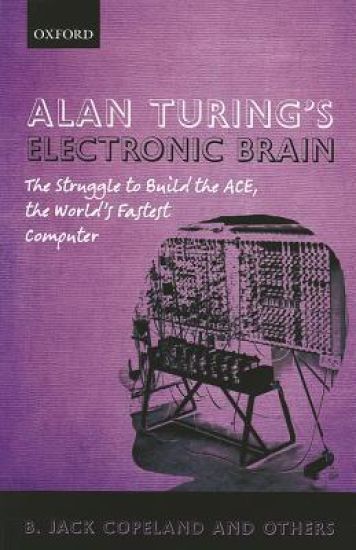
Alan Turing's Electronic Brain

Alan Turing's Electronic Brain

Oxford University Press
2012
nidottu
The mathematical genius Alan Turing, now well known for his crucial wartime role in breaking the ENIGMA code, was the first to conceive of the fundamental principle of the modern computer-the idea of controlling a computing machine's operations by means of a program of coded instructions, stored in the machine's 'memory'. In 1945 Turing drew up his revolutionary design for an electronic computing machine-his Automatic Computing Engine ('ACE'). A pilot model of the ACE ran its first program in 1950 and the production version, the 'DEUCE', went on to become a cornerstone of the fledgling British computer industry. The first 'personal' computer was based on Turing's ACE. Alan Turing's Automatic Computing Engine describes Turing's struggle to build the modern computer. The first detailed history of Turing's contributions to computer science, this text is essential reading for anyone interested in the history of the computer and the history of mathematics. It contains first hand accounts by Turing and by the pioneers of computing who worked with him. As well as relating the story of the invention of the computer, the book clearly describes the hardware and software of the ACE-including the very first computer programs. The book is intended to be accessible to everyone with an interest in computing, and contains numerous diagrams and illustrations as well as original photographs. The book contains chapters describing Turing's path-breaking research in the fields of Artificial Intelligence (AI) and Artificial Life (A-Life). The book has an extensive system of hyperlinks to The Turing Archive for the History of Computing, an on-line library of digital facsimiles of typewritten documents by Turing and the other scientists who pioneered the electronic computer.
The Turing Test

The Turing Test

Bradford Books
2004
pokkari
Historical and contemporary papers on the philosophical issues raised by the Turing Test as a criterion for intelligence.The Turing Test is part of the vocabulary of popular culture-it has appeared in works ranging from the Broadway play "Breaking the Code" to the comic strip "Robotman." The writings collected by Stuart Shieber for this book examine the profound philosophical issues surrounding the Turing Test as a criterion for intelligence. Alan Turing's idea, originally expressed in a 1950 paper titled "Computing Machinery and Intelligence" and published in the journal Mind, proposed an "indistinguishability test" that compared artifact and person. Following Descartes's dictum that it is the ability to speak that distinguishes human from beast, Turing proposed to test whether machine and person were indistinguishable in regard to verbal ability. He was not, as is often assumed, answering the question "Can machines think?" but proposing a more concrete way to ask it. Turing's proposed thought experiment encapsulates the issues that the writings in The Turing Test define and discuss. The first section of the book contains writings by philosophical precursors, including Descartes, who first proposed the idea of indistinguishablity tests. The second section contains all of Turing's writings on the Turing Test, including not only the Mind paper but also less familiar ephemeral material. The final section opens with responses to Turing's paper published in Mind soon after it first appeared. The bulk of this section, however, consists of papers from a broad spectrum of scholars in the field that directly address the issue of the Turing Test as a test for intelligence.ContributorsJohn R. Searle, Ned Block, Daniel C. Dennett, and Noam Chomsky (in a previously unpublished paper). Each chapter is introduced by background material that can also be read as a self-contained essay on the Turing Test
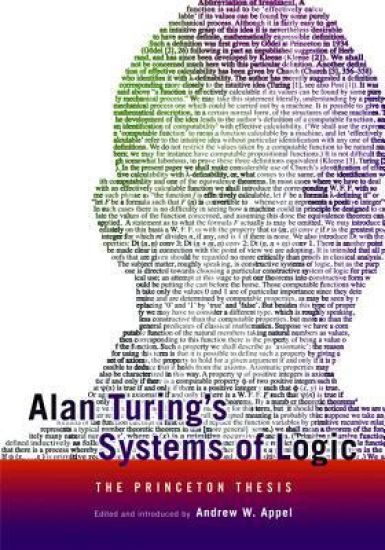
Alan Turing's Systems of Logic

Alan Turing's Systems of Logic

Princeton University Press
2012
sidottu
Between inventing the concept of a universal computer in 1936 and breaking the German Enigma code during World War II, Alan Turing (1912-1954), the British founder of computer science and artificial intelligence, came to Princeton University to study mathematical logic. Some of the greatest logicians in the world--including Alonzo Church, Kurt Godel, John von Neumann, and Stephen Kleene--were at Princeton in the 1930s, and they were working on ideas that would lay the groundwork for what would become known as computer science. This book presents a facsimile of the original typescript of Turing's fascinating and influential 1938 Princeton PhD thesis, one of the key documents in the history of mathematics and computer science. The book also features essays by Andrew Appel and Solomon Feferman that explain the still-unfolding significance of the ideas Turing developed at Princeton. A work of philosophy as well as mathematics, Turing's thesis envisions a practical goal--a logical system to formalize mathematical proofs so they can be checked mechanically. If every step of a theorem could be verified mechanically, the burden on intuition would be limited to the axioms. Turing's point, as Appel writes, is that "mathematical reasoning can be done, and should be done, in mechanizable formal logic." Turing's vision of "constructive systems of logic for practical use" has become reality: in the twenty-first century, automated "formal methods" are now routine. Presented here in its original form, this fascinating thesis is one of the key documents in the history of mathematics and computer science.
Alan Turing: The Enigma: The Book That Inspired the Film the Imitation Game - Updated Edition
A NEW YORK TIMES BESTSELLER The official book behind the Academy Award-winning film The Imitation Game, starring Benedict Cumberbatch and Keira Knightley It is only a slight exaggeration to say that the British mathematician Alan Turing (1912-1954) saved the Allies from the Nazis, invented the computer and artificial intelligence, and anticipated gay liberation by decades--all before his suicide at age forty-one. This New York Times bestselling biography of the founder of computer science, with a new preface by the author that addresses Turing's royal pardon in 2013, is the definitive account of an extraordinary mind and life. Capturing both the inner and outer drama of Turing's life, Andrew Hodges tells how Turing's revolutionary idea of 1936--the concept of a universal machine--laid the foundation for the modern computer and how Turing brought the idea to practical realization in 1945 with his electronic design. The book also tells how this work was directly related to Turing's leading role in breaking the German Enigma ciphers during World War II, a scientific triumph that was critical to Allied victory in the Atlantic. At the same time, this is the tragic account of a man who, despite his wartime service, was eventually arrested, stripped of his security clearance, and forced to undergo a humiliating treatment program--all for trying to live honestly in a society that defined homosexuality as a crime. The inspiration for a major motion picture starring Benedict Cumberbatch and Keira Knightley, Alan Turing: The Enigma is a gripping story of mathematics, computers, cryptography, and homosexual persecution.
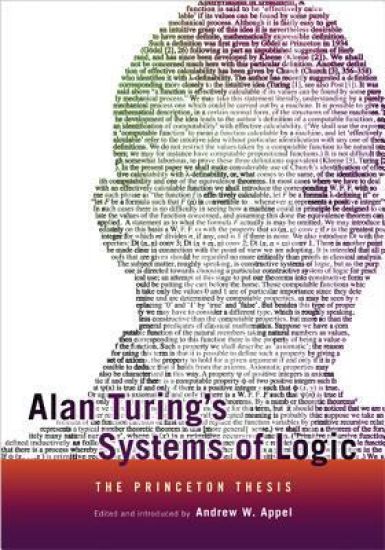
Alan Turing's Systems of Logic

Alan Turing's Systems of Logic

Princeton University Press
2014
pokkari
Between inventing the concept of a universal computer in 1936 and breaking the German Enigma code during World War II, Alan Turing (1912-1954), the British founder of computer science and artificial intelligence, came to Princeton University to study mathematical logic. Some of the greatest logicians in the world--including Alonzo Church, Kurt Godel, John von Neumann, and Stephen Kleene--were at Princeton in the 1930s, and they were working on ideas that would lay the groundwork for what would become known as computer science. This book presents a facsimile of the original typescript of Turing's fascinating and influential 1938 Princeton PhD thesis, one of the key documents in the history of mathematics and computer science. The book also features essays by Andrew Appel and Solomon Feferman that explain the still-unfolding significance of the ideas Turing developed at Princeton. A work of philosophy as well as mathematics, Turing's thesis envisions a practical goal--a logical system to formalize mathematical proofs so they can be checked mechanically. If every step of a theorem could be verified mechanically, the burden on intuition would be limited to the axioms. Turing's point, as Appel writes, is that "mathematical reasoning can be done, and should be done, in mechanizable formal logic." Turing's vision of "constructive systems of logic for practical use" has become reality: in the twenty-first century, automated "formal methods" are now routine. Presented here in its original form, this fascinating thesis is one of the key documents in the history of mathematics and computer science.