Kirjahaku
Etsi kirjoja tekijän nimen, kirjan nimen tai ISBN:n perusteella.
1000 tulosta hakusanalla W F Reed

Scientific Freedom outlines what needs to be done to restore the freedom that can transform scientific understanding. The author defines Transformative Research (Venture Research) and explains how an initiative might be designed and implemented; discusses the revolutionary concept of low-risk, high-reward research; explains the wider significance of instability, and introduces the formidable Damocles Zone; explores threats to the university as an institution; and describes how a Transformative Research initiative might work in practice.

This book is the author's humble effort to communicate an encounter with God that continued approximately seven days. Over thirty years later, the understanding of the vision was now being revealed. Regardless of the date of your birth, a lot of history occurred before your arrival. Many of the questions you may have asked yourself and others may be answered in this book. I believe that at least one of the answers to why there is so much hatred and division in our world will be discovered by you, the reader-either new discoveries or confirmations of your current understanding. This book explains the horrible state of relationships in the world today. It will identify the instigator of hatred and division and how he accomplished that mission. It will also unveil the initiator of love and unity and the method used to fulfill the promised restitution of all things.
In the decades following the Civil War, white southerners throughout the region created a system of racial segregation designed to perpetuate white supremacy, guarantee white leadership, and keep black southerners in their place. For over half a century, this brutal, violent, and inhumane system penalized both races educationally, socially, and economically. This collection of speeches examines the conditions that made a Civil Rights Movement necessary, ranging from early supporters of civil rights for African Americans to defenders of segregation, as well as what enabled the movement to triumph. Towns includes many speeches by lesser-known persons, such as Fannie Lou Hamer and James M. Lawson Jr.After World War II, as new opportunities for education, travel, and economic growth for southerners in general and black southerners in particular, a major social movement swept the region. By the mid- to late-1960s, a significant revolution in southern folkways and culture had occurred. By 1965, southern blacks had achieved first-class citizenship under the laws of the land, in spite of the oratorical tirades and the ugly violence of southern white supremacist demagogues. The rhetoric and leadership of many black grassroots activists, along with a solid cadre of white support, created an environment in which the Civil Rights Act of 1964 and the Voting Rights Act of 1965 finally leveled the playing field.

The American Civil War (1861-1865), was the most traumatic event in this country's history. To win the war, the Northern states ceded enormous power to the federal government. However, the paradigm shift in federal-state relations occurred during the Reconstruction Era of 1863 to 1877.A New Birth of Freedom, by author W. Thomas Minahan, examines that paradigm shift that occurred in Ohio during this time. The beginning chapters explore Ohio's early political, social, and legal history and how the state grew to become a social microcosm of the entire country by 1860. The later chapters examine the changes to the political, social, and legal climate in the country, and particularly in the Buckeye State, during the 1860s and 1870s.Offering a comprehensive discussion of the effects of the Civil War and reconstruction on the development of Ohio state law, A New Birth of Freedom provides both historical detail on the antecedents to the law as well as an analysis of how federal and state constitutions evolved through the turn of the nineteenth century. It discusses the central role Ohio and Ohioans played in securing the future of the United States.

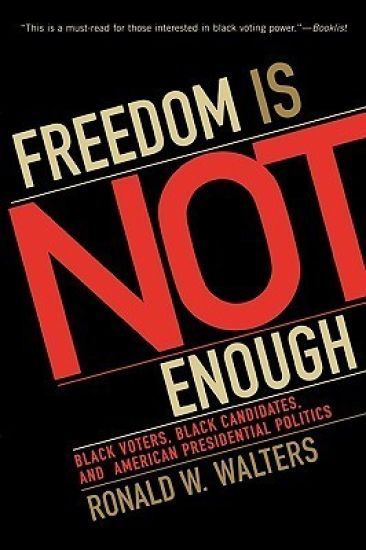
Black voters can make or break a presidential election—look at the close electoral results in 2000 and the difference the disenfranchised Black vote in Florida alone might have made. Black candidates can influence a presidential election—look at the effect that Jesse Jackson had on the Democratic party, the platform, and the electorate in 1984 and 1988, and the contributions to the Democratic debates that Carol Moseley Braun and Al Sharpton made in 2004. American presidential politics can't get along without the Black vote—witness the controversy over candidates' appearing (or not) at the NAACP convention, or the extent to which candidates court (or not) the Black vote in a variety of venues. It all goes back to the Voting Rights Act of 1965 which formally gave African Americans the right to vote, even if after all these years that right is continuously contested. In Freedom Is Not Enough (a quote from Lyndon Johnson's 1965 commencement address to Howard University just before he signed the Voting Rights Act), Ronald W. Walters traces the history of the Black vote since 1965, celebrates its fortieth anniversary in 2005, and shows why passing a law is not the same as ensuring its enforcement, legitimacy, and opportunity.

Despite all of humanity's failures, futile efforts and wrong turnings in the past, Adorno did not let himself be persuaded that we are doomed to suffer a bleak future for ever. One of the factors that prevented him from identifying a definitive plan for the future course of history was his feelings of solidarity with the victims and losers. As for the future, the course of events was to remain open-ended; instead of finality, he remained committed to a Hölderlin-like openness. This trace of the messianic has what he called the colour of the concrete as opposed to mere abstract possibility. Early in the 1960s Adorno gave four courses of lectures on the road leading to Negative Dialectics, his magnum opus of 1966. The second of these was concerned with the topics of history and freedom. In terms of content, these lectures represented an early version of the chapters in Negative Dialectics devoted to Kant and Hegel. In formal terms, these were improvised lectures that permit us to glimpse a philosophical work in progress. The text published here gives us an overview of all the themes and motifs of Adorno's philosophy of history: the key notion of the domination of nature, his criticism of the existentialist concept of a historicity without history and, finally, his opposition to the traditional idea of truth as something permanent, unchanging and ahistorical.

Despite all of humanity's failures, futile efforts and wrong turnings in the past, Adorno did not let himself be persuaded that we are doomed to suffer a bleak future for ever. One of the factors that prevented him from identifying a definitive plan for the future course of history was his feelings of solidarity with the victims and losers. As for the future, the course of events was to remain open-ended; instead of finality, he remained committed to a Hölderlin-like openness. This trace of the messianic has what he called the colour of the concrete as opposed to mere abstract possibility. Early in the 1960s Adorno gave four courses of lectures on the road leading to Negative Dialectics, his magnum opus of 1966. The second of these was concerned with the topics of history and freedom. In terms of content, these lectures represented an early version of the chapters in Negative Dialectics devoted to Kant and Hegel. In formal terms, these were improvised lectures that permit us to glimpse a philosophical work in progress. The text published here gives us an overview of all the themes and motifs of Adorno's philosophy of history: the key notion of the domination of nature, his criticism of the existentialist concept of a historicity without history and, finally, his opposition to the traditional idea of truth as something permanent, unchanging and ahistorical.

A worldwide trend toward democracy is surely one of the more remarkable phenomena of our times, even if the movement twoard that goal may often be haphazard and elusive. Past history will provide a healthy skepticism concerning the likelihood of democracy being reached in the near future in many parts of the world, as well as a preparedness for the possibility that many countries apparently close to the "institutional divide" are going to slip back rather than cross it soon. Nevertheless, the past 2600 years, or even 5000, yield the reassuring message that during that long period freedom has improved its extent significantly, with respect both to geographical breadth and institutional depth. This book is the first to attempt to describe the history of the growth of freedom on a world scale within one single set of covers. It sets out not to redefine freedom nor to discvoer freedom where no one else has, nor to argue that freedom is the proud possession of one country or tradition or people. Its purpose instead is to show how certain elements of free society made their appearance in an amazing variety of places, from ancient Sumeria and China to medieval Japan, modern Czechoslovakia and Costa Rica, in areas both inside and outside of the Western European and North American tradition that will probably be familiar to most readers of the English language edition of this book. The whole story, with its fits and starts, triumphs and tragedies, deserves the thoughtful reflection of everyone who in the wish to establish and protect freedom would avoid needless disappointment and despair and desires to act intelligently to attain the attainable. But even for the quietest, the person who has no faith in human action to improve man's lot, the story is worth pondering, for along with failure and misery it holds much that is noble and uplifting, tells of much gain for humanity through patient suffering and self-sacrifice, and catches a vision of liberty for all in the present an dpossible future that was inconceivable at the dawn of history.

Freedom, Inc. and Black Political Empowerment
Micah W. Kubic
University of Missouri Press
2016
sidottu
Much has been written about black urban empowerment and about the candidates who are the public face of such shifts in power. Authors invariably mention the important role played by black political organizations in electing black officials or organizing communities, but this study makes one such organization the focus of a booklength study. Using interviews and observation of participants as well as archival research, Kubic offers historical and political analysis of Freedom, Inc. of Kansas City from its founding in 1962 through its role in municipal elections of 2007. Kubic asserts that strong local organizations are living, dynamic organisms and that they, rather than charismatic candidates or interracial alliances, are the crucial players in both determining political outcomes and advancing black interests in urban areas.

Rediscover Life's Joys on Two WheelsAre you ready to redefine your retirement and embark on an exhilarating adventure? This comprehensive guide reveals the secret to a healthier, happier, and more adventurous lifestyle through the wonders of electric biking.Freedom on Two Wheels: The Ultimate E-Bike Guide for Retirees is your gateway to the thrilling world of e-biking. Each chapter is meticulously crafted to cover every aspect of e-biking, starting from the basics and leading you to master long-distance explorations and solo journeys. No prior experience is needed Dive into the e-bike revolution and understand all you need to know about different types of e-bikes, how they work, and the latest innovations. Learn the multitude of benefits tailored specifically for retirees, including physical and mental health perks, as well as environmental and financial advantages. Discover how to choose the perfect e-bike that meets your unique needs and budget, and delve into essential gear and accessories to ensure a safe and comfortable ride.This book goes beyond just introducing you to the world of e-bikes. It helps you build confidence with riding techniques, overcome common fears, and practice safe riding habits. Uncover hidden scenic routes, plan breathtaking multi-day trips, and navigate foreign terrains effortlessly. Connect with fellow e-bike enthusiasts, join clubs, or relish in the tranquility of solo rides.Special chapters focus on sustaining your e-biking lifestyle, adapting bikes for physical needs, using tech tools, and even budgeting your e-bike adventures. Be inspired by real-life stories from retirees who have found a new lease on life through e-biking, and set your own goals for future adventures.Don't let age be a barrier. Blaze trails, explore new horizons, and reclaim your sense of freedom. Your next great journey awaits-on two wheels.