Kirjojen hintavertailu. Mukana 11 244 527 kirjaa ja 12 kauppaa.

Kirjahaku

Etsi kirjoja tekijän nimen, kirjan nimen tai ISBN:n perusteella.

1000 tulosta hakusanalla W. F. Stroh

G.W.F. Hegel

G.W.F. Hegel

Ashgate Publishing Limited
2009
sidottu
Hegel is notable for his distinctive contribution to the perennial concerns of political philosophy. He outlines a powerful account of freedom as both a personal and social achievement, discussing theories of personal rights, private property and punishment. He articulates a social analysis of human action and criticizes Kantian ethics. His theory of self-actualization locates our social identities within 'Ethical Life' - the institutions of family life, civil society and the state - expressing a unique variety of rationalist conservatism. In this volume some of the finest interpreters of Hegel writing in English explore this distinguished heritage and explain its contemporary relevance.
G W F Hegel

G W F Hegel

Fred R. Dallmayr

SAGE PUBLICATIONS INC
1993
sidottu
Dallmayr argues that G W F Hegel is perhaps the leading philosopher of modernity and explores his philosophy as it pertains to the meaning of modernity and postmodernity: its celebration of individual freedom and the importance of a network of social relationships, public justice and civic virtue. This important text explains Hegel's work in the context of current theoretical and philosophical debates about modernity, illustrating his response to contemporary issues and recognizing him as a major figure in the history of political thought.
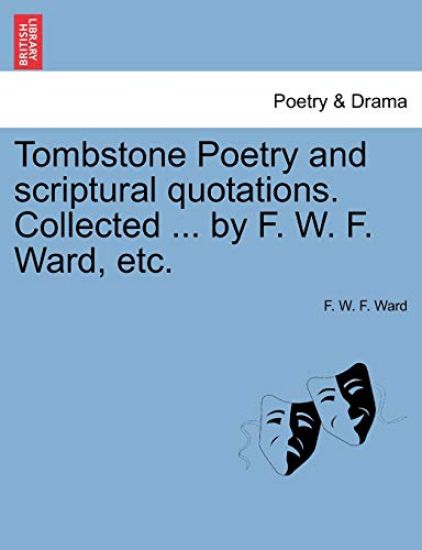
Tombstone Poetry and Scriptural Quotations. Collected ... by F. W. F. Ward, Etc.
Title: Tombstone Poetry and scriptural quotations. Collected ... by F. W. F. Ward, etc.Publisher: British Library, Historical Print EditionsThe British Library is the national library of the United Kingdom. It is one of the world's largest research libraries holding over 150 million items in all known languages and formats: books, journals, newspapers, sound recordings, patents, maps, stamps, prints and much more. Its collections include around 14 million books, along with substantial additional collections of manuscripts and historical items dating back as far as 300 BC.The POETRY & DRAMA collection includes books from the British Library digitised by Microsoft. The books reflect the complex and changing role of literature in society, ranging from Bardic poetry to Victorian verse. Containing many classic works from important dramatists and poets, this collection has something for every lover of the stage and verse. ++++The below data was compiled from various identification fields in the bibliographic record of this title. This data is provided as an additional tool in helping to insure edition identification: ++++ British Library Ward, F. W. F.; 1895.]. 218 p.; 8 . 11602.ccc.26.
Pensées (Thoughts): [translated by W. F. Trotter with an Introduction by Thomas S. Kepler]
Blaise Pascal was a 17th century French scientist, author, and Christian philosopher who is best known for his work, "Pens es" or "Thoughts." First published posthumously in 1670, "Thoughts" is an edited compilation of the notes that Pascal had prepared for a planned work that scholars refer to as an "Apology for the Christian Religion." Given its incompleteness when Pascal died, the order and composition of the work has been debated and as a result has produced many variant publications. In spite of their incompleteness and frequent incoherence, "Thoughts" has long held a high place among the great classics of the Christian religion. Much of the theological argument implied in these utterances has little appeal to the modern mind, but the acuteness of the observation of human life, the subtlety of the reasoning, the combination of precision and fervid imagination in the expression, make this a book to which the discerning mind can return again and again for insight and inspiration. This edition is printed on premium acid-free paper, follows the translation of W. F. Trotter, with an introduction by Thomas S. Kepler.
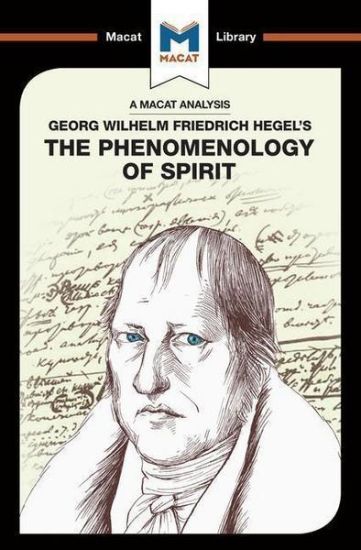
An Analysis of G.W.F. Hegel's Phenomenology of Spirit

An Analysis of G.W.F. Hegel's Phenomenology of Spirit

Ian Jackson

Macat International Limited
2017
nidottu
Hegel’s 1807 Phenomenology of Spirit is renowned for being one of the most challenging and important books in Western philosophy. Above all, it is famous for laying out a new approach to reasoning and philosophical argument, an approach that has been credited with influencing Karl Marx, Jean-Paul Sartre, and many other key modern philosophers. That approach is the so-called “Hegelian dialectic” – an open-ended sequence of reasoning and argument in which contradictory concepts generate and are incorporated into a third, more sophisticated concept. While the Phenomenology does not always clearly use this dialectical method – and it is famously one of the most difficult works of philosophy ever written – the Hegelian dialectic provides a perfect template for critical thinking reasoning skills. A hallmark of good reasoning in the construction of an argument, and the searching out of answers must necessarily consider contradictory viewpoints or evidence. For Hegel, contradiction is key: it is precisely what allows reasoning to progress. Only by incorporating and overcoming contradictions, according to his method, is it possible for thought to progress at all. While writing like Hegel might not be advisable, thinking like him can help take your reasoning to the next level.
An Analysis of G.W.F. Hegel's Phenomenology of Spirit

An Analysis of G.W.F. Hegel's Phenomenology of Spirit

Ian Jackson

Macat International Limited
2017
sidottu
Hegel’s 1807 Phenomenology of Spirit is renowned for being one of the most challenging and important books in Western philosophy. Above all, it is famous for laying out a new approach to reasoning and philosophical argument, an approach that has been credited with influencing Karl Marx, Jean-Paul Sartre, and many other key modern philosophers. That approach is the so-called “Hegelian dialectic” – an open-ended sequence of reasoning and argument in which contradictory concepts generate and are incorporated into a third, more sophisticated concept. While the Phenomenology does not always clearly use this dialectical method – and it is famously one of the most difficult works of philosophy ever written – the Hegelian dialectic provides a perfect template for critical thinking reasoning skills. A hallmark of good reasoning in the construction of an argument, and the searching out of answers must necessarily consider contradictory viewpoints or evidence. For Hegel, contradiction is key: it is precisely what allows reasoning to progress. Only by incorporating and overcoming contradictions, according to his method, is it possible for thought to progress at all. While writing like Hegel might not be advisable, thinking like him can help take your reasoning to the next level.