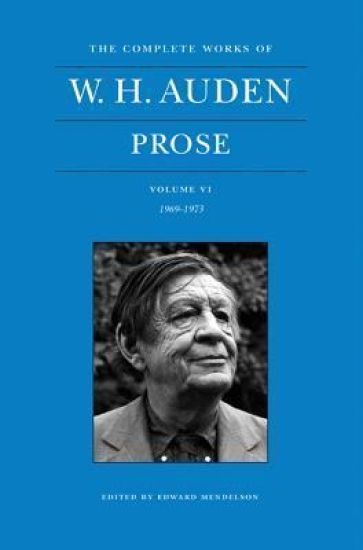
This sixth and final volume of W. H. Auden's prose displays a great writer's mind in its full maturity of wisdom, learning, and emotional and moral intelligence. It contains the full text of the only book that he regarded as an autobiography, A Certain World, in which he portrayed himself by selecting and commenting on writings by others that most affected him throughout his life. It also features late essays and reviews that in many cases present lightly disguised autobiographies, among them the most detailed account of his sexuality, in "Papa Was a Wise Old Sly-Boots." The appendixes gather lectures and public talks that are otherwise unpublished or unavailable. Edward Mendelson's comprehensive notes provide biographical and historical explanations of obscure references. The text includes corrections and revisions that Auden marked in personal copies of his work and that are published here for the first time.
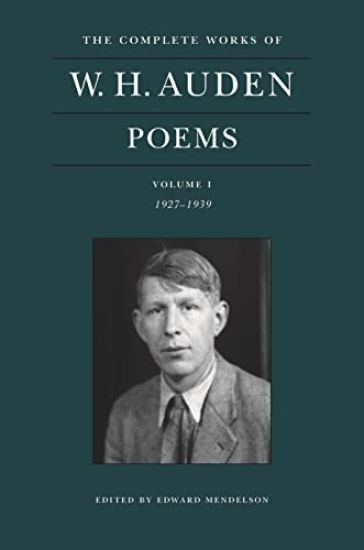
The first of two volumes of the eagerly anticipated first complete edition of Auden’s poems—including some that have never been published beforeW. H. Auden (1907–1973) is one of the greatest poets of the twentieth century, and his reputation has only grown since his death. Published on the hundredth anniversary of the year in which he began to write poetry, this is the first of two volumes of the first complete edition of Auden’s poems. Edited, introduced, and annotated by renowned Auden scholar Edward Mendelson, this definitive edition includes all the poems Auden wrote for publication, in their original texts, and all his later revised versions, as well as poems and songs he never published, some of them printed here for the first time.This volume traces the development of Auden’s early career, and contains all the poems, including juvenilia, that he published or submitted for publication, from his first printed work, in 1927, at age twenty, through the poems he wrote during his first months in America, in 1939, when he was thirty-two. The book also includes poems that Auden wrote during his adult career with the expectation that he might publish them, but which he never did; song lyrics that he wrote to be set to music by Benjamin Britten, but which he never put into print; and verses that he wrote for magazines at schools where he was teaching.The main text presents the poems in their original published versions. The notes include the extensive revisions that he made to his poems over the course of his career, and provide explanations of obscure references.The second volume of this edition, Poems, Volume 2: 1940–1973, is also available.
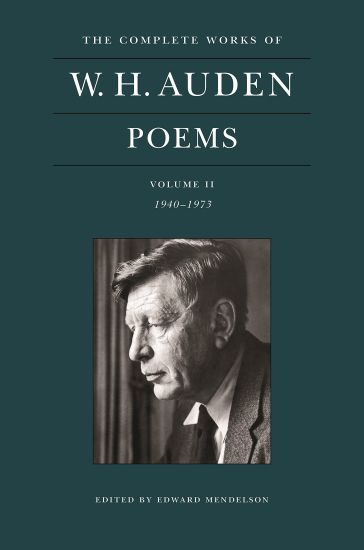
The second of two volumes of the eagerly anticipated first complete edition of Auden’s poems—including some that have never been published beforeW. H. Auden (1907–1973) is one of the greatest poets of the twentieth century, and his reputation has only grown since his death. Published on the hundredth anniversary of the year in which he began to write poetry, this is the second volume of the first complete edition of Auden’s poems. Edited, introduced, and annotated by renowned Auden scholar Edward Mendelson, this definitive edition includes all the poems Auden wrote for publication, in their original texts, and all his later revised versions, as well as poems and songs he never published, some of them printed here for the first time.This volume follows Auden as a mature artist, containing all the poems that he published or submitted for publication from 1940 until his death in 1973, at age sixty-six. This includes all his poetry collections from this period, from The Double Man (1941) through Epistle to a Godson (1972). The volume also features an edited version of his incomplete, posthumous book Thank You, Fog, as well as his self-designated “posthumous” poems.The main text presents the poems in their original published versions. The notes include the extensive revisions that he made to his poems over the course of his career, and provide explanations of obscure references.The first volume of this edition, Poems, Volume I: 1927–1939, is also available.
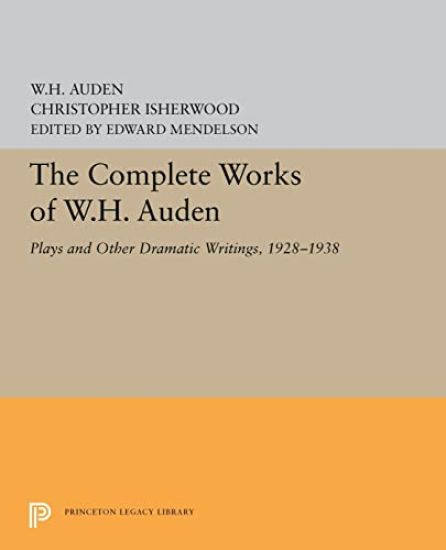
This volume contains Auden and Christopher Isherwood's dramatic extravaganzas The Dog Beneath the Skin, the Ascent of F 6, and On the Frontier. It also includes the two versions of Paid on Both Sides--which are so different as to constitute two works--and Auden's satiric revue The Dance of Death. Two plays appear in print for the first time, Auden and Isherwood's The Enemies of a Bishop and Auden's The Chase. Also included are Auden's prose and verse written for doucmentary films, a cabaret sketch, and an unpublished radio script. Many of the texts include poems by the young Auden that have never been published before. The extensive historical and textual notes trace the complex history of the production and revision of these plays, including full texts and rewritten scenes.During the years when these works were created, Auden moved from a "poetry of isolation" to more expansive and public writing. After he left Oxford at age twenty-one, during the summer of 1928, he wrote the tragicomic charade Paid on Both Sides. During the next ten years, until he left England for America, he created the increasingly ambitious works for stage, film, and broadcast that appear in this volume. The most important of these plays were written in collaboration with Isherwood. As the world political situation worsened, Isherwood and Auden's style combined the energy of popular entertainment with the urgency of sacramental ritual.Edard Mendelson is Professor of English and Comparative Literature at Columbia University and the author of Early Auden (Viking). He is the editor of two volumes of Aduen's poetry, Collected Poems (Random House) and The English Auden (Random House).Originally published in 1988.The Princeton Legacy Library uses the latest print-on-demand technology to again make available previously out-of-print books from the distinguished backlist of Princeton University Press. These editions preserve the original texts of these important books while presenting them in durable paperback and hardcover editions. The goal of the Princeton Legacy Library is to vastly increase access to the rich scholarly heritage found in the thousands of books published by Princeton University Press since its founding in 1905.
This volume contains Auden and Christopher Isherwood's dramatic extravaganzas The Dog Beneath the Skin, the Ascent of F 6, and On the Frontier. It also includes the two versions of Paid on Both Sides--which are so different as to constitute two works--and Auden's satiric revue The Dance of Death. Two plays appear in print for the first time, Auden and Isherwood's The Enemies of a Bishop and Auden's The Chase. Also included are Auden's prose and verse written for doucmentary films, a cabaret sketch, and an unpublished radio script. Many of the texts include poems by the young Auden that have never been published before. The extensive historical and textual notes trace the complex history of the production and revision of these plays, including full texts and rewritten scenes.During the years when these works were created, Auden moved from a "poetry of isolation" to more expansive and public writing. After he left Oxford at age twenty-one, during the summer of 1928, he wrote the tragicomic charade Paid on Both Sides. During the next ten years, until he left England for America, he created the increasingly ambitious works for stage, film, and broadcast that appear in this volume. The most important of these plays were written in collaboration with Isherwood. As the world political situation worsened, Isherwood and Auden's style combined the energy of popular entertainment with the urgency of sacramental ritual.Edard Mendelson is Professor of English and Comparative Literature at Columbia University and the author of Early Auden (Viking). He is the editor of two volumes of Aduen's poetry, Collected Poems (Random House) and The English Auden (Random House).Originally published in 1988.The Princeton Legacy Library uses the latest print-on-demand technology to again make available previously out-of-print books from the distinguished backlist of Princeton University Press. These editions preserve the original texts of these important books while presenting them in durable paperback and hardcover editions. The goal of the Princeton Legacy Library is to vastly increase access to the rich scholarly heritage found in the thousands of books published by Princeton University Press since its founding in 1905.
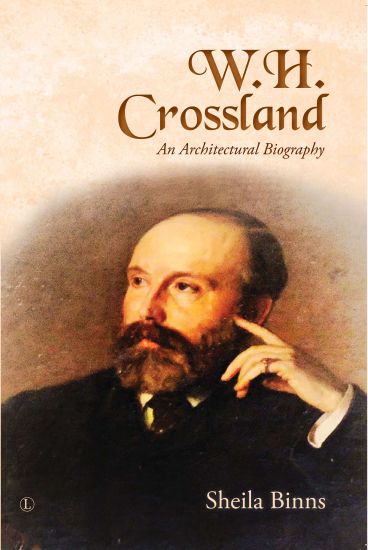
The creative genius behind Founder's Building at Royal Holloway, University of London, arguably the most glorious building in England of the end of the nineteenth century, is widely respected and its architectural style is regarded as archetypally 'Victorian'. Yet its architect, William Henry Crossland, is little known, despite a substantial catalogue of buildings, most of which remain standing today. Bringing Crossland out of the shadows, this biography explores this mysterious and elusive figure in depth for the first time. Recently digitised documents and long-hidden archival material have thrown a powerful light on Crossland, which, together with the author's first-hand knowledge of his buildings, offer the reader an unprecedented appreciation and understanding of the man, his life and work, as well as his personal and artistic influences. W.H. Crossland fills a gap in nineteenth-century architectural knowledge, but it is also the touching story of an ambitious and talented man, who is long overdue to be recognised as one of the 'greats' among nineteenth-century architects. This book is intended for architects, architectural historians and anyone who is interested in the built environment, nineteenth-century history and intriguing personal stories.
Title: W. H. Seward's Travels around the World. Edited by O. R. Seward, etc.Publisher: British Library, Historical Print EditionsThe British Library is the national library of the United Kingdom. It is one of the world's largest research libraries holding over 150 million items in all known languages and formats: books, journals, newspapers, sound recordings, patents, maps, stamps, prints and much more. Its collections include around 14 million books, along with substantial additional collections of manuscripts and historical items dating back as far as 300 BC.The HISTORY OF TRAVEL collection includes books from the British Library digitised by Microsoft. This collection contains personal narratives, travel guides and documentary accounts by Victorian travelers, male and female. Also included are pamphlets, travel guides, and personal narratives of trips to and around the Americas, the Indies, Europe, Africa and the Middle East. ++++The below data was compiled from various identification fields in the bibliographic record of this title. This data is provided as an additional tool in helping to insure edition identification: ++++ British Library Seward, William Henry; Seward, Olive Risley; 1873. 8 . 10026.g.6.
This work has been selected by scholars as being culturally important, and is part of the knowledge base of civilization as we know it. This work was reproduced from the original artifact, and remains as true to the original work as possible. Therefore, you will see the original copyright references, library stamps (as most of these works have been housed in our most important libraries around the world), and other notations in the work.This work is in the public domain in the United States of America, and possibly other nations. Within the United States, you may freely copy and distribute this work, as no entity (individual or corporate) has a copyright on the body of the work.As a reproduction of a historical artifact, this work may contain missing or blurred pages, poor pictures, errant marks, etc. Scholars believe, and we concur, that this work is important enough to be preserved, reproduced, and made generally available to the public. We appreciate your support of the preservation process, and thank you for being an important part of keeping this knowledge alive and relevant.
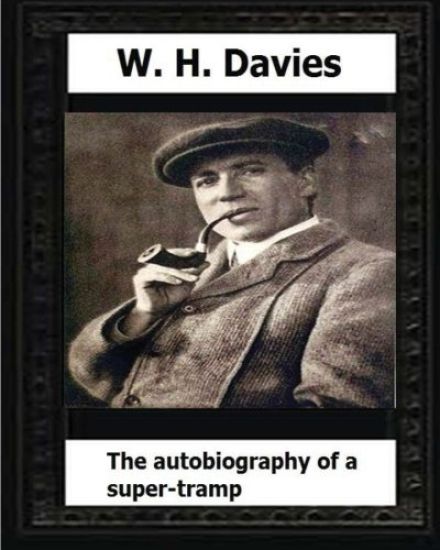
The Welsh poet and author WH Davies spent much of his life on the road. There's a moment in A Poet's Pilgrimage, first published in 1918 and extracted here, in which the writer stops an old man who is travelling between Carmarthen and Kidwelly, some 10 miles distant, to ask if there are any inns along the way. Yes, he is told, "but if you will take my advice you will keep out of places of that kind. I have not been inside one for 13 years. If I had, I would not be the owner of this." And he points to a rusty old bicycle, the pitiful product of 13 years' abstinence, and rides off. This is one of the more benign moments in Davies' perambulations. He had by this time achieved success with his first books, The Autobiography of a Super-Tramp, Beggars and The True Traveller; he was back in his native country after years of train-hopping in America and Canada, and, as he puts it, "full of joy at the thought of going on and on". He also had, by this stage, the esteem of George Bernard Shaw, and the friendship of Edward Thomas (yet to be killed in the trenches).
William Henry Hudson (4 August 1841 - 18 August 1922) was an author, naturalist, and ornithologist Hudson was born in the borough of Quilmes, now Florencio Varela of the greater Buenos Aires, in Buenos Aires Province, Argentina. He was the son of Daniel Hudson and his wife Catherine n e Kemble, U.S. settlers of English and Irish origin. He spent his youth studying the local flora and fauna and observing both natural and human dramas on what was then a lawless frontier, publishing his ornithological work in Proceedings of the Royal Zoological Society, initially in an English mingled with Spanish idioms. He had a special love of Patagonia. Hudson settled in England during 1874, taking up residence at St Luke's Road in Bayswater. He produced a series of ornithological studies, including Argentine Ornithology (1888-1899) and British Birds (1895), and later achieved fame with his books on the English countryside, including Hampshire Day (1903), Afoot in England (1909) and A Shepherd's Life (1910), which helped foster the back-to-nature movement of the 1920s and 1930s
WILLIAM HEYSHAM OVEREND (1851-1898) William Heysham Overend was a painter and illustrator, specialising in naval and other marine subjects. Despite his short career, he was prolific and successful. William Heysham Overend was born on 5 October 1851 in Coatham, near Middlesborough, now in the county of North Yorkshire. He was the third son of James Overend, a flax spinner, and Martha n e Hodgson. When he was 10 years old, he and his family moved south to Hackney, London, where his father took up a position as a railway contractor. They later lived at Buccleuch Terrace, Clapton Common. Overend was educated as a dayboy at Charterhouse, in 1863, and then at Bruce Castle, a progressive school in Tottenham. Determined to become a painter, he studied for three years in the studio of the painter, Davis Cooper. Developing as a marine artist, he exhibited paintings mainly at the Royal Academy of Arts and the Royal Institute of Oil Painters (being elected a member of the latter in 1886). He also contributed to magazines, especially the Illustrated London News (1872-96), and illustrated books, most notably boys' stories, such as those by G A Henty. Having had various addresses through the 1870s, Overend is recorded in 1881 as living with his wife, Sofia, at a boarding house at 64 Guilford Street, Bloomsbury, and keeping a studio close by at 39a Queen Square. In 1882, Overend sailed to New York, in order to fulfil a commission to commemorate Admiral David Porter's naval conquest of New Orleans, during the American Civil War. The resulting painting proved a great success. He would also exhibit at the World's Columbian Exposition, held in Chicago in 1893. Overend died at home at 17 Southampton Street, Fitzroy Square, London, on 18 March 1898. George Alfred Henty (8 December 1832 - 16 November 1902) was a prolific English novelist and war correspondent.He is best known for his historical adventure stories that were popular in the late 19th century. His works include The Dragon & The Raven (1886), For The Temple (1888), Under Drake's Flag (1883) and In Freedom's Cause (1885).Biography--G.A.Henty was born in Trumpington, near Cambridge. He was a sickly child who had to spend long periods in bed. During his frequent illnesses he became an avid reader and developed a wide range of interests which he carried into adulthood. He attended Westminster School, London, and later Gonville and Caius College, Cambridge, where he was a keen sportsman. He left the university early without completing his degree to volunteer for the Army Hospital Commissariat when the Crimean War began. He was sent to the Crimea and while there he witnessed the appalling conditions under which the British soldier had to fight. His letters home were filled with vivid descriptions of what he saw. His father was impressed by his letters and sent them to The Morning Advertiser newspaper which printed them. This initial writing success was a factor in Henty's later decision to accept the offer to become a special correspondent, the early name for journalists now better known as war correspondents.....
With Cochrane the dauntless: a tale of the exploits of Lord Cochrane in South American waters, By: G. A. Henty and W. H. Margetson(illustrator).George Alfred Henty (8 December 1832 - 16 November 1902) was a prolific English novelist and war correspondent.He is best known for his historical adventure stories that were popular in the late 19th century. His works include The Dragon & The Raven (1886), For The Temple (1888), Under Drake's Flag (1883) and In Freedom's Cause (1885).Biography--G.A.Henty was born in Trumpington, near Cambridge. He was a sickly child who had to spend long periods in bed. During his frequent illnesses he became an avid reader and developed a wide range of interests which he carried into adulthood. He attended Westminster School, London, and later Gonville and Caius College, Cambridge, where he was a keen sportsman. He left the university early without completing his degree to volunteer for the Army Hospital Commissariat when the Crimean War began. He was sent to the Crimea and while there he witnessed the appalling conditions under which the British soldier had to fight. His letters home were filled with vivid descriptions of what he saw. His father was impressed by his letters and sent them to The Morning Advertiser newspaper which printed them. This initial writing success was a factor in Henty's later decision to accept the offer to become a special correspondent, the early name for journalists now better known as war correspondents. Shortly before resigning from the army as a captain in 1859 he married Elizabeth Finucane. The couple had four children. Elizabeth died in 1865 after a long illness and shortly after her death Henty began writing articles for the Standard newspaper. In 1866 the newspaper sent him as their special correspondent to report on the Austro-Italian War where he met Giuseppe Garibaldi. He went on to cover the 1868 British punitive expedition to Abyssinia, the Franco-Prussian War, the Ashanti War, the Carlist Rebellion in Spain and the Turco-Serbian War.He also witnessed the opening of the Suez Canal and travelled to Palestine, Russia and India. William Henry Margetson (Londen, 1860 - Wallingford, 2 januari 1940) was een Engels kunstschilder en illustrator, vooral bekend om zijn esthetische portretten van vrouwen.Leven en werk Margetson studeerde aan het Dulwich College, en vervolgens aan de South Kensington Schools en de Royal Academy Schools. In 1885 exposeerde hij ook voor het eerst bij de Royal Academy, en later ook bij de Royal Society of British Artists, het Royal Institute of Oil Painters en de Grosvenor Gallery. In 1909 werd hij lid van het Royal Institute. Margetson schilderde in olie en in waterverf. Hij maakte vooral naam als portrettist van mooie vrouwen, vaak met modern aandoende korte kapsels en hoeden. Ook maakte hij religieuze en allegorische werken. Aanvankelijk werkte bij in een academische, Victoriaans stijl. Later hanteerde hij een meer losse penseelvoering, beinvloed door het post-impressionisme en de prerafa lieten, meer in het bijzonder door Laurens Alma-Tadema. Zijn meest succesvolle werk is het klassiek-decoratieve The Sea Hath its Pearls, waarmee hij in 1897 exposeerde bij de Royal Academy, thans in het bezit van de 'Art Gallery of New South Wales', Australi . Een door Margetson geschilderd portret van Alfred Tennyson hangt in de National Portrait Gallery te Londen. Margetson werkte ook veel als boekillustrator. Hij was gehuwd met kunstenares Helen Hatton, die hij had leren kennen tijdens een gezamenlijke illustratieopdracht. Hij woonde en werkte eerst in Londen en later in Blewbury en Wallingford. Hij overleed in 1940, 79 jaar oud.