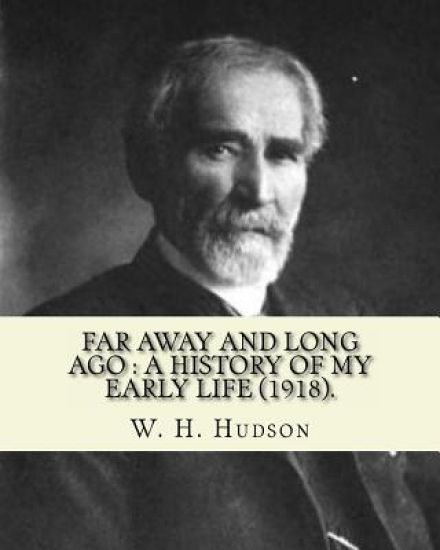
William Henry Hudson (4 August 1841 - 18 August 1922) was an author, naturalist, and ornithologist. Life and work: Hudson was born in the borough of Quilmes, now Florencio Varela of the greater Buenos Aires, in Buenos Aires Province, Argentina. He was the son of Daniel Hudson and his wife Catherine n e Kemble, United States settlers of English and Irish origin. He spent his youth studying the local flora and fauna and observing both natural and human dramas on what was then a lawless frontier, publishing his ornithological work in Proceedings of the Royal Zoological Society, initially in an English mingled with Spanish idioms. He had a special love of Patagonia. Hudson settled in England during 1874, taking up residence at St Luke's Road in Bayswater. He produced a series of ornithological studies, including Argentine Ornithology (1888-1899) and British Birds (1895), and later achieved fame with his books on the English countryside, including Hampshire Day (1903), Afoot in England (1909) and A Shepherd's Life (1910), which helped foster the back-to-nature movement of the 1920s and 1930s. It was set in Wiltshire and inspired a later book The Shepherd's Life about a Lake District farmer which was published in 2015. He was a founding member of the Royal Society for the Protection of Birds. Hudson's best known novel is Green Mansions (1904), and his best known non-fiction is Far Away and Long Ago (1918), which was made into a film. Ernest Hemingway famously referred to Hudson's book The Purple Land (1885) in his novel The Sun Also Rises and also referred to Hudson's Far Away and Long Ago in his posthumous novel The Garden of Eden (1986). In Argentina, Hudson is considered to belong to the national literature as Guillermo Enrique Hudson, the Spanish version of his name. A town in Berazategui Partido and several other public places and institutions are named after him. Towards the end of his life, Hudson moved to Worthing in Sussex, England. His grave is in Broadwater and Worthing Cemetery in Worthing.
A Crystal Age is a utopian novel/ Dystopia written by W. H. Hudson, first published in 1887.The book has been called a "significant S-F milestone"and has been noted for its anticipation of the "modern ecological mysticism" that would evolve a century later. William Henry Hudson (4 August 1841 - 18 August 1922) was an author, naturalist, and ornithologist. Life and work: Hudson was born in the borough of Quilmes, now Florencio Varela of the greater Buenos Aires, in Buenos Aires Province, Argentina. He was the son of Daniel Hudson and his wife Catherine n e Kemble, United States settlers of English and Irish origin. He spent his youth studying the local flora and fauna and observing both natural and human dramas on what was then a lawless frontier, publishing his ornithological work in Proceedings of the Royal Zoological Society, initially in an English mingled with Spanish idioms. He had a special love of Patagonia. Hudson settled in England during 1874, taking up residence at St Luke's Road in Bayswater. He produced a series of ornithological studies, including Argentine Ornithology (1888-1899) and British Birds (1895), and later achieved fame with his books on the English countryside, including Hampshire Day (1903), Afoot in England (1909) and A Shepherd's Life (1910), which helped foster the back-to-nature movement of the 1920s and 1930s. It was set in Wiltshire and inspired a later book The Shepherd's Life about a Lake District farmer which was published in 2015. He was a founding member of the Royal Society for the Protection of Birds. Hudson's best known novel is Green Mansions (1904), and his best known non-fiction is Far Away and Long Ago (1918), which was made into a film. Ernest Hemingway famously referred to Hudson's book The Purple Land (1885) in his novel The Sun Also Rises and also referred to Hudson's Far Away and Long Ago in his posthumous novel The Garden of Eden (1986). In Argentina, Hudson is considered to belong to the national literature as Guillermo Enrique Hudson, the Spanish version of his name. A town in Berazategui Partido and several other public places and institutions are named after him. Towards the end of his life, Hudson moved to Worthing in Sussex, England. His grave is in Broadwater and Worthing Cemetery in Worthing.
Though Davies is a well-known and unique literary figure of the early twentieth century, most famous now for The Autobiography of a Super-Tramp and poems such as ‘Leisure’, which came 14th in the BBC’s search to find ‘The Nation’s Favourite Poems’, no other volume of essays, or other critical monograph, concentrates on his work. This book not only provides a reassessment of Davies, putting him in his literary and cultural context, but also sheds light on the many more central literary figures he encountered and befriended. The central aim of the book is to reconsider his major works and his place in the literary and cultural milieu of his period.
The daughter of Russian immigrants, Gladys Dubovsky survived her abusive childhood by finding refuge in poetry. In the winter of 1940 when she was twenty-five, she took a poetry class taught by W.H. Auden. She met with Auden privately to discuss her poetry and found that his encouragement forever changed her.W.H. Auden, Poetry, and Me is a heartwarming story that fluctuates between Gladys's and Auden's life. We see how their lives mirror one another--their joy and pain, and their triumph and loss as they traveled the world, fell in love, and wrote poetry. Spanning the early 1930s to today, the story deals with such subjects as war, love, family, loss, homosexuality, pain, and triumph. This is the story of a woman who has faced adversity with humor and grace, and of the famous poet she loved. Through it all, Gladys bestows pearls of wisdom that only a 102-year-old can give.