Kirjojen hintavertailu. Mukana 11 342 296 kirjaa ja 12 kauppaa.

Kirjahaku

Etsi kirjoja tekijän nimen, kirjan nimen tai ISBN:n perusteella.

1000 tulosta hakusanalla W.D. Snodgrass

A boy's town, described for "Harper's young people," (1890). By: W .D. Howells (ILLUSTRATED): William Dean Howells ( March 1, 1837 - May 11, 1920) was
Describes the typical adventures of a mid-nineteenth-century boy from his third to eleventh years...... William Dean Howells ( March 1, 1837 - May 11, 1920) was an American realist novelist, literary critic, and playwright, nicknamed "The Dean of American Letters". He was particularly known for his tenure as editor of The Atlantic Monthly, as well as for his own prolific writings, including the Christmas story "Christmas Every Day" and the novels The Rise of Silas Lapham and A Traveler from Altruria. Early life and family: William Dean Howells was born on March 1, 1837 in Martinsville, Ohio (now known as Martins Ferry, Ohio) to William Cooper Howells and Mary Dean Howells, the second of eight children. His father was a newspaper editor and printer who moved frequently around Ohio. In 1840, the family settled in Hamilton, Ohio, where his father oversaw a Whig newspaper and followed Swedenborgianism.Their nine years there were the longest period that they stayed in one place. The family had to live frugally, although the young Howells was encouraged by his parents in his literary interests. He began at an early age to help his father with typesetting and printing work, a job known at the time as a printer's devil. In 1852, his father arranged to have one of his poems published in the Ohio State Journal without telling him. Early career: In 1856, Howells was elected as a clerk in the State House of Representatives. In 1858, he began to work at the Ohio State Journal where he wrote poetry and short stories, and also translated pieces from French, Spanish, and German. He avidly studied German and other languages and was greatly interested in Heinrich Heine. In 1860, he visited Boston and met with writers James Thomas Fields, James Russell Lowell, Oliver Wendell Holmes, Sr., Nathaniel Hawthorne, Henry David Thoreau, and Ralph Waldo Emerson. He became a personal friend to many of them, including Henry Adams, William James, Henry James, and Oliver Wendell Holmes, Jr. In 1860 Howells wrote Abraham Lincoln's campaign biography Life Of Abraham Lincoln and subsequently gained a consulship in Venice. He married Elinor Mead on Christmas Eve 1862 at the American embassy in Paris. She was a sister of sculptor Larkin Goldsmith Mead and architect William Rutherford Mead of the firm McKim, Mead, and White. Among their children was architect John Mead Howells. Editorship and other literary pursuits: The Howells returned to America in 1865 and settled in Cambridge, Massachusetts. He wrote for various magazines, including the Atlantic Monthly and Harper's Magazine. In January 1866, James Fields offered him a position as assistant editor at the Atlantic Monthly; he accepted after successfully negotiating for a higher salary, though he was frustrated by Fields' close supervision.
Criticism and fiction, By: W .D. Howells: William Dean Howells ( March 1, 1837 - May 11, 1920) was an American realist novelist, literary critic,
William Dean Howells ( March 1, 1837 - May 11, 1920) was an American realist novelist, literary critic, and playwright, nicknamed "The Dean of American Letters". He was particularly known for his tenure as editor of The Atlantic Monthly, as well as for his own prolific writings, including the Christmas story "Christmas Every Day" and the novels The Rise of Silas Lapham and A Traveler from Altruria. Early life and family: William Dean Howells was born on March 1, 1837 in Martinsville, Ohio (now known as Martins Ferry, Ohio) to William Cooper Howells and Mary Dean Howells, the second of eight children. His father was a newspaper editor and printer who moved frequently around Ohio. In 1840, the family settled in Hamilton, Ohio, where his father oversaw a Whig newspaper and followed Swedenborgianism.Their nine years there were the longest period that they stayed in one place. The family had to live frugally, although the young Howells was encouraged by his parents in his literary interests. He began at an early age to help his father with typesetting and printing work, a job known at the time as a printer's devil. In 1852, his father arranged to have one of his poems published in the Ohio State Journal without telling him. Early career: In 1856, Howells was elected as a clerk in the State House of Representatives. In 1858, he began to work at the Ohio State Journal where he wrote poetry and short stories, and also translated pieces from French, Spanish, and German. He avidly studied German and other languages and was greatly interested in Heinrich Heine. In 1860, he visited Boston and met with writers James Thomas Fields, James Russell Lowell, Oliver Wendell Holmes, Sr., Nathaniel Hawthorne, Henry David Thoreau, and Ralph Waldo Emerson. He became a personal friend to many of them, including Henry Adams, William James, Henry James, and Oliver Wendell Holmes, Jr. In 1860 Howells wrote Abraham Lincoln's campaign biography Life Of Abraham Lincoln and subsequently gained a consulship in Venice. He married Elinor Mead on Christmas Eve 1862 at the American embassy in Paris. She was a sister of sculptor Larkin Goldsmith Mead and architect William Rutherford Mead of the firm McKim, Mead, and White. Among their children was architect John Mead Howells. Editorship and other literary pursuits: The Howells returned to America in 1865 and settled in Cambridge, Massachusetts. He wrote for various magazines, including the Atlantic Monthly and Harper's Magazine. In January 1866, James Fields offered him a position as assistant editor at the Atlantic Monthly; he accepted after successfully negotiating for a higher salary, though he was frustrated by Fields' close supervision...........
The coast of Bohemia By: W .D. Howells (Biographical edition): William Dean Howells ( March 1, 1837 - May 11, 1920) was an American realist nov
William Dean Howells ( March 1, 1837 - May 11, 1920) was an American realist novelist, literary critic, and playwright, nicknamed "The Dean of American Letters". He was particularly known for his tenure as editor of The Atlantic Monthly, as well as for his own prolific writings, including the Christmas story "Christmas Every Day" and the novels The Rise of Silas Lapham and A Traveler from Altruria. Early life and family: William Dean Howells was born on March 1, 1837 in Martinsville, Ohio (now known as Martins Ferry, Ohio) to William Cooper Howells and Mary Dean Howells, the second of eight children. His father was a newspaper editor and printer who moved frequently around Ohio. In 1840, the family settled in Hamilton, Ohio, where his father oversaw a Whig newspaper and followed Swedenborgianism.Their nine years there were the longest period that they stayed in one place. The family had to live frugally, although the young Howells was encouraged by his parents in his literary interests. He began at an early age to help his father with typesetting and printing work, a job known at the time as a printer's devil. In 1852, his father arranged to have one of his poems published in the Ohio State Journal without telling him. Early career: In 1856, Howells was elected as a clerk in the State House of Representatives. In 1858, he began to work at the Ohio State Journal where he wrote poetry and short stories, and also translated pieces from French, Spanish, and German. He avidly studied German and other languages and was greatly interested in Heinrich Heine. In 1860, he visited Boston and met with writers James Thomas Fields, James Russell Lowell, Oliver Wendell Holmes, Sr., Nathaniel Hawthorne, Henry David Thoreau, and Ralph Waldo Emerson. He became a personal friend to many of them, including Henry Adams, William James, Henry James, and Oliver Wendell Holmes, Jr. In 1860 Howells wrote Abraham Lincoln's campaign biography Life Of Abraham Lincoln and subsequently gained a consulship in Venice. He married Elinor Mead on Christmas Eve 1862 at the American embassy in Paris. She was a sister of sculptor Larkin Goldsmith Mead and architect William Rutherford Mead of the firm McKim, Mead, and White. Among their children was architect John Mead Howells. Editorship and other literary pursuits: The Howells returned to America in 1865 and settled in Cambridge, Massachusetts. He wrote for various magazines, including the Atlantic Monthly and Harper's Magazine. In January 1866, James Fields offered him a position as assistant editor at the Atlantic Monthly; he accepted after successfully negotiating for a higher salary, though he was frustrated by Fields' close supervision. Howells was made editor in 1871, after five years as assistant editor, and he remained in this position until 1881. In 1869, he met Mark Twain with whom he formed a longtime friendship. But his relationship with journalist Jonathan Baxter Harrison was more important for the development of his literary style and his advocacy of Realism. Harrison wrote a series of articles for the Atlantic Monthly during the 1870s on the lives of ordinary Americans.Howells gave a series of twelve lectures on "Italian Poets of Our Century" for the Lowell Institute during its 1870-71 season. He published his first novel Their Wedding Journey in 1872, but his literary reputation soared with the realist novel A Modern Instance (1882), which described the decay of a marriage. His 1885 novel The Rise of Silas Lapham became his best known work, describing the rise and fall of an American entrepreneur of the paint business. His social views were also strongly represented in the novels Annie Kilburn (1888), A Hazard of New Fortunes (1890), and An Imperative Duty (1891).............
The mouse-trap, and other farces By: W .D. Howells: Illustrated

The mouse-trap, and other farces By: W .D. Howells: Illustrated

W. D. Howells

Createspace Independent Publishing Platform
2017
nidottu
William Dean Howells ( March 1, 1837 - May 11, 1920) was an American realist novelist, literary critic, and playwright, nicknamed "The Dean of American Letters". He was particularly known for his tenure as editor of The Atlantic Monthly, as well as for his own prolific writings, including the Christmas story "Christmas Every Day" and the novels The Rise of Silas Lapham and A Traveler from Altruria. Early life and family: William Dean Howells was born on March 1, 1837 in Martinsville, Ohio (now known as Martins Ferry, Ohio) to William Cooper Howells and Mary Dean Howells, the second of eight children. His father was a newspaper editor and printer who moved frequently around Ohio. In 1840, the family settled in Hamilton, Ohio, where his father oversaw a Whig newspaper and followed Swedenborgianism.Their nine years there were the longest period that they stayed in one place. The family had to live frugally, although the young Howells was encouraged by his parents in his literary interests. He began at an early age to help his father with typesetting and printing work, a job known at the time as a printer's devil. In 1852, his father arranged to have one of his poems published in the Ohio State Journal without telling him. Early career: In 1856, Howells was elected as a clerk in the State House of Representatives. In 1858, he began to work at the Ohio State Journal where he wrote poetry and short stories, and also translated pieces from French, Spanish, and German. He avidly studied German and other languages and was greatly interested in Heinrich Heine. In 1860, he visited Boston and met with writers James Thomas Fields, James Russell Lowell, Oliver Wendell Holmes, Sr., Nathaniel Hawthorne, Henry David Thoreau, and Ralph Waldo Emerson. He became a personal friend to many of them, including Henry Adams, William James, Henry James, and Oliver Wendell Holmes, Jr. In 1860 Howells wrote Abraham Lincoln's campaign biography Life Of Abraham Lincoln and subsequently gained a consulship in Venice. He married Elinor Mead on Christmas Eve 1862 at the American embassy in Paris. She was a sister of sculptor Larkin Goldsmith Mead and architect William Rutherford Mead of the firm McKim, Mead, and White. Among their children was architect John Mead Howells. Editorship and other literary pursuits: The Howells returned to America in 1865 and settled in Cambridge, Massachusetts. He wrote for various magazines, including the Atlantic Monthly and Harper's Magazine. In January 1866, James Fields offered him a position as assistant editor at the Atlantic Monthly; he accepted after successfully negotiating for a higher salary, though he was frustrated by Fields' close supervision. Howells was made editor in 1871, after five years as assistant editor, and he remained in this position until 1881. In 1869, he met Mark Twain with whom he formed a longtime friendship. But his relationship with journalist Jonathan Baxter Harrison was more important for the development of his literary style and his advocacy of Realism. Harrison wrote a series of articles for the Atlantic Monthly during the 1870s on the lives of ordinary Americans.Howells gave a series of twelve lectures on "Italian Poets of Our Century" for the Lowell Institute during its 1870-71 season....
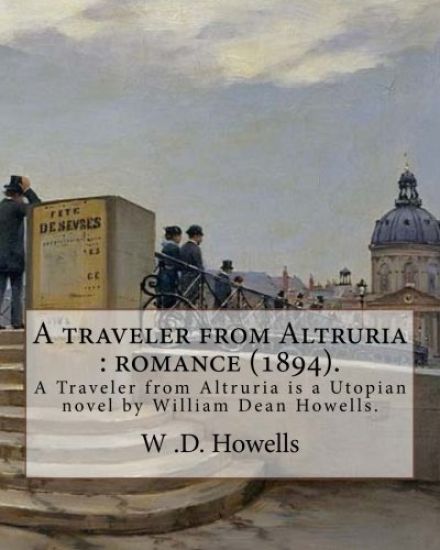
A traveler from Altruria: romance (1894). By: W .D. Howells: A Traveler from Altruria is a Utopian novel by William Dean Howells.
A Traveler from Altruria is a Utopian novel by William Dean Howells. It was first published in installments in The Cosmopolitan between November 1892 and October 1893, and eventually in book form by Harper & Brothers in 1894. The novel is a critique of unfettered capitalism and its consequences, and of the Gilded Age.Set during the early 1890s in a fashionable summer resort somewhere on the East Coast of the United States, the book is narrated by a Mr Twelvemough, a popular author of light fiction who has been selected to function as host to a visitor from the faraway island of Altruria called Mr Homos. Homos has come all the way to the United States to experience first-hand everyday life in the country which prides itself to represent democracy and equality, to see for himself how the principle that "all men are created equal" is being practiced. However, due to Altruria's secluded existence very little is known about that state, so Twelvemough and his circle of acquaintances, all of whom are staying at the same hotel, are more eager to learn something about Altruria than to explain American life and institutions. To their dismay, it becomes gradually clear to everyone involved in the conversations with Mr Homos-who in the course of the novel becomes less and less reluctant to talk about his own country-that the United States is greatly lagging behind Altruria in practically every aspect of life, be it political, economical, cultural, or moral. Thus, in the novel the island state of Altruria serves as a foil to America, whose citizens, compared to Altrurians, appear selfish, obsessed with money, and emotionally imbalanced. Mainly, A Traveller from Altruria is a critique of unfettered capitalism and its consequences, and of the Gilded Age in particular. In A Traveler from Altruria, Howells acknowledges the history of Utopian literature by having his group of educated characters refer to eminent representatives of that literary tradition such as Campanella (La citt del Sole, 1602) and Francis Bacon (New Atlantis, 1623), but also to quite recent authors like Edward Bellamy (Looking Backward, 1888) and William Morris (News from Nowhere, 1890). "With all those imaginary commonwealths to draw upon, from Plato, through More, Bacon, and Campanella, down to Bellamy and Morris, he has constructed the shakiest effigy ever made of old clothes stuffed with straw," says the professor, one of Homos's discussion partners, to his fellow Americans. "Depend upon it, the man is a humbug. He is not an Altrurian at all."...... William Dean Howells ( March 1, 1837 - May 11, 1920) was an American realist novelist, literary critic, and playwright, nicknamed "The Dean of American Letters".
The story of a play; a novel By: W .D. Howells: Novel (World's classic's)

The story of a play; a novel By: W .D. Howells: Novel (World's classic's)

W. D. Howells

Createspace Independent Publishing Platform
2017
nidottu
William Dean Howells ( March 1, 1837 - May 11, 1920) was an American realist novelist, literary critic, and playwright, nicknamed "The Dean of American Letters". He was particularly known for his tenure as editor of The Atlantic Monthly, as well as for his own prolific writings, including the Christmas story "Christmas Every Day" and the novels The Rise of Silas Lapham and A Traveler from Altruria. Early life and family: William Dean Howells was born on March 1, 1837 in Martinsville, Ohio (now known as Martins Ferry, Ohio) to William Cooper Howells and Mary Dean Howells, the second of eight children. His father was a newspaper editor and printer who moved frequently around Ohio. In 1840, the family settled in Hamilton, Ohio, where his father oversaw a Whig newspaper and followed Swedenborgianism.Their nine years there were the longest period that they stayed in one place. The family had to live frugally, although the young Howells was encouraged by his parents in his literary interests. He began at an early age to help his father with typesetting and printing work, a job known at the time as a printer's devil. In 1852, his father arranged to have one of his poems published in the Ohio State Journal without telling him. Early career: In 1856, Howells was elected as a clerk in the State House of Representatives. In 1858, he began to work at the Ohio State Journal where he wrote poetry and short stories, and also translated pieces from French, Spanish, and German. He avidly studied German and other languages and was greatly interested in Heinrich Heine. In 1860, he visited Boston and met with writers James Thomas Fields, James Russell Lowell, Oliver Wendell Holmes, Sr., Nathaniel Hawthorne, Henry David Thoreau, and Ralph Waldo Emerson. He became a personal friend to many of them, including Henry Adams, William James, Henry James, and Oliver Wendell Holmes, Jr. In 1860 Howells wrote Abraham Lincoln's campaign biography Life Of Abraham Lincoln and subsequently gained a consulship in Venice. He married Elinor Mead on Christmas Eve 1862 at the American embassy in Paris. She was a sister of sculptor Larkin Goldsmith Mead and architect William Rutherford Mead of the firm McKim, Mead, and White. Among their children was architect John Mead Howells. Editorship and other literary pursuits: The Howells returned to America in 1865 and settled in Cambridge, Massachusetts. He wrote for various magazines, including the Atlantic Monthly and Harper's Magazine. In January 1866, James Fields offered him a position as assistant editor at the Atlantic Monthly; he accepted after successfully negotiating for a higher salary, though he was frustrated by Fields' close supervision. Howells was made editor in 1871, after five years as assistant editor, and he remained in this position until 1881. In 1869, he met Mark Twain with whom he formed a longtime friendship. But his relationship with journalist Jonathan Baxter Harrison was more important for the development of his literary style and his advocacy of Realism. Harrison wrote a series of articles for the Atlantic Monthly during the 1870s on the lives of ordinary Americans.Howells gave a series of twelve lectures on "Italian Poets of Our Century" for the Lowell Institute during its 1870-71 season. He published his first novel Their Wedding Journey in 1872, but his literary reputation soared with the realist novel A Modern Instance (1882), which described the decay of a marriage. His 1885 novel The Rise of Silas Lapham became his best known work, describing the rise and fall of an American entrepreneur of the paint business. His social views were also strongly represented in the novels Annie Kilburn (1888), A Hazard of New Fortunes (1890), and An Imperative Duty (1891)....
The landlord at Lion's Head; a novel By: W .D. Howells: The Landlord at Lion's Head is a novel by American writer William Dean Howells.
The Landlord at Lion's Head is a novel by American writer William Dean Howells. The book was first published in 1897 by Harper & Brothers. Plot summary: The Durgin family, owners of a New Hampshire country house near a mountain whose peak resembles the head of a lion, plan to move to California because of a bad crop season and Mr. Durgin's ill health. As the family is packing, Mr. Westover, an artist, arrives. He pays the Durgins to stay in their home while he paints an image of the mountain. Jeff Durgin, the youngest son of the family, caters to Mr. Westover, who scolds him for scaring the nearby Whitwell children, Cynthia and Frank, with his dog. Instead of moving, Mrs. Durgin decides to change their home into a hotel; Mr. Durgin passes away in the winter before the hotel is opened. Five years later, Mr. Westovers pays another visit and is welcomed as a friend. The small country house has been renovated and expanded, and the Inn at Lion's Head is a huge success. The Whitwell family now helps run the inn. Mr. Westover catches a glimpse of Cynthia Whitwell and notices how beautiful she has become. When Jeff brings out a picnic lunch to the boarders of the hotel, Mrs. Marven, an upper class lady, does not allow him to eat with them; when Mrs. Durgin hears of this she kicks Mrs. Marven and her daughter out of the hotel. Jeff studies law at Harvard, but he is shunned by the wealthier upper-class students. He is suspended from school when he is caught with a friend who breaks a streetlight. Instead of going back to Lion's Head, he goes to Europe for the summer, and learns all about the hotels there. Once more, Mr. Westover spends the summer at Lion's head; Jeff arrives back from Europe on the same ship as wealthy Mrs. Vostrand and her daughter Genivieve. Jeff is attracted to Genivieve, but Mrs. Durgin does not allow him to associate with the upper-class boarders and sends Jeff back to Boston.The Vostrands settle in Boston, spending more and more time with Jeff Durgin. Jeff's proposes marriage to Genivieve, but she tells him that she is in love with an Italian. The Vostrands depart for Italy, leaving Jeff heartbroken. He returns to Lion's Head and is soon engaged to Cynthia, who Westover believes is far too fine for a blackguard like Jeff. Jeff tells his mother that he is content with being the Landlord at Lion's Head; she disapproves of both his low ambitions and his engagement to Cynthia. Jackson, Jeff's eldest brother, falls ill and is sent to Egypt for the winter to try to regain his health. Although Jeff no longer has plans to become a lawyer, Cynthia and Mrs. Durgin insist that he return to Harvard for his final year...... William Dean Howells ( March 1, 1837 - May 11, 1920) was an American realist novelist, literary critic, and playwright, nicknamed "The Dean of American Letters". He was particularly known for his tenure as editor of The Atlantic Monthly, as well as for his own prolific writings, including the Christmas story "Christmas Every Day" and the novels The Rise of Silas Lapham and A Traveler from Altruria................
The Trading Methods of W.D. Gann

The Trading Methods of W.D. Gann

Hima Reddy

Celer Wealth, LLC
2020
sidottu
While W.D. Gann's works helped pioneer the discipline of technical analysis, they can be challenging to read and implement in the original. Experienced day trader and chartered technical analyst, Hima Reddy, takes her 20+ years experience with translating Gann into the modern markets, distilling Gann's tenets into crystal-clear, bite-sized explanations and illustrating them with exceptionally intuitive charts and descriptions. With this textbook as a foundation, you'll be ready to delve more deeply into Gann, identifying even greater opportunities for profit.
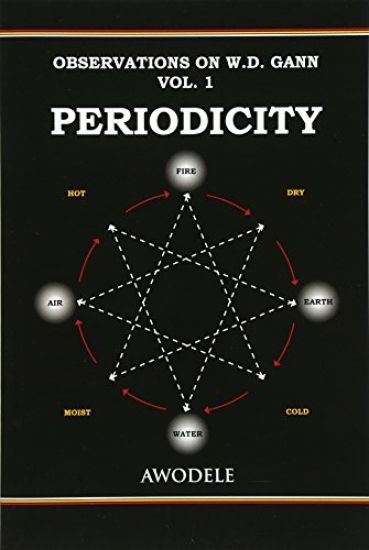
Observations on W.D. Gann Vol. 1: Periodicity
During my time studying Gann, I was fortunate to come across an e-book published by the Gann Study Group entitled, W.D. Gann on the Law of Vibration. In this e-book is where I first read a little known Gann article from 1919. In this article, Gann makes some predictions about the German Kaiser, Wilhelm Hohenzollern, and provides some details as to how he made his predictions. Continued study and work on the contents of the article led to the publication of my first book entitled, W.D. Gann: Divination By Mathematics. In this book, I wrote a chapter on periodicity, which was personally for me, one of my favorites in the book. In that chapter I was able to show how Gann may have derived key periods in the life of the German Kaiser, Wilhelm Hohenzollern. Interestingly, during my continued research, I found another example in Gann's work that matched the same procedure Gann may have used to derive some of the key periods in the 1919 article. Thus, one of the main goals of this small booklet is to simply share what I found. It has always been my intention to publish additional books to get some of the ideas that I have been contemplating out in the open, but I didn't have enough information on a particular topic to fill a three hundred, two hundred, or even a one hundred page book. With this in mind, I realized that I could publish small booklets in a series of volumes, each focusing on a different topic to achieve my goal. So this is what you will find in this publication, a small booklet on the topic of periodicity, which is the first volume in a series of volumes on observations I have made with respect to Gann's work. It is my hope that the reader will find something valuable within these pages to further their own research and study.
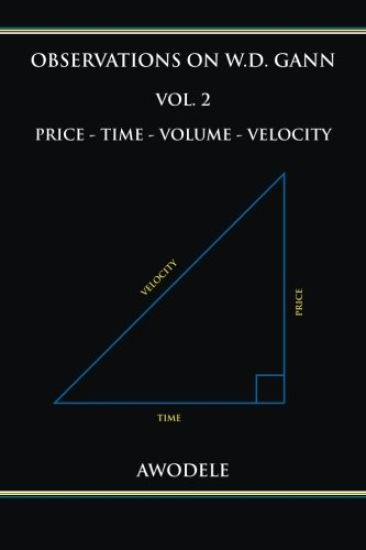
Observations on W.D. Gann Vol. 2: Price - Time - Volume - Velocity
Shortly after the publication of W.D. Gann: Divination By Mathematics: Harmonic Analysis, I came across some material I had not seen related to the same subject matter. In addition, there was a connection to Gann, and it seemed to answer some of the questions I had left off with in that publication. Thus, one of the goals of this book is to simply share this additional information along with the ideas that have resulted from its investigation. These new ideas are based on the four factors of Price, Time, Volume, and Velocity. Based on the Gann material in the pubic domain, it appears that various combinations of these factors are referenced as early as 1933. In fact, Gann states that every investor and trader should know the relationship between Time to Price and Volume. In the majority of instances where they are mentioned, the Master Time Factor is mentioned along with them. Since knowledge of the relationship between these factors was deemed important by Gann, the main goal of this book is to explore their relationship to each other, and to define what each of them means in the context of Gann's own words. It is my hope that the reader will find something valuable within these pages to further their own research and study.
The Trading Methodologies of W.D. Gann

The Trading Methodologies of W.D. Gann

Hima Reddy

John Wiley Sons Inc
2020
sidottu
How to spot patterns, identify opportunities, and grow your technical analysis skillsThe Trading Methodologies of W.D. Gann, Second Edition is a detailed yet accessible guide for trading, forecasting, and investing--using the principles of technical analysis to identify opportunities for profit. Beginning in the early 20th century, W.D. Gann developed pioneering methods of technical analysis that continue to hold value for modern traders. Gann's insights on interpreting market conditions and recognizing patterns are a valuable addition to any trader's strategy. The often cryptic nature of Gann's original publications, however, prove challenging to modern readers. This valuable guide demystifies Gann's techniques, providing clear and concise explanations and easy-to-follow instructions for today's traders and investors. Expert trader and technical analyst Hima Reddy draws from her extensive experience to provide a systematic approach to Gann's methodologies. This revised second edition includes expanded coverage of essential topics, more in-depth examination of key principles, and greater focus on contemporary applications.This insightful and informative book supplies everything you need to integrate Gann's technical analysis methods into your overall trading strategy. Explaining how Gann's methodologies of price, pattern, and time can be applied to various market conditions, this valuable resource supplies a solid foundational knowledge and encourages deeper investigation. Intuitive charts and graphs, multiple appendices, and precise interpretation of concepts allow you to: Discover the value of Gann's approach to contemporary trading practicesIntegrate the Gann trading methodology into your own tradesApply technical analysis principles to areas such as risk assessment and pattern recognitionBuild and implement a powerful trading strategy rooted in technical analysisFrom the history of his works to the application of his principles, The Trading Methodologies of W.D. Gann: Building Your Technical Analysis Toolbox, Second Edition is a must-have for traders and investors of all levels.
Fluglotse (m/w/d)

Fluglotse (m/w/d)

Dietmar Schmitz

Books on Demand
2022
pokkari
Fluglotsen (m/w/d) haben, genau wie ihre fliegende Kundschaft, einen hoch verantwortungsvollen und stressigen beruf. Die Tower- und Centerbesatzungen kommen aus allen sozialen Schichten und mussten in einem mehrt gigen gnadenlosen Auswahlverfahren wichtige Schl sself higkeiten und Fertigkeiten nachweisen, bevor sie berhaupt zur anspruchsvollen Berufsausbildung zugelassen wurden. Die Fluglotsen (m/w/d) der DFS leisten t glich hoch professionelle Arbeit, immer dem Motto folgend: SAFTY FIRST Dieses Buch zeigt aber auch die humoristische Seite in der Luftfahrt. Anekdoten, Fehltritte und Versprecher der letzten 50 Jahre wurden vom Autor liebevoll gesammelt und zeigen ein Dienststellen bergreifendes Potpourri, nicht immer "bierernst" zunehmender Geschichten, hinter den Kulissen der Luftfahrt.