Kirjojen hintavertailu. Mukana 11 627 630 kirjaa ja 12 kauppaa.

Kirjahaku

Etsi kirjoja tekijän nimen, kirjan nimen tai ISBN:n perusteella.

1000 tulosta hakusanalla WERNER PFISTER

Werner Herzog

Werner Herzog

Richard Eldridge

Bloomsbury Academic
2018
sidottu
Werner Herzog has produced some of the most powerful, haunting, and memorable images ever captured on film. Both his fiction films and his documentaries address fundamental issues about nature, selfhood, and history in ways that engage with but also criticize and qualify the best philosophical thinking about these topics. In focusing on figures from Aguirre, Kasper Hauser, and Stroszek to Timothy Treadwell, Graham Dorrington, Dieter Dengler, and Walter Steiner, among many others, Herzog investigates the nature of human life in time and the possibilities of meaning that might be available within it. His films demonstrate the importance of the image in coming to terms with the plights of contemporary industrial and commercial culture. Eldridge unpacks and develops Herzog's achievement by bringing his work into engagement with the thinking of Freud, Merleau-Ponty, Nietzsche, Hegel, Cavell, and Benjamin, but more importantly also by attending closely to the logic and development of the films themselves and to Herzog's own extensive writings about filmmaking.
Werner’s Syndrome and Human Aging

Werner’s Syndrome and Human Aging

Springer-Verlag New York Inc.
2012
nidottu
In keeping with the traditions of deve1opmenta1 bio1ogy and geronto1ogy, there was a long incubation period before fu11 expres- sion of the plans for an International Conference on the Werner Syndrome and the pub1ication of the present monograph based upon the proceedings of that conference. The initial concept emerged at the Xlth International Congress. of Geronto1ogy, which took p1ace in Tokyo in 1978. Drs. G.M. Martin, Y. Fujiwara and Y. Mitsui met on that occasion to discuss ways of acce1erating the pace of research on this important disorder, inc1uding banking and sharing of ce11 cu1tures, establishment of patient registries, and p1anning of joint conferences and pub1ications. In November 1979, under the auspices of the Geronto1ogica1 Society of America and a conference grant from the National Institute on Aging of the U.S. National Institutes of Hea1th, a group of Japanese investigators (Drs. Fujiwara, Mitsui, M. Goto, T. Ishii, K. Oota and *T. Matsumura) met with Drs. Martin, D. Sa1k and W. Ted Brown to deve10p plans to implement the goals discussed at the initial Tokyo meeting. A workshop focused on the needs of ce11 banking and 1ed to an accumu1ation of research materials both in Japan (main1y under the leadership of T. Matsumura) and in the U.S.A. (with the cooperation of Dr. Arthur Greene of the Institute of Medica1 Research).
Werner Herzog

Werner Herzog

University Press of Mississippi
2015
nidottu
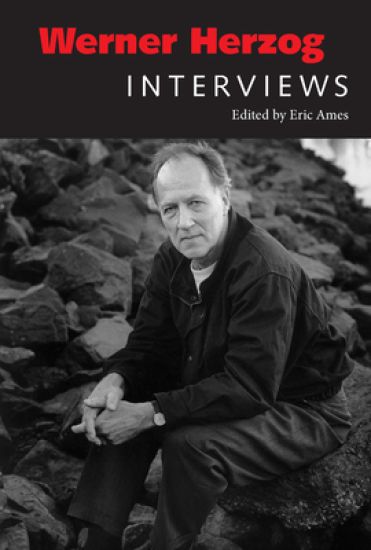
Over the course of his career, legendary director Werner Herzog (b. 1942) has made almost sixty films and given more than eight hundred interviews. This collection features the best of these, focusing on all the major films, from Signs of Life and Aguirre, the Wrath of God to Grizzly Man and Cave of Forgotten Dreams. When did Herzog decide to become a filmmaker? Who are his key influences? Where does he find his peculiar themes and characters? What role does music play in his films? How does he see himself in relation to the German past and in relation to film history? And how did he ever survive the wrath of Klaus Kinski? Herzog answers these and many other questions in twenty-five interviews ranging from the 1960s to the present. Critics and fans recognized Herzog's importance as a young German filmmaker early on, but his films have attained international significance over the decades. Most of the interviews collected in this volume--some of them from Herzog's production archive and previously unpublished--appear in English for the very first time. Together, they offer an unprecedented look at Herzog's work, his career, and his public persona as it has developed and changed over time.
Werner's Nomenclature of Colours;Adapted to Zoology, Botany, Chemistry, Mineralogy, Anatomy, and the Arts
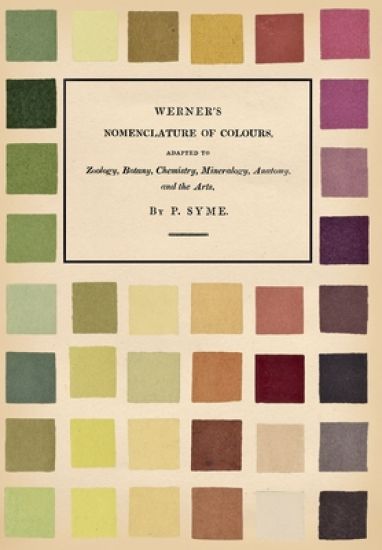
Read & Co. presents this new edition of Werner's Nomenclature of Colours. First published in 1814, this small volume comprises a collection of 110 swatches displaying nature's colour palette together with their poetical descriptions. In the 18th Century, German geologist Abraham Gottlob Werner set out to establish a standard reference guide to colour for use in the general sciences. Scottish flower painter Patrick Syme later enhanced and extended Werner's work to include all of the most common colours or tints that appear in nature, with each colour swatch accompanied by examples from the Animal, Vegetable and Mineral Kingdoms. The resulting work was used by many scientists, explorers and anthropologists to further their studies, including Charles Darwin during his time on the HMS Beagle. Werner's Nomenclature of Colours is considered the predecessor of modern systems such as Pantone and has even inspired heritage paint ranges from the likes of Dulux and Farrow & Ball. Read & Co. is republishing this beautiful little volume in a new facsimile edition and has taken great care to reproduce the original text and art for a new generation of artists and scientists.
Werner's Nomenclature of Colours;Adapted to Zoology, Botany, Chemistry, Mineralogy, Anatomy, and the Arts
Read & Co. presents this new edition of Werner's Nomenclature of Colours. First published in 1814, this small volume comprises a collection of 110 swatches displaying nature's colour palette together with their poetical descriptions. In the 18th Century, German geologist Abraham Gottlob Werner set out to establish a standard reference guide to colour for use in the general sciences. Scottish flower painter Patrick Syme later enhanced and extended Werner's work to include all of the most common colours or tints that appear in nature, with each colour swatch accompanied by examples from the Animal, Vegetable and Mineral Kingdoms. The resulting work was used by many scientists, explorers and anthropologists to further their studies, including Charles Darwin during his time on the HMS Beagle. Werner's Nomenclature of Colours is considered the predecessor of modern systems such as Pantone and has even inspired heritage paint ranges from the likes of Dulux and Farrow & Ball. Read & Co. is republishing this beautiful little volume in a new facsimile edition and has taken great care to reproduce the original text and art for a new generation of artists and scientists.