

Kirjahaku
Etsi kirjoja tekijän nimen, kirjan nimen tai ISBN:n perusteella.
1000 tulosta hakusanalla Wilfred Bion

Second Thoughts is a collection of papers on Schizophrenia, Linking and Thinking, and is a commentary upon them in the light of later work. Originally composed between 1950 and 1962, it derives its title from the lengthy critical commentary which Bion attached to these case histories in the year of publication, 1967, and represents the evolutionary change of position marked in his three previous books and brought to further refinement in the present work.
'As the problems raised in this book are fundamental to learning they have a long history of investigation and discussion. In phsycho-analytical practice, particularly with patients displaying symptoms of disorders of thought, it becomes clear that psycho-analysis has added a dimension to problems if not to their solution. 'This book deals with emotional experiences that are directly related both to theories of knowledge and to clinical psycho-analysis, and that in the most practical manner.'- Wilfred R. Bion, from the Introduction

Elements is a discussion of categorising the ideational context and emotional experience that may occur in a psychoanalytic interview. The text aims to expand the reader's understanding of cognition and its clinical ramifications.

Transformations continues the investigation of various aspects of psychoanalytic theory and practice which the author commenced with Learning from Experience (1962) and pursued in Elements of Psychoanalysis (1963). In this third work published in 1965, the author examines the ways in which the analyst's description of the original analytic experience, mediated by theory, necessarily transforms it in the course of effecting an interpretation.
Bion's central thesis in this volume is that for the study of people, whether individually or in groups, a cardinal requisite is accurate observation, accompanied by accurate appreciation and formulation of the observations so made. The study represents a further development of a theme introduced in the author's earlier works, particularly in Elements of Psychoanalysis (1963) and Transformations (1965). Bion's concern with the subject stems directly from his psycho-analytic experience and reflects his endeavor to overcome, in a scientific frame of reference, the immense difficulty of observing, assessing, and communicating non-sensuous experience. Here, he lays emphasis on he overriding importance of attending to the realities of mental phenomena as they manifest themselves in the individual or group under study. In influences that interpose themselves between the observer and the subject of his scrutiny giving rise to opacity, are examined, together with ways of controlling them.
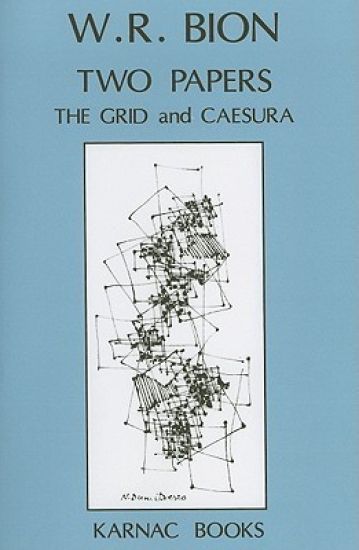
The Grid, an instrument devised to help the analyst record and elaborate observations arising from the analytic encounter, demonstrates how mathematics can be applied to locate the development, evolution and transformation of psychic elements and events. Caesura takes its title from Freud's observation: "There is much more continuity between intra-uterine life than the impressive caesura of the act of birth would have us believe". Here Bion speculates on the relationship between physiological and psychological birth, and the possibility that a pre-natal "primitive sensitiveness" may carry over and inform later psychological life.

These lectures, delivered in Sao Paulo and Rio de Janeiro during 1973 and 1974, reveal Bion in his most vital and challenging mode both in respect of the material he presents, and in his responses to the questions from his audience.

A Memoir of the Future, Bion's unorthodox attempt to cast psychoanalytic speculation in fictional form, is composed of three semi-autobiographical novels: The Dream (1975), The Past Presented (1977), and The Dawn of Oblivion (1979). Presented here for the first time in one volume, they appear together with the Key to A Memoir of the Future, a glossary of terms and concepts compiled by Wilfred and Francesca Bion.
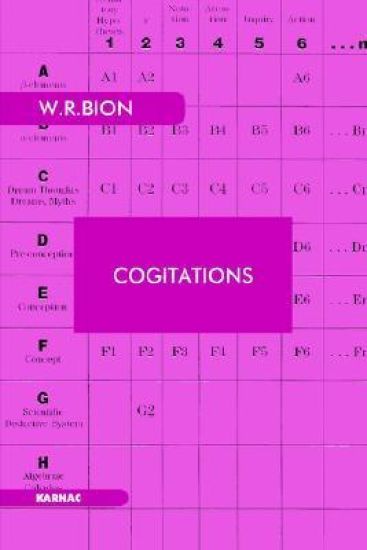
Cogitations, the last of the posthumous publications, is a collection of occasional writings representing Bion's attempts to clarify and evaluate both his own ideas and those of others by casting them in written form and frequently addressing them to an imaginary audience. Covering a period between February 1958 and April 1979, Cogitations delves into a wide range of material - psychoanalysis and science, mathematics and logic, literature and semantics. Some form a background to Bion's theoretical development, showing the doubts and arguments leading to the ideas expressed in his books, others highlighting and detailing some of the more abstract points in them, and some exploring topics destined for books that were to remain unwritten.

In this book Bion describes his use of the term "alpha-function" to conceptualize how the data of emotional experience is processed and digested. This includes his thinking on "contact barriers" and the bearing of "projective identification" on the genesis of thought. A Jason Aronson Book

A discussion of categorising the ideational context and emotional experience that may occur in a psychoanalytic interview. The text aims to expand the reader's understanding of cognition and its clinical ramifications.

Bion's War Memoirs is perhaps the most exceptional piece of autobiography yet written by a psychoanalyst. The first section of the book is documentary, consisting of the entire text of the diaries which the author wrote as a young man to record his experiences on the Western Front in 1917-1919, and this volume also includes the photographs and diagrams with which he illustrated his recollections. The diaries are followed by two later essays, in which he reflects upon his wartime experiences. The author has long been renowned as one of the great psychoanalysts, his career spanning much of the twentieth century and making him one of the most influential names in the field. The author's war diary, which he kept with him during combat, covered his years fighting in France during the First World War. He was just twenty years old when he began writing it. War Memoirs constitutes the final part of the author's autobiography.

Reminiscence of the first twenty-one years of Wilfred Bion?s life: eight years of childhood in India, ten years at public school in England, and three years of life in the army.

This selection of clinical seminars held by Wilfred Bion in Brasilia (1975) and Sao Paulo (1978) is the nearest we shall ever get to experiencing his application of his theories and views to consulting-room practice. It is also likely to be the only printed record of this area of his work. As those who underwent analysis with Bion will testify, nothing can approach the experience of the thing itself, but, failing that, these seminars may help to fill the gap now that his voice can only be heard through his published writings and lectures.

Taming Wild Thoughts brings together previously unpublished works from two different periods of the author's life which are linked, as Parthenope Bion Talamo says in her introduction, by the concept of classifying and conceptualizing thought. The first paper, "The Grid", dates from 1963 and is a discussion of great clarity about one of the author's most widely-used conceptual tools; it predates his more discursive paper of the same title (published in Two Papers) by several years. As a teaching paper on this topic, this version of "The Grid" is without parallel, and will doubtless be of great value to all students of his work. The second part of the book consists of transcripts of two tape-recordings made in 1977. They underline his interest in "wild" or "stray" thoughts; and they provide an insight into his extraordinary sensibility at the time of A Memoir of the Future.
The Italian Seminars, previously unpublished in English, comprises lectures W.R. Bion gave in Rome, in 1977. The volume consists of questions from the floor and Bion's fascinating and, at times, controversial answers. The lectures are divided in two: the first part was organized by the Italian Psychoanalytical Society and the second by the Via Pollaiolo Research Group. Bion's replies examine such diverse subjects as difficulties in the interaction between the therapist and the patient; music and psychoanalysis; non-verbal communication in the consulting room; and methodology in psychoanalysis.
Previously unpublished lectures from the author. The book consists of eight talks Bion gave at the Tavistock Clinic between 1976 and 1979. Topics explored include the importance of observation; dreams; art and psychoanalysis; and the significance of time in psychoanalysis. In addition, this volume includes an illuminating interview of Bion by Anthony G. Banet in 1976.'In your practice you will find yourself under pressure. You say whatever you have to say, and then there is an entirely new situation. You don't really know what is going on because it is an entirely new situation, things will not be the same. It is likely enough that the patient will say, "Why don't you say something?" Or if not the patient, the relatives - "Why don't you do something?" So you are always under pressure prematurely and precociously to produce your idea. Poor little thing! Pull it up by the roots and have a look at it - it hasn't got a chance.

All My Sins Remembered is the continuation of Wilfred Bion's autobiography, The Long Week-end. Although it is by no means a full account of his thirty years following the First World War - and he wrote no more - his memories of that period contrast vividly with the impression we gain of the following thirty years of his life through his letters. The Other Side of Genius gives us a glimpse of this remarkable man as his family knew him: those who met him only through his professional work will find here the same characteristic threads of humour, concern for truth, and flashes of insight that were the hallmark of his work in psycho-analysis. OXFORD: 'Thus opened for me a period of unparalleled opportunities to which I remained obstinately blind. I was overwhelmed before I started by the aura of intellectual brilliance with which Oxford was surrounded'.