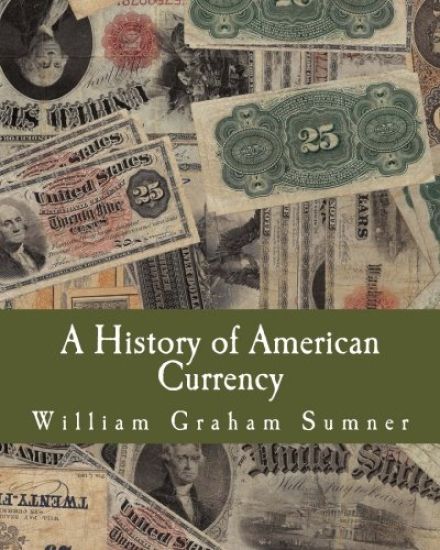
LARGE PRINT EDITION More at LargePrintLiberty.com.The author, William Graham Sumner, was the great sociologist of late 19th century America, but also a wise observer of economic conditions.In 1874, in the midst of another debate about the future of the American monetary system, he offered this sweeping history of the calamity of paper money in the United States from the Colonial Period to the Civil War. In many ways, it is a popular history in the sense that he hoped it could be read by anyone.What's strike here is his "Austrian" understanding of the relationship of paper money to credit cycles, inflation, and corruption. He was a firm advocate of sound money and 100% reserve banking.His lesson was that paper currency leads to a trap: continued crisis, hyperinflation, or the restoration of sound money. This pattern has been repeated again and again. The burden of this book is to show that there is nothing good to come out of any paper money experiment, and that sound money is the only answer in a free society.So there is profound historical interest in these pages--he was writing at a time when these issues were debated in all campaigns and classrooms--but also excellent theorizing too. Indeed, this work demonstrates that Sumner was not only a pioneering American sociologist but also one of the great American pre-Austrians of the late 19th century.
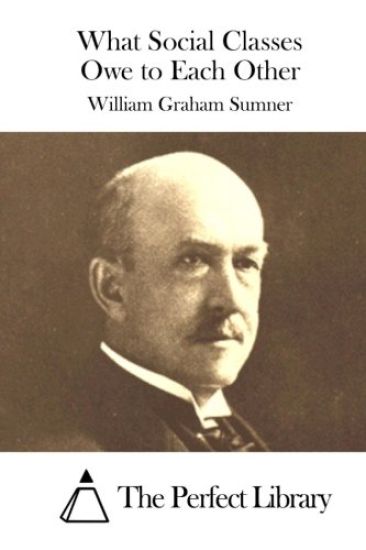
First published in 1883, Sumner's "What Social Classes Owe to Each Other" is an excellent source for the promotion of limited government. Sumner talks about the "Forgotten Man" in context to the socio-political and economic of a state. He defines the differences between the "weak", "poor" and the "burden" and how the humanitarians, reformers and the philathropists of our society seek forced charities from the "Forgotten Man" to support the above. In this book he promotes the principles of democracy and voluntary charity. He gives solid reason and logical explainations about his philosophy. No author has ever done a better job, in such a short book, of taking the bark off the socialist concepts of one social class owing anything to another. The philosophy of Sumner, who was a professor at Yale, has shown up in the rhetoric of many politicians throughout this century. The Marxist idea of forced redistribution of the wealth is profoundly defeated. Every politician should be required to read this book before taking office. Sumner's caustic pen and penetrating analysis make this one of the best books ever written in the Annals of Freedom.
LARGE PRINT EDITION More at LargePrintLiberty.com.This book was first published in 1883, and it answers a crucially important question: does any class or interest group have the duty and burden of fighting the battles of life for any other class or of solving the social problems to the satisfaction of any other class or group?
What Social Classes Owe To Each Other is a book written by American sociologist and economist William Graham Sumner. Originally published in 1883, the book explores the concept of social responsibility and the relationship between different social classes. Sumner argues that each social class has its own duties and obligations towards society, and that these duties are not necessarily equal or interchangeable. He contends that the wealthy and powerful have a responsibility to use their resources and influence for the greater good, while the poor and working classes have a duty to work hard and contribute to society in their own way. Sumner also delves into the role of government in regulating social relations and the potential consequences of excessive interference. Overall, What Social Classes Owe To Each Other is a thought-provoking and influential work that continues to be relevant today.This Is A New Release Of The Original 1883 Edition.This scarce antiquarian book is a facsimile reprint of the old original and may contain some imperfections such as library marks and notations. Because we believe this work is culturally important, we have made it available as part of our commitment for protecting, preserving, and promoting the world's literature in affordable, high quality, modern editions, that are true to their original work.
With the reprinting of Folkways it seems in place to inform the admirers of this book and of its author concerning the progress of Professor Sumner's work between 1907 and his death, in his seventieth year, in April, 1910. Several articles bearing on the mores, and realizing in part the programme outlined in the last paragraph of the foregoing Preface, have been published: "The Family and Social Change," in the American Journal of Sociology for March, 1909 (14: 577-591); "Witchcraft," in the Forum for May, 1909 (41: 410-423); "The Status of Women in Chaldea, Egypt, India, Judea, and Greece to the time of Christ," in the Forum for August, 1909 (42: 113-136); "Mores of the Present and the Future," in the Yale Review for November, 1909 (18: 233-245); and "Religion and the Mores," in the American Journal of Sociology for March, 1910 (15: 577-591).
A fascinating but often overlooked topic is the establishment of currency in a new nation. The process involves not only a host of unknown and complicated political factors, but also economics and the culture of the new nation. In A History WILLIAM GRAHAM SUMNER was a professor of political and social science at Yale University and became known as a Social Darwinist and advocate of the laissez faire principle in economics. Besides writing a number of books on sociology, history, and econo
Robert Morris' tombstone states that he was "The Financier"; officially, however, he was Superintendent of Finance. Whatever his title, Robert Morris played an integral role in financing the American Revolution, and Yale Prof WILLIAM GRAHAM SUMNER was a professor of political and social science at Yale University and became known as a Social Darwinist and advocate of the laissez faire principle in economics. Besides writing a number of books on sociology, history, and econo
Robert Morris' tombstone states that he was "The Financier"; officially, however, he was Superintendent of Finance. Whatever his title, Robert Morris played an integral role in financing the American Revolution, and Yale Prof WILLIAM GRAHAM SUMNER was a professor of political and social science at Yale University and became known as a Social Darwinist and advocate of the laissez faire principle in economics. Besides writing a number of books on sociology, history, and econo