

Kirjahaku
Etsi kirjoja tekijän nimen, kirjan nimen tai ISBN:n perusteella.
1000 tulosta hakusanalla Z D Boxall

By his own admission this is by far D Z Phillip’s most systematic attempt to discuss the problem of evil. Within the text the author argues that the majority of Anglo-American philosophers of religion who make a distinction between what is called the logical problem of evil and what is known as the practical, emotive or pastoral problem of evil are making false distinction. He argues that the logical is rooted in the practical. He does not intend to offer one 'correct' response to the problem of evil, but to point out the the confusions that are created by reflecting on the logical, conceptual problem in isolation. He advocates that there will always be more than one response to dealing with the problem of evil, but sees it as the job pf philosophers to point out where conceptual confusion arises.

This is Volume VI of nine in a collection of studies in Ethics and the Philosophy of Religion. Originally published in 1970, this volume looks at moral practices and the question which has puzzled philosophers: whether any value judgement can follow logically from the facts, can follow in such a way that someone who assents to the facts is bound in logic to assent also to the value judgement based upon them.
Foundationalism is the view that philosophical propositions are of two kinds, those which need supporting evidence, and those which in themselves provide the evidence which renders them irrefutable. This book, originally published 1988, describes the battle between foundationalism, which places belief in God in the first category, and various other approaches to the problem of faith – ‘Reformed Epistemology’, hermeneutics; and sociological analysis. In the concluding section of the book, an examination of concept formation in religious belief is used to reinterpret the gap between the expressive power of language and the reality of God.
The concern of this book is the nature of religious belief and the ways in which philosophical enquiry is related to it. Six chapters present the positive arguments the author wishes to put forward to discusses religion and rationality, scepticism about religion, language-games, belief and the loss of belief.The remaining chapters include criticisms of some contemporary philosophers of religion in the light of the earlier discussions, and the implications for more specific topics, such as religious education, are investigated. The book ends with a general attempt to say something about the character of philosophical enquiry, and to show how important it is to realise this character in the philosophy of religion.

In locating friendly fire in contemporary philosophy of religion, D.Z. Phillips shows that more harm can be done to religion by its philosophical defenders than by its philosophical despisers. Friendly fire is the result of an uncritical acceptance of empiricism, and Phillips argues that we need to examine critically the claims that individual consciousness is the necessary starting point from which we have to argue: for the existence of an external world and the reality of God; that God is a person without a body, a pure consciousness; and that to assent to a religious belief is essentially to assign a truth value to a proposition independent of any confessional context. When these products of friendly fire are avoided, we arrive at a new understanding of belief, trust and the soul, and refuse to say more or less than we know about the realities of human life in the service of religious apologetics.


In locating friendly fire in contemporary philosophy of religion, D.Z. Phillips shows that more harm can be done to religion by its philosophical defenders than by its philosophical despisers. Friendly fire is the result of an uncritical acceptance of empiricism, and Phillips argues that we need to examine critically the claims that individual consciousness is the necessary starting point from which we have to argue: for the existence of an external world and the reality of God; that God is a person without a body, a pure consciousness; and that to assent to a religious belief is essentially to assign a truth value to a proposition independent of any confessional context. When these products of friendly fire are avoided, we arrive at a new understanding of belief, trust and the soul, and refuse to say more or less than we know about the realities of human life in the service of religious apologetics.

The concern of this book is the nature of religious belief and the ways in which philosophical enquiry is related to it. Six chapters present the positive arguments the author wishes to put forward to discusses religion and rationality, scepticism about religion, language-games, belief and the loss of belief.The remaining chapters include criticisms of some contemporary philosophers of religion in the light of the earlier discussions, and the implications for more specific topics, such as religious education, are investigated. The book ends with a general attempt to say something about the character of philosophical enquiry, and to show how important it is to realise this character in the philosophy of religion.

Foundationalism is the view that philosophical propositions are of two kinds, those which need supporting evidence, and those which in themselves provide the evidence which renders them irrefutable. This book, originally published 1988, describes the battle between foundationalism, which places belief in God in the first category, and various other approaches to the problem of faith – ‘Reformed Epistemology’, hermeneutics; and sociological analysis. In the concluding section of the book, an examination of concept formation in religious belief is used to reinterpret the gap between the expressive power of language and the reality of God.



Este livro o resultado de estudos no ambiente do marketing de varejo, e consitui-se de modo a apresentar aforsimsos voltados gest o do varejo, pode contribuir efetivamente para a administra o de lojas e para a amplia o da compreens o deste segmento de mercado. Atrav s de uma base pr tica e conceitural, cuidadosa em seus fundamentos, procura contribuir para o gerenciamento das organiza es e ao sucesso dos gestores, estudantes e interessados na tem tica.

Pippa Parvin and the Mystery of the Ruined Corridor
D Z Mah
Workhorse Productions, Inc.
2020
pokkari
Can you solve the mystery?You're an orphan (well, maybe not in real life, but in these books you are) and you've gone to live with your Aunt Vivian and cousin Pippa out in the country. Their house is in a small village surrounded by lush forest and the two of them welcome you with open arms.But you have a secret that you've never told anyone. There's something about Pippa, though. She seems to know your secret already.When someone ruins the main corridor of your new school, tearing down paintings and spilling paint everywhere, Pippa is determined to learn that secret, too. She sneaks into your room at night and asks you to go to the school with her to crack the case.To solve it, you must collect four clues, and Pippa will follow YOUR lead. You decide where to explore in the darkened school; you decide which order to uncover the clues. Do you think you can solve the mystery before Pippa does?


No Past Tense is the biography of Katarina (Kati) Kellner and William (Willi) Salcer, two Czech Jews who as teenagers were swept up by the Holocaust in Hungary and survived Auschwitz and Mauthausen, respectively. Covering their entire lives, weaving in first person 'real time' voices as if watching a documentary about themselves, the unique structure of No Past Tense provides a distinctive 'whole life' view of the Holocaust. The book begins with their childhoods, education in Budapest, and 16-year-old Kati meeting 19-year-old Willi in the Jewish ghetto in Plesivec, a Slovak village annexed by Hungary in 1938. After liberation from the camps they returned to discover most Jews were gone, and the villagers did not want them back. In defiance, Kati took up residence in a shed on her family's property, and in reclaiming what was hers, won Willi's heart. They lived as smugglers in post-war Europe until immigrating illegally to Palestine in 1946. Describing Palestine, they talk frankly about rarely addressed issues such as prejudice against 'newcomers' from other Jews. Willi built tanks for the Haganah, the underground Jewish army, and supported the War of Independence but refused to move into homes abandoned by Palestinian Arabs. After discharge from the Israeli Air Force, Willi founded the country's first rubber factory and headed the association of Israeli manufacturers at only 28. In 1958, saying he did not want the children to know war, Willi convinced Kati to move to America. He did not tell her that punitive tax fines, imposed when the government needed money due to the crisis in the Sinai, shook his faith in Israel. Once in America, after a few bad investments, Willi lost all their money and for the first time Kati suffered panic attacks. But Willi rebuilt his fortune, while Kati rediscovered her courage, and started living again.

It is a plain, boring pencil to most people, but you've had it for ages. It's your lucky pencil, but now it's missing. What's worse, your cousin Pippa sees you crying over it.But she doesn't laugh. She sees this as a new mystery to solve, and she needs your help. The werefoxes are on the move again, this time to track down that missing pencil Pippa needs YOU to decide where to look and what order to collect clues. See if you can solve the mystery of who has your missing pencil before Pippa does?

Pippa Parvin and the Mystery of the Unidentified Flying Object
D Z Mah
Workhorse Productions, Inc.
2020
pokkari
It appears in your window every night, a mysterious configuration of lights that hovers for a moment, then is gone. You don't dare tell your Aunt Vivian or Cousin Pippa. Surely they'll laugh.But Pippa pries the secret from you and doesn't laugh. Instead, she gets out her notebook and declares it the next mystery she wants to solve. It's your most difficult mystery yet, and your cousin needs your help to gather clues.See if you can crack the case before she does
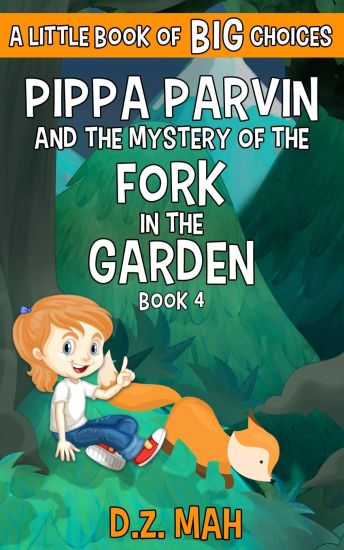
Pippa Parvin and the Mystery of the Fork in the Garden
D Z Mah
Workhorse Productions, Inc.
2020
pokkari
Someone has left a fork in the garden. You find it one morning, sticking out of a rotting piece of wood. It's a nice fork, and an odd thing to lose in the forest.Your cousin Pippa is intrigued and decides that this is the next case she must solve. Together you must investigate all the clues and get the fork back to its rightful owner. As always, YOU decide where to look first.The true mystery, though, is why the owner left it in your garden. See if you can crack the case before Pippa does

"I hear you're quite the sleuths." Nils's mother is onto you and your cousin, Pippa. She knows that you are good at solving mysteries, and now she has a new one. Who is stealing Nils's lunch every day?Pippa needs your help to discover all the clues. You decide where to look and when, and once you have done your investigation, see if you can solve the mystery before Pippa does