

Kirjahaku
Etsi kirjoja tekijän nimen, kirjan nimen tai ISBN:n perusteella.
1000 tulosta hakusanalla DM Low







First published in 1961, Perception and the Physical World contends that there are insuperable difficulties for the Representative and Phenomenalist theories. Unreflective common sense thinks of sense-perception as a direct grasping of the nature of the physical world. But when we are confronted with facts about sensory illusion, about the physical and physiological causes of perception, and with modern scientific views of the real nature of matter, it is hard to maintain such a ‘Direct Realist’ theory of perception. We tend to substitute a Copy or Representative theory which puts sense-impressions between ourselves and physical reality. Some philosophers overwhelmed by the difficulties of the Copy theory, retreat into Phenomenalism, which identifies the physical world with our sense-impressions. The author re-examines all the traditional objections to a Direct Realist theory and tries to show that they can be overcome. This book will be of interest to students of philosophy.
First published in 1961, Perception and the Physical World contends that there are insuperable difficulties for the Representative and Phenomenalist theories. Unreflective common sense thinks of sense-perception as a direct grasping of the nature of the physical world. But when we are confronted with facts about sensory illusion, about the physical and physiological causes of perception, and with modern scientific views of the real nature of matter, it is hard to maintain such a ‘Direct Realist’ theory of perception. We tend to substitute a Copy or Representative theory which puts sense-impressions between ourselves and physical reality. Some philosophers overwhelmed by the difficulties of the Copy theory, retreat into Phenomenalism, which identifies the physical world with our sense-impressions. The author re-examines all the traditional objections to a Direct Realist theory and tries to show that they can be overcome. This book will be of interest to students of philosophy.

First published in 1962, Bodily Sensations argues that bodily sensations are nothing but impressions that physical happenings are taking place in the body, impressions that may correspond or fail to correspond to physical reality. In the case of such sensations as pains, these impressions are accompanied by certain attitudes to the impressions. He argues, that is to say that bodily sensations are a sub-species of sense-impression, standing to perception of our own bodily state (or in some cases to touch) as visual impressions stand to the sense of sight. He examines, and tries to refute, all plausible alternative accounts of the nature of bodily sensations. He prefaces his argument by an account of tactual and bodily perception. Here he argues that, with the exception of heat and cold, the qualities discerned by these senses are all reducible to spatial and temporal properties of material objects. Combined with his own conclusions on bodily sensations, this allows him to draw up a short and exhaustive list of the so-called "secondary" qualities of physical objects. This book will be of interest to students of philosophy.

First published in 1962, Bodily Sensations argues that bodily sensations are nothing but impressions that physical happenings are taking place in the body, impressions that may correspond or fail to correspond to physical reality. In the case of such sensations as pains, these impressions are accompanied by certain attitudes to the impressions. He argues, that is to say that bodily sensations are a sub-species of sense-impression, standing to perception of our own bodily state (or in some cases to touch) as visual impressions stand to the sense of sight. He examines, and tries to refute, all plausible alternative accounts of the nature of bodily sensations. He prefaces his argument by an account of tactual and bodily perception. Here he argues that, with the exception of heat and cold, the qualities discerned by these senses are all reducible to spatial and temporal properties of material objects. Combined with his own conclusions on bodily sensations, this allows him to draw up a short and exhaustive list of the so-called "secondary" qualities of physical objects. This book will be of interest to students of philosophy.

Vivienne's diary delves deep into the societal intricacies of the early 1900s, where the newly minted Royal Australian Navy drew its cultural moorings from the upper echelons of the Royal Navy. In 1916, a heart-wrenching tragedy shatters the fa ade when Vivienne, the Headmaster's elder daughter, is believed to have taken her own life. Left in the wake of this calamity is twelve-year-old Phyllis, who grapples with grief and abandonment. With her parents emotionally absent and physically distant, she finds solace in Tally, cadet-midshipman and Vivienne's beau. But as war calls him to Scapa Flow in 1917, Phyllis is cast adrift. In her quest for affection, Phyllis stumbles, her heart often leading her astray, until fate causes her to marry Tally, now a Lieutenant. Yet, what promises a safe harbour turns stormy with a loveless union and Tally's deteriorating health. As Phyllis navigates a life marred by addiction and multiple marriages, her constant remains Ginnie, her ever-faithful Persian cat, who not only provides solace but also offers a unique narrative lens, weaving a tale of love, loss, and resilience.

Throughout history, people have disappeared without a trace under strange circumstances, in mysterious locations like the Bermuda Triangle. These people don't just vanish-across time, and across different universes, they end up in Crossroads.That's just what happens to party girl Beth McDee. Broke, kicked out of her apartment, and ditched and robbed by her girlfriend, she was hoping to forget her problems with a free weekend in the Keys, compliments of her brother-that is, until a plane crash brings her to Crossroads. The place seems pretty dodgy, but when Beth gets a scan and she finds out they want her to work there . . . well, it beats being unceremoniously transported to god-knows-where, right? Little does Beth know she's gotten tangled up in chain of events that will involve romance, Ancient Egyptians, Roman soldiers, MMA fighters, and the ultimate fate of Crossroads.With multiple intersecting plots and a rich cast of characters, Crossroads: Where the Multiverse Meets is a charming, compelling, and frequently hilarious science fiction novel where worlds collide and you find out what a difference one person can really make.

Throughout history, people have disappeared without a trace under strange circumstances, in mysterious locations like the Bermuda Triangle. These people don't just vanish-across time, and across different universes, they end up in Crossroads.That's just what happens to party girl Beth McDee. Broke, kicked out of her apartment, and ditched and robbed by her girlfriend, she was hoping to forget her problems with a free weekend in the Keys, compliments of her brother-that is, until a plane crash brings her to Crossroads. The place seems pretty dodgy, but when Beth gets a scan and she finds out they want her to work there . . . well, it beats being unceremoniously transported to god-knows-where, right? Little does Beth know she's gotten tangled up in chain of events that will involve romance, Ancient Egyptians, Roman soldiers, MMA fighters, and the ultimate fate of Crossroads.With multiple intersecting plots and a rich cast of characters, Crossroads: Where the Multiverse Meets is a charming, compelling, and frequently hilarious science fiction novel where worlds collide and you find out what a difference one person can really make.
In the novel The Benefits of Insanity, a doctor with a traumatic childhood recounts his experiences with the mental health system through his friendships. At the age of nine, Gabriel "Gabe" Guzman (a.k.a. George Garrison) must move in with his grandparents after a tragedy leaves him parentless. His grandparents live in the countryside of South Florida, in a little area he nicknames World's End. There, he meets the feisty and intelligent Cat, whom he instantly falls for, and the brother and sister duo, Samantha and Samuel. Gabe finds a life-long kinship in the trio who soon help him come out of his shell and get through the other side of adolescence. But all good things come to an end, and the pack breaks when Samantha's father finds out she has been dating J. Lee, a Black boy. After a series of misfortunes, Gabe must return to live with his foster parents in New York-where he was born. He exchanges letters with Cat through the years but loses touch with her during their time in medical school. After a terrible storm hits World's End, Gabe returns to check out his grandparents' house only to unexpectedly find Cat, Samantha, and J. Lee in a world turned upside down-a world that will never be the same.Intelligent, earnest, and infused with Cuban culture, The Benefits of Insanity is a story of love, friendship, and resilience in the face of a society that fails those suffering from trauma and mental illness.
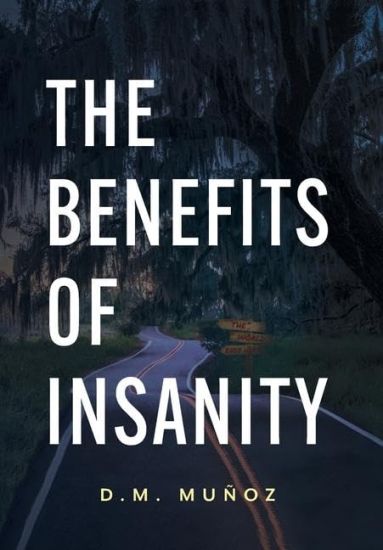
At the age of nine, Gabriel "Gabe" Guzman (a.k.a. George Garrison) must move in with his grandparents after a tragedy leaves him parentless. His grandparents live in the countryside of South Florida, in a little area he nicknames World's End. There, he meets the feisty and intelligent Cat, whom he instantly falls for, and the brother and sister duo, Samantha and Samuel. Gabe finds a life-long kinship in the trio who soon help him come out of his shell and get through the other side of adolescence. But all good things come to an end, and the pack breaks when Samantha's father finds out she has been dating J. Lee, a Black boy. After a series of misfortunes, Gabe must return to live with his foster parents in New York-where he was born. He exchanges letters with Cat through the years but loses touch with her during their time in medical school. After a terrible storm hits World's End, Gabe returns to check out his grandparents' house only to unexpectedly find Cat, Samantha, and J. Lee in a world turned upside down-a world that will never be the same.Intelligent, earnest, and infused with Cuban culture, The Benefits of Insanity is a story of love, friendship, and resilience in the face of a society that fails those suffering from trauma and mental illness.


An army of darkness marches across the land, wrought by the fury of a demonic young man bent on vengeance, in the second book of this grimdark fantasy. Swain lived for art and beauty. They were his natural defenses against a cruel world populated by greedy and abusive people. He found refuge in poetry, crafting rhythmic phrases out of his chaotic thoughts, desperate to tap into the spiritual divinity of creation. But Swain's naivet blinded him to an inevitable betrayal by the one person he entrusted with his heart: the girl who uncovered the magic woven within his words. Now he's the Demon King. His poems have shattered the very fabric of reality, conjuring monstrous beings, summoning vicious specters, and twisting people into undead entities-creating a legion of wrathful, despairing creatures eager to do his bidding. With each corrupted soul strengthening his army, the Demon King gains ever more power as he lays waste to one city after another across the realm. He will stop at nothing to expose the hypocrisy buried deep in the hearts of every living thing, bend it to his will, and rip out society's ugliness, leaving his dark vision of beauty to take root and spread. Meanwhile, half-elf river sorceress Ruhr and guardsman Zacarias have brought the war to the Demon King, storming his dungeons, battling inhuman and unnatural things, and falling prey to his devilish sorcery. Tormented by visions dredged up from their darkest secrets and buried memories, Ruhr and Zacarias must prevail not only against the Demon King's forces . . . but against their very own doubts and fears. The second volume of the hit LitRPG fantasy series-with more than 300,000 views on Royal Road-now available on Audible and wherever ebooks are sold