Kirjojen hintavertailu. Mukana 12 290 406 kirjaa ja 12 kauppaa.

Kirjahaku

Etsi kirjoja tekijän nimen, kirjan nimen tai ISBN:n perusteella.

1000 tulosta hakusanalla David J. Fitzpatrick

Red Brethren

Red Brethren

David J. Silverman

Cornell University Press
2010
sidottu
New England Indians created the multitribal Brothertown and Stockbridge communities during the eighteenth century with the intent of using Christianity and civilized reforms to cope with white expansion. In Red Brethren, David J. Silverman considers the stories of these communities and argues that Indians in early America were racial thinkers in their own right and that indigenous people rallied together as Indians not only in the context of violent resistance but also in campaigns to adjust peacefully to white dominion. All too often, the Indians discovered that their many concessions to white demands earned them no relief. In the era of the American Revolution, the pressure of white settlements forced the Brothertowns and Stockbridges from New England to Oneida country in upstate New York. During the early nineteenth century, whites forced these Indians from Oneida country, too, until they finally wound up in Wisconsin. Tired of moving, in the 1830s and 1840s, the Brothertowns and Stockbridges became some of the first Indians to accept U.S. citizenship, which they called "becoming white," in the hope that this status would enable them to remain as Indians in Wisconsin. Even then, whites would not leave them alone. Red Brethren traces the evolution of Indian ideas about race under this relentless pressure. In the early seventeenth century, indigenous people did not conceive of themselves as Indian. They sharpened their sense of Indian identity as they realized that Christianity would not bridge their many differences with whites, and as they fought to keep blacks out of their communities. The stories of Brothertown and Stockbridge shed light on the dynamism of Indians' own racial history and the place of Indians in the racial history of early America.
Discontented America

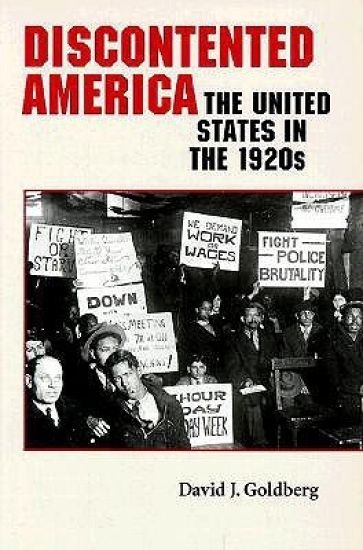
Discontented America

David J. Goldberg; Stanley I. Kutler

Johns Hopkins University Press
1999
pokkari
It was a decade of great heroes like Babe Ruth and Charles Lindbergh, and of passive leaders like Warren Harding and Calvin Coolidge. The exuberant freedom of flappers drinking bathtub gin and dancing the Charleston did little to counter such powers of oppression as the rapidly rising Ku Klux Klan. Only the fictional wealth of F. Scott Fitzgerald's Jay Gatsby survived the stock market crash unscathed; by the end of the decade, the comic adventures of Charlie Chaplin's "little tramp" bore faint resemblance to the grim realities faced by countless destitute Americans. Too often, notes historian David Goldberg, the mythic allure of the "Roaring Twenties" has deafened our ears to the real voices of those who lived through the decade. In Discontented America, he integrates social and political history to provide a new take on the 1920s-an account deeply rooted in the perspectives of that time. Goldberg argues that this contentious and fascinating decade should be viewed now as it was viewed then, as a distinctive postwar period, during which many of the conflicts generated by World War I continued to reverberate throughout American society. As America sought to step back from the leadership role it had taken in the Great War, Goldberg explains, the nation faced internal battles over women's suffrage, prohibition of the sale of "intoxicating beverages," the specter of communism, and the declining power of labor unions. Large numbers of African Americans migrated from the southern states to the north in search of employment and a better life, and at the same time, there was another heavy wave of newcomers from overseas. These, Goldberg concludes, were the issues that preoccupied serious Americans, and their concern is reflected in the federal legislation of the period, from constitutional amendments providing for prohibition and women's suffrage to the National Origins Act, meant to curtail immigration from nonwestern European countries. "The 1920s involved a time of confronting (or sometimes, ignoring) profound social problems, fears, and anxieties that had nagged the national consciousness for decades. David Goldberg very properly calls it a time of discontent, and in this work he thoroughly probes much of the underside of life that pitted Americans of differing classes, ethnicity, and religion against one another...As Goldberg notes, the Great Depression exposed underlying fallacies and weaknesses in the economy and provided the occasion for the great political and social transformation of the twentieth century. The achievements of the 1920s are long behind us, but the lessons of unbridled capitalism, intolerance, and the clashes between traditionalism and modernism very much remain."-from the foreword by Stanley I. Kutler
Heal Your Brain

Heal Your Brain

David J. Hellerstein

Johns Hopkins University Press
2011
sidottu
Maybe you are one of the more than 45 million people in the United States who is currently struggling with depression. Maybe anxiety keeps you from truly enjoying your job, your relationships, your life. Maybe every change you have tried to make seems to have failed and you are beginning to feel as if change is simply not possible. Author David J. Hellerstein uses the term New Neuropsychiatry to refer to a dramatically different approach to help people who have depression and anxiety disorders. Unlike Old Psychiatry, which often focused on early life issues, the New Neuropsychiatry focuses on improving present-day life and on achieving long-term remission of symptoms. Heal Your Brain combines the advances of neuroscience and medicine with the art of the storyteller to show how the New Neuropsychiatry can alter the course of your life. Dr. Hellerstein, a psychiatrist at Columbia University's College of Physicians and Surgeons, puts this new form of psychiatry to the test. Depression and anxiety disorders damage the brain, but as Dr. Hellerstein explains, the right treatment can change the patterns of brain activity, brain cell connections, and even the brain's anatomy. To illustrate, he relates the stories of people as they travel through various phases of New Neuropsychiatry treatment, from evaluation to therapy to remission, and illustrates how this approach can help you progress through each phase as well. The book's compelling narrative demonstrates that, in many cases, it is possible to achieve a stable recovery and return to-or even experience for the first time-a life free of crippling anxiety and depression.
Judges

Judges

David J. H. Beldman

William B. Eerdmans Publishing Company
2020
nidottu
Judges is a book for our time. It forces readers to come face to face with the way that faith speaks into the situations we encounter and read about in our newsfeeds. Warfare, authoritarianism, sexual exploitation, tribalism--these are a few of the repercussions from not having our social order oriented toward God. In this commentary David Beldman expounds the story of God and Israel that unfolds in the book of Judges, highlighting the vital message it speaks to contemporary Christians who strive to live lives of integrity and undivided loyalty to Jesus under the constant pressure of the idols of twenty-first-century culture.
Ezra and Nehemiah

Ezra and Nehemiah

David J. Shepherd; Christopher J. H. Wright

William B Eerdmans Publishing Co
2018
nidottu
Two features especially distinguish the Two Horizons Old Testament Commentary series: theological exegesis and theological reflection. Both of these features are fully realized in this THOTC volume on Ezra and Nehemiah by David J. Shepherd and Christopher J. H. Wright. Following an introduction and concise, verse-by-verse commentary on both books, Shepherd and Wright highlight key ways in which these Old Testament texts continue to speak to us today. They closely examine what Ezra and Nehemiah tell us about God and the people of Israel, reflect practically on leadership, and engage critically with those portions of the text (such as Ezra's dissolution of the Judeans' marriages with foreigners) that present special problems for contemporary readers. Offering deep theological insight throughout, this volume will prove essential for students, pastors, and other Christian leaders seeking to engage in theological interpretation of Scripture.
Unrelenting God

Unrelenting God

David J. Downs

William B Eerdmans Publishing Co
2013
nidottu
Is God still, as it has been argued, the -neglected factor- in New Testament theology? How does the Bible speak imaginatively and concretely about who God is and what God's activity on behalf of the world looks like? In The Unrelenting God sixteen accomplished scholars in the fields of biblical and theological studies explore ways in which Scripture speaks about God's character and God's activity in the world. As honoree Beverly Roberts Gaventa has done throughout her career, the contributors address important and nuanced theological themes such as God's dramatic invasion of the world in the gospel of Jesus Christ, God's ultimate triumph over the powers of sin and death, and humanity's ongoing participation with God in Christ. Scholars, students, and church leaders will appreciate this volume's careful theological interpretation of whole scriptural books and individual passages -- and its ability to model instructively how that interpretation is best done. Contributors Shane BergMartinus C. de BoerAlexandra R. BrownWilliam Sanger CampbellDavid J. DownsSusan Grove EastmanJoel B. GreenDouglas HarinkRichard B. HaysL. Ann JervisJacqueline E. LapsleyJ. Louis MartynJohn B. F. MillerMatthew L. SkinnerKatherine SondereggerFrancis WatsonMichael Welker
The Offering of the Gentiles

The Offering of the Gentiles

David J Downs

William B Eerdmans Publishing Co
2016
nidottu
The monetary fund that the apostle Paul organized among his Gentile congregations for the Jewish-Christian community in Jerusalem was clearly an important endeavor to Paul; discussion of it occupies several prominent passages in his letters. In this book David Downs carefully investigates that offering from historical, sociocultural, and theological standpoints. Downs first pieces together a chronological account of Paul's fund-raising efforts on behalf of the Jerusalem church, based primarily on information from the Pauline epistles. He then examines the sociocultural context of the collection, including gift-giving practices in the ancient Mediterranean world relating to benefaction and care for the poor. Finally, Downs explores how Paul framed this contribution rhetorically as a religious offering consecrated to God.
The Miami-Illinois Language

The Miami-Illinois Language

David J. Costa

University of Nebraska Press
2003
sidottu
The Miami-Illinois Language reconstructs the language spoken by the Miami and the Illinois Native Americans. During the latter half of the seventeenth century both Native communities lived in the region to the south of Lake Michigan in present-day Illinois and Indiana. The French and Indian War, followed in the late eighteenth and early nineteenth centuries by massive influxes of white settlers into the Ohio River Valley, proved disastrous for both Native groups. Reduced in number by warfare and disease, the Illinois (now called the Peorias) along with half of the Miamis relocated first to Kansas and then to northeast Oklahoma, while the other half of the Miamis remained in northern Indiana. The Miami and the Illinois Native Americans speak closely related dialects of a language of the Algonquian language family. Linguist David J. Costa reconstructs key elements of their language from available historical sources, close textual analysis of surviving stories, and comparison with related Algonquian languages. The result is the first overview of the Miami-Illinois language.
Or Perish in the Attempt

Or Perish in the Attempt

David J. Peck; Moira Ambrose

Bison Books
2011
pokkari
David J. Peck's Or Perish in the Attempt ingeniously combines the remarkable adventures of Lewis and Clark with an examination of the health problems their expedition faced. Formidable problems indeed, but the author patiently, expertly—and humorously—guides us through the medical travails of the famous journey, juxtaposing treatment then against remedy now. The result is a fascinating book that sheds new light not only on Lewis and Clark and the men and one remarkable woman (and her infant) who accompanied them along an eight-thousand-mile wilderness path but also on the practice of medicine in their time and place.
The Last Days of the Rainbelt

The Last Days of the Rainbelt

David J. Wishart

Bison Books
2013
sidottu
Looking over the vast open plains of eastern Colorado, western Kansas, and southwestern Nebraska, where one can travel miles without seeing a town or even a house, it is hard to imagine the crowded landscape of the last decades of the nineteenth century. In those days farmers, speculators, and town builders flooded the region, believing that rain would follow the plow and that the "Rainbelt" would become their agricultural Eden. It took a mere decade for drought and economic turmoil to drive these dreaming thousands from the land, turning farmland back to rangeland and reducing settlements to ghost towns.David J. Wishart's The Last Days of the Rainbelt is the sobering tale of the rapid rise and decline of the settlement of the western Great Plains. History finds its voice in interviews with elderly residents of the region by Civil Works Administration employees in 1933 and 1934. Evidence similarly emerges from land records, climate reports, census records, and diaries, as Wishart deftly tracks the expansion of westward settlement across the central plains and into the Rainbelt. Through an examination of migration patterns, land laws, town-building, and agricultural practices, Wishart re-creates the often-difficult life of settlers in a semiarid region who undertook the daunting task of adapting to a new environment. His book brings this era of American settlement and failure on the western Great Plains fully into the scope of historical memory.
Great Plains Indians

Great Plains Indians

David J. Wishart

Bison Books
2016
pokkari
2017 Nebraska Book Awards Nonfiction: Reference David J. Wishart’s Great Plains Indians covers thirteen thousand years of fascinating, dynamic, and often tragic history. From a hunting and gathering lifestyle to first contact with Europeans to land dispossession to claims cases, and much more, Wishart takes a wide-angle look at one of the most significant groups of people in the country. Myriad internal and external forces have profoundly shaped Indian lives on the Great Plains. Those forces-the environment, religion, tradition, guns, disease, government policy-have written their way into this history. Wishart spans the vastness of Indian time on the Great Plains, bringing the reader up to date on reservation conditions and rebounding populations in a sea of rural population decline. Great Plains Indians is a compelling introduction to Indian life on the Great Plains from thirteen thousand years ago to the present.
The Fur Trade of the American West

The Fur Trade of the American West

David J. Wishart

Bison Books
1992
pokkari
"In stressing the exploitation and destruction of the physical and human environment rather than the usual frontier romanticism, David Wishart has provided for students of the trans-Mississippi fur trade a valuable service."--Journal of the Early Republic. A standard reference work [that] should be required reading for all students of the American west."--Pacific Historical Review. "The whole [fur trade] system is traced out from the Green River rendezvous or the Fort Union post to the trading houses of St. Louis and the auctions in New York and Europe. Such factors as capital formation, shifting commercial institutions, the role of advanced market information, and the nature, kinds, costs, and speed of transportation are all worked into the story, as is the relationship of the whole fur trade to national and international business cycles. This is an impressive achievement for a book so brief...[It] opens out onto new methodological vistas and paradigms in western history."--William H. Goetzmann, New Mexico Historical Review David J. Wishart is a professor of geography at the University of Nebraska-Lincoln. He is the winner of the John Brinckerhoff Jackson Prize for distin-guished books in American geography, sponsored by the Association of American Geographers for An Unspeakable Sadness: The Dispossession of the Nebraska Indians, also available from the University of Nebraska Press.
An Unspeakable Sadness

An Unspeakable Sadness

David J. Wishart

University of Nebraska Press
1997
pokkari
Of all the interactions between American Indians and Euro-Americans, none was as fundamental as the acquisition of the indigenous peoples' lands. To Euro-Americans this takeover of lands was seen as a natural right, an evolution to a higher use; to American Indians the loss of homelands was a tragedy involving also a loss of subsistence, a loss of history, and a loss of identity. Historical geographer David J. Wishart tells the story of the dispossession process as it affected the Nebraska Indians—Otoe-Missouria, Ponca, Omaha, and Pawnee—over the course of the nineteenth century. Working from primary documents, and including American Indian voices, Wishart analyzes the spatial and ecological repercussions of dispossession. Maps give the spatial context of dispossession, showing how Indian societies were restricted to ever smaller territories where American policies of social control were applied with increasing intensity. Graphs of population loss serve as reference lines for the narrative, charting the declining standards of living over the century of dispossession. Care is taken to support conclusions with empirical evidence, including, for example, specific details of how much the Indians were paid for their lands. The story is told in a language that is free from jargon and is accessible to a general audience.
On Demand

On Demand

David J. Baker

Stanford University Press
2009
sidottu
In early modern England, while moralists railed against the theater as wasteful and depraved and inflation whittled away at the value of wages, people attended the theater in droves. On Demand draws on recent economic history and theory to account for this puzzling consumer behavior. He shows that during this period demand itself, with its massed acquisitive energies, transformed the English economy. Over the long sixteenth-century consumption burgeoned, though justifications for it lagged behind. People were in a curious predicament: they practiced consumption on a mass scale but had few acceptable reasons for doing so. In the literary marketplace, authors became adept at accommodating such contradictions fashioning works that spoke to self-divided consumers: Thomas Nashe castigated and satiated them at the same time . William Shakespeare satirized credit problems. Ben Jonson investigated the problems of global trade, and Robert Burton enlisted readers in a project of economic betterment.
Ratifying the Republic

Ratifying the Republic

David J. Siemers

Stanford University Press
2002
sidottu
Ratifying the Republic explains how the United States Constitution made the transition from a very divisive proposal to a consensually legitimate framework for governing. This story has never been told in its entirety, mainly because the transition seemed so seamless. But the Federalists' proposal had been bitterly opposed, and constitutional legitimation required a major transformation. The story of that transformation is the substance of this book. The progression of constitutional contexts triggered new responses from participants in the ratification debate which led to legitimation. Antifederalists had been loath to scrap the Articles of Confederation because of their conservative approach to the rule of law. After ratification, this same conservative predisposition led them to agree to abide by the newly legalized Constitution and instruct their followers to do the same. Implementation of the Constitution yielded other responses which bolstered the document. For instance, this progression in "constitutional time" exposed incomplete views within the Federalist camp about how a constitution should be treated in practice. James Madison believed the Constitution fairly clearly distinguished federal powers from those retained by the states; successful constitutionalism dictated preserving that division. In contrast, Alexander Hamilton thought that a constitution that split sovereignty between the states and the nation was inherently unstable. His hope was to salvage the Union by extending national power, a project directly contrary to Madison's more static view. Madison and these Federalists who agreed with him joined with the former Antifederalists to become the Republican party. This alliance held the remaining Federalists to their well-publicized ratification debate argument that the Constitution was a grant of limited, specific powers only. This new alliance had sufficient strength to contemplate taking the reins of government. With majority status a distinct possibility, incentives to replace the new regime were minimized, eclipsed by a state-centric interpretation of the Constitution. The legislative process adopted by Congress was also satisfactory to the opposition, who were sticklers for proper procedures. Finally, the trying and financially unrewarding nature of service in the new government discouraged the best and the brightest from seeking national office, hindering institutional prestige and the growth of national power, developments which pleased those who favored dual sovereignty. Throughout, the author emphasizes the role fear, contingency, and happenstance played in the success and legitimation of the Constitution.
Between Nations

Between Nations

David J. Baker

Stanford University Press
2002
pokkari
Fusing historiography with literary criticism, Between Nations produces an array of unexpected readings of early modern texts. Starting from the premise that England has never been able to emerge or define itself in isolation from its neighbors on the British Isles, this book places Renaissance England and its literature at a meeting of English, Irish, Scottish, and Welsh histories. It ranges from the late sixteenth through the late seventeenth centuries and deals with the "reigns" of three monarchs and one regicide—those of Elizabeth I, James I, Charles II, and Oliver Cromwell. However, it shifts the domain they ruled from the customary center into interactions between England and the other British polities. The author argues that England was able to develop into what we call a "nation" only in and by means of its relations with the other proto-"nations" that often it was also suppressing. Among the authors who served one or more of the four English rulers are Shakespeare, Spenser, and Marvell, who are studied here in the way they responded to the complexities of British history that encompassed their "nation." They not only participated in nation building/destroying, but their works are shown often to be meditations on that process and their own roles in the process. In Henry V, for example, Shakespeare both produces a vision of an ideal Britain and inscribes into his play the voices of various British peoples that are meant to be subsumed. Spenser's A View of the Present State of Ireland, which is often taken as an anti-Gaelic screed, is more plausibly seen as a text compounded of heterogeneous cultural influences, many of them originating from within Ireland. The complexity of the text reflects Spenser's own situation as a colonial official exiled from one British nation, England, to another, Ireland. In "An Horation Ode upon Cromwell's Return from Ireland," Marvell explicitly considers the consequences of a campaign that historians have called the "War of the Three Kingdoms." In that, and in a later poem, "The Loyal Scot," Marvell emerges as a shrewd commentator on the British politics of his day. Throughout, the book demonstrates that historical readings of this period's English literary works can be as multivalent and multicentric as the British history that produced them.
Ratifying the Republic

Ratifying the Republic

David J. Siemers

Stanford University Press
2004
pokkari
Ratifying the Republic explains how the United States Constitution made the transition from a very divisive proposal to a consensually legitimate framework for governing. This story has never been told in its entirety, mainly because the transition seemed so seamless. But the Federalists' proposal had been bitterly opposed, and constitutional legitimation required a major transformation. The story of that transformation is the substance of this book. The progression of constitutional contexts triggered new responses from participants in the ratification debate which led to legitimation. Antifederalists had been loath to scrap the Articles of Confederation because of their conservative approach to the rule of law. After ratification, this same conservative predisposition led them to agree to abide by the newly legalized Constitution and instruct their followers to do the same. Implementation of the Constitution yielded other responses which bolstered the document. For instance, this progression in "constitutional time" exposed incomplete views within the Federalist camp about how a constitution should be treated in practice. James Madison believed the Constitution fairly clearly distinguished federal powers from those retained by the states; successful constitutionalism dictated preserving that division. In contrast, Alexander Hamilton thought that a constitution that split sovereignty between the states and the nation was inherently unstable. His hope was to salvage the Union by extending national power, a project directly contrary to Madison's more static view. Madison and these Federalists who agreed with him joined with the former Antifederalists to become the Republican party. This alliance held the remaining Federalists to their well-publicized ratification debate argument that the Constitution was a grant of limited, specific powers only. This new alliance had sufficient strength to contemplate taking the reins of government. With majority status a distinct possibility, incentives to replace the new regime were minimized, eclipsed by a state-centric interpretation of the Constitution. The legislative process adopted by Congress was also satisfactory to the opposition, who were sticklers for proper procedures. Finally, the trying and financially unrewarding nature of service in the new government discouraged the best and the brightest from seeking national office, hindering institutional prestige and the growth of national power, developments which pleased those who favored dual sovereignty. Throughout, the author emphasizes the role fear, contingency, and happenstance played in the success and legitimation of the Constitution.
The Wages of Wins

The Wages of Wins

David J. Berri; Martin B. Schmidt; Stacey L. Brook

Stanford University Press
2006
sidottu
Arguing about sports is as old as the games people play. Over the years sports debates have become muddled by many myths that do not match the numbers generated by those playing the games. In The Wages of Wins, the authors use layman's language and easy to follow examples based on their own academic research to debunk many of the most commonly held beliefs about sports. In this updated version of their book, these authors explain why Allen Iverson leaving Philadelphia made the 76ers a better team, why the Yankees find it so hard to repeat their success from the late 1990s, and why even great quarterbacks like Brett Favre are consistently inconsistent. The book names names, and makes it abundantly clear that much of the decision making of coaches and general managers does not hold up to an analysis of the numbers. Whether you are a fantasy league fanatic or a casual weekend fan, much of what you believe about sports will change after reading this book.
The Wages of Wins

The Wages of Wins

David J. Berri; Martin B. Schmidt; Stacey L. Brook

Stanford University Press
2007
pokkari
Arguing about sports is as old as the games people play. Over the years sports debates have become muddled by many myths that do not match the numbers generated by those playing the games. In The Wages of Wins, the authors use layman's language and easy to follow examples based on their own academic research to debunk many of the most commonly held beliefs about sports. In this updated version of their book, these authors explain why Allen Iverson leaving Philadelphia made the 76ers a better team, why the Yankees find it so hard to repeat their success from the late 1990s, and why even great quarterbacks like Brett Favre are consistently inconsistent. The book names names, and makes it abundantly clear that much of the decision making of coaches and general managers does not hold up to an analysis of the numbers. Whether you are a fantasy league fanatic or a casual weekend fan, much of what you believe about sports will change after reading this book.
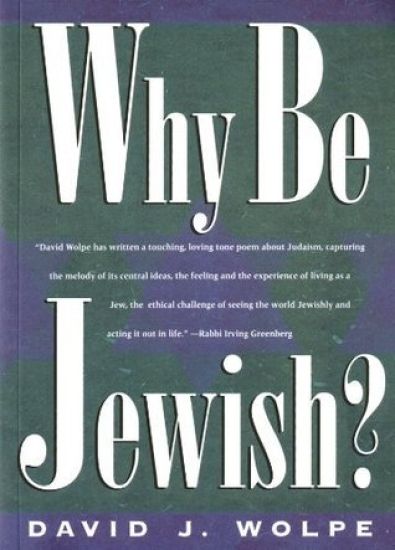
Why Be Jewish?

Why Be Jewish?

David J Wolpe

St. Martins Press-3PL
1995
pokkari
"All beginnings require that you unlock new doors."--Rabbi Nachman of BratslavIn this short and inspiring text, Rabbi David J. Wolpe addresses all who seek to enlarge the spiritual side of their lives. For those considering a return to the faith of their forebears, for those drawn to conversion, " Why Be Jewish?" is a learned, graceful, and welcoming introduction beckoning readers into the heart of this venerable and enduring religion.