
Kirjahaku
Etsi kirjoja tekijän nimen, kirjan nimen tai ISBN:n perusteella.
1000 tulosta hakusanalla Henri Conscience

Henri Rochefort : déportation et évasion d'un polémiste
Joël Dauphiné
Editions L'Harmattan
2022
nidottu

Henri III et sa cour de Alexandre Dumas (fiche de lecture et analyse complète de l'oeuvre)
Alexandre Dumas
Comprendre La Litterature
2022
nidottu
Venez d couvrir Henri III et sa cour d'Alexandre Dumas gr ce une analyse litt raire de r f rence crite par un sp cialiste universitaire, cette fiche de lecture est recommand e par de nombreux enseignants. Cet ouvrage contient la biographie de l' crivain, le r sum d taill , le mouvement litt raire, le contexte de publication de l'oeuvre et l'analyse compl te. Retrouvez tous nos titres sur: www.fichedelecture.fr.

Henri Bergson (étude et analyse complète de sa pensée)
Henri Bergson
Comprendre la philosophie
2022
pokkari
Venez d couvrir la pens e d'Henri Bergson gr ce une analyse philosophique de r f rence crite par un sp cialiste universitaire, cette tude est recommand e par de nombreux enseignants. Cet ouvrage contient notamment la biographie du philosophe, le r sum d taill de sa pens e, ainsi que l'analyse de son courant philosophique. Retrouvez tous nos titres sur: www.fichedelecture.fr.


Henri Wallon (1879-1962): Action Pensée, Pensée de l'Action
Serge Netchine; Gaby Netchine-Grynberg
PIE - Peter Lang
2017
nidottu
Henri Wallon (1879-1962), minent psychologue de l'enfant, fut aussi, partir des ann es 1900, un acteur de la vie intellectuelle et politique fran aise. Cet ouvrage parcourt les grands th mes de ses recherches sur les enfants souffrant ou non de pathologies mentales, en les articulant ses engagements de citoyen et ses positionnements intellectuels. Sont envisag es, au regard du contexte politique et culturel, les prises de position et les actions effectu es par Henri Wallon au cours d'une p riode historique qui fut riche en v nements et en retournements. De plus, cette recherche illustre la d termination d'une doctrine philosophique int grant le r sultat des controverses entre courants spiritualistes et mat rialistes apparues tout au long des XIXe et XXe si cles ainsi que l' laboration d'une d marche scientifique sur le d veloppement psychologique qui int gre des enjeux pratiques et soci taux. Ce livre met finalement en lumi re ce qui, du parcours d'Henri Wallon, m rite d' tre soulign et d'intervenir dans les probl mes contemporains.
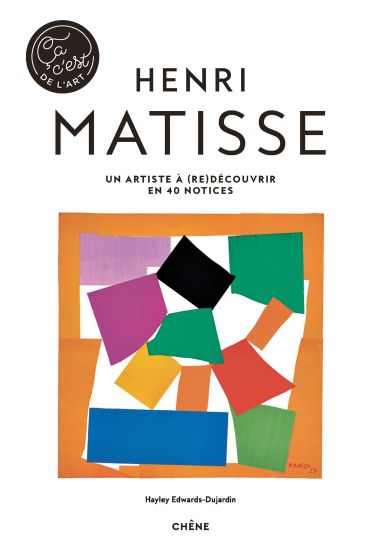
Visste du att det var en attack av blindtarmsinflammation som avslöjade Matisse smak för konst? Att han började med att måla stilleben? Att han ritade porträtten av sina barnbarn i taket på sitt hotellrum i Nice? Att Pablo Picasso förblev hans bästa fiende under hela hans liv? Eller att Andy Warhol sa: "Jag vill vara Matisse" Det är konst, en samling för att (åter)upptäcka de stora konstnärerna i 40 illustrerade meddelanden. • En exakt urval av väsentliga och oväntade verk • Tydliga visuella signaler: tidslinjer, kartor, grafer • Olika rutor: anekdoter, sammanhang, influenser



Henri Cartier-Bresson: The Decisive Moment
Henri Cartier-Bresson
Fondation Henri Cartier-Bresson
2024
sidottu
A new edition of one of the most important and genre-defining photobooks of the twentieth century. The Decisive Moment (Images à la Sauvette in French) is one of the greatest photography books ever published. It brings together photographic material from the first twenty years of Henri Cartier-Bresson’s career. Images à la Sauvette was published in 1952 by Verve, with an original cover by Matisse. It was the result of a collaboration between the photographer, the famous art critic and publisher Tériade, and the painter, at the peak of his career. The American version, published the same year by Simon and Schuster, was the first to introduce the now-famous expression “decisive moment”. The book, which reveals the intrinsic duality of Henri Cartier-Bresson’s work, the combination of intimate interpretation with documentary observation, received tremendous critical acclaim within the art world and is considered a “bible for photographers”, in the words of photographer Robert Capa. It remains an essential reference for photographers to this day. The original book, now out of print, has become a collector’s item. The Fondation Henri Cartier-Bresson sought to make this classic photography book accessible again, in a smaller and practical format, at an affordable price. The latest print features the same material as the original 1952 edition, and is accompanied by a comprehensive study of the book’s making, its enduring popularity and the considerations behind its title, written by Clément Chéroux, Director of the Fondation Henri Cartier-Bresson.
Henri Poincaré: Electrons to Special Relativity
Bruce D Popp
Springer Nature Switzerland AG
2020
sidottu
Produced by an award-winning translator of Henri Poincaré, this book contains translations of several seminal articles by Poincaré and discusses the experimental and theoretical investigations of electrons that form their context. In the 1950s, a dispute ignited about the origin of the theory of special relativity and thrust considerable notoriety on a paper written by Henri Poincaré in 1905. Accordingly, Part I presents the relevant translations of Poincaré’s work showing that radiation carries momentum and the covariance of the equations of electrodynamics, the continuity equation for charge, and the spacetime interval. Part II then discusses investigations by Thomson, Becquerel, and Kaufmann of electrons in diverse contexts; contributions of Abraham, Lorentz and Poincaré to a theory of electrons that includes Lorentz transformations and explains the dependence of mass on velocity; and finally, Poincaré’s exploration of the relativity principle, electron stability, and gravitation while rejecting absolute motion (ether) and an electromagnetic origin of mass. Part III contains the 1904 article by H. A. Lorentz presenting his transformations.This book will be a fascinating read to graduate-level students, physicists, and science historians who are interested in the development of electrodynamics and the classical, relativistic theory of electrons at the beginning of the 20th century.
Henri Poincaré: Electrons to Special Relativity
Bruce D Popp
Springer Nature Switzerland AG
2021
nidottu
Produced by an award-winning translator of Henri Poincaré, this book contains translations of several seminal articles by Poincaré and discusses the experimental and theoretical investigations of electrons that form their context. In the 1950s, a dispute ignited about the origin of the theory of special relativity and thrust considerable notoriety on a paper written by Henri Poincaré in 1905. Accordingly, Part I presents the relevant translations of Poincaré’s work showing that radiation carries momentum and the covariance of the equations of electrodynamics, the continuity equation for charge, and the spacetime interval. Part II then discusses investigations by Thomson, Becquerel, and Kaufmann of electrons in diverse contexts; contributions of Abraham, Lorentz and Poincaré to a theory of electrons that includes Lorentz transformations and explains the dependence of mass on velocity; and finally, Poincaré’s exploration of the relativity principle, electron stability, and gravitation while rejecting absolute motion (ether) and an electromagnetic origin of mass. Part III contains the 1904 article by H. A. Lorentz presenting his transformations.This book will be a fascinating read to graduate-level students, physicists, and science historians who are interested in the development of electrodynamics and the classical, relativistic theory of electrons at the beginning of the 20th century.
Henri Lefebvre's Critical Theory of Space
Francesco Biagi
Springer Nature Switzerland AG
2020
sidottu
Henri Lefebvre's Critical Theory of Space offers a rigorous analysis and revival of Lefebvre’s works and the context in which he produced them. Biagi traces the historical-critical time-frame of Lefebvre's intellectual investigations, bringing to light a theoretical constellation in which historical methods intersect with philosophical and sociological issues: from Marxist political philosophy to the birth of urban sociology; from rural studies to urban and everyday life studies in the context of capitalism. Examining Lefebvre’s extended investigations into the urban sphere as well as highlighting his goal of developing a “general political theory of space” and of innovating Marxist thought, and clarifying the various (more or less accurate) meanings attributed to Lefebvre's concept of the “right to the city” (analysed in the context of the French and international sociological and philosophical-political debate), Henri Lefebvre's Critical Theory of Space ultimately brings the contours of Lefebvre’s innovative perspective—itself developed at the end of the “short twentieth century”—back into view in all its richness and complexity.
Henri Lefebvre's Critical Theory of Space
Francesco Biagi
Springer Nature Switzerland AG
2021
nidottu
Henri Lefebvre's Critical Theory of Space offers a rigorous analysis and revival of Lefebvre’s works and the context in which he produced them. Biagi traces the historical-critical time-frame of Lefebvre's intellectual investigations, bringing to light a theoretical constellation in which historical methods intersect with philosophical and sociological issues: from Marxist political philosophy to the birth of urban sociology; from rural studies to urban and everyday life studies in the context of capitalism. Examining Lefebvre’s extended investigations into the urban sphere as well as highlighting his goal of developing a “general political theory of space” and of innovating Marxist thought, and clarifying the various (more or less accurate) meanings attributed to Lefebvre's concept of the “right to the city” (analysed in the context of the French and international sociological and philosophical-political debate), Henri Lefebvre's Critical Theory of Space ultimately brings the contours of Lefebvre’s innovative perspective—itself developed at the end of the “short twentieth century”—back into view in all its richness and complexity.

Henri Poincaré, 1912–2012
Birkhauser Verlag AG
2014
sidottu
This thirteenth volume of the Poincaré Seminar Series, Henri Poincaré, 1912-2012, is published on the occasion of the centennial of the death of Henri Poincaré in 1912. It presents a scholarly approach to Poincaré’s genius and creativity in mathematical physics and mathematics. Its five articles are also highly pedagogical, as befits their origin in lectures to a broad scientific audience. Highlights include “Poincaré’s Light” by Olivier Darrigol, a leading historian of science, who uses light as a guiding thread through much of Poincaré ’s physics and philosophy, from the application of his superior mathematical skills and the theory of diffraction to his subsequent reflections on the foundations of electromagnetism and the electrodynamics of moving bodies; the authoritative “Poincaré and the Three-Body Problem” by Alain Chenciner, who offers an exquisitely detailed, hundred-page perspective, peppered with vivid excerpts from citations, on the monumental work of Poincaré onthis subject, from the famous (King Oscar’s) 1889 memoir to the foundations of the modern theory of chaos in “Les méthodes nouvelles de la mécanique céleste.” A profoundly original and scholarly presentation of the work by Poincaré on probability theory is given by Laurent Mazliak in “Poincaré’s Odds,” from the incidental first appearance of the word “probability” in Poincaré’s famous 1890 theorem of recurrence for dynamical systems, to his later acceptance of the unavoidability of probability calculus in Science, as developed to a great extent by Emile Borel, Poincaré’s main direct disciple; the article by Francois Béguin, “Henri Poincaré and the Uniformization of Riemann Surfaces,” takes us on a fascinating journey through the six successive versions in twenty-six years of the celebrated uniformization theorem, which exemplifies the Master’s distinctive signature in the foundational fusion of mathematics and physics, on which conformal field theory, string theory and quantum gravityso much depend nowadays; the final chapter, “Harmony and Chaos, On the Figure of Henri Poincaré” by the filmmaker Philippe Worms, describes the homonymous poetical film in which eminent scientists, through mathematical scenes and physical experiments, display their emotional relationship to the often elusive scientific truth and universal “harmony and chaos” in Poincaré’s legacy.This book will be of broad general interest to physicists, mathematicians, philosophers of science and historians.


Henri-Joseph Du Laurens: Der Gevatter Matthies Oder Die Ausschweifungen Des Menschlichen Geistes. Teil 2
Henri Joseph Dulaurens
De Gruyter
1791
sidottu

Henri-Joseph Du Laurens: Der Gevatter Matthies Oder Die Ausschweifungen Des Menschlichen Geistes. Teil 1
Henri Joseph Dulaurens
De Gruyter
1791
sidottu