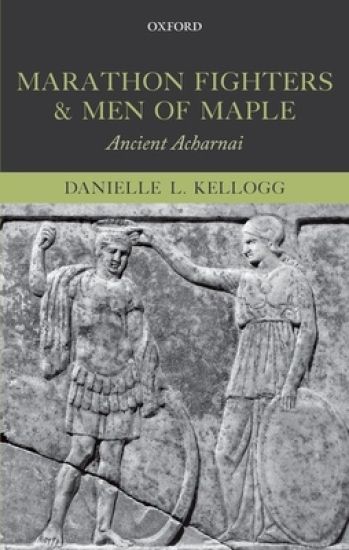
In ancient Athenian democracy there were one hundred and thirty-nine official demes, or recognized population centres, which formed the foundation of the political system introduced by Kleisthenes in 508/7 BC. Enrolment in one of these demes was a prerequisite for citizenship and participation in the Athenian socio-political system. Acharnai was by far the largest of the Kleisthenic demes and one of the best known from the ancient sources, most notably Thucydides and Aristophanes' comedy Acharnians; it therefore provides a rare opportunity for a comprehensive investigation into the workings of a rural deme. In this volume, Kellogg combines literary, prosopographical, epigraphical, and archaeological evidence to create an encompassing overview of this dynamic and historical settlement with a well-developed identity and unique traditions. Such an investigation also functions as a corrective to a 'one size fits all' approach to rural Attica, which privileges the city and its political and economic opportunities over the countryside where most of the Athenian citizenry lived. This volume constitutes a new and distinctive contribution to the study of ancient Athens, and is a major advance in the analysis of the critically important role of the Attic demes in the economic, political, social, and religious structures of Athenian democracy.
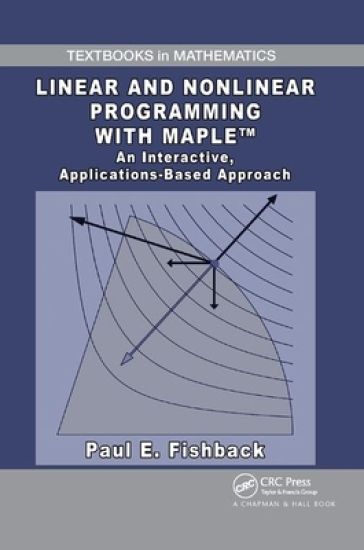
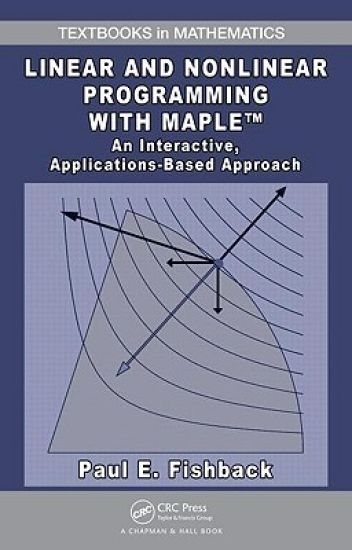
Helps Students Understand Mathematical Programming Principles and Solve Real-World ApplicationsSupplies enough mathematical rigor yet accessible enough for undergraduatesIntegrating a hands-on learning approach, a strong linear algebra focus, Maple™ software, and real-world applications, Linear and Nonlinear Programming with Maple™: An Interactive, Applications-Based Approach introduces undergraduate students to the mathematical concepts and principles underlying linear and nonlinear programming. This text fills the gap between management science books lacking mathematical detail and rigor and graduate-level books on mathematical programming. Essential linear algebra toolsThroughout the text, topics from a first linear algebra course, such as the invertible matrix theorem, linear independence, transpose properties, and eigenvalues, play a prominent role in the discussion. The book emphasizes partitioned matrices and uses them to describe the simplex algorithm in terms of matrix multiplication. This perspective leads to streamlined approaches for constructing the revised simplex method, developing duality theory, and approaching the process of sensitivity analysis. The book also discusses some intermediate linear algebra topics, including the spectral theorem and matrix norms. Maple enhances conceptual understanding and helps tackle problemsAssuming no prior experience with Maple, the author provides a sufficient amount of instruction for students unfamiliar with the software. He also includes a summary of Maple commands as well as Maple worksheets in the text and online. By using Maple’s symbolic computing components, numeric capabilities, graphical versatility, and intuitive programming structures, students will acquire a deep conceptual understanding of major mathematical programming principles, along with the ability to solve moderately sized rea
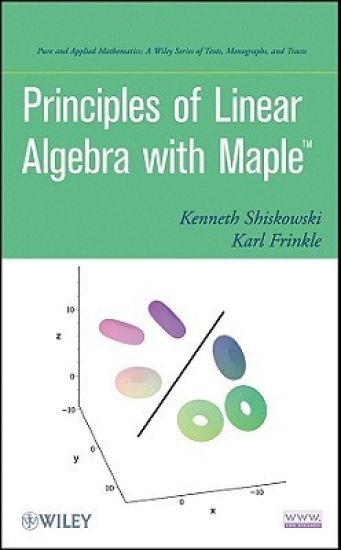
An accessible introduction to the theoretical and computational aspects of linear algebra using MapleTM Many topics in linear algebra can be computationally intensive, and software programs often serve as important tools for understanding challenging concepts and visualizing the geometric aspects of the subject. Principles of Linear Algebra with Maple uniquely addresses the quickly growing intersection between subject theory and numerical computation, providing all of the commands required to solve complex and computationally challenging linear algebra problems using Maple. The authors supply an informal, accessible, and easy-to-follow treatment of key topics often found in a first course in linear algebra. Requiring no prior knowledge of the software, the book begins with an introduction to the commands and programming guidelines for working with Maple. Next, the book explores linear systems of equations and matrices, applications of linear systems and matrices, determinants, inverses, and Cramer's rule. Basic linear algebra topics such as vectors, dot product, cross product, and vector projection are explained, as well as the more advanced topics of rotations in space, rolling a circle along a curve, and the TNB Frame. Subsequent chapters feature coverage of linear transformations from Rn to Rm, the geometry of linear and affine transformations, least squares fits and pseudoinverses, and eigenvalues and eigenvectors. The authors explore several topics that are not often found in introductory linear algebra books, including sensitivity to error and the effects of linear and affine maps on the geometry of objects. The Maple software highlights the topic's visual nature, as the book is complete with numerous graphics in two and three dimensions, animations, symbolic manipulations, numerical computations, and programming. In addition, a related Web site features supplemental material, including Maple code for each chapter's problems, solutions, and color versions of the book's figures. Extensively class-tested to ensure an accessible presentation, Principles of Linear Algebra with Maple is an excellent book for courses on linear algebra at the undergraduate level. It is also an ideal reference for students and professionals who would like to gain a further understanding of the use of Maple to solve linear algebra problems.
Science demands that all theory must be checked by experiment. Richard Feyn man, Nobel Laureate in physics (1965), reminds us in a wonderful quote that "The test of all knowledge is experiment. Experiment is the sole judge of sci entific truth. " 1 It is because nonlinear physics can be so profoundly counter intuitive that these laboratory investigations are so important. This manual is designed to be used with the text Nonlinear Physics with Maple for Scientists and Engineers. Understanding is enhanced when experiments are used to check so please attempt as many of the activities as you can. As you perform theory, these activities, we hope that you will be amazed and startled by strange behav ior, intrigued and terrorized by new ideas, and be able to amaze your friends as you relate your strange sightings! Remember that imagination is just as impor tant as knowledge, so exercise yours whenever possible. But please be careful, as nonlinear activities can be addicting, can provide fond memories, and can awaken an interest that lasts a lifetime. Although it has been said that a rose by any other name is still a rose, (with apologies to Shakespeare) the authors of this laboratory manual have, in an endeavor to encourage the use of these nonlinear investigations, called them experimental activities rather than experiments. A number of design innovations have been introduced: A.
2020 Christy Award Winner"A heartbreakingly beautiful romance...truly, a story that will capture your heart." New York Times bestselling author Courtney Walsh Last year, after traumatic circumstances forced her from her job as a nanny, Mara Bristol finally found a place to belong--the winsome Everwood Bed & Breakfast at the edge of Maple Valley, Iowa. For months, she's helped its owner, Lenora, maintain the ramshackle property despite their shortage of guests. But when Lenora fails to return from a month-long trip and the bank threatens foreclosure, Mara worries she's once again alone . . . abandoned . . . about to lose the only true home she's ever known.Detective Marshall Hawkins is no closer to whole today than he was two years ago . . . the day his daughter died. Between his divorce, debilitating migraines, and a dependence on medication, his life is falling apart. And when a reckless decision on the job propels him into administrative leave, he has no other plan but to get in his truck and drive. A one-night stay at the Everwood was supposed to be just that. But there's something about the old house--or maybe its intriguing caretaker--that pulls him in.Together, Mara and Marshall set out to save the Everwood. But its secrets run deeper than they could've imagined. As they renovate the house and search for its missing owner, they'll each confront the pain that brought them to the Everwood in the first place . . . and just maybe discover a faith and love to help them carry on.Other Books by Melissa TaggWalker Family SeriesThree Little Words (prequel novella)From the StartLike Never BeforeKeep Holding OnAll This TimeEnchanted Christmas CollectionOne Enchanted ChristmasOneEnchanted EveOne Enchanted NoelWhere Love Begins SeriesMade to LastHere to StayNovellasA Place to Belong (A Maple Valley Romance)One Royal Christmas
This text is designed to update the Differential Geometry course by making it more relevant to today’s students. This new approach emphasizes applications and computer programs aimed at twenty-first-century audiences. It is intended for mathematics students, applied scientists, and engineers who attempt to integrate differential geometry techniques in their work or research.The course can require students to carry out a daunting amount of time-consuming hand computations like the computation of the Christoffel Symbols. As a result, the scope of the applied topics and examples possible to cover might be limited. In addition, most books on this topic have only a scant number of applications.The book is meant to evolve the course by including topics that are relevant to students. To achieve this goal the book uses numerical, symbolic computations, and graphical tools as an integral part of the topics presented. The provides students with a set of Maple/Matlab programs that will enable them to explore the course topics visually and in depth. These programs facilitate topic and application integration and provide the student with visual enforcement of the concepts, examples, and exercises of varying complexity.This unique text will empower students and users to explore in-depth and visualize the topics covered, while these programs can be easily modified for other applications or other packages of numerical/symbolic languages. The programs are available to download to instructors and students using the book for coursework.
This text is designed to update the Differential Geometry course by making it more relevant to today’s students. This new approach emphasizes applications and computer programs aimed at twenty-first-century audiences. It is intended for mathematics students, applied scientists, and engineers who attempt to integrate differential geometry techniques in their work or research.The course can require students to carry out a daunting amount of time-consuming hand computations like the computation of the Christoffel Symbols. As a result, the scope of the applied topics and examples possible to cover might be limited. In addition, most books on this topic have only a scant number of applications.The book is meant to evolve the course by including topics that are relevant to students. To achieve this goal the book uses numerical, symbolic computations, and graphical tools as an integral part of the topics presented. The provides students with a set of Maple/Matlab programs that will enable them to explore the course topics visually and in depth. These programs facilitate topic and application integration and provide the student with visual enforcement of the concepts, examples, and exercises of varying complexity.This unique text will empower students and users to explore in-depth and visualize the topics covered, while these programs can be easily modified for other applications or other packages of numerical/symbolic languages. The programs are available to download to instructors and students using the book for coursework.
Marty the Moose is making maple muffins, and making a mess. Follow along with Marty as he tries to remember his tongue twisting recipe, step by step.An outrageously funny read aloud or early readers book.
The 18th century was a wealth of knowledge, exploration and rapidly growing technology and expanding record-keeping made possible by advances in the printing press. In its determination to preserve the century of revolution, Gale initiated a revolution of its own: digitization of epic proportions to preserve these invaluable works in the largest archive of its kind. Now for the first time these high-quality digital copies of original 18th century manuscripts are available in print, making them highly accessible to libraries, undergraduate students, and independent scholars.Medical theory and practice of the 1700s developed rapidly, as is evidenced by the extensive collection, which includes descriptions of diseases, their conditions, and treatments. Books on science and technology, agriculture, military technology, natural philosophy, even cookbooks, are all contained here.++++The below data was compiled from various identification fields in the bibliographic record of this title. This data is provided as an additional tool in helping to insure edition identification: ++++British LibraryW042788Philadelphia: printed by R. Aitken & Son, for a Society of gentlemen, 1792. 16p.; 8
Helps Students Understand Mathematical Programming Principles and Solve Real-World ApplicationsSupplies enough mathematical rigor yet accessible enough for undergraduatesIntegrating a hands-on learning approach, a strong linear algebra focus, Maple™ software, and real-world applications, Linear and Nonlinear Programming with Maple™: An Interactive, Applications-Based Approach introduces undergraduate students to the mathematical concepts and principles underlying linear and nonlinear programming. This text fills the gap between management science books lacking mathematical detail and rigor and graduate-level books on mathematical programming. Essential linear algebra toolsThroughout the text, topics from a first linear algebra course, such as the invertible matrix theorem, linear independence, transpose properties, and eigenvalues, play a prominent role in the discussion. The book emphasizes partitioned matrices and uses them to describe the simplex algorithm in terms of matrix multiplication. This perspective leads to streamlined approaches for constructing the revised simplex method, developing duality theory, and approaching the process of sensitivity analysis. The book also discusses some intermediate linear algebra topics, including the spectral theorem and matrix norms. Maple enhances conceptual understanding and helps tackle problemsAssuming no prior experience with Maple, the author provides a sufficient amount of instruction for students unfamiliar with the software. He also includes a summary of Maple commands as well as Maple worksheets in the text and online. By using Maple’s symbolic computing components, numeric capabilities, graphical versatility, and intuitive programming structures, students will acquire a deep conceptual understanding of major mathematical programming principles, along with the ability to solve moderately sized rea
This concise text on geometry with computer modeling presents some elementary methods for analytical modeling and visualization of curves and surfaces. The author systematically examines such powerful tools as 2-D and 3-D animation of geometric images, transformations, shadows, and colors, and then further studies more complex problems in differential geometry. Well-illustrated with more than 350 figures---reproducible using Maple programs in the book---the work is devoted to three main areas: curves, surfaces, and polyhedra. Pedagogical benefits can be found in the large number of Maple programs, some of which are analogous to C++ programs, including those for splines and fractals. To avoid tedious typing, readers will be able to download many of the programs from the Birkhauser web site. Aimed at a broad audience of students, instructors of mathematics, computer scientists, and engineers who have knowledge of analytical geometry, i.e., method of coordinates, this text will be an excellent classroom resource or self-study reference. With over 100 stimulating exercises, problems and solutions, {\it Geometry of Curves and Surfaces with Maple} will integrate traditional differential and non- Euclidean geometries with more current computer algebra systems in a practical and user-friendly format.
The book presents an introduction to Stochastic Processes including Markov Chains, Birth and Death processes, Brownian motion and Autoregressive models. The emphasis is on simplifying both the underlying mathematics and the conceptual understanding of random processes. In particular, non-trivial computations are delegated to a computer-algebra system, specifically Maple (although other systems can be easily substituted). Moreover, great care is taken to properly introduce the required mathematical tools (such as difference equations and generating functions) so that even students with only a basic mathematical background will find the book self-contained. Many detailed examples are given throughout the text to facilitate and reinforce learning.Jan Vrbik has been a Professor of Mathematics and Statistics at Brock University in St Catharines, Ontario, Canada, since 1982. Paul Vrbik is currently a PhD candidate in Computer Science at the University of Western Ontario in London, Ontario, Canada..
Harvard honor alumnus Dale Maple had a promising future, but his obsession with Nazi Germany led to his downfall. Classmates often accused him of pro-Nazi sentiments, and one campus organization even expelled him. After graduation, he enlisted in the U.S. Army, only to be relegated to a unit of soldiers suspected of harboring German sympathies. He helped two German POWs escape imprisonment at Camp Hale and flee to Mexico. The fugitives ran out of gas seventeen miles from the border and managed to cross it on foot, only to be arrested and returned to American authorities. Convicted and sentenced to death for treason, Maple awaited his fate until President Franklin Roosevelt commuted his sentence to life imprisonment. Ultimately, he was released in 1950. Paul N. Herbert narrates the engrossing details of this riveting story.
There is much history in the Bull City, and some of it can be found within these pages. Journalist and local historian Jim Wise relates how Bull Durham smoking tobacco put Durham, North Carolina, on the map; how a plastic cow and an oversized flag cut the city council down to size; how it felt to travel back in time at the Duke Homestead; and how sportsman Al Mann and "Mom" Ruby Planck left indelible marks on their hometown. Durham's stories are its own, but in them readers may find people, places and truths that resonate with hometowns everywhere.