Kirjojen hintavertailu. Mukana 12 390 323 kirjaa ja 12 kauppaa.

Kirjahaku

Etsi kirjoja tekijän nimen, kirjan nimen tai ISBN:n perusteella.

1000 tulosta hakusanalla Mathias Jüsche

Oriental Dreams

Oriental Dreams

Mathias Ary Jan; Claire Maingon

Editions Norma
2023
sidottu
This beautifully illustrated book, with over 300 colour reproductions, showcases many of the greatest masterpieces of 19th century Orientalist art. During this period, colonization, and a revolution in means of transportation allowed artists to visit countries from North Africa to the Middle East that had previously been relatively inaccessible. The patterns, colours, and light of this region influenced artists such as Delacroix, Decamps, Berche`re, Bridgman, Ziem, Ge´ro^me, Corrodi, Dinet, Matisse, Majorelle and many others. Upon returning to Europe, these artists captured the atmosphere of these distant and exotic lands in painted scenes of daily life and wrote memoirs of their travels. Some returned to settle there, including painters like Dinet, who spent a large part of his life in Algeria, and Majorelle, known as the “painter of Marrakech.” This book offers insight into the Orientalist aesthetic that inspired the movement, and lays the groundwork for a deeper understanding of these vibrant works of art. Text in English and French.
Envolées fugaces

Envolées fugaces

Mathias Atayi

Euphorie Chimerique Editions
2018
pokkari
Mathias Atayi, rugbyman de m tier le jour et po te une fois la nuit tomb e, se livre coeur ouvert dans un ouvrage fleur de peau. Il nous d voile, sans d tour, ses pens es, ses rancoeurs, ses peines et ses sentiments sous forme de po mes. travers ses crits, il nous d peint un monde plus humain et le lecteur remarquera, d s les premi res lignes, que les Envol es fugaces sont bien plus qu'un simple recueil de po sie, en effet, elles sont galement un trait philosophique o l'auteur m dite sur la condition humaine et ses valeurs. C'est un loge profond au bonheur, la tol rance et l'amour. Il s'agit galement d'un pamphlet contre l' go sme, la haine, le d sespoir et la barbarie. Avec beaucoup de fra cheur, le lecteur est invit partager un moment privil gi de po sie avec l'auteur qui nous r v le une vision plus douce de la vie moderne. Tr s agr ables lire, les po mes de Mathias nous emportent dans son monde plein d' motions. "Un go t prononc pour les mots et les belles formules, tout comme mon int r t et ma curiosit naturelle pour autrui m'ont pouss crire ce bouquin." Mathias Atayi
La Réconciliation Franco-Allemande Par La Jeunesse

La Réconciliation Franco-Allemande Par La Jeunesse

Mathias Delori

Peter Lang AG, Internationaler Verlag der Wissenschaften
2016
nidottu
Les guerres prennent souvent naissance dans les representations mutuelles, les sentiments de haine reciproque et le desir de revanche des populations. Les jeunes se trouvent souvent en premiere ligne dans ce mecanisme. Au cours de la Premiere guerre mondiale, par exemple, les jeunes Europeens se sont mutuellement entretues au rythme de 1000 personnes par jour. Conscients de ce phenomene, des pacifistes et des antimilitaristes ont propose, des le tournant des XIXe et XXe siecle, de faire de la jeunesse l'objet de leur propagande pour la paix. Leurs propositions ont rarement franchi le rubicond de la sphere politique. Il existe cependant au moins une exception: en 1963, les gouvernements francais et ouest-allemand ont mis en place une politique ambitieuse de reconciliation centree sur les echanges de jeunes. La plupart des auteurs qui se sont interesses a cette politique publique ont adopte une perspective hagiographique. Cet ouvrage propose au contraire de normaliser cet objet d'etude en s'appuyant sur la methode genealogique developpee par Michel Foucault. Le livre etudie la genese (de 1871 a 1963), la mise en oeuvre (de 1963 a 1973) et la revision (depuis 1973) de cette politique de reconciliation par la jeunesse. Il s'adresse autant aux personnes interessees par cet aspect particulier du rapprochement franco-allemand qu'a celles qui veulent comprendre, d'une maniere plus generale, l'interet et les limites des politiques de socialisation a la cause de la paix.
Les conditions et les oraisons de la Tijaniya

Les conditions et les oraisons de la Tijaniya

Mathias Eichhorn

Mathias Eichhorn
2021
pokkari
Quelqu'un pourrait ne pas comprendre et dire: il y a d j tant de livres riches et suffisants qu'il est peu avantageux d' crire un de plus aujourd'hui. Celui qui dit cela a raison: les livres sont v ritablement nombreux et devraient suffire. Mais il a galement tort quand il dit que la composition des nouveaux livres n'est pas b n fique. En effet, les coeurs des humains sont, par leur nature, attir s vers toute chose nouvelle, et Allah donne la science chaque poque selon le contexte actuel afin que les gens puissent comprendre le mieux possible. Ce livre que vous avez sous les yeux s'inscrit justement dans cet esprit d' ducation perp tuelle. Il s'inspire des secrets spirituels du Coran, de la Sunna et des livres des plus grands Ma tres de la voie de la Tijaniya pour vous aider raviver votre foi, surmonter vos doutes et approfondir votre lien avec Allah.Gr ce des citations des Ma tres de la Tijaniya et de textes classiques, vous d velopperez la connaissance des pratiques spirituelles - profond ment ancr es dans la vaste tradition islamique - n cessaires pour mieux conna tre cette voix au point de ne plus en douter, voire la critiquer. Les passages de ce livre sont votre boussole et constituent le manuel qui vous ram nera directement aux sources des pratiques de la spiritualit islamique. travers les principes et les pratiques du Soufisme, vous apprendrez comment d velopper votre potentiel spirituel et d voiler la perfection personnelle. Les conditions et les oraisons de la Tijaniya utilise une approche rationnelle, traditionnelle, bas e sur les crits des plus grands Ma tres, qui non seulement claire les principes de la spiritualit islamique, mais inspire l' me vers une intimit plus profonde avec Allah. M. Eichhorn a plus de 20 ans d'exp rience d' tudes et de pratique de la voie spirituelle de la Tijaniya, dans l' criture et la traduction des crits des rudits de cette voie. Au cours des derni res ann es, il a inspir ses lecteurs par son approche rationnelle et traditionnelle, toujours fond e sur les crits classiques et ax e sur la spiritualit islamique, afin d'aider les autres surmonter les difficult s spirituelles dans leur qu te de l'amour divin.
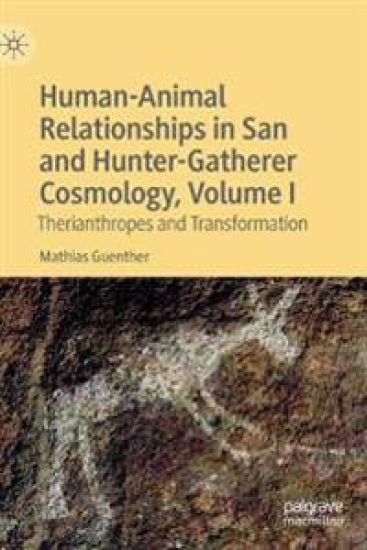
Human-Animal Relationships in San and Hunter-Gatherer Cosmology, Volume I
Exploring a hitherto unexamined aspect of San cosmology, Mathias Guenther’s two volumes on human-animal relations in San cosmology link “new Animism” with Khoisan Studies, providing valuable insights for Khoisan Studies and San culture, but also for anthropological theory, relational ontology, folklorists, historians, literary critics and art historians. In Volume I, therianthropes and transformations, two manifestations of ontological mutability that are conceptually and phenomenologically linked, are contextualized in broader San myth. Guenther explores the pervasiveness of human-animal hybridity and transformation in San expressive culture (myth, stories and storytelling, ludic dancing and art, ancestral rock art and contemporary easel art), ritual (trance dance curing, female and male rites of passage) and hunting. Transformation is shown to be experienced by humans, particularly via rituals and dancing that evoke animal identity mergers, but also by hunters who may engage with their prey animals in terms of sympathy and inter-subjectivity, particularly through the use of “hunting medicines.”
Human-Animal Relationships in San and Hunter-Gatherer Cosmology, Volume I
Exploring a hitherto unexamined aspect of San cosmology, Mathias Guenther’s two volumes on human-animal relations in San cosmology link “new Animism” with Khoisan Studies, providing valuable insights for Khoisan Studies and San culture, but also for anthropological theory, relational ontology, folklorists, historians, literary critics and art historians. In Volume I, therianthropes and transformations, two manifestations of ontological mutability that are conceptually and phenomenologically linked, are contextualized in broader San myth. Guenther explores the pervasiveness of human-animal hybridity and transformation in San expressive culture (myth, stories and storytelling, ludic dancing and art, ancestral rock art and contemporary easel art), ritual (trance dance curing, female and male rites of passage) and hunting. Transformation is shown to be experienced by humans, particularly via rituals and dancing that evoke animal identity mergers, but also by hunters who may engage with their prey animals in terms of sympathy and inter-subjectivity, particularly through the use of “hunting medicines.”
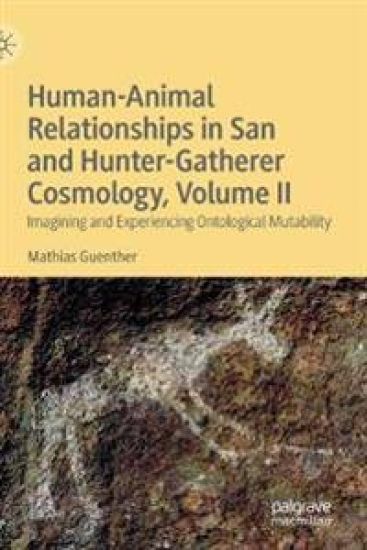
Human-Animal Relationships in San and Hunter-Gatherer Cosmology, Volume II
Exploring a hitherto unexamined aspect of San cosmology, Mathias Guenther’s two volumes on human-animal relations in San cosmology link “new Animism” with Khoisan Studies, providing valuable insights for Khoisan Studies and San culture, but also for anthropological theory, relational ontology, folklorists, historians, literary critics and art historians. Building from the examinations of San myth and contemporary culture in Volume I, Volume II considers the experiential implications of a cosmology in which ontological mutability—ambiguity and inconstancy—hold sway. As he considers how people experience ontological mutability and deal with profound identity issues mentally and affectively, Guenther explores three primary areas: general receptiveness to ontological ambiguity; the impact of the experience of transformation (both virtual/vicarious and actual/direct); and the intersection of the mythic, spirit world with reality. Through a comparative consideration of animistic cosmology amongst the San, Bantu-speakers and the Inuit of Canada’s eastern Arctic, alongside a discussion of animistic currents in Western humanities and ethology, Guenther clearly paints the relative strengths and weaknesses of New Animism discourse, particularly in relation to San ontology and cosmology, but with overarching relevance.
Human-Animal Relationships in San and Hunter-Gatherer Cosmology, Volume II
Exploring a hitherto unexamined aspect of San cosmology, Mathias Guenther’s two volumes on human-animal relations in San cosmology link “new Animism” with Khoisan Studies, providing valuable insights for Khoisan Studies and San culture, but also for anthropological theory, relational ontology, folklorists, historians, literary critics and art historians. Building from the examinations of San myth and contemporary culture in Volume I, Volume II considers the experiential implications of a cosmology in which ontological mutability—ambiguity and inconstancy—hold sway. As he considers how people experience ontological mutability and deal with profound identity issues mentally and affectively, Guenther explores three primary areas: general receptiveness to ontological ambiguity; the impact of the experience of transformation (both virtual/vicarious and actual/direct); and the intersection of the mythic, spirit world with reality. Through a comparative consideration of animistic cosmology amongst the San, Bantu-speakers and the Inuit of Canada’s eastern Arctic, alongside a discussion of animistic currents in Western humanities and ethology, Guenther clearly paints the relative strengths and weaknesses of New Animism discourse, particularly in relation to San ontology and cosmology, but with overarching relevance.
Inverse Problems

Inverse Problems

Mathias Richter

Springer Nature Switzerland AG
2021
nidottu
This textbook is an introduction to the subject of inverse problems with an emphasis on practical solution methods and applications from geophysics. The treatment is mathematically rigorous, relying on calculus and linear algebra only; familiarity with more advanced mathematical theories like functional analysis is not required. Containing up-to-date methods, this book will provide readers with the tools necessary to compute regularized solutions of inverse problems. A variety of practical examples from geophysics are used to motivate the presentation of abstract mathematical ideas, thus assuring an accessible approach.Beginning with four examples of inverse problems, the opening chapter establishes core concepts, such as formalizing these problems as equations in vector spaces and addressing the key issue of ill-posedness. Chapter Two then moves on to the discretization of inverse problems, which is a prerequisite for solving them on computers. Readers will be well-prepared for the final chapters that present regularized solutions of inverse problems in finite-dimensional spaces, with Chapter Three covering linear problems and Chapter Four studying nonlinear problems. Model problems reflecting scenarios of practical interest in the geosciences, such as inverse gravimetry and full waveform inversion, are fully worked out throughout the book. They are used as test cases to illustrate all single steps of solving inverse problems, up to numerical computations. Five appendices include the mathematical foundations needed to fully understand the material.This second edition expands upon the first, particularly regarding its up-to-date treatment of nonlinear problems. Following the author’s approach, readers will understand the relevant theory and methodology needed to pursue more complex applications. Inverse Problems is ideal for graduate students and researchers interested in geophysics and geosciences.
Visual Information Retrieval Using Java and LIRE

Visual Information Retrieval Using Java and LIRE

Mathias Lux; Oge Marques

Springer International Publishing AG
2013
nidottu
Visual information retrieval (VIR) is an active and vibrant research area, which attempts at providing means for organizing, indexing, annotating, and retrieving visual information (images and videos) from large, unstructured repositories. The goal of VIR is to retrieve matches ranked by their relevance to a given query, which is often expressed as an example image and/or a series of keywords. During its early years (1995-2000), the research efforts were dominated by content-based approaches contributed primarily by the image and video processing community. During the past decade, it was widely recognized that the challenges imposed by the lack of coincidence between an image's visual contents and its semantic interpretation, also known as semantic gap, required a clever use of textual metadata (in addition to information extracted from the image's pixel contents) to make image and video retrieval solutions efficient and effective. The need to bridge (or at least narrow) the semantic gap has been one of the driving forces behind current VIR research. Additionally, other related research problems and market opportunities have started to emerge, offering a broad range of exciting problems for computer scientists and engineers to work on. In this introductory book, we focus on a subset of VIR problems where the media consists of images, and the indexing and retrieval methods are based on the pixel contents of those images -- an approach known as content-based image retrieval (CBIR). We present an implementation-oriented overview of CBIR concepts, techniques, algorithms, and figures of merit. Most chapters are supported by examples written in Java, using Lucene (an open-source Java-based indexing and search implementation) and LIRE (Lucene Image REtrieval), an open-source Java-based library for CBIR. Table of Contents: Introduction / Information Retrieval: Selected Concepts and Techniques / Visual Features / Indexing Visual Features / LIRE: An Extensible Java CBIR Library / Concluding Remarks