Pierre-Simon Laplace (1749-1827) is remembered amoung probabilitists today particularly for his "Theorie analytique des probabilites", published in 1812. The "Essai philosophique dur les probabilites" is his introduction for the second edition of this work. Here Laplace provided a popular exposition on his "Theorie". The "Essai", based on a lecture on probability given by Laplace in 1794, underwent sweeping changes, almost doubling in size, in the various editions published during Laplace's lifetime. Translations of various editions in different languages have apeared over the years. The only English translation of 1902 reads awkwardly today. This is a thorough and modern translation based on the recent re-issue, with its voluminous notes, of the fifth edition of 1826, with preface by Rene Thom and postscript by Bernard Bru. In the second part of the book, the reader is provided with an extensive commentary by the translator including valuable histographical and mathematical remarks and various proofs.
The French social theorist Pierre Bourdieu was a key thinker about education and educational processes in the second half of the twentieth century. He made his name in seminal texts such as The Inheritors and Reproduction in which he analysed academic discourse and showed how differences in cultural capital led to different outcomes for those who passed through school and university. His concepts of Habitus and Field have since been used extensively in educational research. This book begins by setting his intellectual development within his own biography and then discusses each of his major works on education in turn: from the early studies of students and their learning to later analyses of the French academic space and the elite training colleges. There is also critical discussion of a range of commentators’ views on this approach. The book concludes with a series of applications of Bourdieusian thinking on various educational topics: teacher education, classroom discourse, higher education and policy. No educational discussion is complete without consideration from a Bourdieusian perspective. This book shows how and why.
This collection of writings from Pierre Hadot (1992-2010) presents, for the first time, previously unreleased and in some cases untranslated materials from one of the world's most prominent classical philosophers and historians of thought. As a passionate proponent of philosophy as a 'way of life' (most powerfully communicated in the life of Socrates), Pierre Hadot rejuvenated interest in the ancient philosophers and developed a philosophy based on their work which is peculiarly contemporary. His radical recasting of philosophy in the West was both provocative and substantial. Indeed, Michel Foucault cites Pierre Hadot as a major influence on his work. This beautifully written, lucid collection of writings will not only be of interest to historians, classicists and philosophers but also those interested in nourishing, as Pierre Hadot himself might have put it, a 'spiritual life'.
This collection of writings from Pierre Hadot (1992-2010) presents, for the first time, previously unreleased and in some cases untranslated materials from one of the world's most prominent classical philosophers and historians of thought. As a passionate proponent of philosophy as a 'way of life' (most powerfully communicated in the life of Socrates), Pierre Hadot rejuvenated interest in the ancient philosophers and developed a philosophy based on their work which is peculiarly contemporary. His radical recasting of philosophy in the West was both provocative and substantial. Indeed, Michel Foucault cites Pierre Hadot as a major influence on his work. This beautifully written, lucid collection of writings will not only be of interest to historians, classicists and philosophers but also those interested in nourishing, as Pierre Hadot himself might have put it, a 'spiritual life'.
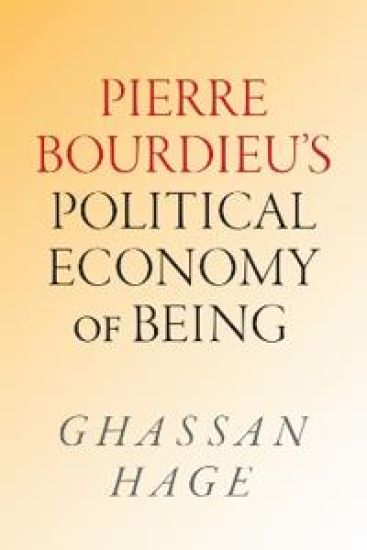
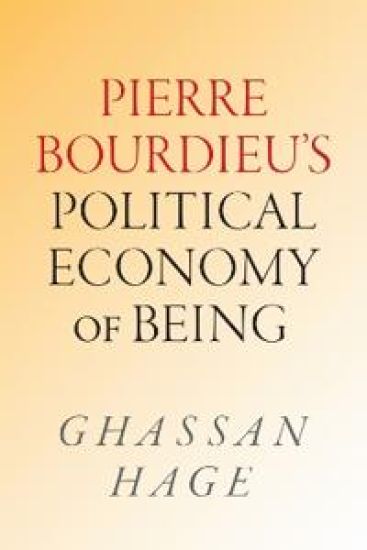
In Pierre Bourdieu's Political Economy of Being, Ghassan Hage explores the great French social theorist's work and revitalizes conventional and undertheorized aspects of his thinking. Hage focuses on Bourdieu's concern with social being and what constitutes a worthwhile and fulfilling life. Such a life is not something that one either has or does not have; rather, society distributes and assigns values to ways of living. These values are structured by relations of power and domination and are subject to the outcome of political conflicts. Hage elucidates this political economy of being by reworking Bourdieu's key concepts of habitus, illusion, symbolic capital, and field. In this political economy, people enjoy a worthwhile life to the degree that they are able to orient and deploy themselves practically in the world that surrounds them, have a sense of purpose, and achieve a level of social recognition. For Hage, the project of theorizing and understanding how people struggle to define, legitimize, and live a viable life in the face of symbolic domination permeates all of Bourdieu's work.
In Pierre Bourdieu's Political Economy of Being, Ghassan Hage explores the great French social theorist's work and revitalizes conventional and undertheorized aspects of his thinking. Hage focuses on Bourdieu's concern with social being and what constitutes a worthwhile and fulfilling life. Such a life is not something that one either has or does not have; rather, society distributes and assigns values to ways of living. These values are structured by relations of power and domination and are subject to the outcome of political conflicts. Hage elucidates this political economy of being by reworking Bourdieu's key concepts of habitus, illusion, symbolic capital, and field. In this political economy, people enjoy a worthwhile life to the degree that they are able to orient and deploy themselves practically in the world that surrounds them, have a sense of purpose, and achieve a level of social recognition. For Hage, the project of theorizing and understanding how people struggle to define, legitimize, and live a viable life in the face of symbolic domination permeates all of Bourdieu's work.
Trieste Publishing has a massive catalogue of classic book titles. Our aim is to provide readers with the highest quality reproductions of fiction and non-fiction literature that has stood the test of time. The many thousands of books in our collection have been sourced from libraries and private collections around the world.The titles that Trieste Publishing has chosen to be part of the collection have been scanned to simulate the original. Our readers see the books the same way that their first readers did decades or a hundred or more years ago. Books from that period are often spoiled by imperfections that did not exist in the original. Imperfections could be in the form of blurred text, photographs, or missing pages. It is highly unlikely that this would occur with one of our books. Our extensive quality control ensures that the readers of Trieste Publishing's books will be delighted with their purchase. Our staff has thoroughly reviewed every page of all the books in the collection, repairing, or if necessary, rejecting titles that are not of the highest quality. This process ensures that the reader of one of Trieste Publishing's titles receives a volume that faithfully reproduces the original, and to the maximum degree possible, gives them the experience of owning the original work.We pride ourselves on not only creating a pathway to an extensive reservoir of books of the finest quality, but also providing value to every one of our readers. Generally, Trieste books are purchased singly - on demand, however they may also be purchased in bulk. Readers interested in bulk purchases are invited to contact us directly to enquire about our tailored bulk rates.