Kirjojen hintavertailu. Mukana 12 104 031 kirjaa ja 12 kauppaa.

Kirjahaku

Etsi kirjoja tekijän nimen, kirjan nimen tai ISBN:n perusteella.

1000 tulosta hakusanalla Random House Disney

Random Heterogeneous Materials

Random Heterogeneous Materials

Salvatore Torquato

Springer-Verlag New York Inc.
2001
sidottu
The interdisciplinary subject of random heterogeneous materials has experienced remarkable growth since the publication of the well-known monograph Statistical Con­ tinuum Theories by Beran ( 1968). Many of these advances, especially those concerning the statistical characterization of the microstructure and its effect on the physical prop­ erties of the material, have not been treated fully in any book. One of the intents of the present book is to fill this gap. This book also distinguishes itself in that it provides a unified rigorous framework to characterize the microstructures and macroscopic properties of the widely diverse types of heterogeneous materials found in nature and synthetic products. Emphasis is placed on providing foundational theoretical methods that can simultaneously yield results of practical utility. This book treats a wide breadth of topics, but the choice of subjects naturally reflects my own interests. The sheer enormity of the field has prevented me from covering many important topics. I apologize to those colleagues, known and unknown, who may not find enough of their own work cited in the ensuing pages.
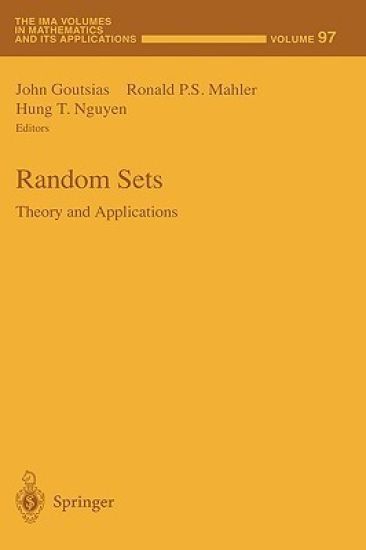
Random Sets

Random Sets

Springer-Verlag New York Inc.
1997
sidottu
This IMA Volume in Mathematics and its Applications RANDOM SETS: THEORY AND APPLICATIONS is based on the proceedings of a very successful 1996 three-day Summer Program on "Application and Theory of Random Sets." We would like to thank the scientific organizers: John Goutsias (Johns Hopkins University), Ronald P.S. Mahler (Lockheed Martin), and Hung T. Nguyen (New Mexico State University) for their excellent work as organizers of the meeting and for editing the proceedings. We also take this opportunity to thank the Army Research Office (ARO), the Office ofNaval Research (0NR), and the Eagan, MinnesotaEngineering Center ofLockheed Martin Tactical Defense Systems, whose financial support made the summer program possible. Avner Friedman Robert Gulliver v PREFACE "Later generations will regard set theory as a disease from which one has recovered. " - Henri Poincare Random set theory was independently conceived by D.G. Kendall and G. Matheron in connection with stochastic geometry. It was however G.
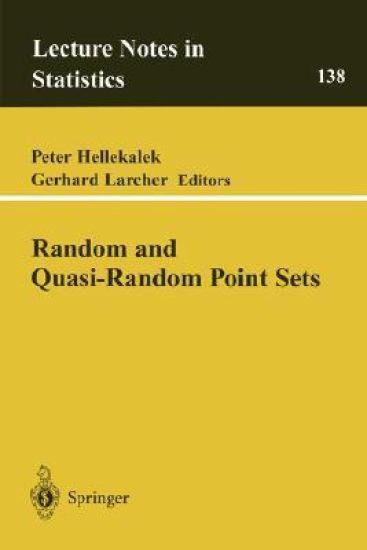
Random and Quasi-Random Point Sets

Random and Quasi-Random Point Sets

Springer-Verlag New York Inc.
1998
nidottu
This volume is a collection of survey papers on recent developments in the fields of quasi-Monte Carlo methods and uniform random number generation. We will cover a broad spectrum of questions, from advanced metric number theory to pricing financial derivatives. The Monte Carlo method is one of the most important tools of system modeling. Deterministic algorithms, so-called uniform random number gen­ erators, are used to produce the input for the model systems on computers. Such generators are assessed by theoretical ("a priori") and by empirical tests. In the a priori analysis, we study figures of merit that measure the uniformity of certain high-dimensional "random" point sets. The degree of uniformity is strongly related to the degree of correlations within the random numbers. The quasi-Monte Carlo approach aims at improving the rate of conver­ gence in the Monte Carlo method by number-theoretic techniques. It yields deterministic bounds for the approximation error. The main mathematical tool here are so-called low-discrepancy sequences. These "quasi-random" points are produced by deterministic algorithms and should be as "super"­ uniformly distributed as possible. Hence, both in uniform random number generation and in quasi-Monte Carlo methods, we study the uniformity of deterministically generated point sets in high dimensions. By a (common) abuse oflanguage, one speaks of random and quasi-random point sets. The central questions treated in this book are (i) how to generate, (ii) how to analyze, and (iii) how to apply such high-dimensional point sets.
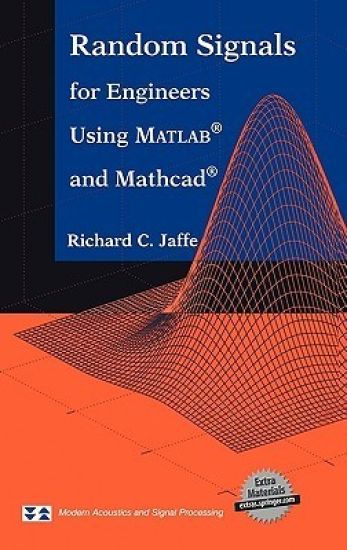
Random Signals for Engineers Using MATLAB® and Mathcad®

Random Signals for Engineers Using MATLAB® and Mathcad®

Richard C. Jaffe

Springer-Verlag New York Inc.
2000
sidottu
This introduction to random variables and signals is intended to provide engineering students with the analytical and computational tools for processing random signals using linear systems. It presents the underlying theory as well as examples and applications using computational aids throughout, in particular, computer-based symbolic computation programs are used for performing the analytical manipulations and the numerical calculations. Intended for a one-semester course for advanced undergraduates or beginning graduate students, the book covers such topics as: set theory and an introduction to probability; random variables, distributions, and processes; deterministic signals, spectral properties, and transformations; and filtering, and detection theory. The large number of worked examples together with the programming aids provided on the CD make the book eminently suited for self study as well as classroom use.
Random Probability Measures on Polish Spaces
In this monograph the narrow topology on random probability measures on Polish spaces is investigated in a thorough and comprehensive way. As a special feature, no additional assumptions on the probability space in the background, such as completeness or a countable generated algebra, are made. One of the main results is a direct proof of the random analog of the Prohorov theorem, which is obtained without invoking an embedding of the Polish space into a compact space. Further, the narrow topology is examined and other natural topologies on random measures are compared. In addition, it is shown that the topology of convergence in law-which relates to the "statistical equilibrium"-and the narrow topology are incompatible. A brief section on random sets on Polish spaces provides the fundamentals of this theory. In a final section, the results are applied to random dynamical systems to obtain existence results for invariant measures on compact random sets, as well as uniformity results in the individual ergodic theorem. This clear and incisive volume is useful for graduate students and researchers in mathematical analysis and its applications.
Random Data

Random Data

Julius S. Bendat; Allan G. Piersol

John Wiley Sons Inc
2010
sidottu
RANDOM DATA A TIMELY UPDATE OF THE CLASSIC BOOK ON THE THEORY AND APPLICATION OF RANDOM DATA ANALYSIS First published in 1971, Random Data served as an authoritative book on the analysis of experimental physical data for engineering and scientific applications. This Fourth Edition features coverage of new developments in random data management and analysis procedures that are applicable to a broad range of applied fields, from the aerospace and automotive industries to oceanographic and biomedical research. This new edition continues to maintain a balance of classic theory and novel techniques. The authors expand on the treatment of random data analysis theory, including derivations of key relationships in probability and random process theory. The book remains unique in its practical treatment of nonstationary data analysis and nonlinear system analysis, presenting the latest techniques on modern data acquisition, storage, conversion, and qualification of random data prior to its digital analysis. The Fourth Edition also includes: A new chapter on frequency domain techniques to model and identify nonlinear systems from measured input/output random dataNew material on the analysis of multiple-input/single-output linear modelsThe latest recommended methods for data acquisition and processing of random dataImportant mathematical formulas to design experiments and evaluate results of random data analysis and measurement proceduresAnswers to the problem in each chapter Comprehensive and self-contained, Random Data, Fourth Edition is an indispensible book for courses on random data analysis theory and applications at the upper-under-graduate and graduate level. It is also an insightful reference for engineers and scientists who use statistical methods to investigate and solve problems with dynamic data.
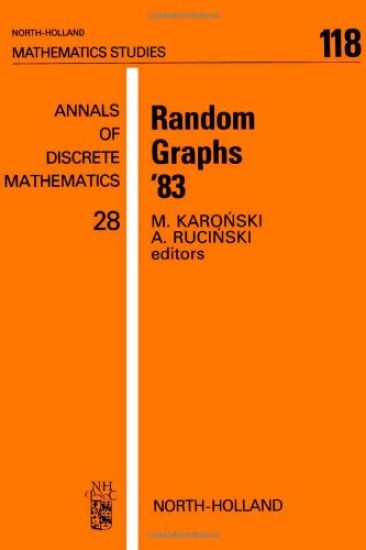
Random Graphs

Random Graphs

Svante Janson; Tomasz Luczak; Andrzej Rucinski

John Wiley Sons Inc
2000
sidottu
A unified, modern treatment of the theory of random graphs-including recent results and techniques Since its inception in the 1960s, the theory of random graphs has evolved into a dynamic branch of discrete mathematics. Yet despite the lively activity and important applications, the last comprehensive volume on the subject is Bollobas's well-known 1985 book. Poised to stimulate research for years to come, this new work covers developments of the last decade, providing a much-needed, modern overview of this fast-growing area of combinatorics. Written by three highly respected members of the discrete mathematics community, the book incorporates many disparate results from across the literature, including results obtained by the authors and some completely new results. Current tools and techniques are also thoroughly emphasized. Clear, easily accessible presentations make Random Graphs an ideal introduction for newcomers to the field and an excellent reference for scientists interested in discrete mathematics and theoretical computer science. Special features include:*A focus on the fundamental theory as well as basic models of random graphs*A detailed description of the phase transition phenomenon*Easy-to-apply exponential inequalities for large deviation bounds*An extensive study of the problem of containing small subgraphs*Results by Bollobas and others on the chromatic number of random graphs*The result by Robinson and Wormald on the existence of Hamilton cycles in random regular graphs*A gentle introduction to the zero-one laws*Ample exercises, figures, and bibliographic references
Random Graphs for Statistical Pattern Recognition

Random Graphs for Statistical Pattern Recognition

David J. Marchette

John Wiley Sons Inc
2004
sidottu
A timely convergence of two widely used disciplines Random Graphs for Statistical Pattern Recognition is the first book to address the topic of random graphs as it applies to statistical pattern recognition. Both topics are of vital interest to researchers in various mathematical and statistical fields and have never before been treated together in one book. The use of data random graphs in pattern recognition in clustering and classification is discussed, and the applications for both disciplines are enhanced with new tools for the statistical pattern recognition community. New and interesting applications for random graph users are also introduced. This important addition to statistical literature features: *Information that previously has been available only through scattered journal articles *Practical tools and techniques for a wide range of real-world applications *New perspectives on the relationship between pattern recognition and computational geometry *Numerous experimental problems to encourage practical applications With its comprehensive coverage of two timely fields, enhanced with many references and real-world examples, Random Graphs for Statistical Pattern Recognition is a valuable resource for industry professionals and students alike.
Random Processes

Random Processes

Lonnie C. Ludeman

John Wiley Sons Inc
2003
sidottu
An understanding of random processes is crucial to many engineering fields–including communication theory, computer vision, and digital signal processing in electrical and computer engineering, and vibrational theory and stress analysis in mechanical engineering. The filtering, estimation, and detection of random processes in noisy environments are critical tasks necessary in the analysis and design of new communications systems and useful signal processing algorithms. Random Processes: Filtering, Estimation, and Detection clearly explains the basics of probability and random processes and details modern detection and estimation theory to accomplish these tasks. In this book, Lonnie Ludeman, an award-winning authority in digital signal processing, joins the fundamentals of random processes with the standard techniques of linear and nonlinear systems analysis and hypothesis testing to give signal estimation techniques, specify optimum estimation procedures, provide optimum decision rules for classification purposes, and describe performance evaluation definitions and procedures for the resulting methods. The text covers four main, interrelated topics: *Probability and characterizations of random variables and random processes *Linear and nonlinear systems with random excitations *Optimum estimation theory including both the Wiener and Kalman Filters *Detection theory for both discrete and continuous time measurements Lucid, thorough, and well-stocked with numerous examples and practice problems that emphasize the concepts discussed, Random Processes: Filtering, Estimation, and Detection is an understandable and useful text ideal as both a self-study guide for professionals in the field and as a core text for graduate students.
Random Graphs

Random Graphs

John Wiley Sons Inc
1992
sidottu
Presents refereed papers by international experts regarding such diverse areas of interest as: random mappings and permutations, quasirandom graphs, random walks on trees, degree sequences, random matroids, central limit theorems, percolations and random subgraphs of the n-cube. Features an appendix of open problems from the conference.
Random Signals

Random Signals

K. Sam Shanmugan; Arthur M. Breipohl

John Wiley Sons Inc
1988
nidottu
Random Signals, Noise and Filtering develops the theory of random processes and its application to the study of systems and analysis of random data. The text covers three important areas: (1) fundamentals and examples of random process models, (2) applications of probabilistic models: signal detection, and filtering, and (3) statistical estimation--measurement and analysis of random data to determine the structure and parameter values of probabilistic models. This volume by Breipohl and Shanmugan offers the only one-volume treatment of the fundamentals of random process models, their applications, and data analysis.
Random Violence

Random Violence

Joel Best

University of California Press
1999
pokkari
"Random Violence" is a deft and thought-provoking exploration of the ways we talk about - and why we worry about - new crimes and new forms of victimization. Focusing on so-called random crimes such as freeway shootings, gang violence, hate crimes, stalking, and wilding, Joel Best shows how new crime problems emerge and how some quickly fade from public attention while others spread and become enduring subjects of concern. Best's original and incisive argument illuminates the fact that while these crimes are in actuality neither new, nor epidemic, nor random, the language used to describe them nonetheless shapes both private fears and public policies. Best scrutinizes the melodramatic quality of the American public's attitudes toward crime, exposing the cultural context for the popularity of 'random violence' as a catch-all phrase to describe contemporary crime, and the fallacious belief that violence is steadily rising. He points out that the age, race, and sex of homicide victims reveal that violence is highly patterned. Best also details the contemporary ideology of victimization, as well as the social arrangements that create and support a victim industry that can label large numbers of victims. He demonstrates why it has become commonplace to 'declare war' on social problems, including drugs, crime, poverty, and cancer, and outlines the complementary influence of media, activists, officials, and experts in institutionalizing crime problems. Intrinsic to all these concerns is the way in which policy choices and outcomes are affected by the language used to describe social problems.
Random Walks on Infinite Graphs and Groups

Random Walks on Infinite Graphs and Groups

Woess Wolfgang

Cambridge University Press
2008
pokkari
The main theme of this book is the interplay between the behaviour of a class of stochastic processes (random walks) and discrete structure theory. The author considers Markov chains whose state space is equipped with the structure of an infinite, locally finite graph, or as a particular case, of a finitely generated group. The transition probabilities are assumed to be adapted to the underlying structure in some way that must be specified precisely in each case. From the probabilistic viewpoint, the question is what impact the particular type of structure has on various aspects of the behaviour of the random walk. Vice-versa, random walks may also be seen as useful tools for classifying, or at least describing the structure of graphs and groups. Links with spectral theory and discrete potential theory are also discussed. This book will be essential reading for all researchers working in stochastic process and related topics.
Random Graphs

Random Graphs

V. F. Kolchin

Cambridge University Press
2009
pokkari
This book is devoted to the study of classical combinatorial structures such as random graphs, permutations, and systems of random linear equations in finite fields. The author shows how the application of the generalized scheme of allocation in the study of random graphs and permutations reduces the combinatorial problems to classical problems of probability theory on the summation of independent random variables. He concentrates on research by Russian mathematicians, including a discussion of equations containing an unknown permutation and a presentation of techniques for solving systems of random linear equations in finite fields. These results will interest specialists in combinatorics and probability theory and will also be useful in applied areas of probabilistic combinatorics such as communication theory, cryptology, and mathematical genetics.
Random Matrices: High Dimensional Phenomena

Random Matrices: High Dimensional Phenomena

Gordon Blower

Cambridge University Press
2009
pokkari
This book focuses on the behaviour of large random matrices. Standard results are covered, and the presentation emphasizes elementary operator theory and differential equations, so as to be accessible to graduate students and other non-experts. The introductory chapters review material on Lie groups and probability measures in a style suitable for applications in random matrix theory. Later chapters use modern convexity theory to establish subtle results about the convergence of eigenvalue distributions as the size of the matrices increases. Random matrices are viewed as geometrical objects with large dimension. The book analyzes the concentration of measure phenomenon, which describes how measures behave on geometrical objects with large dimension. To prove such results for random matrices, the book develops the modern theory of optimal transportation and proves the associated functional inequalities involving entropy and information. These include the logarithmic Sobolev inequality, which measures how fast some physical systems converge to equilibrium.