Kirjojen hintavertailu. Mukana 12 016 292 kirjaa ja 12 kauppaa.

Kirjahaku

Etsi kirjoja tekijän nimen, kirjan nimen tai ISBN:n perusteella.

1000 tulosta hakusanalla Samuel Rutherford

Novels I of Samuel Beckett

Novels I of Samuel Beckett

Samuel Beckett

Grove Press / Atlantic Monthly Press
2006
sidottu
Edited by Paul Auster, this four?volume set of Beckett's canon has been designed by award-winner Laura Lindgren. Available individually, as well as in a boxed set, the four hardcover volumes have been specially bound with covers featuring images central to Beckett's works. Typographical errors that remained uncorrected in the various prior editions have now been corrected in consultation with Beckett scholars C. J. Ackerley and S. E. Gontarski. Beckett was interested in consciousness as a form of comedy close to tragedy and logic as a crime. He loved the tension in 'cogito ergo sum' and took a dim view of the connecting word, the 'ergo' in the equation. Cogitating was the nightmare from which his characters were trying to awake. Being was a sour trick played on them by some force with whom they were trying desperately not to reckon. Beckett produced infinite amounts of comedy about the business of thinking as boring, invalid, and quite unnecessary. His characters did not need to think in order to be, or be in order to think. They knew they existed because of the odd habits and deep discomforts of their bodies. I itch therefore I am." ? Colm Toibin, from his Introduction
Novels II of Samuel Beckett

Novels II of Samuel Beckett

Samuel Beckett

Grove Press / Atlantic Monthly Press
2006
sidottu
Edited by Paul Auster, this four?volume set of Beckett's canon has been designed by award-winner Laura Lindgren. Available individually, as well as in a boxed set, the four hardcover volumes have been specially bound with covers featuring images central to Beckett's works. Typographical errors that remained uncorrected in the various prior editions have now been corrected in consultation with Beckett scholars C. J. Ackerley and S. E. Gontarski. "A man speaking English beautifully chooses to speak in French, which he speaks with greater difficulty, so that he is obliged to choose his words carefully, forced to give up fluency and to find the hard words that come with difficulty, and then after all that finding he puts it all back into English, a new English containing all the difficulty of the French, of the coining of thought in a second language, a new English with the power to change English forever. This is Samuel Beckett. This is his great work. It is the thing that speaks. Surrender." ? Salman Rushdie, from his Introduction
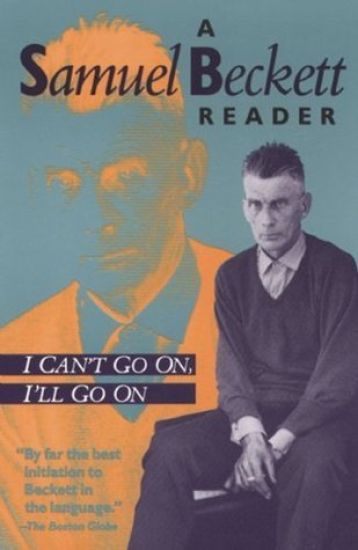
I Can't Go on, I'LL Go on: a Selection from Samuel Beckett's Work

I Can't Go on, I'LL Go on: a Selection from Samuel Beckett's Work

Samuel Beckett

Grove Press / Atlantic Monthly Press
1994
nidottu
Winner of the Nobel Prize for literature and acknowledged as one of the greatest writers of our time, Samuel Beckett has had a profound impact upon the literary landscape of the twentieth century. In this one-volume collection of his fiction, drama, poetry, and critical writings, we get an unsurpassed look at his work. Included, among others, are: - The complete plays Waiting for Godot, Krapp's Last Tape, Cascando, Eh Joe, Not I, and That Time- Selections from his novels Murphy, Watt, Mercier and Camier, Molloy, and The Unnamable- The shorter works "Dante and the Lobster," "The Expelled," Imagination Dead Imagine, and Lessness- A selection of Beckett's poetry and critical writings With an indispensable introduction by editor and Beckett intimate Richard Seaver, and featuring a useful select bibliography, I Can't Go On, I'll Go On is indeed an invaluable introduction to a writer who has changed the face of modern literature.
Samuel Richardson's Fictions of Gender

Samuel Richardson's Fictions of Gender

Tassie Gwilliam

Stanford University Press
1993
sidottu
In developing a new gender theory for analyzing Samuel Richardson's three major novels - Pamela, Clarissa, and Sir Charles Grandison - the author argues that these novels of sexual threat expose, sometimes unwillingly, the extraordinary labor required to construct and maintain the eighteenth-century ideology of gender, that apparently natural dream of perfect symmetry between the sexes. The instability of that model is revealed notably in Richardson's fascination with cross-gender identification and other instances of transgressive desires. The author demonstrates that these violations of the supposedly unbreachable barriers between masculinity and femininity produce what is most moving and imaginative in Richardson's fiction and create an equally powerful repression in the form of punishment of transgressive characters and desires. She also illustrates, through a reading of recurrent fantasies about the composition of bodies - especially women's bodies - the complex interaction between those fantasies and the construction of masculinity and femininity. The genesis of Richardson's own writing is located in a dynamic, reciprocal idea of gender that allows him to see femininity from the inside while retaining the privileges of the masculine viewpoint; the relation between this origin and the novels themselves forms the basis for the discussions of the novels. Each of the three chapters in the book seeks to investigate particular turn of gender construction and a particular mode of the reiterative story of sexual differences. The first chapter, on Pamela, calls on eighteenth-century discourse about opposing ideologies of gender and sexuality to elucidate Richardson's project. The next chapter, on Clarissa, shifts to a more intricate analysis of fantasies about sex and gender, in particular the double reading of masculinity and femininity in the form of of masculinity reading itself through the feminine. The final chapter, on The History of Sir Charles Grandison, examines Richardson's attempt to solidify masculinity in the person of the "good man."
Samuel Richardson's Fictions of Gender

Samuel Richardson's Fictions of Gender

Gwilliam Tassie

Stanford University Press
1995
pokkari
In developing a new gender theory for analyzing Samuel Richardson's three major novels - Pamela, Clarissa, and Sir Charles Grandison - the author argues that these novels of sexual threat expose, sometimes unwillingly, the extraordinary labor required to construct and maintain the eighteenth-century ideology of gender, that apparently natural dream of perfect symmetry between the sexes. The instability of that model is revealed notably in Richardson's fascination with cross-gender identification and other instances of transgressive desires. The author demonstrates that these violations of the supposedly unbreachable barriers between masculinity and femininity produce what is most moving and imaginative in Richardson's fiction and create an equally powerful repression in the form of punishment of transgressive characters and desires. She also illustrates, through a reading of recurrent fantasies about the composition of bodies - especially women's bodies - the complex interaction between those fantasies and the construction of masculinity and femininity. The genesis of Richardson's own writing is located in a dynamic, reciprocal idea of gender that allows him to see femininity from the inside while retaining the privileges of the masculine viewpoint; the relation between this origin and the novels themselves forms the basis for the discussions of the novels. Each of the three chapters in the book seeks to investigate particular turn of gender construction and a particular mode of the reiterative story of sexual differences. The first chapter, on Pamela, calls on eighteenth-century discourse about opposing ideologies of gender and sexuality to elucidate Richardson's project. The next chapter, on Clarissa, shifts to a more intricate analysis of fantasies about sex and gender, in particular the double reading of masculinity and femininity in the form of of masculinity reading itself through the feminine. The final chapter, on The History of Sir Charles Grandison, examines Richardson's attempt to solidify masculinity in the person of the "good man."
Samuel Beckett

Samuel Beckett

Edouard Morot-Sir; Howard Harper; Dougald McMillan III

The University of North Carolina Press
1976
nidottu
Collected essays from a symposium held in April 1974, at the University of North Carolina at Chapel Hill, this volume analyzes Beckett's philosophy, rhetoric, poetry, and novels.
Samuel Johnson and Moral Discipline

Samuel Johnson and Moral Discipline

Paul Kent Alkon

Northwestern University Press
2018
nidottu
Paul Kent Alkon’s Samuel Johnson and Moral Discipline provides reading of Johnson that emphasizes his moral discourse. Shortly after its publication, Alkon’s book became first of all the standard reading of Johnson’s essays, contrasting them with the moral ideas Johnson discussed in his sermons, as moral writings, and second, as one of the first books on Johnson to explore the essayist’s focus on moral thinking as central to his writing.
Samuel Coleridge-Taylor

Samuel Coleridge-Taylor

Jewel Taylor Thompson

Scarecrow Press
1994
sidottu
During the late 1890s and early 1900s, Samuel Coleridge-Taylor (1875-1912) was a popular and important British composer. Respected by his contemporaries, such as Sir Arthur Sullivan, Sir Edward Elgar, Gustav Holst, and Ralph Vaughan Williams, he attracted the attention of the British music critics who followed his career with curious interest and often placed him in a class with other noted composers. A prolific composer during his short lifetime, he received great public acclaim and became known both nationally and internationally. Born of a West African doctor and a British mother, Coleridge-Taylor belonged to two decidedly different cultures. Therefore, his compositional style was affected by two underlying currents: the classical tradition that dominated his training at the Royal College of Music, and the Negro folk music that was introduced to him through contacts with members of his father's race. This volume traces the development of his compostional style, from his final years at the Royal College of Music, to the time of his death in 1912. The author uses examples from selected works to show the influence of classical procedures, West African and African-American elements, and English poetical dramas.
Samuel Coleridge-Taylor

Samuel Coleridge-Taylor

William Tortolano

Scarecrow Press
2002
sidottu
During the late 1890s and early 1900s, Samuel Coleridge-Taylor (1875-1912) was an important and popular British composer. Respected by such contemporaries as Sir Arthur Sullivan, Sir Edward Elgar, Gustav Holst, and Ralph Vaughan Williams, he attracted the attention of the British music critics, who followed his career with curious interest and often placed him in a class with other noted composers. A prolific composer during his short lifetime, he received great public acclaim and became known both nationally and internationally-his setting of Longfellow's Hiawatha was just as popular as Handel's Messiah in Victorian England. Although he composed Hiawatha when he was only twenty-three, Coleridge-Taylor already had reached a published opus of twenty-nine compositions. Born of a West African doctor and a British mother, Coleridge-Taylor belonged to two decidedly different cultures. Therefore, his compositional style was affected by two underlying currents: the classical tradition that dominated his training at the Royal College of Music, and the African and African-American folk music that was introduced to him through contacts with members of his father's race. This revised second edition, equipped with both an updated and expanded discography and bibliography, traces the development of his compositional style from his final years at the Royal College of Music to the time of his death in 1912. Also included is a list of his arrangements and later editions of his music. The author uses examples from selected works to show the influence of classical texts, West African and African-American elements, and English poetical dramas. Of particular interest are eight rare and/or never-before seen articles by and about this ground-breaking composer.
Samuel Beckett's Novel "Watt"

Samuel Beckett's Novel "Watt"

University of Pennsylvania Press
1984
sidottu
For years the novel Watt has been overlooked or explained away in the most cursory fashion by scholars and critics who have otherwise paid the most scrupulous attention to the rest of Samuel Beckett's work. Now, Gottfried Büttner, a philosopher as well as a physician trained in psychology, offers a penetrating analysis of the work's narrative form and a convincing interpretation of Watt's journey. Büttner interprets Watt through hermeneutic analysis in order to demonstrate the metaconscious state of being which he believes is central not only to this novel, but also to Beckett's oeuvre. Büttner's method combines a biographical, psychological, and anthropological approach. He offers an exegesis of the narrative form and moves to a convincing interpretation of Watt's journey as the Lebenswanderung from birth to death and back to birth into the unknown. His analysis reveals that in Watt Beckett sought to unveil the hidden experience of a soul suffering under the ordeal of birth and death, and even under an ordeal of rebirth. A kind of soul-wandering, a metamorphosis of the spirit, has thus been made clear for the reader in the figure of Watt in Beckett's novel. Büttner's work is informed not only by his far-reaching literary interests but by his twenty years of intellectual friendship with Beckett. Their correspondence has touched upon questions of translation, philological intent, and interpretation of the text. While Beckett made it clear that he would not explicate his writings and would insist that text and exegesis stand separately, his degree of interest in Büttner's work is unparalleled.
Samuel Sloan

Samuel Sloan

University of Pennsylvania Press
1986
sidottu
Samuel Sloan: Architect of Philadelphia, 1815-1884 is a comprehensive study of one of America's most influential architects. Sloan created the designs that have become prototypes for many public buildings. His plan for the Hospital of the Protestant Episcopal Church in Philadelphia served as the model for American general hospitals, and, with Dr. Thomas S. Kirkbride, he created the model for mental hospitals in the United States. Sloan was also an innovative designer of public schools, creating the "Philadelphia Plan" of schoolhouse design, which came to be internationally known and widely used. Sloan helped to shape the architecture of his time not only through the buildings he designed but also through his writings. He published several major pattern books, covering every aspect of the architectural profession from carpentry to furnishings. One of these, The Model Architect, went through five editions and was among the most widely distributed works of its kind in the history of nineteenth-century architectural publishing. As a result, Sloan's influence on the architectural environment of nineteenth-century America is so pervasive that a full accounting of the works which can be traced back to his books is almost impossible. From 1868 until 1871 Sloan also produced The Architectural Review, the first periodical in the United States devoted exclusively to architecture and its related arts and crafts and the unofficial organ of the reconstituted American Institute of Architects. In Samuel Sloan, Harold N. Cooledge, Jr. examines the social, economic, and environmental factors that influenced Sloan's personal and professional character and includes a consideration of the theorists and tastemakers whose ideas influenced Sloan's attitude toward architectural theory and practice. Cooledge then presents a chronological biography in which the majority of Sloan's important commissions are considered in detail, and as much information about his private life as could be documented is given. The book concludes with a detailed catalogue of Sloan's work. Samuel Sloan: Architect of Philadelphia 1815-1884 will be of value to architects and to scholars interested in art history, social history, and American studies.
The Diary of Samuel Pepys

The Diary of Samuel Pepys

Samuel Pepys

Modern Library Inc
2003
pokkari
Richard Le Gallienne's elegant abridgment of the Diary captures the essential writings of Samuel Pepys (1633-1703), a remarkable man who witnessed the coronation of Charles II, the Great Plague of 1665, and the Great Fire of 1666. Originally scribbled in a cryptic shorthand, Pepys's quotidian journal of life in Restoration London provides an astonishingly frank and diverting account of political intrigues; naval, church, and cultural affairs; and the sexual escapades and domestic strife of a man with a voracious, childlike appetite for living. "As a human document the Diary is literally unique," notes Le Gallienne. "It will have a still greater value for its historical importance."
Samuel P. Harn Museum Of Art At Twenty Years
"I congratulate the Samuel P. Harn Museum of Art on its twentieth birthday. This catalogue, which highlights those twenty years of collecting, is an impressive tribute to the museum's donors and supporters as well as to the staff."--Brian A. Dursum, director, University of Miami Lowe Art MuseumThe Samuel P. Harn Museum of Art at the University of Florida opened in 1990, dedicated to promoting the power of the arts to inspire, educate, and enrich people's lives. Today, more than 7,400 works are represented in the Harn's various collections.This brilliantly illustrated volume is the museum's first overall collection catalogue. It offers 50 highlights from the museum's five major collecting areas--African art, Asian art, contemporary art, modern art, and photography--as well as selections from its ancient American and Oceanic collections. Featuring fine, full-page photography and expert commentary from the curators, it is the most complete guide to the museum's collection ever produced.In addition, this innovative volume also provides a history of the facility and offers exclusive, behind-the-scenes information about registration, education, development, marketing, public relations, and community engagement. The result is a truly comprehensive and fascinating look at the Harn's collection, history, and operations.
Samuel Roth, Infamous Modernist

Samuel Roth, Infamous Modernist

Jay A. Gertzman

University Press of Florida
2015
nidottu
Samuel Roth is known to most literary scholars as a bold literary “pirate” for issuing unauthorised editions of modernist sensations, including Ulysses and Lady Chatterley’s Lover.In the absence of an international copyright agreement and because works deemed obscene could not be copyrighted, what he did was not illegal. But it did violate the protocols of mutual fair dealing between publishers and authors. Those publications provoked an unprecedented international protest of writers, publishers, and intellectuals, who eventually vilified Roth on two continents.Roth was a man with an uncanny ability to recognise good contemporary writing and make it accessible to popular audiences. Ultimately, his dedication to the publication of these works broke down many of the censorship laws of the time, though he suffered greatly for his efforts. His story portrays a struggle with literary censorship in the mid-twentieth century while providing insights into how modernism was marketed in America.
Samuel Steward and the Pursuit of the Erotic Sexuality, Literature, Archives
Samuel Steward and thePursuit of the Erotic: Sexuality, Literature, Archivesexamines one of the most fascinating sexual renegades of the twentieth century and the social, cultural, pedagogical, and erotic projects with which he was engaged. This innovative collection, edited by Debra A. Moddelmog and Martin Joseph Ponce, examines the life and work of Samuel Steward at their most daring and controversial. Samuel Steward writer, literature professor, visual artist, tattoo artist, sexual archivist, unofficial sexologist, and vernacular pornographer gave voice and vision to some of the central concerns of twentieth-century U.S. gay culture and politics. These essays frame Steward not merely as an associate or a lover of more well-known luminaries but as a significant cultural figure in his own right, one whose work anticipated some of the current aims and methods of queer studies. With work by prominent scholars in queer, transgender, and sexuality studies, and with topics such as the queer archive, hoarding, masochism, the queer mystery, race and desire, sexology, and gay pornography, Samuel Steward and the Pursuit of the Eroticwill appeal to a wide range of readers across a variety of disciplines invested in queer experience. Closing on a personal recollection from one of Steward s last close friends, the volume will also appeal to readers interested in the personal aspects of this fascinating, idiosyncratic figure s multifaceted life. "
Samuel Babcock (ca. 1760-1813)
Samuel Babcock was an active Boston-area composer who made a significant contribution to the repertory of American psalmody. Best known for his tunebook, Middlesex Harmony, Babcock composed extended and plain psalm tunes, set pieces, fuging tunes, and anthems, and frequently used three-part vocal textures. He uniquely combined elements of both traditional and newer Methodist styles of psalmody. This edition includes 75 works known to be by Babcock, plus six of unknown attribution.