David G. Anderson; Derek T. Anderson; Katherine McMillan Barry; Kara Bridgman Sweeney; Samuel O. Brookes; Adam M. Burke; Stephen B. Carmody; Philip J. Carr; William A. Childress; I. Randolph Daniel; Ryan Duggins; Grayal E. Farr; Michael K. Faught; Brendan Fenerty; Jay D. Franklin; Lauren M. Franklin; J. Christopher Gillam; Joseph A. M. Gingerich; Jessi J. Halligan; Kandace D. Hollenbach; Vance T. Holliday; Thomas A. Jennings; K. C. Jones; Shawn A. Joy; Jerald Ledbetter; Greg J. Maggard; Steven M. Meredith; D. Shane Miller
The definitive book on what is known about the Late Pleistocene and Early Holocene archaeological record in the Southeast The 1996 benchmark volume The Paleoindian and Early Archaic Southeast, edited by David G. Anderson and Kenneth E. Sassaman, was the first study to summarize what was known of the peoples who lived in the Southeast when ice sheets covered the northern part of the continent and mammals such as mammoths, saber-toothed cats, and ground sloths roamed the landscape.The American Southeast at the End of the Ice Age provides an updated, definitive synthesis of current archaeological research gleaned from an array of experts in the region. It is organized in three parts: state records, the regional perspective, and reflections and future directions. Chapters survey a diversity of topics including the distribution of the earliest archaeological sites in the region, chipped-stone tool technology, the expanding role of submerged archaeology, hunter-gatherer lifeways, past climate changes and the extinction of megafauna on the transitional landscape, and evidence of demographic changes at the end of the Ice Age. Discussion of the ethical responsibilities regarding the use of private collections and the relationship of archaeologists and the avocational community, insight from outside the Southeast, and considerations for future research round out the volume.
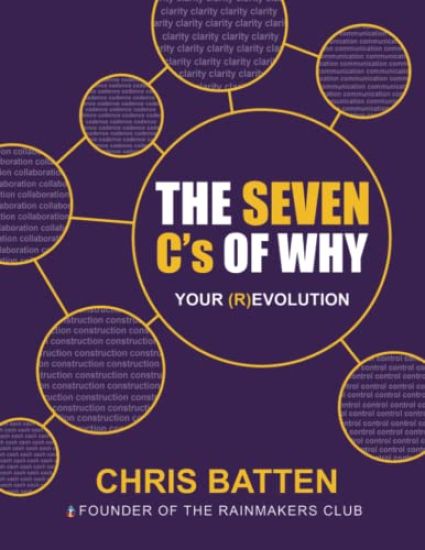
Written by Chris Batten an international CEO and founder of the Rainmakers Club. The author is on a quest to change the world for the start-Up and Micro businesses by introducing his tried and tested success model called ' The 7C's of Why.' This unique model is focused on 7 elements that need to be present in every business, not just present they need to be in complete balance too. The 7C's are - Cadence, Clarity, Communication, Control, Cash Construction and Collaboration. In the book the author points out in a no nonsense style that success will come from the choice the reader will make, they can choose how they feel and deal with issues, they can choose who they align themselves to, they can choose to win, they can choose to create a business capable of exceptional and sustainable results. The choices made by the small business and the mindset they maintain can be made that much simpler by following the 7C's of Why. A model for development deigned by the author during his career as a CEO and business adviser. This book will give the reader all they need to set them on the right course for true success. The book also encourages the Reader to take part in a support program designed to accompany the book, giving the reader an even better chance of producing sustainable and exceptional results. The book has been designed to stand alone too with multiple exercise as part of the content and an open invitation for the reader to share their results with the author. The book will take the reader through all the key elements and give them all they need to build a strong business. It starts by focusing on the misleading information about business failure and the causes, and provides an alternate view that can and will change how the reader thinks about their business. The book challenges the reader to establish high quality principles and create a vivid vision for the future, but unlike main-stream businesses the book encourages a new way of thinking to establish a tangible advantage. Based on proven principles and referencing the works of Napoleon Hill and Earl Nightingale this book is suitable reading, giving great value to the over 6 million UK businesses and the significant US market too. The book also opens the door for follow on books for each of the individual 'C' words as part of a series.
This book will appeal to investigators in each of the scientific disciplines it integrates-evolutionary biology, ecology, salmonid biology, management, and conservation. Variation in salmonids can be used to illustrate virtually all evolutionary questions, and so the work will also attract general scientific interest by ecologists and evolutionary and conservation biologists.
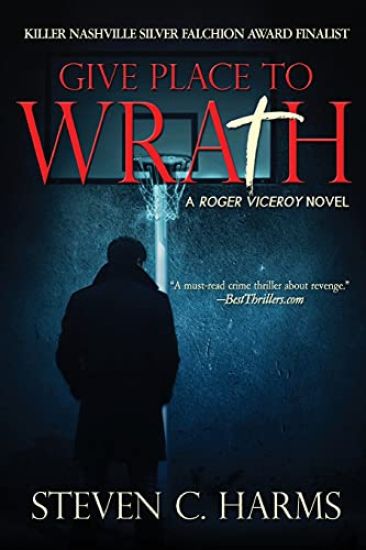
Killer Nashville Silver Falchion Award Finalist - Best MysteryAmerican Book Fest American Fiction Awards Finalist - Mystery/Suspense Detective Roger Viceroy, divisional head of the Midwest Region Special Crimes Unit, awakes one morning to a bombing in a wealthy suburb of Milwaukee. As he and his team dive into the investigation, a mysterious clue launches a manhunt with scant other evidence to point them in the right direction.Over the coming weeks, the related murders unfold, each with a unique twist and the same clue left behind. Viceroy uncovers one other common thread-a seemingly random association with the small north woods town of Curwood, Wisconsin.As the death toll mounts, Viceroy has to connect the dots and stop the carnage before it reaches the final target, Governor Kay Spurgeon.
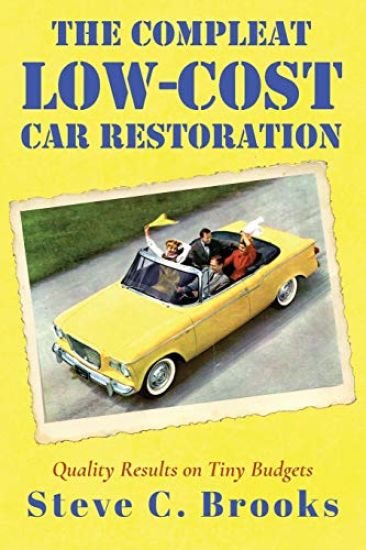
AT LAST, BOTH VOLUMES OF THIS BEST-SELLER IN ONE BOOK Would you love to restore your car to as-new condition but don't have the money to hire professionals? Author Steve Brooks shows you how to plan and perform a quality car restoration that you can be proud of - and that you can afford.DISCOVER THESE SECRETS OF LOW-COST CAR RESTORATION: 7 tips for organising your parts - and yourself20+ different ways to repair, restore and rejuvenate your car interior68 body and mechanical tips and handy techniquesHow to restore to as-new or better-than-new conditionHow to renew a prestige interior's wooden veneers or even simulated woodgrainPlus Bonus Features: 9 secrets of extreme maintenance and fuel economy Bring any older car back to life with minimal tools, facilities and budgets. Boost the value of your vehicle, whether it's a collector car or not. Save hundreds, perhaps thousands, doing your own restorations and improvements that only a professional would tackle - and sometimes not even then The Compleat Low-Cost Car Restoration shows how a relative novice, with minimal tools, facilities and budget can bring any older car back to life-from the 1990's all the way back to the 1930's "Your procedures are accurate and clearly written-all well done." - Geoff, NY"In this series, the author has avoided the dry, textbook approach of other how-to guides. He uses a writing style that is spritely, amusing and accessible to people with all skill ranges." - Restored Cars Australia magazine
For many people outside the state, North Dakota conjures visions of a remote, sparse, and seemingly inhospitable landscape, replete with ghost towns, scattered farmsteads, and settings reminiscent of the movie Fargo. Yet beyond this facile image lies a spectacular array of high-style, vernacular, ethnic, and modern buildings, a pragmatic architecture that reflects the setting and settlers of the Great Plains. A distinct “prairie mosaic” of houses, homesteads, and rural churches draws on the cultures of Germans from Russia, Norwegians, and Icelanders, and varied Native American groups such as the Mandan, Hidatsa, and Arikara. North Dakota's architectural heritage is complemented by more contemporary work dating from Progressive-era boom times and the New Deal to the present. This volume, with more than 400 entries illustrated by 250 photographs and 17 maps, provides the first comprehensive overview of the state, from Pembina and Walhalla to the Badlands. This richly diverse legacy includes earthlodges and Eastern Orthodox churches, powwow grounds and campmeeting grounds, and varied settings from the Ronald Reagan Minuteman Missile State Historic Site to the International Peace Garden. The cast of characters is equally compelling, among them Sakakawea, Lewis and Clark, the Marquis de Mores, Theodore Roosevelt, Lawrence Welk, Peggy Lee, and regional and international architects working in a range of styles and traditions, from Marcel Breuer to Surrounded-by-Enemy.
This guide to the theory and practice of RF power amplifier (PA) design for modern communications systems aims to help readers tackle PA design with confidence and save time in determining the cause of malfunctioning hardware. The book explores a unified approach to the classification of higher amplifier modes based on overdrive considerations. The text contains a complete survey of RF PA efficiency enhancement and linearization techniques and aims to help the reader design suitable matching networks which provide correct fundamental harmonic terminations for conventional high efficiency PA modes. It also provides an understanding of the class D, E and F modes and their feasibility at microwave frequencies and uses envelope simulation techniques to analyze the effects of distortion in overdriven PAS. Finally, the text discusses the maintenance of high efficiency operation at low points in an amplitude modulated signal envelope including detailed coverage of the Doherty, Chireix and Kahn techniques, it explores the possibilities and limitations of linearization methods and analyzes PA stability and oscillation problems.
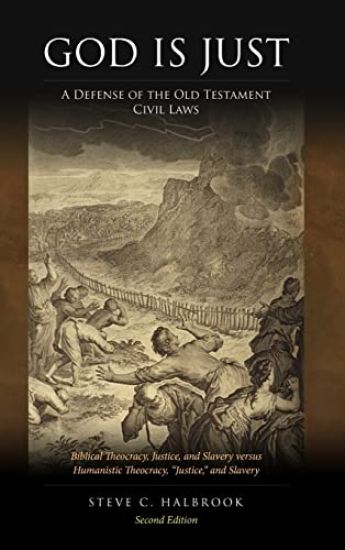
This 600+ page book is a defense of biblical civil law, on topics despised not only by humanists, but by professing Christians. It is, in short, theonomic apologetics. "God is Just" takes our culture and its attacks on the Bible to task. It defends biblical theocracy, justice, and slavery, and cuts humanistic opposition down to size by its own self-destructive foolishness, and, most importantly, by the sword of God's word. The book includes appendices defending theonomy biblically and historically, as well as appendices refuting alternative political philosophies. One appendix is written by Daniel F. N. Ritchie, and there is also a forward by Buddy Hanson. The second edition includes a Scripture index and a new appendix by Vindiciae Legis, who gives an excellent historical treatment of the theonomic views of the Westminster divines.