
Kirjahaku
Etsi kirjoja tekijän nimen, kirjan nimen tai ISBN:n perusteella.
1000 tulosta hakusanalla Vector Hasting
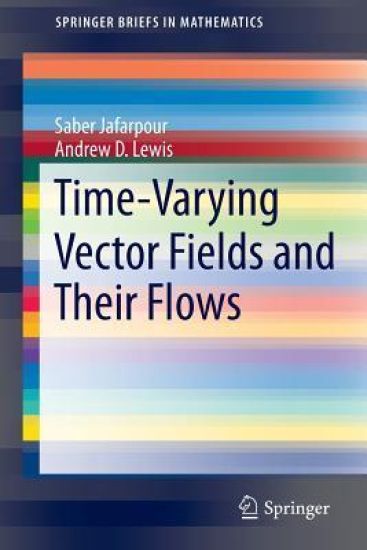
Time-Varying Vector Fields and Their Flows
Saber Jafarpour; Andrew D. Lewis
Springer International Publishing AG
2014
nidottu
This short book provides a comprehensive and unified treatment of time-varying vector fields under a variety of regularity hypotheses, namely finitely differentiable, Lipschitz, smooth, holomorphic, and real analytic. The presentation of this material in the real analytic setting is new, as is the manner in which the various hypotheses are unified using functional analysis. Indeed, a major contribution of the book is the coherent development of locally convex topologies for the space of real analytic sections of a vector bundle, and the development of this in a manner that relates easily to classically known topologies in, for example, the finitely differentiable and smooth cases. The tools used in this development will be of use to researchers in the area of geometric functional analysis.
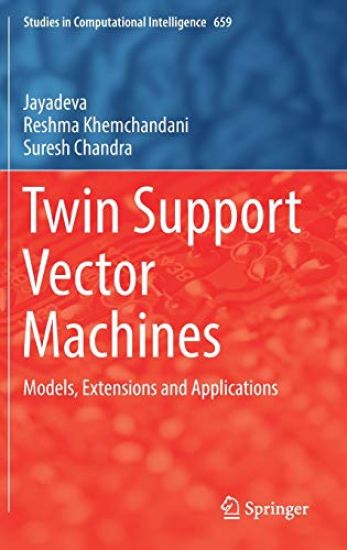
Twin Support Vector Machines
Jayadeva; Reshma Khemchandani; Suresh Chandra
Springer International Publishing AG
2016
sidottu
This book provides a systematic and focused study of the various aspects of twin support vector machines (TWSVM) and related developments for classification and regression. In addition to presenting most of the basic models of TWSVM and twin support vector regression (TWSVR) available in the literature, it also discusses the important and challenging applications of this new machine learning methodology. A chapter on “Additional Topics” has been included to discuss kernel optimization and support tensor machine topics, which are comparatively new but have great potential in applications. It is primarily written for graduate students and researchers in the area of machine learning and related topics in computer science, mathematics, electrical engineering, management science and finance.
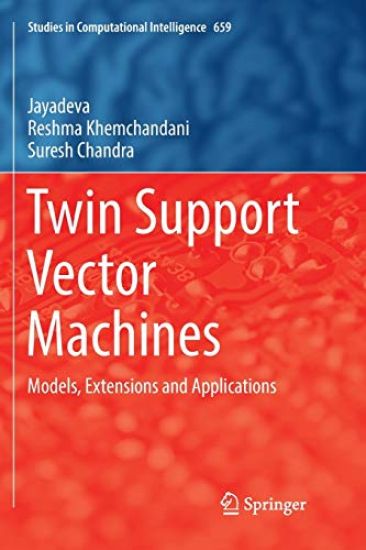
Twin Support Vector Machines
Jayadeva; Reshma Khemchandani; Suresh Chandra
Springer International Publishing AG
2018
nidottu
This book provides a systematic and focused study of the various aspects of twin support vector machines (TWSVM) and related developments for classification and regression. In addition to presenting most of the basic models of TWSVM and twin support vector regression (TWSVR) available in the literature, it also discusses the important and challenging applications of this new machine learning methodology. A chapter on “Additional Topics” has been included to discuss kernel optimization and support tensor machine topics, which are comparatively new but have great potential in applications. It is primarily written for graduate students and researchers in the area of machine learning and related topics in computer science, mathematics, electrical engineering, management science and finance.
Structurally Unstable Quadratic Vector Fields of Codimension One
Joan C. Artés; Jaume Llibre; Alex C. Rezende
Birkhauser Verlag AG
2018
nidottu
Originating from research in the qualitative theory of ordinary differential equations, this book follows the authors’ work on structurally stable planar quadratic polynomial differential systems. In the present work the authors aim at finding all possible phase portraits in the Poincaré disc, modulo limit cycles, of planar quadratic polynomial differential systems manifesting the simplest level of structural instability. They prove that there are at most 211 and at least 204 of them.

The Efficient Use of Vector Computers with Emphasis on Computational Fluid Dynamics
Willi Schönauer; Gentzsch Wolfgang
Friedrich Vieweg Sohn Verlagsgesellschaft mbH
1986
nidottu
The GAMM Committee for Numerical Methods in Fluid Mechanics organizes workshops which should bring together experts of a narrow field of computational fluid dynamics (CFD) to exchange ideas and experiences in order to speed-up the development in this field. In this sense it was suggested that a workshop should treat the solution of CFD problems on vector computers. Thus we organized a workshop with the title "The efficient use of vector computers with emphasis on computational fluid dynamics". The workshop took place at the Computing Centre of the University of Karlsruhe, March 13-15,1985. The participation had been restricted to 22 people of 7 countries. 18 papers have been presented. In the announcement of the workshop we wrote: "Fluid mechanics has actively stimulated the development of superfast vector computers like the CRAY's or CYBER 205. Now these computers on their turn stimulate the development of new algorithms which result in a high degree of vectorization (sca1ar/vectorized execution-time). But with 3-D problems we quickly reach the limit of present vector computers. If we want e.g. to solve a system of 6 partial differential equations (e.g. for u, v, w, p, k, € or for the vectors u, curl u) on a 50x50x50 grid we have 750.000 unknowns and for a 4th order difference method we have circa 60 million nonzero coefficients in the highly sparse matrix. This characterizes the type of problems which we want to discuss in the workshop".
Calculus in Vector Spaces without Norm
A. Frölicher; W. Bucher
Springer-Verlag Berlin and Heidelberg GmbH Co. K
1966
nidottu
Summer School on Topological Vector Spaces
Springer-Verlag Berlin and Heidelberg GmbH Co. K
1973
nidottu
Proceedings 1972
Probability Theory on Vector Spaces
Springer-Verlag Berlin and Heidelberg GmbH Co. K
1978
nidottu
Probability Theory on Vector Spaces II
Springer-Verlag Berlin and Heidelberg GmbH Co. K
1980
nidottu
Counterexamples in Topological Vector Spaces
S.M. Khaleelulla
Springer-Verlag Berlin and Heidelberg GmbH Co. K
1982
nidottu
Bundles of Topological Vector Spaces and Their Duality
G. Gierz
Springer-Verlag Berlin and Heidelberg GmbH Co. K
1982
nidottu
Group Actions and Vector Fields
Springer-Verlag Berlin and Heidelberg GmbH Co. K
1982
nidottu
Spaces of Vector-Valued Continuous Functions
J. Schmets
Springer-Verlag Berlin and Heidelberg GmbH Co. K
1983
nidottu
Probability Theory on Vector Spaces III
Springer-Verlag Berlin and Heidelberg GmbH Co. K
1984
nidottu
a
Forecasting Aggregated Vector ARMA Processes
Helmut Lütkepohl
Springer-Verlag Berlin and Heidelberg GmbH Co. K
1987
nidottu
This study is concerned with forecasting time series variables and the impact of the level of aggregation on the efficiency of the forecasts. Since temporally and contemporaneously disaggregated data at various levels have become available for many countries, regions, and variables during the last decades the question which data and procedures to use for prediction has become increasingly important in recent years. This study aims at pointing out some of the problems involved and at pro viding some suggestions how to proceed in particular situations. Many of the results have been circulated as working papers, some have been published as journal articles, and some have been presented at conferences and in seminars. I express my gratitude to all those who have commented on parts of this study. They are too numerous to be listed here and many of them are anonymous referees and are therefore unknown to me. Some early results related to the present study are contained in my monograph "Prognose aggregierter Zeitreihen" (Lutkepohl (1986a)) which was essentially completed in 1983. The present study contains major extensions of that research and also summarizes the earlier results to the extent they are of interest in the context of this study.
Model Reduction Methods for Vector Autoregressive Processes
Ralf Brüggemann
Springer-Verlag Berlin and Heidelberg GmbH Co. K
2004
nidottu
1. 1 Objective of the Study Vector autoregressive (VAR) models have become one of the dominant research tools in the analysis of macroeconomic time series during the last two decades. The great success of this modeling class started with Sims' (1980) critique of the traditional simultaneous equation models (SEM). Sims criticized the use of 'too many incredible restrictions' based on 'supposed a priori knowledge' in large scale macroeconometric models which were popular at that time. Therefore, he advo cated largely unrestricted reduced form multivariate time series models, unrestricted VAR models in particular. Ever since his influential paper these models have been employed extensively to characterize the underlying dynamics in systems of time series. In particular, tools to summarize the dynamic interaction between the system variables, such as impulse response analysis or forecast error variance decompo sitions, have been developed over the years. The econometrics of VAR models and related quantities is now well established and has found its way into various textbooks including inter alia Llitkepohl (1991), Hamilton (1994), Enders (1995), Hendry (1995) and Greene (2002). The unrestricted VAR model provides a general and very flexible framework that proved to be useful to summarize the data characteristics of economic time series. Unfortunately, the flexibility of these models causes severe problems: In an unrestricted VAR model, each variable is expressed as a linear function of lagged values of itself and all other variables in the system.
High Performance Computing on Vector Systems 2005
Springer-Verlag Berlin and Heidelberg GmbH Co. K
2006
sidottu
InMarch2005about40scientistsfromEurope,JapanandtheUScametogether the second time to discuss ways to achieve sustained performance on superc- puters in the range of Tera?ops. The workshop held at the High Performance Computing Center Stuttgart (HLRS) was the second of this kind. The ?rst one had been held in May 2004. At both workshops hardware and software issues were presented and applications were discussed that have the potential to scale and achieve a very high level of sustained performance. The workshops are part of a collaboration formed to bring to life a concept that was developed in 2000 at HLRS and called the “Tera?op Workbench”. The purpose of the collaboration into which HLRS and NEC entered in 2004 was to turn this concept into a real tool for scientists and engineers. Two main goals were set out by both partners: • To show for a variety of applications from di?erent ?elds that a sustained level of performance in the range of several Tera?ops is possible. • To show that di?erent platforms (vector based systems, cluster systems) can be coupled to create a hybrid supercomputer system from which applications can harness an even higher level of sustained performance.