

Kirjahaku
Etsi kirjoja tekijän nimen, kirjan nimen tai ISBN:n perusteella.
1000 tulosta hakusanalla W. Hall-patch

"In the age when man has forgotten his origins and is blind to even his most essential needs for survival, water along with other resources has become the victim of his indifference." - Rachel Carson The water crisis in sub-Saharan Africa is critical. Lack of clean water is the leading reason that hospital beds in Africa are full, and yet most who are sick from bad water cannot seek medical attention. Addressing the shortage of clean water in developing nations will take investments of money, time, and resources. Seventeen students traveled to Benin in West Africa. They trained staff at the Songhai Center in Porto-Novo how to make effective drinking water filters. This is just one of many stories about innovative ways of tackling the water crisis - all of the successful stories involve leadership, community building and personal sacrifice. NOTE: ANY PROCEEDS FROM THE SALE OF THIS BOOK ARE USED TO CONTINUE TO DOCUMENT THE WATER PROGRAM AND ASSIST THE SONGHAI CENTER IN BENIN.
W.O.R.S.H.I.P. (Volume I) is a divinely inspired book. The author, through heartfelt Words of Remembrance, Salvation, Healing, Inspiration, and Purpose, expresses God's love and concern for the state of the common Christian in a way only she can. This book embodies literary diversity; ranging from prayers, to poems, to inspirational writings that will leave you reevaluating your life and desiring change.


W.T.F.: Why Teens Fail- What To Fix
John Iannarelli; Adam Brooks; Shannon Butler
Be the One, LLC
2012
nidottu
W. E. A. Series, No. 3. a History of Trade Unionism in Australia
J T Sutcliffe
Trieste Publishing
2018
nidottu
Spiritual Conceits, Extracted from the Writings of the Fathers, the Old English Poets & C., & Illustrated by W. Harry Rogers
W Harry Rogers
Trieste Publishing
2018
nidottu
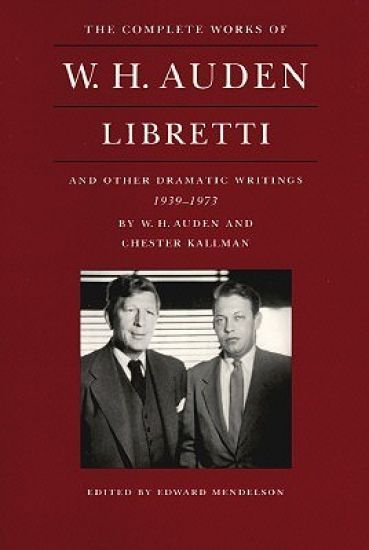
The Complete Works of W. H. Auden
W. H. Auden; Chester Kallman
Princeton University Press
1993
sidottu
W. H. Auden called opera the "last refuge of the High Style," and considered it the one art in which the grand manner survived the ironic levelings of modernity. He began writing libretti soon after he arrived in America in 1939 and abandoned his earlier attempts to write public, political drama. Opera gave him the opportunity to rise to the high style in public, not in an attempt to elevate his own status as a poet, but in service of the heroic voice of the singers. These works present their mythical actions with a direct intensity unlike anything in even his greatest poems. In this volume of Auden and Chester Kallman's libretti, extensive historical and textual notes trace the history of the production and revision of the works and provide full texts of early scenarios, as well as abandoned and rewritten scenes. Almost all the works included here were previously published in incomplete and often inaccessible editions--or were never published at all. The book prints for the first time the full text of Paul Bunyan, Auden's first libretto, which he wrote for music by Benjamin Britten. It also includes Auden and Kallman's The Rake's Progress, written for Igor Stravinsky, and Delia, written for Stravinsky but never set to music. The book continues with Auden and Kallman's two libretti written for music by Hans Werner Henze, Elegy for Young Lovers and The Bassarids, and their adaptation of Love's Labour's Lost, composed by Nicolas Nabokov. It also contains their translation of The Magic Flute, with its scenes reordered for greater dramatic coherence and added dialogue for sharper mythical significance, and their antimasque, The Entertainment of the Senses, for music by John Gardner. The book contains two radio plays--The Dark Valley, a monologue written by Auden alone, and The Rocking Horse Winner, written with James Stern and based on a story by D. H. Lawrence. Also included are the unpublished masque that Auden wrote for Kallman's twenty-second birthday, the unpublished versions of The Dutchess of Malfi that Auden prepared with Bertolt Brecht, scenarios for a film script and a libretto that were never completed, Auden's narrative for the medieval Play of Daniel, two narratives for documentary films, and his song lyrics written for Man of La Mancha before the producer decided to use a different lyricist.

The Complete Works of W. H. Auden: Prose, Volume I
W. H. Auden
Princeton University Press
1997
sidottu
This book contains all the essays and reviews that W. H. Auden wrote during the years when he was living in England, and also includes the full original versions of his two illustrated travel books, Letters from Iceland (written in collaboration with Louis MacNeice) and Journey to a War (written in collaboration with Christopher Isherwood). Auden's early prose ranges from extravagant indiscreet travel diaries through sharply observed critiques of writers from John Skelton to Winston Churchill. It includes studies of Communism and Christianity; audaciously wide-ranging essays on literature, psychology, and politics; and writings about gossip, sex, prisons, and schools. The editor's notes include explanations of contemporary and private allusions. The long "Last Will and Testament" written in verse by Auden and MacNeice, which Evelyn Waugh described as a "gossip column," is annotated in full. The book will interest not only Auden's many admirers, but everyone concerned with twentieth-century literature and culture. About the series: In 1928, Stephen Spender hand-printed thirty copies of a small volume of poems by his friend W. H. Auden--the first published book by a man who was to become the dominant literary figure of his generation and one of the century's greatest poets. Sixty years later, Princeton University Press inaugurated an edition of the complete works of Auden, which is intended to serve as the definitive text for all the works Auden published or intended to publish in the form in which he expected to see them printed: his plays and other drama, libretti, essays and reviews, and poems. The Complete Works of W. H. Auden will provide a unique opportunity to solve the numerous textual problems connected with the severe revisions Auden made in his own works. The texts are newly edited from Auden's manuscripts by Edward Mendelson, the literary executor of the Auden estate.
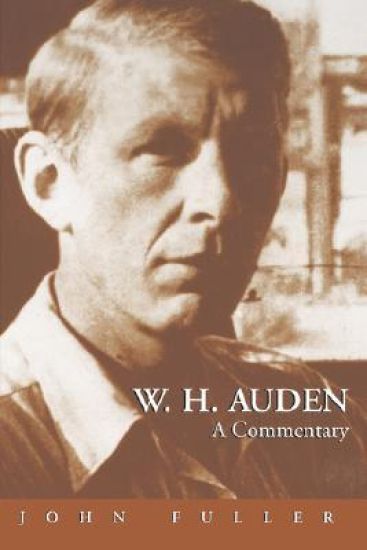
This is an indispensable reference guide to the works of one of the most important poets of the twentieth century. W. H. Auden's writing is notoriously complex--full of puzzling allusions and shaped by influences as diverse as Old English poetry and Auden's own theory of psychosomatic illness. To help readers understand Auden's work, the poet and scholar John Fuller examines all of Auden's published poems, plays, and libretti, leaving out only some juvenilia. In unprecedented detail, he reviews the works' publishing history, paraphrases difficult passages, and explains allusions. He points out interesting variants (including material abandoned in drafts), identifies sources, looks at verse forms, and offers critical interpretations. Along the way, he presents a wealth of facts about Auden's works and life that are available in no other publication. The book is a major revision of Fuller's critically acclaimed Reader's Guide to Auden, published in 1970. It contains more than twice the material of that earlier volume. Fuller organizes the book on the basis of the individual collections that Auden himself originally published, with sections of "uncollected" work interwoven. Clear, meticulously researched, and carefully designed for ease of use, it is an essential guide for anyone interested in Auden's remarkable and sometimes elusive writing.
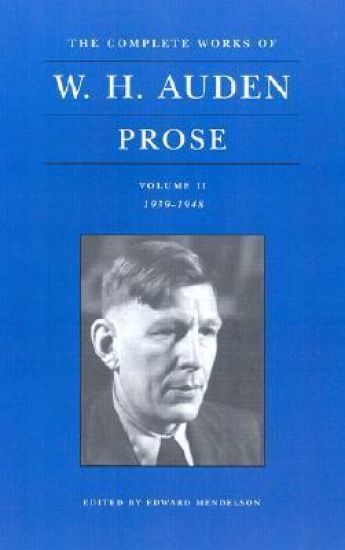
The Complete Works of W. H. Auden: Prose, Volume II
W. H. Auden
Princeton University Press
2002
sidottu
W. H. Auden's first ten years in the United States were marked by rapid and extensive change in his life and thought. He became an American citizen, fell in love with Chester Kallman, and began to reflect on American culture and to explore the ideas of Reinhold Niebuhr and other Protestant theologians. This volume contains every piece of prose that Auden wrote during these years, including essays and reviews he published under pseudonyms. Most have never been reprinted in any form since their initial publication in such magazines and newspapers as the Nation, the New Republic, Common Sense, Vogue, and the New York Times. Auden's prose during this period is frequently directly autobiographical even as he comments on literature, psychology, politics, and religion. The writings range from a dialogue about W. B. Yeats through a respectful parody of Gertrude Stein to Jamesian essays on Henry James. They also include lively and often profound responses to ancient and modern history as well as to contemporary issues in politics and religion. Other highlights include writings on opera and poetry as well as reports of Auden's lectures and the text of an unfinished autobiographical book, The Prolific and the Devourer. Throughout, Edward Mendelson's extensive and illuminating editor's notes explain all contemporary and private allusions. By making available a large cache of important but previously difficult-to-obtain writings on key subjects, this volume will be of obvious appeal to Auden's legions of admirers. It will also be enjoyed by everyone interested in twentieth-century literature, religion, and culture.
The most influential philosopher in the analytic tradition of his time, Willard Van Orman Quine (1908-2000) changed the way we think about language and its relation to the world. His rejection of the analytic/synthetic distinction, his scepticism about modal logic and essentialism, his celebrated theme of the indeterminacy of translation, and his advocacy of naturalism have challenged key assumptions of the prevailing orthodoxy and helped shape the development of much of recent philosophy. This introduction to Quine's philosophical ideas provides philosophers, students, and generalists with an authoritative analysis of Quine's lasting contributions to philosophy. The major themes covered include the adaptation of the language of modern logic to formulate a criterion of ontological commitment; Quine's own ontological commitments; Duhemian-Holistic empiricism and the attendant rejection of a priori knowledge; the nature and grounds of logical truth; Quine's criticisms of such notions as meaning, synonymy, analyticity, and necessity; the conjecture of the indeterminacy of translation; modal logic; propositional attitudes; and Quine's work on naturalized epistemology. Quine's ideas throughout are contrasted with more traditional views, as well as with contemporaries such as Frege, Russell, Carnap, Davidson, Field, Kripke, and Chomsky, enabling the reader to grasp a clear sense of the place of Quine's views in twentieth-century philosophy and the important criticisms of them.
The most influential philosopher in the analytic tradition of his time, Willard Van Orman Quine (1908-2000) changed the way we think about language and its relation to the world. His rejection of the analytic/synthetic distinction, his scepticism about modal logic and essentialism, his celebrated theme of the indeterminacy of translation, and his advocacy of naturalism have challenged key assumptions of the prevailing orthodoxy and helped shape the development of much of recent philosophy. This introduction to Quine's philosophical ideas provides philosophers, students, and generalists with an authoritative analysis of Quine's lasting contributions to philosophy. The major themes covered include the adaptation of the language of modern logic to formulate a criterion of ontological commitment; Quine's own ontological commitments; Duhemian-Holistic empiricism and the attendant rejection of a priori knowledge; the nature and grounds of logical truth; Quine's criticisms of such notions as meaning, synonymy, analyticity, and necessity; the conjecture of the indeterminacy of translation; modal logic; propositional attitudes; and Quine's work on naturalized epistemology. Quine's ideas throughout are contrasted with more traditional views, as well as with contemporaries such as Frege, Russell, Carnap, Davidson, Field, Kripke, and Chomsky, enabling the reader to grasp a clear sense of the place of Quine's views in twentieth-century philosophy and the important criticisms of them.
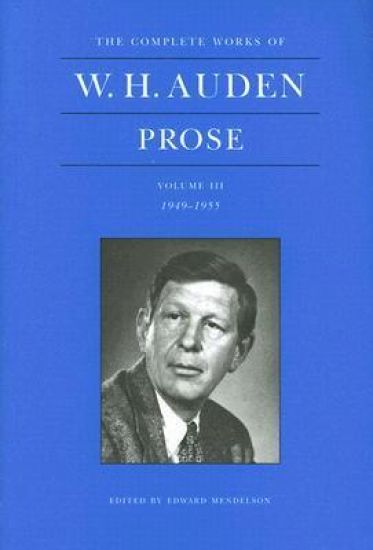
The Complete Works of W. H. Auden: Prose, Volume III
W. H. Auden
PRINCETON UNIVERSITY PRESS
2008
sidottu
This volume contains all of W. H. Auden's prose works from 1949 through 1955, including many little-known essays that exemplify his range, wit, depth, and wisdom. The book includes the complete text of Auden's first separately published prose book, The Enchafed Flood, or, The Romantic Iconography of the Sea, followed by more than one hundred separate essays, reviews, introductions, and lectures, as well as a questionnaire (complete with his own answers) about the reader's fantasy version of Eden. Two reviews that Auden wrote for the New Yorker, but which the magazine never printed, appear here for the first time, and a series of aphorisms previously published only in a French translation are printed in English. Among the previously unpublished lectures is a long account of the composition of his poem "Prime," complete with his comments on early rejected drafts. The variety of style and subject in this book is almost inexhaustible. Auden writes about the imaginary mirrors that everyone carries through life; French existentialism and New Yorker cartoons; Freud, Kierkegaard, Dostoyevsky, and Camus; Keats, Cervantes, Melville, Colette, Byron, Virgil, Yeats, Tolkien, and Virginia Woolf; opera, ballet, cinema, prosody, and music; English and American poetry and society; and politics and religion. The introduction by Edward Mendelson places the essays in biographical and historical context, and the extensive textual notes explain obscure contemporary references and provide an often-amusing history of Auden's work as an editor of anthologies and a series of books by younger poets.
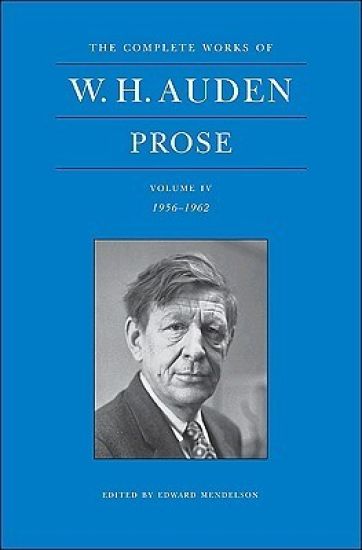
The Complete Works of W. H. Auden: Prose, Volume IV
W. H. Auden
Princeton University Press
2010
sidottu
This fourth volume of W. H. Auden's prose provides a unique picture of this legendary writer's mind and art when he was at the height of his powers, from 1956 through 1962, including the years when he was Professor of Poetry at Oxford. The volume includes his best-known and most important prose collection, "The Dyer's Hand", as well as scores of essays, reviews, and lectures on subjects ranging from J. R. R. Tolkien and Martin Luther to psychedelic drugs, cooking, and Homer. Much of the material has never been collected in book form, and some selections, such as the witty orations Auden wrote for ceremonies at Oxford University, are almost entirely unknown. Edward Mendelson's introduction and comprehensive notes provide biographical and historical explanations of all obscure references. The text includes extensive corrections and revisions that Auden marked in personal copies of his work and which are printed here for the first time.
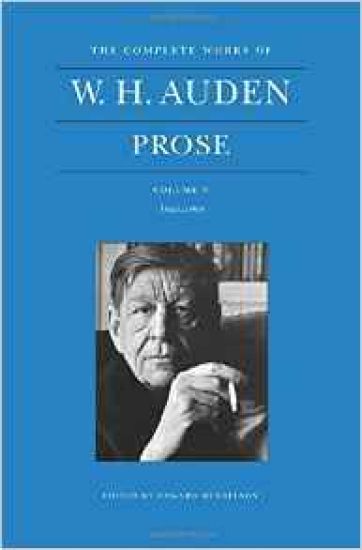
The Complete Works of W. H. Auden: Prose, Volume V
W. H. Auden
PRINCETON UNIVERSITY PRESS
2015
sidottu
This fifth volume of W. H. Auden's prose displays a great writer's mind in its full maturity of wisdom, learning, and emotional and moral intelligence. It contains his most personally revealing essays, the ones in which he wrote for the first time about the full history of his family life, his sexuality, and the development of his moral and religious beliefs. Among these works are the lightly disguised autobiographies that appear in long essays on the Protestant mystics and on Shakespeare's sonnets. The book also features the full text of his T. S. Eliot Memorial Lectures, Secondary Worlds, and many unpublished or unavailable lectures and speeches. Edward Mendelson's introduction and comprehensive notes provide biographical and historical explanations of obscure references. The text includes corrections and revisions that Auden marked in personal copies of his work and that are published here for the first time.
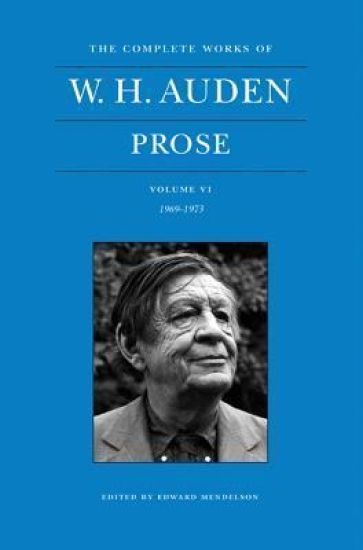
The Complete Works of W. H. Auden: Prose, Volume VI
W. H. Auden
PRINCETON UNIVERSITY PRESS
2015
sidottu
This sixth and final volume of W. H. Auden's prose displays a great writer's mind in its full maturity of wisdom, learning, and emotional and moral intelligence. It contains the full text of the only book that he regarded as an autobiography, A Certain World, in which he portrayed himself by selecting and commenting on writings by others that most affected him throughout his life. It also features late essays and reviews that in many cases present lightly disguised autobiographies, among them the most detailed account of his sexuality, in "Papa Was a Wise Old Sly-Boots." The appendixes gather lectures and public talks that are otherwise unpublished or unavailable. Edward Mendelson's comprehensive notes provide biographical and historical explanations of obscure references. The text includes corrections and revisions that Auden marked in personal copies of his work and that are published here for the first time.