Kirjahaku
Etsi kirjoja tekijän nimen, kirjan nimen tai ISBN:n perusteella.
1000 tulosta hakusanalla C. David Heymann
Biologists have known for decades that many traits involved in competition for mates or other resources and that influence mate choice are exaggerated, and their expression is influenced by the individuals’ ability to tolerate a variety of environmental and social stressors. Evolution of Vulnerability applies this concept of heightened sensitivity to humans for a host of physical, social, psychological, cognitive, and brain traits. By reframing the issue entirely, renowned evolutionary psychologist David C. Geary demonstrates this principle can be used to identify children, adolescents, or populations at risk for poor long-term outcomes and identify specific traits in each sex and at different points in development that are most easily disrupted by exposure to stressors. Evolution of Vulnerability begins by reviewing the expansive literature on traits predicted to show sex-specific sensitivity to environmental and social stressors, and details the implications for better assessing and understanding the consequences of exposure to these stressors. Next, the book reviews sexual selection—mate competition and choice—and the mechanisms involved in the evolution of condition dependent traits and the stressors that can undermine their development and expression, such as poor early nutrition and health, parasites, social stress, and exposure to man-made toxins. Then it reviews condition dependent traits (physical, behavioral, cognitive, and brain) in birds, fish, insects, and mammals to demonstrate the ubiquity of these traits in nature. The focus then turns to humans and covers sex-specific vulnerabilities in children and adults for physical traits, social behavior, psychological wellbeing, and brain and cognitive traits. The sensitivity of these traits is related to exposure to parasites, poor nutrition, social maltreatment, environmental toxins, chemotherapy, and Alzheimer’s disease, among others. The book concludes with an implications chapter that outlines how to better assess vulnerabilities in children and adults and how to more fully understand how, why, and when in development some types of environmental and social stressors are particularly harmful to humans.
Fundamentals of Soil Ecology
David C. Coleman; Mac A. Callaham; D. A. Crossley Jr.
Academic Press Inc
2020
nidottu
Fundamentals of Soil Ecology, 3rd Edition, offers a holistic approach to soil biology and ecosystem function, providing students and ecosystem researchers with a greater understanding of the central roles that soils play in ecosystem development and function. The text emphasizes the increasing importance of soils as the organizing center for all terrestrial ecosystems and provides an overview of theory and practice in soil ecology, both from an ecosystem and evolutionary biology point of view. This new edition is fully updated, including an expanded treatment of microbial ecology and new sections on advances in molecular techniques and climate change research. These updates make this edition an essential resource for researchers and students in soil ecology and microbiology.
Analytical Methods for Biomass Characterization and Conversion
David C. Dayton; Thomas D. Foust
Elsevier Science Publishing Co Inc
2020
nidottu
Analytical Methods for Biomass Characterization and Conversion is a thorough resource for researchers, students and professors who investigate the use of biomass for fuels, chemicals and products. Advanced analytical chemistry methods and techniques can now provide detailed compositional and chemical measurements of biomass, biomass conversion process streams, intermediates and products. This volume from the Emerging Issues in Analytical Chemistry series brings together the current knowledge on each of these methods, including spectroscopic methods (Fourier Transform Infrared Spectroscopy, Near-infrared Spectroscopy, Solid State Nuclear Magnetic Resonance), pyrolysis (Gas Chromatography/Mass Spectrometry), Liquid Chromatography/High Performance Liquid Chromatography, Liquid Chromatography/Mass Spectrometry, and so on. Authors David C. Dayton and Thomas D. Foust show how these can be used for measuring biomass composition and for determining the composition of intermediates with regard to subsequent processing for biofuels, bio-chemicals and bio-based products.
How did a gentle liberal humanist become responsible for the creation of the first real weapon of mass destruction? How could a brilliant mind like his virtually found "scientific militarism" and then let it destroy him? Cassidy opens up a life story that is emblematic of the transformation of America over the last three generations.
TIPERs: Sensemaking Tasks for Introductory Physics gives introductory physics students the type of practice they need to promote a conceptual understanding of problem solving. This supplementary text helps students to connect the physical rules of the universe with the mathematical tools used to express them. The exercises in this workbook are intended to promote sensemaking. The various formats of the questions are difficult to solve just by using physics equations as formulas. Students will need to develop a solid qualitative understanding of the concepts, principles, and relationships in physics. In addition, they will have to decide what is relevant and what isn’t, which equations apply and which don’t, and what the equations tell one about physical situations. The goal is that when students are given a physics problem where they are asked solve for an unknown quantity, they will understand the physics of the problem in addition to finding the answer.
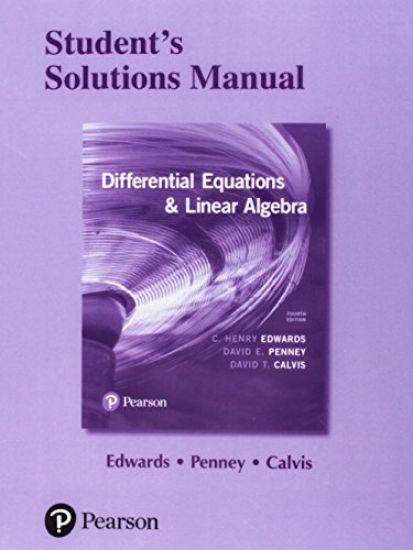
Differential Equations and Linear Algebra
C. Edwards; David Penney; David Calvis
Pearson
2017
sidottu
For courses in Differential Equations and Linear Algebra . Concepts, methods, and core topics covering elementary differential equations and linear algebra through real-world applications In a contemporary introduction to differential equations and linear algebra, acclaimed authors Edwards and Penney combine core topics in elementary differential equations with concepts and methods of elementary linear algebra. Renowned for its real-world applications and blend of algebraic and geometric approaches, Differential Equations and Linear Algebra introduces you to mathematical modeling of real-world phenomena and offers the best problems sets in any differential equations and linear algebra textbook. The 4th Edition includes fresh new computational and qualitative flavor evident throughout in figures, examples, problems, and applications. Additionally, an Expanded Applications website containing expanded applications and programming tools is now available.
Student Solutions Manual for Differential Equations and Linear Algebra
C. Edwards; David Penney; David Calvis
Pearson
2017
nidottu
For courses in Differential Equations and Linear Algebra. Now available with MyLab Math The right balance between concepts, visualization, applications, and skills – now available with MyLab Math Differential Equations and Linear Algebra provides the conceptual development and geometric visualization of a modern differential equations and linear algebra course that is essential to science and engineering students. It balances traditional manual methods with the new, computer-based methods that illuminate qualitative phenomena – a comprehensive approach that makes accessible a wider range of more realistic applications. The book combines core topics in elementary differential equations with concepts and methods of elementary linear algebra. It starts and ends with discussions of mathematical modeling of real-world phenomena, evident in figures, examples, problems, and applications throughout. For the first time, MyLab Math is available for this text, providing online homework with immediate feedback, the complete eText, and more. Additionally, new presentation slides created by author David Calvis are available in Beamer (LaTeX) and PDF formats. The slides are ideal for classroom lectures and student review, and combined with Calvis' superlative instructional videos offer a level of support not found in any other Differential Equations course. Personalize learning with MyLab Math MyLab Math is the teaching and learning platform that empowers you to reach every student. By combining trusted author content with digital tools and a flexible platform, MyLab Math personalizes the learning experience and improves results for each student. 0136743641 / 9780136743644 MYLAB MATH DIGITAL UPDATE WITH PEARSON ETEXT -- ACCESS CARD -- FOR DIFFERENTIAL EQUATIONS AND LINEAR ALGEBRA, 4/e
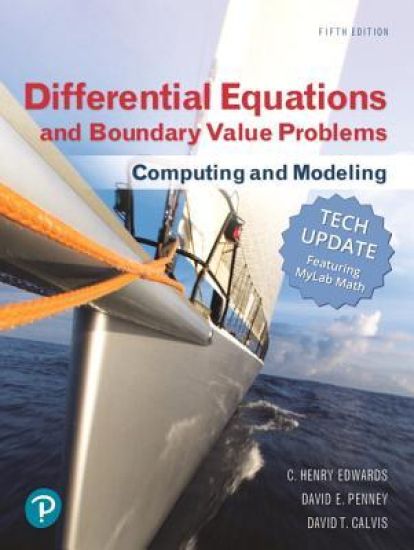
Differential Equations and Boundary Value Problems
C. Edwards; David Penney; David Calvis
Pearson
2018
sidottu
For one-semester sophomore- or junior-level courses in Differential Equations. Fosters the conceptual development and geometric visualization students need – now available with MyLab Math Differential Equations and Boundary Value Problems: Computing and Modeling blends traditional algebra problem-solving skills with the conceptual development and geometric visualization of a modern differential equations course that is essential to science and engineering students. It balances traditional manual methods with the new, computer-based methods that illuminate qualitative phenomena—a comprehensive approach that makes accessible a wider range of more realistic applications. The book starts and ends with discussions of mathematical modeling of real-world phenomena, evident in figures, examples, problems, and applications throughout. For the first time, MyLab™ Math is available for the 5th Edition, providing online homework with immediate feedback, the complete eText, and more. Additionally, new presentation slides created by author David Calvis are now live in MyLab Math, available in Beamer (LaTeX) and PDF formats. The slides are ideal for both classroom lectures and student review, and combined with Calvis’ superlative videos offer a level of support not found in any other Differential Equations course. Also available with MyLab Math MyLab™ Math is the teaching and learning platform that empowers instructors to reach every student. By combining trusted author content with digital tools and a flexible platform, MyLab Math personalizes the learning experience and improves results for each student. Note: You are purchasing a standalone product; MyLab Math does not come packaged with this content. Students, if interested in purchasing this title with MyLab Math, ask your instructor to confirm the correct package ISBN and Course ID. Instructors, contact your Pearson representative for more information. If you would like to purchase both the physical text and MyLab Math, search for: 0134995988 / 9780134995984 Differential Equations and Boundary Value Problems: Computing and Modeling (Tech Update) and MyLab Math with Pearson eText - Title-Specific Access Card Package Package consists of: 0134837398 / 9780134837390 Differential Equations and Boundary Value Problems: Computing and Modeling (Tech Update)0134872975 / 9780134872971 MyLab Math with Pearson eText - Standalone Access Card - for Differential Equations and Boundary Value Problems: Computing and Modeling Tech Update
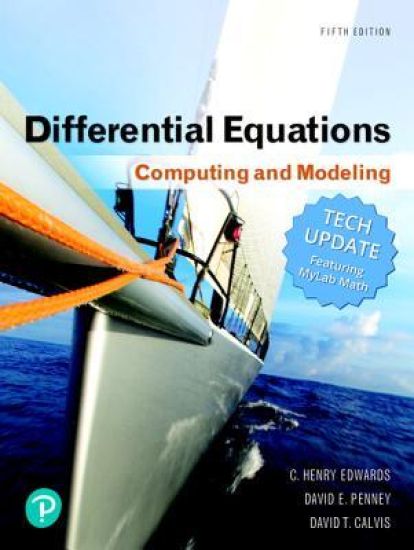
For one-semester sophomore- or junior-level courses in Differential Equations. Fosters the conceptual development and geometric visualization students need–now available with MyLab Math Differential Equations: Computing and Modeling blends traditional algebra problem-solving skills with the conceptual development and geometric visualization of a modern differential equations course that is essential to science and engineering students. It balances traditional manual methods with the new, computer-based methods that illuminate qualitative phenomena–a comprehensive approach that makes accessible a wider range of more realistic applications. The book starts and ends with discussions of mathematical modeling of real-world phenomena, evident in figures, examples, problems, and applications throughout. For the first time, MyLab™ Math is available for the 5th Edition, providing online homework with immediate feedback, the complete eText, and more. Additionally, new presentation slides created by author David Calvis are now live in MyLab Math, available in Beamer (LaTeX) and PDF formats. The slides are ideal for both classroom lectures and student review, and combined with Calvis’ superlative videos offer a level of support not found in any other Differential Equations course. Also available with MyLab Math MyLab™ Math is the teaching and learning platform that empowers instructors to reach every student. By combining trusted author content with digital tools and a flexible platform, MyLab Math personalizes the learning experience and improves results for each student. Note: You are purchasing a standalone product; MyLab Math does not come packaged with this content. Students, if interested in purchasing this title with MyLab Math, ask your instructor to confirm the correct package ISBN and Course ID. Instructors, contact your Pearson representative for more information. If you would like to purchase both the physical text and MyLab Math, search for: 0134996003 / 9780134996004 Differential Equations: Computing and Modeling Media Update and MyLab Math with Pearson eText -- Title-Specific Access Card Package, 5/e Package consists of: 0134850475 / 9780134850474 Differential Equations: Computing and Modeling Media Update0134873084 / 9780134873084 MyLab Math plus Pearson eText — Standalone Access Card - for Differential Equations: Computing and Modeling Media Update
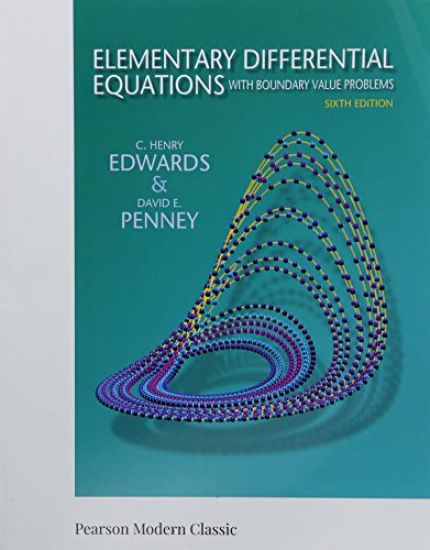
Elementary Differential Equations with Boundary Value Problems (Classic Version)
C. Edwards; David Penney
Pearson
2018
nidottu
This title is part of the Pearson Modern Classics series. Pearson Modern Classics are acclaimed titles at a value price. Please visit www.pearsonhighered.com/math-classics-series for a complete list of titles.For briefer traditional courses in elementary differential equations that science, engineering, and mathematics students take following calculus. The Sixth Edition of this widely adopted book remains the same classic differential equations text it's always been, but has been polished and sharpened to serve both instructors and students even more effectively. Edwards and Penney teach students to first solve those differential equations that have the most frequent and interesting applications. Precise and clear-cut statements of fundamental existence and uniqueness theorems allow understanding of their role in this subject. A strong numerical approach emphasizes that the effective and reliable use of numerical methods often requires preliminary analysis using standard elementary techniques.
Differential Equations and Boundary Value Problems: Computing and Modeling
C. Edwards; David Penney; David Calvis
PEARSON
2022
sidottu
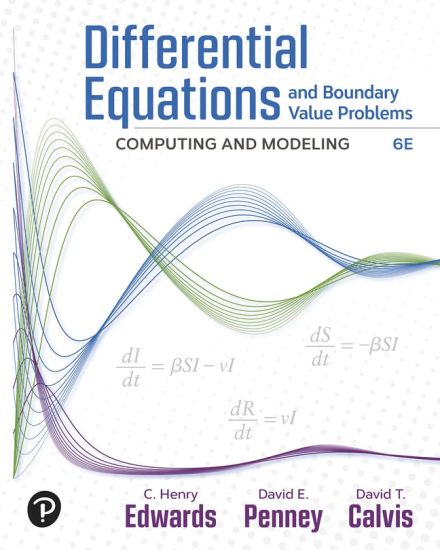
Differential Equations and Boundary Value Problems: Computing and Modeling balances concepts, visualization, applications and skills, helping you develop the conceptual understanding and geometric visualization that are essential for science and engineering students. It utilizes computer algebra systems such as Mathematica, Maple, and MATLAB plus online platforms like WolframAlpha and GeoGebra, along with traditional manual methods. The text begins and ends with discussion of mathematical modeling of real-world phenomena, evident in its figures, examples, problems and applications. The 6th Edition adds and updates content throughout, including an expanded Application Module for Section 6.4 that discusses COVID-19.
Mylab Math With Pearson Etext 24 month Access Card for Differential Equations and Boundary Value Problems
C. Henry Edwards; David E. Penney; David Calvis
Pearson College Div
2022
sidottu
The Emergency State: America's Pursuit of Absolute Security at All Costs
David C. Unger
PENGUIN BOOKS
2013
nidottu
From the New York Times's veteran foreign policy editorialist, a lucid analysis of the harm caused by America's increasingly misdirected national security state America is trapped in a state of war that has consumed our national life since before Pearl Harbor. Over seven decades and several bloody wars, Democratic and Republican politicians alike have assembled an increasingly complicated, ineffective, and outdated network of security services. Yet this pursuit has notonly damaged our democratic institutions and undermined our economic strengths; it has fundamentally failed to make us safer. In The Emergency State, senior New York Times writer David C. Unger reveals the hidden costs of America's bipartisan obsession with achieving absolute national security and traces a series of missed opportunities--from the end of World War II through the presidency of Barack Obama--when we could have rethought our defense strategy but did not. Provocative, insightful, and refreshingly nonpartisan, this is the definitive untold story of how America became so vulnerable--and how it can build real security again.
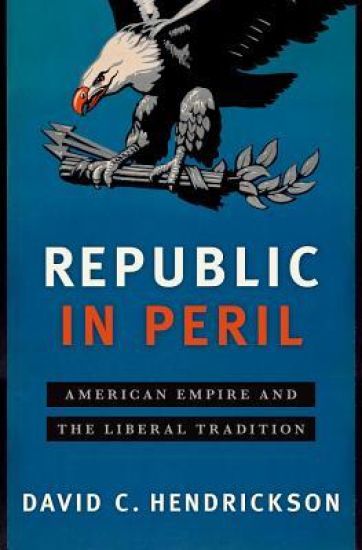
It has become a staple among critics of American foreign policy to refer to the United States's approach as "liberal imperialism." By this they mean that America's globalist agenda and its willingness to use force in theaters across the globe derives from its desire to evangelize the gospel of liberalism and thereby extend the reach of a US-dominated democratic capitalist order. These critics point to the presidency of Woodrow Wilson and trace how this agenda evolved over the next century. The dominance of liberal ideology, they argue, is so all-encompassing that virtually all of the main variants within the modern US foreign policy tradition, from anti-communism to neoliberalism to neoconservatism, fit under liberalism's umbrella. In Republic in Peril, the eminent foreign policy scholar David C. Hendrickson turns this thesis on its head. A trenchant critic of America's quest for global dominance, Hendrickson argues not only that liberalism is not the culprit, but is in fact where we should turn because it offers a powerful critique of both militarized interventionism and the US quest for full-spectrum global dominance. Covering all of the major episodes of the past century, he shows how the US has fully abandoned a tradition of republican liberalism that dates back to the Founders. The republican liberal tradition, which dominated US foreign policy for over a century, mandated non-intervention and the promotion of peace. This "golden rule" policy toward other nations served America well, he contends, and many of the pathologies that plague US foreign policy now--particularly its disastrous approach to the Middle East--can be traced to the desertion of the republican liberal tradition. He therefore advocates returning to the more collegial form of internationalism ("iso-internationalism") that preceded Wilsonianism. Combining both a rich historical overview of modern American foreign policy with a forceful indictment of the illiberal straitjacket in which US has bound itself, Republic in Peril provides a genuinely original defense of liberalism in the service of peaceful non-intervention--a position that contemporary critics of aggressive liberalism are sure to find surprising.
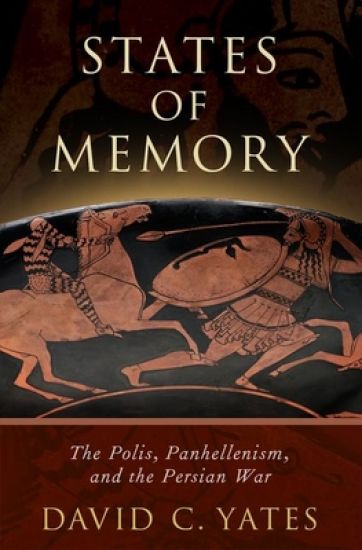
The Persian War was one of the most significant events in ancient history. It halted Persia's westward expansion, inspired the Golden Age of Greece, and propelled Athens to the heights of power. From the end of the war almost to the end of antiquity, the Greeks and later the Romans recalled the battles and heroes of this war with unabated zeal. The resulting monuments and narratives have long been used to reconstruct the history of the war itself, but they have only recently begun to be used to explore how the conflict was remembered over time. States of Memory focuses on the initial recollection of the war in the classical period down to the Lamian War (480-322 BCE). Drawing together recent work on memory theory and a wide range of ancient evidence, Yates argues that the Greek memory of the war was deeply divided from the outset. Despite the panhellenic scope of the conflict, the Greeks very rarely recalled the war as Greeks. Instead they presented themselves as members of their respective city-states. What emerged was a tangled web of idiosyncratic stories about the Persian War that competed with each other fiercely throughout the classical period. It was not until Philip of Macedonia and Alexander the Great dealt a devastating blow to the very notion of the independent city-state at the battle of Chaeronea that anything like a unified memory of the Persian War came to dominate the tradition.
The deep divides that define politics in the United States are not restricted to policy or even cultural differences anymore. Americans no longer agree on basic questions of fact. Is climate change real? Does racism still determine who gets ahead? Is sexual orientation innate? Do immigration and free trade help or hurt the economy? Does gun control reduce violence? Are false convictions common? Employing several years of original survey data and experiments, Marietta and Barker reach a number of enlightening and provocative conclusions: dueling fact perceptions are not so much a product of hyper-partisanship or media propaganda as they are of simple value differences and deepening distrust of authorities. These duels foster social contempt, even in the workplace, and they warp the electorate. The educated -- on both the right and the left -- carry the biggest guns and are the quickest to draw. And finally, fact-checking and other proposed remedies don't seem to holster too many weapons; they can even add bullets to the chamber. Marietta and Barker's pessimistic conclusions will challenge idealistic reformers.
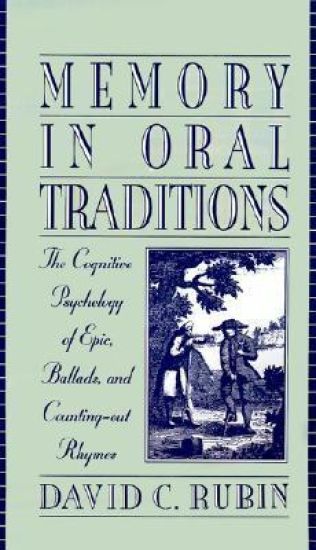
This book applies the methods and theories of cognitive psychology to the study of oral traditions. Rubin elaborates on three structural devices that appear in oral traditions: those consisting of meaning, those using imagery, and those in which sound pattern is predominant. Next, the way in which these and other constraints fit together is examined. The processes of transmission and recall are then considered. Three genres are considered as different applications of the principles outlined in the book. For two of these -- counting-out rhymes and ballads -- original studies are reported. For the third -- epic -- new analyses of existing data are reported.
Monte Carlo Modeling for Electron Microscopy and Microanalysis
David C. Joy
Oxford University Press Inc
1995
sidottu
This book describes how Monte Carlo modeling methods can be applied to Electron Microscopy and Microanalysis. Computer programs for two basic types of Monte carlo simulation are developed from physical models of the electron scattering process; a Single Scattering program capable of high accuracy but requiring long computation times, and a Plural Scattering program which is less accurate but much more rapid. The programs are optimised for use on personal computers and provide a real time graphical display of the interaction. These programs are then used as the starting point for the development of programs aimed at studying particular effects in the electron microscope including backscattering, secondary electron production, EBIC and cathodo- luminescence imaging, and X- ray microanalysis. The computer code is given in a fully annotated format so that it may be readily be modified for use in specific problems. Many examples of the applications of these methods are provided, together with a complete bibliography.
This is a brass tacks look at television with an eye on the bottom line by two men who boast over sixty years of experience in the medium. This book is intended for general readers with an interest in the media and how it makes use of television.
Oral tradition is important in many fields of study such as psychology, anthropology, linguistics, folklore studies, history and the classics. This book combines the methods and theories of cognitive psychology with the study of oral traditions to test and expand the ideas of both. It is the first book on oral tradition from an author with professional knowledge of human memory and cognition. Easy to read, and in a jargon-free style, this book will appeal to a wide range of academics and graduate students from various disciplines.