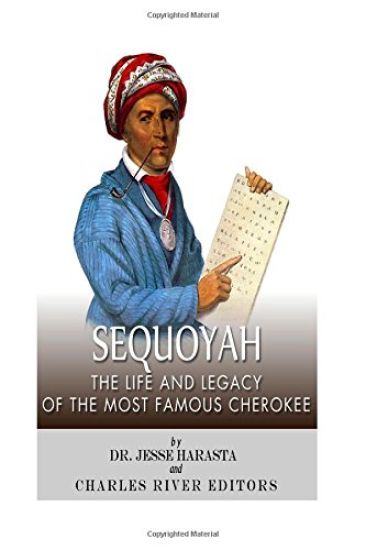
*Includes pictures *Explains how the syllabary works and its influences *Includes footnotes and a bibliography for further reading Tragically, the Cherokee is one of America's best known tribes due to the trials and tribulations they suffered by being forcibly moved west along the "Trail of Tears", but that overlooks the contributions they made to American society well before the 19th century. The Cherokee began the process of assimilation into European America very early, even before the establishment of the Unites States, and by the early 19th century they were one of the "Five Civilized Tribes." Despite all of the hostilities and the Trail of Tears, the Cherokee ultimately became the first people of non-European descent to become U.S. citizens en masse, and today the Cherokee Nation is the largest federally recognized tribe in the United States, boasting over 300,000 members. The Cherokee might be the most famous tribe in the country, and if so, the person most responsible for it is Sequoyah, whose invention of the Cherokee syllabary also played a prominent role in facilitating the assimilation between the Cherokee and Americans. Sequoyah began work on devising the writing and reading system around 1809, and it was instantly popular among the Cherokee, to the extent that it was being used in written publications among the tribe by the 1820s. The syllabary has been in use ever since, both within the tribe and among outsiders. Thanks to his accomplishments, Sequoyah was celebrated in his own lifetime, but due to his obscure roots, accounts of his early years still vary dramatically. Sequoyah: The Life and Legacy of the Most Famous Cherokee looks at the life and work of the man who put the Cherokee language down in print and made it possible for outsiders to both read and write it. This includes analyzing the nature of his invention, the social context in which he lived, and the ongoing legacy he has left for the modern Cherokee. Along with pictures of important people, places, and events, you will learn about Sequoyah like never before, in no time at all.
An astonishing untold story from the nineteenth century--a "riveting...engrossing...'American Epic'" (The Wall Street Journal) and necessary work of history that reads like Gone with the Wind for the Cherokee. "A vigorous, well-written book that distills a complex history to a clash between two men without oversimplifying" (Kirkus Reviews), Blood Moon is the story of the feud between two rival Cherokee chiefs from the early years of the United States through the infamous Trail of Tears and into the Civil War. Their enmity would lead to war, forced removal from their homeland, and the devastation of a once-proud nation. One of the men, known as The Ridge--short for He Who Walks on Mountaintops--is a fearsome warrior who speaks no English, but whose exploits on the battlefield are legendary. The other, John Ross, is descended from Scottish traders and looks like one: a pale, unimposing half-pint who wears modern clothes and speaks not a word of Cherokee. At first, the two men are friends and allies who negotiate with almost every American president from George Washington through Abraham Lincoln. But as the threat to their land and their people grows more dire, they break with each other on the subject of removal. In Blood Moon, John Sedgwick restores the Cherokee to their rightful place in American history in a dramatic saga that informs much of the country's mythic past today. Fueled by meticulous research in contemporary diaries and journals, newspaper reports, and eyewitness accounts--and Sedgwick's own extensive travels within Cherokee lands from the Southeast to Oklahoma--it is "a wild ride of a book--fascinating, chilling, and enlightening--that explains the removal of the Cherokee as one of the central dramas of our country" (Ian Frazier). Populated with heroes and scoundrels of all varieties, this is a richly evocative portrait of the Cherokee that is destined to become the defining book on this extraordinary people.
The U.S. Court of Claims ruled in favor of the Eastern Cherokee Tribe's claim against the U.S. on May 18, 1905. This resulted in the appropriation of $1 million to the Tribe's eligible individuals and families. Interior Department employee Guion Miller created a list using several rolls and applications to verify tribal enrollment for the distribution of funds.The applications received documented over 125,000 individuals; the court approved more than 30,000 individuals to share in the funds.For individuals seeking to prove native lineage in their genealogy, this index includes the names of all persons applying for compensation arising from the judgment of the United States Court of Claims on May 28, 1906, for the Eastern Cherokee tribe. While numerous individuals applied, not all the claims were allowed. The information included on the index is the application number, the name of the applicant, and the State or Territory in which the individual resided at the time the application was filed.
Explore the Cruel History of the Trail of Tears One of the darkest and cruelest chapters in the history of the United States occurred when the nation's young government decided to remove the native peoples from their lands in the name of profit. Having helped settlers for hundreds of years, five Native American tribes found it increasingly more difficult to relate to and trust the country that had once acted as their allies. The native peoples had fought alongside the Americans to gain freedom from England, the nation that the colonists deemed oppressive and unfair. The native peoples acted as benefactors and teachers, helping the colonists to gain an advantage against an army that was far superior to the small forces that the colonists could muster. The new country owed a lot of its existence to the native peoples, yet the settlers, who were of European descent, did not see it that way. The following topics will be covered in this book: The Early RelationshipThe Growth of Manifest DestinyThe Discovery of Gold and the Indian Removal ActPeaceful Protests and a Push for RecognitionThe People Versus the PresidentThe Militia Force RemovalThe Trail of TearsStories of Pain, Loss, and LoveMaking a New HomeAnd a Great Deal More You Don't Want to Miss Out On Get the book now to learn more about the Trail of Tears
*Includes pictures of important people, places, and events. *Explains the origins, religion, and social structure of the Cherokee *Comprehensively covers the Trail of Tears and includes eyewitness accounts of it. *Includes a Bibliography for further reading. "We are overwhelmed Our hearts are sickened, our utterance is paralyzed, when we reflect on the condition in which we are placed, by the audacious practices of unprincipled men, who have managed their stratagems with so much dexterity as to impose on the Government of the United States, in the face of our earnest, solemn, and reiterated protestations." - Principal Chief John Ross From the "Trail of Tears" to Wounded Knee and Little Bighorn, the narrative of American history is incomplete without the inclusion of the Native Americans that lived on the continent before European settlers arrived in the 16th and 17th centuries. Since the first contact between natives and settlers, tribes like the Sioux, Cherokee, and Navajo have both fascinated and perplexed outsiders with their history, language, and culture. In Charles River Editors' Native American Tribes series, readers can get caught up to speed on the history and culture of North America's most famous native tribes in the time it takes to finish a commute, while learning interesting facts long forgotten or never known. Tragically, the Cherokee is one of America's best known tribes due to the trials and tribulations they suffered by being forcibly moved west along the "Trail of Tears", but that overlooks the contributions they made to American society well before the 19th century. The Cherokee began the process of assimilation into European America very early, even before the establishment of the Unites States, and by the early 19th century they were one of the "Five Civilized Tribes." Ultimately, however, it is unclear what benefits "civilization" brought the tribe. Throughout the colonial period and after the American Revolution, the Cherokee struggled to satisfy the whims and desires of American government officials and settlers, often suffering injustices after complying with their desires. Nevertheless, the Cherokee continued to endure, and after being pushed west, they rose from humble origins as refugees new to the southeastern United States to build themselves back up into a powerhouse both economically and militarily. Even after being forced to leave their traditional homeland again, they once more rose to become a powerful tribe and nation, ruling themselves and building their economic power through wise and skillful leadership. Despite all of the hostilities, the Cherokee ultimately became the first people of non-European descent to become U.S. citizens en masse, and today the Cherokee Nation is the largest federally recognized tribe in the United States, boasting over 300,000 members. Given what they overcame in the last 200 years, the story of the Cherokee Nation is a testament to the resiliency, cohesiveness, and power of the Cherokee people. Native American Tribes: The History and Culture of the Cherokee comprehensively covers the culture and history of the famous tribe, profiling their origins, their famous leaders, and their lasting legacy. Along with pictures of important people, places, and events, you will learn about the Cherokee like you never have before, in no time at all.
*Includes pictures *Explains how the syllabary works and its influences *Includes footnotes and a bibliography for further reading Tragically, the Cherokee is one of America's best known tribes due to the trials and tribulations they suffered by being forcibly moved west along the "Trail of Tears", but that overlooks the contributions they made to American society well before the 19th century. The Cherokee began the process of assimilation into European America very early, even before the establishment of the Unites States, and by the early 19th century they were one of the "Five Civilized Tribes." Despite all of the hostilities and the Trail of Tears, the Cherokee ultimately became the first people of non-European descent to become U.S. citizens en masse, and today the Cherokee Nation is the largest federally recognized tribe in the United States, boasting over 300,000 members. The Cherokee might be the most famous tribe in the country, and if so, the person most responsible for it is Sequoyah, whose invention of the Cherokee syllabary also played a prominent role in facilitating the assimilation between the Cherokee and Americans. Sequoyah began work on devising the writing and reading system around 1809, and it was instantly popular among the Cherokee, to the extent that it was being used in written publications among the tribe by the 1820s. The syllabary has been in use ever since, both within the tribe and among outsiders. Thanks to his accomplishments, Sequoyah was celebrated in his own lifetime, but due to his obscure roots, accounts of his early years still vary dramatically. Sequoyah: The Life and Legacy of the Most Famous Cherokee looks at the life and work of the man who put the Cherokee language down in print and made it possible for outsiders to both read and write it. This includes analyzing the nature of his invention, the social context in which he lived, and the ongoing legacy he has left for the modern Cherokee. Along with pictures of important people, places, and events, you will learn about Sequoyah like never before, in no time at all.
This book features kid-friendly stories, based on the classic ""Living Stories of the Cherokee"".Cherokee people have lived in the Great Smoky Mountains for thousands of years. During all this time, they have told stories to each other to explain how things came to be, to pass on lessons about life, and to describe the mountains, animals, plants, and spirits around them. ""The Origin of the Milky Way and Other Living Stories of the Cherokee"" collects 26 stories that are great for kids and are still being told by storytellers today.Presented by members of the Eastern Band of Cherokee Indians in their own words, the stories appear in free-verse form, like poems on the page, so that if you read them aloud, you can hear the rhythm of the stories as they were originally told. Barbara R. Duncan provides a helpful introduction that describes Cherokee people's past and present ways of life and their storytelling traditions. The book also includes a glossary of key words from the stories, suggestions for further reading, and notes on the storytellers. Suitable for young readers, for parents to read aloud to young listeners, and for teachers and libraries, ""The Origin of the Milky Way"" provides an excellent introduction to Cherokee culture.
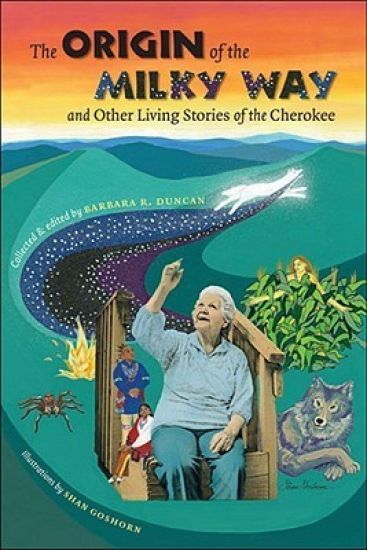
Cherokee people have lived in the Great Smoky Mountains for thousands of years. During all this time, they have told stories to each other to explain how things came to be, to pass on lessons about life, and to describe the mountains, animals, plants, and spirits around them. The Origin of the Milky Way and Other Living Stories of the Cherokee collects 27 stories that are great for kids and are still being told by storytellers today. Presented by members of the Eastern Band of Cherokee Indians in their own words, the stories appear in free-verse form, like poems on the page, so that if you read them aloud, you can hear the rhythm of the stories as they were originally told. Barbara R. Duncan provides a helpful introduction that describes Cherokee people's past and present ways of life and their storytelling traditions. The book also includes a glossary of key words from the stories, suggestions for further reading, and notes on the storytellers. For young readers, for parents to read aloud to young listeners, and for teachers and libraries, The Origin of the Milky Way provides an excellent introduction to Cherokee culture. (For readers age 9 and up.)Storytellers:Davy ArchRobert BushyheadEdna ChekeleleeMarie JunaluskaKathi LittlejohnFreeman Owle
In 1953 Albert Speer, Germany's Minister of Armaments & War Production during World War II, wrote from his cell in Spandau Prison, West Berlin, regarding the genocide of the American Indian. The Nazis' study of the treatment and eradication of the American Indian was an element in the plan for the "Final Solution" - the eradication of European Jews and others deemed undesirable or a threat to the Aryan order. Hitler, Heinrich Himmler, Adolf Eichmann, and others who administered the Nazi Holocaust had looked to the Indian Removal Act of 1830 and the subsequent actions of the United States Government as the blueprint for annihilation of a people, a culture, and a way of life. In Losing St. Christopher, Totsuhwa, the revered shaman of the Cherokee Nation, struggles against the assimilation of his people into the white world of men he sees as invaders. The colonists, along with Cherokee who are trying to bridge both worlds, see him as a barbarous threat. When Totsuhwa's visions show him the outcome, it is as black as his deep set haunting eyes. Chancellor, his son, takes a white wife following study at a missionary school and the shaman's fears seem realized. Conflicts between cultures and within the family erupt when Totsuhwa's only grandchild is forced onto the Trail of Tears. In the chase that follows, an estranged love fights to stem the ugly flow of racism that is moving in two directions. "History is written by the victorious, but when almost forgotten historical characters are brought to life, and their stories told, they are preserved through the ages, and in this preservation David-Michael Harding has succeeded." - Principal Chief Bill John Baker, Cherokee Nation, Tahlequah, OK