Kirjojen hintavertailu. Mukana 11 717 486 kirjaa ja 12 kauppaa.

Kirjahaku

Etsi kirjoja tekijän nimen, kirjan nimen tai ISBN:n perusteella.

1000 tulosta hakusanalla Jessica Else

Plato's Epistemology

Plato's Epistemology

Jessica Moss

Oxford University Press
2021
sidottu
Plato's Epistemology: Being and Seeming presents an original interpretation of one of the central topics in Plato's work: epistemology. Jessica Moss argues that Plato's epistemology is radically different from our own. Going against the grain of recent scholarship, and drawing on ancient interpretations of Plato, Jessica Moss argues that Plato is not best understood as studying what we now call knowledge and belief. Instead, Moss proposes that the central players in his epistemology, epistêmê and doxa, are each essentially to be understood as cognition of a certain kind of object. Epistêmê is cognition of what Is - where this turns out to mean that it is a deep grasp of ultimate reality. Doxa is cognition of what seems - where this turns out to mean that it is atheoretical thought that mistakes images for reality. The book defends these characterizations by arguing that they explain important features of Plato's epistemology. In particular, it shows that they underlie and make sense of a view which was long attributed to Plato but has recently been deemed "outrageous": that there is no doxa of Forms, and no epistêmê of perceptibles. Finally, Moss contends that Plato's epistemology is so different from modern epistemology because it is motivated by his central ethical and metaphysical views. As the Cave allegory illustrates, he holds that the goal of life is to be in contact with genuine Being, and that the greatest obstacle to this goal is our tendency to rest content with appearances. Therefore, when Plato turns to epistemological investigations, the distinction he finds most salient is that between cognition of what Is and cognition of what seems.
Thinking of Necessity

Thinking of Necessity

Jessica Leech

Oxford University Press
2023
sidottu
Thinking of Necessity: A Kantian Account of Modal Thought and Modal Metaphysics sets out a Kant-inspired theory of modality, i.e., possibility and necessity. The theory is driven by a methodology which takes seriously questions about the function of modal judgment, i.e., the role or purpose of judgments of possibility and necessity, as a guide to a metaphysics of modality. Kant is a good example for how to develop this methodological approach since, for Kant, modal concepts play an important role in our capacity for thought and experience of the world. The book argues that we need logical modal concepts as a condition on our ability to think, and metaphysical modal concepts as a condition on our ability to think objectively, i.e., to think about the world. Concordant with this, it argues that logical necessity has its source in the laws of thought and that metaphysical necessity is relative to conditions on objective thought. This account of metaphysical necessity, which is termed “Modal Transcendentalism”, is then further developed, covering questions concerning necessary and contingent existence, de re necessity, essentialism, and modal epistemology. The theory of modality developed in the book is inspired by aspects of Kant's writings on modality, but the development and defence of the theory is undertaken mostly independently of Kant.
Disability Through the Lens of Justice

Disability Through the Lens of Justice

Jessica Begon

Oxford University Press
2023
sidottu
Disability through the Lens of Justice offers a contextual framework for considering the limitations that disability places on individuals. Specifically, those that prevent individuals from having control in certain domains of their life, by restricting the availability of acceptable options or the ability to choose between them. Begon argues that our theory of justice should be concerned with the lives individuals can lead, and not with whether their bodies and minds function typically. The problem that disability raises is not the mere fact of difference, but the ways in which that difference is accommodated (or not) and the limitations it may cause. In Disability Through the Lens of Justice, Begon offers a new framework to the disability and justice model. She argues that achieving justice does not require 'normalisation', or the elimination of difference, but through implementating a model which enables all individuals to control their lives as they choose.
Metaphysical Emergence

Metaphysical Emergence

Jessica M. Wilson

Oxford University Press
2023
nidottu
Both the special sciences and ordinary experience suggest that there are metaphysically emergent entities and features: macroscopic goings-on (including mountains, trees, humans, and sculptures, and their characteristic properties) which depend on, yet are distinct from and distinctively efficacious with respect to, lower-level physical configurations and features. These appearances give rise to two key questions. First, what is metaphysical emergence, more precisely? Second, is there any metaphysical emergence, in principle and moreover in fact? Metaphysical Emergence provides clear and systematic answers to these questions. Wilson argues that there are two, and only two, forms of metaphysical emergence of the sort seemingly at issue in the target cases: 'Weak' emergence, whereby a dependent feature has a proper subset of the powers of the feature upon which it depends, and 'Strong' emergence, whereby a dependent feature has a power not had by the feature upon which it depends. Weak emergence unifies and illuminates seemingly diverse accounts of non-reductive physicalism; Strong emergence does the same as regards seemingly diverse anti-physicalist views positing fundamental novelty at higher levels of compositional complexity. After defending the in-principle viability of each form of emergence, Wilson considers whether complex systems, ordinary objects, consciousness, and free will are actually metaphysically emergent. She argues that Weak emergence is quite common, and that there is Strong emergence in the important case of free will.
Plato's Epistemology

Plato's Epistemology

Jessica Moss

Oxford University Press
2023
nidottu
Plato's Epistemology: Being and Seeming presents an original interpretation of one of the central topics in Plato's work: epistemology. Jessica Moss argues that Plato's epistemology is radically different from our own. Going against the grain of recent scholarship, and drawing on ancient interpretations of Plato, Jessica Moss argues that Plato is not best understood as studying what we now call knowledge and belief. Instead, Moss proposes that the central players in his epistemology, epistêmê and doxa, are each essentially to be understood as cognition of a certain kind of object. Epistêmê is cognition of what Is - where this turns out to mean that it is a deep grasp of ultimate reality. Doxa is cognition of what seems - where this turns out to mean that it is atheoretical thought that mistakes images for reality. The book defends these characterizations by arguing that they explain important features of Plato's epistemology. In particular, it shows that they underlie and make sense of a view which was long attributed to Plato but has recently been deemed "outrageous": that there is no doxa of Forms, and no epistêmê of perceptibles. Finally, Moss contends that Plato's epistemology is so different from modern epistemology because it is motivated by his central ethical and metaphysical views. As the Cave allegory illustrates, he holds that the goal of life is to be in contact with genuine Being, and that the greatest obstacle to this goal is our tendency to rest content with appearances. Therefore, when Plato turns to epistemological investigations, the distinction he finds most salient is that between cognition of what Is and cognition of what seems.
Groups as Epistemic and Moral Agents

Groups as Epistemic and Moral Agents

Jessica Brown

Oxford University Press
2024
sidottu
Organised groups such as governments, corporations, charities and courts are an integral part of our lives. They provide services, sell goods, employ people, raise taxes, wage wars, and issue legal judgements. In our interactions with them, we routinely ascribe them mental states, speaking of what they know, want and intend. And we use these ascriptions in predicting what groups will do and assessing their responsibility for outcomes. For instance, in morally assessing the government's performance in the coronavirus pandemic, we might ask what the government knew about the virus at key decision points. And in attempting to predict Russia's response to the current war in Ukraine, we might ask what Russia believes about the West's resolve to defend Ukraine. This book takes these ordinary ways of thinking and talking seriously, assuming that at least some groups are agents with mental states on which they act. In particular, the book examines groups both as epistemic and moral agents providing non-summative accounts of group evidence, group belief, group justified belief, group knowledge, what it is for a group to act or believe for one reason rather than another, and when a group has an excuse for wrongdoing from blameless ignorance. These phenomena are crucial to the evaluation of the beliefs and actions of groups. Whether a group's belief is justified depends on its evidence and the reason for which it believes; whether it's praiseworthy or blameworthy for its actions depends on the reason for which it acted, as well as whether it is blamelessly ignorant of any wrongdoing. By providing a clearer view of central group phenomena, the book will help us assess the beliefs and actions of the powerful groups at work in our lives, whether governments, corporations, public sector bodies or third sector actors.
Expect Us

Expect Us

Jessica L. Beyer

Oxford University Press Inc
2014
sidottu
People use online social forums for all sorts of reasons, including political conversations, regardless of the site's main purpose. But what leads some of these people to take their online political activity into the offline world of activism? In Expect Us, Jessica L. Beyer looks at political consciousness and action in four communities, each born out of chaotic online social spaces that millions of individuals enter, spend time in, and exit moment by moment: Anonymous (4chan), IGN, World of Warcraft, and The Pirate Bay. None of these sites began as places for political organization per se, but visitors to each have used them as places for political engagement to one degree or another. Beyer explains the puzzling emergence of political engagement in these disparate social spaces and offers reasons for their varied capacity to generate political activism. Her comparative ethnography of these four online communities demonstrates that the technological organization of space itself has a strong role in determining the possibility of political mobilization. Overall, she shows that political mobilization rises when a site provides high levels of anonymity, low levels of formal regulation, and minimal access to small-group interaction. Furthermore, her findings reveal that young people are more politically involved than much of the civic engagement literature suggests. Expect Us offers surprising and compelling insights for anyone interested in understanding which factors and online environments lead to the greatest amount of impact offline.
Expect Us

Expect Us

Jessica L. Beyer

Oxford University Press Inc
2014
nidottu
People use online social forums for all sorts of reasons, including political conversations, regardless of the site's main purpose. But what leads some of these people to take their online political activity into the offline world of activism? In Expect Us, Jessica L. Beyer looks at political consciousness and action in four communities, each born out of chaotic online social spaces that millions of individuals enter, spend time in, and exit moment by moment: Anonymous (4chan), IGN, World of Warcraft, and The Pirate Bay. None of these sites began as places for political organization per se, but visitors to each have used them as places for political engagement to one degree or another. Beyer explains the puzzling emergence of political engagement in these disparate social spaces and offers reasons for their varied capacity to generate political activism. Her comparative ethnography of these four online communities demonstrates that the technological organization of space itself has a strong role in determining the possibility of political mobilization. Overall, she shows that political mobilization rises when a site provides high levels of anonymity, low levels of formal regulation, and minimal access to small-group interaction. Furthermore, her findings reveal that young people are more politically involved than much of the civic engagement literature suggests. Expect Us offers surprising and compelling insights for anyone interested in understanding which factors and online environments lead to the greatest amount of impact offline.
Triumph in Defeat

Triumph in Defeat

Jessica H. Clark

Oxford University Press Inc
2014
sidottu
Although a great deal of historical work has been done in the past decade on Roman triumphs, defeats and their place in Roman culture have been relatively neglected. Why should we investigate the defeats of a society that almost never lost a war? In Triumph in Defeat, Jessica H. Clark answers this question by showing what responses to defeat can tell us about the Roman definition of victory. First opening with a general discussion of defeat and commemoration at Rome and then following the Second Punic War from its commencement to its afterlife in Roman historical memory through the second century BCE, culminating in the career of Gaius Marius, Clark examines both the successful production of victory narratives within the Senate and the gradual breakdown of those narratives. The result sheds light on the wars of the Republic, the Romans who wrote about these wars, and the ways in which both the events and their telling informed the political landscape of the Roman state. Triumph in Defeat not only fills a major gap in the study of Roman military, political, and cultural life, but also contributes to a more nuanced picture of Roman society, one that acknowledges the extent to which political discourse shaped Rome's status as a world power. Clark's work shows how defeat shaped the society whose massive reputation was-and still often is-built on its successes.
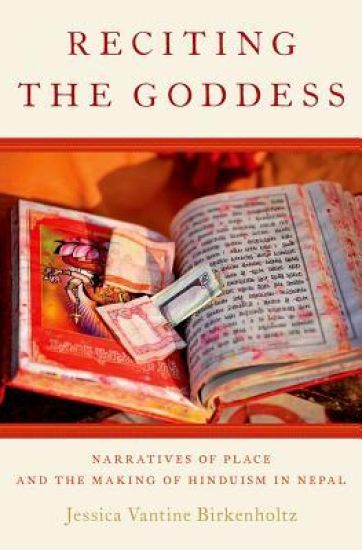
Reciting the Goddess

Reciting the Goddess

Jessica Vantine Birkenholtz

Oxford University Press Inc
2018
sidottu
Reciting the Goddess is the first book-length study of Nepal's goddess Svasthani and the popular Svasthanivratakatha textual tradition. In the centuries following its origin as a simple local legend in the sixteenth century, the Svasthanivratakatha developed into a comprehensive Purana text that is still widely celebrated today among Nepal's Hindus with an annual month-long recitation. Jessica Birkenholtz uses the Svasthanivratakatha as a medium through which to view the ways in which political and cultural shifts among Nepal's ruling elite were taken up by the general public. Drawing on both archival and ethnographic research, the book examines Svasthani and the Svasthanivratakatha within the shifting literary, linguistic, religious, cultural, and political contexts of medieval and modern Nepal from the sixteenth century to the present. It also explores both the complementary and contentious relationships between Nepal's heterogeneous Newar Hindu and high-caste hill Hindu communities, and those of Nepal as a Hindu kingdom vis-à-vis Hindu India. Reciting the Goddess brings the Svasthani devotional tradition to light as a new case study in the discussion of the making of Hindu religious identity and practice in Nepal and South Asia.
Powerful Patriots

Powerful Patriots

Jessica Chen Weiss

Oxford University Press Inc
2014
sidottu
Why has the Chinese government sometimes allowed and sometimes repressed nationalist, anti-foreign protests? What have been the international consequences of these choices? Anti-American demonstrations were permitted in 1999 but repressed in 2001 during two crises in US-China relations. Anti-Japanese protests were tolerated in 1985, 2005, and 2012 but banned in 1990 and 1996. Protests over Taiwan, the issue of greatest concern to Chinese nationalists, have never been allowed. To explain this variation in China's response to nationalist mobilization, Powerful Patriots argues that Chinese and other authoritarian leaders weigh both diplomatic and domestic incentives to allow and repress nationalist protests. Autocrats may not face electoral constraints, but anti-foreign protests provide an alternative mechanism by which authoritarian leaders can reveal their vulnerability to public pressure. Because nationalist protests are costly to repress and may turn against the government, allowing protests demonstrates resolve and increases the domestic cost of diplomatic concessions. Repressing protests, by contrast, sends a credible signal of reassurance, facilitating diplomatic flexibility and signaling a willingness to spend domestic political capital for the sake of international cooperation. To illustrate the logic, the book traces the effect of domestic and diplomatic factors in China's management of nationalist protest in the post-Mao era (1978-2012) and the consequences for China's foreign relations.
Powerful Patriots

Powerful Patriots

Jessica Chen Weiss

Oxford University Press Inc
2014
nidottu
Why has the Chinese government sometimes allowed and sometimes repressed nationalist, anti-foreign protests? What have been the international consequences of these choices? Anti-American demonstrations were permitted in 1999 but repressed in 2001 during two crises in US-China relations. Anti-Japanese protests were tolerated in 1985, 2005, and 2012 but banned in 1990 and 1996. Protests over Taiwan, the issue of greatest concern to Chinese nationalists, have never been allowed. To explain this variation in China's response to nationalist mobilization, Powerful Patriots argues that Chinese and other authoritarian leaders weigh both diplomatic and domestic incentives to allow and repress nationalist protests. Autocrats may not face electoral constraints, but anti-foreign protests provide an alternative mechanism by which authoritarian leaders can reveal their vulnerability to public pressure. Because nationalist protests are costly to repress and may turn against the government, allowing protests demonstrates resolve and increases the domestic cost of diplomatic concessions. Repressing protests, by contrast, sends a credible signal of reassurance, facilitating diplomatic flexibility and signaling a willingness to spend domestic political capital for the sake of international cooperation. To illustrate the logic, the book traces the effect of domestic and diplomatic factors in China's management of nationalist protest in the post-Mao era (1978-2012) and the consequences for China's foreign relations.
The Semantics of Evaluativity

The Semantics of Evaluativity

Jessica Rett

Oxford University Press
2014
sidottu
This book focuses on the semantic phenomenon of evaluativity and its consequences across constructions. Evaluativity has traditionally been associated exclusively with the positive construction, a term for sentences with a gradable adjective but with no overt degree morphology. John is tall is evaluative because it entails that John is tall relative to a contextually valued standard. John is taller than Sue and John is as tall as Sue are not evaluative because both could be used even if John and Sue were short. Previous accounts of evaluativity have assumed that it is not part of the inherent meaning of adjectives, but is contributed by a null morpheme. Jessica Rett argues against this analysis, proposing that no null morpheme is required. Instead, evaluativity is explained on the basis of assumptions that speakers and hearers make about the relationship between the simplicity of a situation and the simplicity of the language used to describe that situation; the analysis is couched in recent approaches to Gricean conversational implicature.
The Semantics of Evaluativity

The Semantics of Evaluativity

Jessica Rett

Oxford University Press
2014
nidottu
This book focuses on the semantic phenomenon of evaluativity and its consequences across constructions. Evaluativity has traditionally been associated exclusively with the positive construction, a term for sentences with a gradable adjective but with no overt degree morphology. John is tall is evaluative because it entails that John is tall relative to a contextually valued standard. John is taller than Sue and John is as tall as Sue are not evaluative because both could be used even if John and Sue were short. Previous accounts of evaluativity have assumed that it is not part of the inherent meaning of adjectives, but is contributed by a null morpheme. Jessica Rett argues against this analysis, proposing that no null morpheme is required. Instead, evaluativity is explained on the basis of assumptions that speakers and hearers make about the relationship between the simplicity of a situation and the simplicity of the language used to describe that situation; the analysis is couched in recent approaches to Gricean conversational implicature.
Herodotus and Hellenistic Culture

Herodotus and Hellenistic Culture

Jessica Priestley

Oxford University Press
2014
sidottu
In a series of literary studies, Priestley explores some of the earliest ancient responses to Herodotus' Histories through the extant written record of the early and middle Hellenistic period. Responses to the Histories were rich and varied, and the range of Hellenistic writers responding in different ways to Herodotus' work is in part a reflection of the Histories'own broad scope. The Histories remained relevant in this later age and continued to speak meaningfully to a broad range of readers long after Herodotus' death. Herodotus and Hellenistic Culture explores a variety of discourses where Herodotus occupies an important place in the intellectual background, and, in particular, it draws attention to writers not usually categorized as historians in order to broaden our perspectives on Herodotus' cultural importance. Through discussions of contemporary discourse relating to, for instance, the Persian Wars, geography, the wondrous, aesthetics, literary style, and biography, it nuances our understanding of how ancient readers reacted to and appropriated the Histories to serve their own distinct rhetorical goals. The volume also contributes to scholarship that reappraises the very term 'Hellenistic', drawing attention to both diachronic continuities and synchronic diversity in ancient Greek literature.
Aristotle on the Apparent Good

Aristotle on the Apparent Good

Jessica Moss

Oxford University Press
2012
sidottu
Aristotle holds that we desire things because they appear good to us--a view still dominant in philosophy now. But what is it for something to appear good? Why does pleasure in particular tend to appear good, as Aristotle holds? And how do appearances of goodness motivate desire and action? No sustained study of Aristotle has addressed these questions, or even recognized them as worth asking. Jessica Moss argues that the notion of the apparent good is crucial to understanding both Aristotle's psychological theory and his ethics, and the relation between them. Beginning from the parallels Aristotle draws between appearances of things as good and ordinary perceptual appearances such as those involved in optical illusion, Moss argues that on Aristotle's view things appear good to us, just as things appear round or small, in virtue of a psychological capacity responsible for quasi-perceptual phenomena like dreams and visualization: phantasia ('imagination'). Once we realize that the appearances of goodness which play so major a role in Aristotle's ethics are literal quasi-perceptual appearances, Moss suggests we can use his detailed accounts of phantasia and its relation to perception and thought to gain new insight into some of the most debated areas of Aristotle's philosophy: his accounts of emotions, akrasia, ethical habituation, character, deliberation, and desire. In Aristotle on the Apparent Good, Moss presents a new--and controversial--interpretation of Aristotle's moral psychology: one which greatly restricts the role of reason in ethical matters, and gives an absolutely central role to pleasure.
The Perils of Peace

The Perils of Peace

Jessica Reinisch

Oxford University Press
2013
sidottu
This is an open access title available under the terms of a CC BY-NC-ND 4.0 International licence. It is free to read at Oxford Scholarship Online and offered as a free PDF download from OUP and selected open access locations. At the end of the war in 1945 Germany was a country with no government, little functioning infrastructure, millions of refugees and homeless people, and huge foreign armies living largely off the land. Large parts of the country were covered in rubble with no clean drinking water, electricity, or gas. Hospitals overflowed with patients but were short of beds, medicines, and medical personnel. In these conditions the potential for epidemics and public health disasters was severe. In The Perils of Peace Jessica Reinisch considers how the four occupiers - Britain, France, the Soviet Union, and the United States - attempted to keep their own troops and the ex-enemy population alive. While the war was still being fought, German public health was a secondary consideration for them: an unaffordable and undeserved luxury. But once fighting ceased and the occupation began, it rapidly turned into an urgent priority. Public health was then recognized as an indispensable component of creating order, keeping the population governable, and facilitating the reconstruction of German society. But they faced a number of problems in the process. Which Germans could be trusted to work with the occupiers and how were they to be identified? Who could be tolerated because of a lack of alternatives? How, if at all, could former Nazis be reformed and reintegrated into German society? What was the purpose of the occupation in the first place? This is the first carefully researched comparison of the four occupation zones which looks at the occupation through the prism of public health, an essential service fundamentally shaped by political and economic criteria, and which in turn was to determine the success or failure of the occupation.
Aspects of Split Ergativity

Aspects of Split Ergativity

Jessica Coon

Oxford University Press Inc
2013
nidottu
In languages with aspect-based split ergativity, one portion of the grammar follows an ergative pattern, while another shows a "split." In this book, Jessica Coon argues that aspectual split ergativity does not mark a split in how case is assigned, but rather, a split in sentence structure. Specifically, the contexts in which we find the appearance of a nonergative pattern in an otherwise ergative language involve added structure -- a disassociation between the syntactic predicate and the stem carrying the lexical verb stem. This proposal builds on the proposal of Basque split ergativity in Laka 2006, and extends it to other languages. The book begins with an analysis of split person marking patterns in Chol, a Mayan language of southern Mexico. Here appearance of split ergativity follows naturally from the fact that the progressive and the imperfective morphemes are verbs, while the perfective morpheme is not. The fact that the nonperfective morphemes are verbs, combined with independent properties of Chol grammar, results in the appearance of a split. In aspectual splits, ergativity is always retained in the perfective aspect. This book further surveys aspectual splits in a variety of unrelated languages and offers an explanation for this universal directionality of split ergativity. Following Laka's (2006) proposal for Basque, Coon proposes that the cross-linguistic tendency for imperfective aspects to pattern with locative constructions is responsible for the biclausality which causes the appearance of a nonergative pattern. Building on Demirdache and Uribe-Etxebarria's (2000) prepositional account of spatiotemporal relations, Coon proposes that the perfective is never periphrastic - and thus never involves a split - because there is no preposition in natural language that correctly captures the relation of the assertion time to the event time denoted by the perfective aspect.
Aspects of Split Ergativity

Aspects of Split Ergativity

Jessica Coon

Oxford University Press Inc
2013
sidottu
In languages with aspect-based split ergativity, one portion of the grammar follows an ergative pattern, while another shows a "split." In this book, Jessica Coon argues that aspectual split ergativity does not mark a split in how case is assigned, but rather, a split in sentence structure. Specifically, the contexts in which we find the appearance of a nonergative pattern in an otherwise ergative language involve added structure -- a disassociation between the syntactic predicate and the stem carrying the lexical verb stem. This proposal builds on the proposal of Basque split ergativity in Laka 2006, and extends it to other languages. The book begins with an analysis of split person marking patterns in Chol, a Mayan language of southern Mexico. Here appearance of split ergativity follows naturally from the fact that the progressive and the imperfective morphemes are verbs, while the perfective morpheme is not. The fact that the nonperfective morphemes are verbs, combined with independent properties of Chol grammar, results in the appearance of a split. In aspectual splits, ergativity is always retained in the perfective aspect. This book further surveys aspectual splits in a variety of unrelated languages and offers an explanation for this universal directionality of split ergativity. Following Laka's (2006) proposal for Basque, Coon proposes that the cross-linguistic tendency for imperfective aspects to pattern with locative constructions is responsible for the biclausality which causes the appearance of a nonergative pattern. Building on Demirdache and Uribe-Etxebarria's (2000) prepositional account of spatiotemporal relations, Coon proposes that the perfective is never periphrastic - and thus never involves a split - because there is no preposition in natural language that correctly captures the relation of the assertion time to the event time denoted by the perfective aspect.
Digital Modernism

Digital Modernism

Jessica Pressman

Oxford University Press Inc
2014
sidottu
Digital Modernism examines how and why some of the most innovative works of online electronic literature adapt and allude to literary modernism. Digital literature has been celebrated as a postmodern form that grows out of contemporary technologies, subjectivities, and aesthetics, but this book provides an alternative genealogy. Exemplary cases show electronic literature looking back to modernism for inspiration and source material (in content, form, and ideology) through which to critique contemporary culture. In so doing, this literature renews and reframes, rather than rejects, a literary tradition that it also reconfigures to center around media. To support her argument, Pressman pairs modernist works by Pound, Joyce, and Bob Brown, with major digital works like William Poundstone's "Project for the Tachistoscope: [Bottomless Pit]" (2005), Young-hae Chang Heavy Industries's Dakota, and Judd Morrissey's The Jew's Daughter. With each pairing, she demonstrates how the modernist movement of the 1920s and 1930s laid the groundwork for the innovations of electronic literature. In sum, the study situates contemporary digital literature in a literary genealogy in ways that rewrite literary history and reflect back on literature's past, modernism in particular, to illuminate the crucial role that media played in shaping the ambitions and practices of that period.