The 1972 Munich Olympics - remembered almost exclusively for the devastating terrorist attack on the Israeli team - were intended to showcase the New Germany and replace lingering memories of the Third Reich. That hope was all but obliterated in the early hours of September 5, when gun-wielding Palestinians murdered 11 members of the Israeli team. In the first cultural and political history of the Munich Olympics, Kay Schiller and Christopher Young set these Games into both the context of 1972 and the history of the modern Olympiad. Delving into newly available documents, Schiller and Young chronicle the impact of the Munich Games on West German society.
The 1972 Munich Olympics - remembered almost exclusively for the devastating terrorist attack on the Israeli team - were intended to showcase the New Germany and replace lingering memories of the Third Reich. That hope was all but obliterated in the early hours of September 5, when gun-wielding Palestinians murdered 11 members of the Israeli team. In the first cultural and political history of the Munich Olympics, Kay Schiller and Christopher Young set these Games into both the context of 1972 and the history of the modern Olympiad. Delving into newly available documents, Schiller and Young chronicle the impact of the Munich Games on West German society.
A critical examination of how contemporary criminal justice reforms expand rather than shrink structurally violent systems of policing, surveillance, and carceral control in the United States. Public opposition to the structural racist, gendered, and economic violence that fuels the criminal legal system is reaching a critical mass. Ignited by popular uprisings, protests, and campaigns against state violence, demands for transformational change have escalated. In response, a now deeply entrenched so-called bipartisan industry has staked its claim to the reform terrain. Representing itself as a sensible bridge across bitterly polarized political divides and party lines, the bipartisan reform industry has sought to control the nature and scope of local, state, and federal reforms. Along the way, it creates an expanding web of neoliberal public-private partnerships, with the promotion and implementation of efforts managed by billionaires, public officials, policy factories, foundations, universities, and mega nonprofit organizations. Yet many bipartisan reforms constitute deceptive sleights of hand that not only fail to produce justice but actively reproduce structural racial and economic inequality. Carceral Con pulls the veil away from the reform public relations machine, providing a riveting overview of the repressive US carceral state and a critical examination of the reform terrain, quagmires, and choices that face us. This book vividly illustrates how contemporary bipartisan reform agendas leave the structural apparatus of mass incarceration intact while widening the net of carceral control and surveillance. Readers are also provided with information and insights useful for examining the likely impacts of reforms today and in the future. What can we learn from reforms of the past? What strategies hold most promise for dismantling structural inequalities, corporate control, and state violence? What approaches will reduce reliance on carceral control and also bring about community safety? Utilizing an abolitionist lens, Carceral Con makes the compelling case for liberatory approaches to envisioning and creating a just society.
A critical examination of how contemporary criminal justice reforms expand rather than shrink structurally violent systems of policing, surveillance, and carceral control in the United States. Public opposition to the structural racist, gendered, and economic violence that fuels the criminal legal system is reaching a critical mass. Ignited by popular uprisings, protests, and campaigns against state violence, demands for transformational change have escalated. In response, a now deeply entrenched so-called bipartisan industry has staked its claim to the reform terrain. Representing itself as a sensible bridge across bitterly polarized political divides and party lines, the bipartisan reform industry has sought to control the nature and scope of local, state, and federal reforms. Along the way, it creates an expanding web of neoliberal public-private partnerships, with the promotion and implementation of efforts managed by billionaires, public officials, policy factories, foundations, universities, and mega nonprofit organizations. Yet many bipartisan reforms constitute deceptive sleights of hand that not only fail to produce justice but actively reproduce structural racial and economic inequality. Carceral Con pulls the veil away from the reform public relations machine, providing a riveting overview of the repressive US carceral state and a critical examination of the reform terrain, quagmires, and choices that face us. This book vividly illustrates how contemporary bipartisan reform agendas leave the structural apparatus of mass incarceration intact while widening the net of carceral control and surveillance. Readers are also provided with information and insights useful for examining the likely impacts of reforms today and in the future. What can we learn from reforms of the past? What strategies hold most promise for dismantling structural inequalities, corporate control, and state violence? What approaches will reduce reliance on carceral control and also bring about community safety? Utilizing an abolitionist lens, Carceral Con makes the compelling case for liberatory approaches to envisioning and creating a just society.
First published in 1968, this monograph is a descriptive grammar of a dialect of ?j?or (Ijaw), a language spoken in the Niger Delta area of Southern Nigeria. The dialect described, Kolokuma, is a central one, quite widely understood. The most interesting features of the language, on which the monograph concentrates, are its syntax and its tonal system. An attempt is made to treat them according to a generative-transformational theory of language. The tonal system is of an unusual type whereby the tones that words bear in isolation are considerably modified according to the syntactic context the word appears in. Syntax and tones are therefore bound closely together, and the grammar is written so as to give rules first for the syntactic sequences of words and then for the tone patterns that will occur on these sequences.
ART treatment is vulnerable to the hazard of potential infection from many different sources: patients, samples, staff and the environment. Culture of gametes and embryos in vitro provides multiple targets for transmission of potential infection, including the developing embryo, neighbouring gametes and embryos, the couple undergoing treatment and other couples being treated during the same period. This unique situation, with multifaceted opportunities for microbial growth and transmission, makes infection and contamination control absolutely crucial in the practice of assisted reproduction, and in the laboratory in particular. Originally published in 2004, this practical book provides a basic overview of microbiology in the context of ART, providing a guide to infections in reproductive medicine. The relevant facets of the complex and vast field of microbiology are condensed and focused, highlighting information that is crucial for safe practice in both clinical and laboratory aspects of ART.
This 1975 book presents the fundamental ideas of fluid flow, viscosity, heat conduction, diffusion, the energy and momentum principles, and the method of dimensional analysis.
Images of Australian identity, and of Australian nationhood, are social and cultural constructs. There are several dominant themes and elements, one of the most pervasive being the Australian bushman confronting a vast and barren landscape. This is a specifically Australian conception of the battle between Man and Nature. Throughout the myths, traditions and literary creations of Australia are underlying assumptions about gender and sexual difference: assumptions about masculinity and femininity within the nationalist tradition, which affect perceptions today. In this new critique, Kay Schaffer applies the insights of feminist scholarship and of literary analysis to examine the national character. She looks at how the concept of ‘the typical Australian’, and the woman who stands in relation to him, has evolved across a range of cultural forms, including historical and literary texts, film and the media. She concentrates in particular on the writings of Henry Lawson and of Barbara Bayton. The circulation of ideas about these writers, their contribution to a national mythology, and the different ways their importance has been represented to modern readers, is explored and discussed. This thoughtful and provocative study will interest readers concerned with Australian literary and cultural history, as well as the broader questions of Australia’s changing self-image. It will be of particular value to those interested in feminist approaches to culture and society.
Eliza Fraser was an English woman shipwrecked on the Australian coast in 1836, where she lived with an Aboriginal community until her rescue. The story of a 'civilised' white female being taken captive by 'savage' black men was both fascinating and repulsive. Images and narratives surrounding this notorious episode have proliferated from the 1830s to the present. Kay Schaffer looks at the various literary and artistic manifestations of Eliza Fraser as a fictional presence in Australian culture. Schaffer looks at the contemporary narratives, and at more recent representations of Mrs Fraser in film, in the art of Sidney Nolan, and the writing of Patrick White. The book uses these texts to examine historical discourses of colonialism, race, gender, and nation. This accessible and stimulating book promises to make an impressive contribution to women's studies, cultural studies, and Australian history.
ART treatment is vulnerable to the hazard of potential infection from many different sources: patients, samples, staff, and the environment. Culture of gametes and embryos in vitro provides multiple targets for transmission of potential infection, including the developing embryo, neighboring gametes and embryos, the couple undergoing treatment and other couples being treated during the same period. This unique situation, with multifaceted opportunities for microbial growth and transmission, makes infection and contamination control absolutely crucial in the practice of assisted reproduction, and in the laboratory in particular. This unique and practical book provides a basic overview of microbiology in the context of ART, providing an up-to-date guide to infections in reproductive medicine. The relevant facets of the complex and vast field of microbiology are condensed and focused, highlighting information that is crucial for safe practice in both clinical and laboratory aspects of ART.
Iconic pop artist Keith Haring comes to life for young readers in this picture book biography lovingly written by his sister This one-of-a-kind book explores the life and art of Keith Haring from his childhood through his meteoric rise to fame. It sheds light on this important artist's great humanity, his concern for children, and his disregard for the establishment art world. Reproductions of Keith's signature artwork appear in scenes boldly rendered by Robert Neubecker. This is a story to inspire, and a book for Keith Haring fans of all ages to treasure.
The acclaimed author of An Unquiet Mind considers the age-old quest for relief from psychological pain and the role of the exceptional healer in the journey back to health. "To treat, even to cure, is not always to heal." In this expansive cultural history of the treatment and healing of mental suffering, Kay Jamison writes about psychotherapy, what makes a great healer, and the role of imagination and memory in regenerating the mind. From the trauma of the battlefields of the twentieth century, to those who are grieving, depressed, or with otherwise unquiet minds, to her own experience with bipolar illness, Jamison demonstrates how remarkable psychotherapy and other treatments can be when done well. She argues that not only patients but doctors must be healed. She draws on the example of W.H.R. Rivers, the renowned psychiatrist who treated poet Siegfried Sassoon and other World War I soldiers, and discusses the long history of physical treatments for mental illness, as well as the ancient and modern importance of religion, ritual, and myth in healing the mind. She looks at the vital role of artists and writers, as well as exemplary figures, such as Paul Robeson, who have helped to heal us as a people. Fires in the Dark is a beautiful meditation on the quest and adventure of healing the mind, on the power of accompaniment, and the necessity for knowledge.
'Chocolate' hits all the right sweet--and bitter--notes: cutting-edge genetic science whisked in with a strong social conscience, history, and culture yield one thought-provoking look into one of the world's most popular foods. Readers who savoured 'Chew on This and Food, Inc.' and lovers of chocolate will relish this fascinating read. AGES: 12 and up AUTHOR: Kay Frydenborg lives in Pennsylvania with her husband and two dogs, and rides her beloved horse, Remy, almost every day. She's the author of numerous books for young readers including 'Wild Horse Scientists', 'They Dreamed of Horses', and 'Animal Therapist'. You can learn more about her at www.kayfrydenborg.com.
"An eye-opening account of life in China's orphanages. Kay Bratt vividly details the conditions and realities faced by Chinese orphans in an easy-to-read manner that draws the reader in to the heart-wrenching moments she has experienced in her work to bring hope to these children."--Dan Cruver, cofounder and director of Together for Adoption When her family relocated to rural China in 2003, Kay Bratt was thrust into a new world, one where boys were considered more valuable than girls and poverty and the one-child policy had created an epidemic of abandoned infants. As a volunteer at a local orphanage, Bratt witnessed conditions that were unfathomable to a middle-class mother of two from South Carolina. Based on Bratt's diary of her four years working at the orphanage, Silent Tears offers a searing account of young lives rendered disposable. In the face of an implacable system, Bratt found ways to work within (and around) the rules to make a better future for the children, whom she came to love. Her story balances the sadness and struggles of life in the orphanage with moments of joy, optimism, faith, and victory. It is the story of hundreds of children--and one woman who never planned on becoming a hero but became one anyway.
A spellbinding tale of contemporary suspense that begins with a mysterious homecoming and ends in a shattering explosion of passion, greed, and murder. And all because a stranger says her name is... Amanda. Others have claimed to be Amanda Daulton, but now a beautiful, self-assured woman has stepped out of the shadows of the past, insisting she's the missing heiress to a multimillion-dollar fortune. One look is all it takes to assure the family patriarch that she's his beloved granddaughter. But others at the magnificent Southern mansion called Glory are not as easily convinced, others with much to lose from her sudden reappearance. Soon suspicion erupts in a chilling attempt on her life, and after the traumatic ordeal, she begins to have flashes of a nightmarish vision. What, if anything, happened twenty years ago to drive a mother and her nine-year-old daughter away from their privileged life? The struggle to find the elusive answer exposes a frightening trail of secrets--a trail that leads shockingly to the present and to the enigmatic woman who calls herself... Amanda.
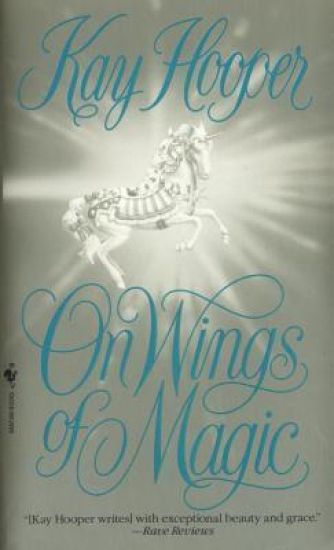
A stunning beauty with an air of seductive innocence, Kendall James looks like the proverbial dumb blonde--and she plays the part to perfection. But it's allan act of self-preservation, for her lovely face belies the experience of a woman who's seen too much...a woman who's traveled the world and said one too many goodbyes. Now, on an island paradise, Kendall is about to meet her match: a sexy, determined, discerning man who'll see beyond her sultry facade to the frightened woman beneath. Hawke Madison will slowly strip away her defenses, and by the time she awakens to the danger, it will be much too late to run. This is a passionate story filled with all the humor and tenderness that Kay Hooper's fans have come to expect--a story that explores the loneliness of heartbreak and the searing, transforming power of love.