Kirjojen hintavertailu. Mukana 12 363 375 kirjaa ja 12 kauppaa.

Kirjahaku

Etsi kirjoja tekijän nimen, kirjan nimen tai ISBN:n perusteella.

1000 tulosta hakusanalla Matthias Roth

Bell Beaker Copper Use in Central Europe: A Distinctive Tradition
Based on a dataset of trace element compositions of copper finds from central Europe dating between 4500 and 2000 BC, this research aims to indicate whether the metallurgy of the Eastern Bell Beaker group indicates a specific knowledge that distinguishes the metal work of this community from other archaeological groups. It also aims to explain the motivation underlying the use of chronologically and chorologically varying types of copper during this period, asking whether the selection of copper types was based on a knowledge of their specific material.
John of Rupescissa´s VADE MECUM IN TRIBULACIONE (1356)

John of Rupescissa´s VADE MECUM IN TRIBULACIONE (1356)

Matthias Kaup

Ashgate Publishing Limited
2016
sidottu
The VADE MECUM IN TRIBULACIONE was meant as an eschatological manual for the thirteen catastrophic years between its composition in December 1356 and the Thousand-Year Reign of Christ expected to begin in 1370. This manual, permeated by passion for clerical reform, was intended to give righteous Christians practical and spiritual advice on how to survive this period of tribulation. Likewise, it aimed to inform them about what to expect from the envoys of Satan, the Western and the Eastern Antichrists, but also from Christ’s warriors, the papal restorer and his secular assistant, the French-Roman Emperor. Moreover, it offered a brief outline of Christ’s Thousand-Year Reign and of Armageddon.The VADE MECUM was written by John of Rupescissa OFM (c. 1310-1366), the most prolific apocalyptic author of the Middle Ages, as the central work of in all three manuals designed to prepare Christendom for the impending crises. As a completely new text type and summary of the late Rupescissa’s doctrines, this eschatological manual fascinated numerous readers in the Late Middle Ages, who copied, reworked and translated it and made it thus a pivotal text of medieval apocalypticism: ten versions of the Latin VADE MECUM in more than forty manuscripts have come down to us.Rupescissa’s eschatological manual is his last known and most widely distributed work; the present study provides an annotated critical edition equipped with an English translation. It inducts in the manual’s contents, places them in the context of Rupescissa’s work and medieval prophetic literature, investigates important aspects of its reception and clarifies the relationships between its different versions. Furthermore, it ends with a critical edition of the VENI MECUM IN TRIBULACIONE, the most influential compendious version of the VADE MECUM. Thus this book offers an indispensable fundamental contribution to the flourishing studies of Rupescissa and medieval apocalypticism.
Jim Curious and the Jungle Journey

Jim Curious and the Jungle Journey

Matthias Picard

Abrams Books for Young Readers
2021
sidottu
This wordless picture book follows a boy’s jungle adventures in breathtaking 3-D illustrations In Jim Curious and the Jungle Journey, a young boy goes on an adventure in an old-fashioned diving suit. After waking up in bed (or is he really awake?), Jim walks through a mirror and into a shallow swamp that leads to a mysterious island. There, in the jungle, he encounters snakes, monkeys, and a giant turtle, as well as some creepy-crawly creatures, before discovering an ancient abandoned temple deep in the heart of the jungle.
Computing the Continuous Discretely

Computing the Continuous Discretely

Matthias Beck; Sinai Robins

Springer-Verlag New York Inc.
2010
nidottu
The world is continuous, but the mind is discrete. David Mumford We seek to bridge some critical gaps between various ?elds of mathematics by studying the interplay between the continuous volume and the discrete v- ume of polytopes. Examples of polytopes in three dimensions include crystals, boxes, tetrahedra, and any convex object whose faces are all ?at. It is amusing to see how many problems in combinatorics, number theory, and many other mathematical areas can be recast in the language of polytopes that exist in some Euclidean space. Conversely, the versatile structure of polytopes gives us number-theoretic and combinatorial information that ?ows naturally from their geometry. Fig. 0. 1. Continuous and discrete volume. The discrete volume of a body P can be described intuitively as the number of grid points that lie inside P, given a ?xed grid in Euclidean space. The continuous volume of P has the usual intuitive meaning of volume that we attach to everyday objects we see in the real world. VIII Preface Indeed, the di?erence between the two realizations of volume can be thought of in physical terms as follows. On the one hand, the quant- level grid imposed by the molecular structure of reality gives us a discrete notion of space and hence discrete volume. On the other hand, the N- tonian notion of continuous space gives us the continuous volume.
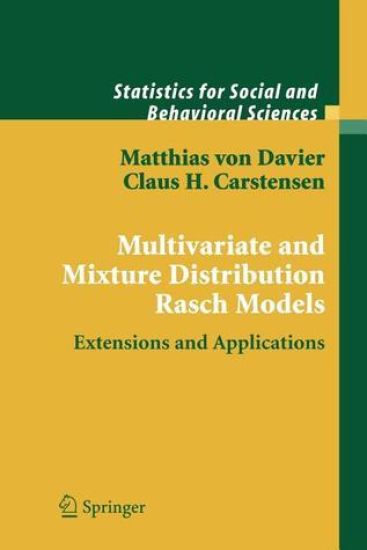
Multivariate and Mixture Distribution Rasch Models

Multivariate and Mixture Distribution Rasch Models

Matthias von Davier; Claus H. Carstensen

Springer-Verlag New York Inc.
2010
nidottu
This volume gathers together a set of extensions of the Rasch model, one of the most prominent models for measurement in educational research and - cial science developed by Danish mathematician Georg Rasch. The idea for this volume emerged during a meeting of the Psychometric Society in M- terey, CA. At that meeting, friends and colleagues discussed news about the impending retirement of Dr. Jurgen ¨ Rost, an important innovator and m- tor in this ?eld. To recognize Jurgen’s ¨ contributions, we decided to produce a collection of research on extending the Rasch model as well as embedding the Rasch model in more complex statistical models, an area that is receiving broad interest in many ?elds of social sciences at the current time. This collection contains 22 chapters by recognized international experts in the?eld.Thecontributionscovertopicsrangingfromgeneralmodelextensions to application in ?elds as diverse as cognition, personality, organizational and sports psychology, and health sciences and education. The Rasch model is designed for categorical data, often collected as ex- inees’ responses to multiple tasks such as cognitive items from psychological tests or from educational assessments. The Rasch model’s elegant mathema- cal form is suitable for extensions that allow for greater ?exibility in handling complex samples of examinees and collections of tasks from di?erent domains. In these extensions, the Rasch model is enhanced by additional structural - ements that account either for di?erences between diverse populations or for di?erences among observed variables.
Building ASIPs:  The Mescal Methodology

Building ASIPs: The Mescal Methodology

Matthias Gries; Kurt Keutzer

Springer-Verlag New York Inc.
2010
nidottu
An increasing number of system designers are using ASIP’s rather than ASIC’s to implement their system solutions. Building ASIPs: The Mescal Methodology gives a simple but comprehensive methodology for the design of these application-specific instruction processors (ASIPs). The key elements of this methodology are: Judiciously using benchmarking Inclusively identifying the architectural space Efficiently describing and evaluating the ASIPs Comprehensively exploring the design space Successfully deploying the ASIP This book includes demonstrations of applications of the methodologies using the Tipi research framework as well as state-of-the-art commercial toolsets from CoWare and Tensilica.
The Art of Proof

The Art of Proof

Matthias Beck; Ross Geoghegan

Springer-Verlag New York Inc.
2010
sidottu
The Art of Proof is designed for a one-semester or two-quarter course. A typical student will have studied calculus (perhaps also linear algebra) with reasonable success. With an artful mixture of chatty style and interesting examples, the student's previous intuitive knowledge is placed on solid intellectual ground. The topics covered include: integers, induction, algorithms, real numbers, rational numbers, modular arithmetic, limits, and uncountable sets. Methods, such as axiom, theorem and proof, are taught while discussing the mathematics rather than in abstract isolation. Some of the proofs are presented in detail, while others (some with hints) may be assigned to the student or presented by the instructor. The authors recommend that the two parts of the book -- Discrete and Continuous -- be given equal attention. The book ends with short essays on further topics suitable for seminar-style presentation by small teams of students, either in class or in a mathematics club setting. These include: continuity, cryptography, groups, complex numbers, ordinal number, and generating functions.
Contextual Development Economics

Contextual Development Economics

Matthias P. Altmann

Springer-Verlag New York Inc.
2010
sidottu
Poverty still persists in today’s low-income countries despite decades of international aid, and extensive research on the determinants of growth and development. The book argues that meeting this challenge requires a holistic understanding of the context-specific factors that influence economic behavior and structures in poor countries. Contextual Development Economics approaches this task by offering a methodology that allows analysing the dynamic interrelations between economic, cultural and historical determinants of economic life in low-income countries. The book starts with an empirical inquiry into the economic characteristics of low-income countries that create the context by which the specific forms of organising economic activity in these countries are determined. It then looks at how different generations of development economists sought to explain economic realities in low-income countries from the 1940s through today. The book finally synthesises the results from this empirical and methodological analysis with insights from an inquiry into contributions of the German Historical School, from which it borrows the concept of the economic style as a methodological alternative to the universal and hence often irrelevant models of mainstream development economics. This book offers a promising perspective for the future of development economics that will be of interest to researchers and development practitioners alike. It will also be relevant for academics and students with an interest in applications of the method and concepts of the Historical School to contemporary problems.
Adaptive Multimodal Interactive Systems

Adaptive Multimodal Interactive Systems

Matthias Bezold; Wolfgang Minker

Springer-Verlag New York Inc.
2011
sidottu
Adaptive Multimodal Interactive Systems introduces a general framework for adapting multimodal interactive systems and comprises a detailed discussion of each of the steps required for adaptation. This book also investigates how interactive systems may be improved in terms of usability and user friendliness while describing the exhaustive user tests employed to evaluate the presented approaches. After introducing general theory, a generic approach for user modeling in interactive systems is presented, ranging from an observation of basic events to a description of higher-level user behavior. Adaptations are presented as a set of patterns similar to those known from software or usability engineering.These patterns describe recurring problems and present proven solutions. The authors include a discussion on when and how to employ patterns and provide guidance to the system designer who wants to add adaptivity to interactive systems. In addition to these patterns, the book introduces an adaptation framework, which exhibits an abstraction layer using Semantic Web technology.Adaptations are implemented on top of this abstraction layer by creating a semantic representation of the adaptation patterns. The patterns cover both graphical interfaces as well as speech-based and multimodal interactive systems.
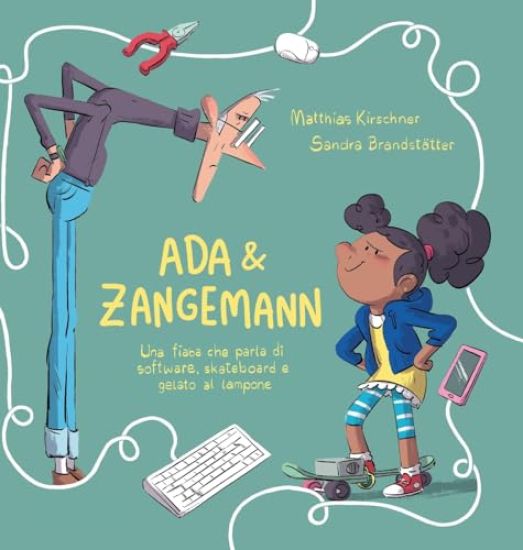
Ada & Zangemann

Ada & Zangemann

Matthias Kirschner

Lulu.com
2023
sidottu
Il famoso inventore Zangemann vive in una grande villa sopra la citt . Sia adulti che bambini amano le sue invenzioni e vogliono averle disperatamente. Ma poi succede qualcosa: Zangemann vuole vedere ancora una volta da vicino le sue invenzioni e va quindi a fare una passeggiata in citt quando, con un grande tonfo, un bambino lo colpisce sugli stinchi con il suo skateboard. Che male Infuriato, l'inventore prende una drastica decisione... Ma Ada, ragazza sveglia, capisce cosa sta succedendo. Insieme ai suoi amici mette a punto un piano. Questo libro illustrato, realizzato con uno stile e semplicit in modo da essere compreso anche da parte dei bambini ma adatto per qualunque et , racconta la storia del famoso inventore Zangemann e di Ada, una ragazza curiosa ed intraprendente. Ada inizia a sperimentare con hardware e software e, nel mentre, realizza quanto sia fondamentale controllare la tecnologia, per lei e per gli altri. Un libro che stimola l'interesse nello sperimentare e incoraggia a plasmare la tecnologia. Per et dai 6 ai 106 anni. Copertina rigida con carta interna usomano.
Fundamental Techniques in Pulmonary and Oesophageal Surgery

Fundamental Techniques in Pulmonary and Oesophageal Surgery

Matthias Paneth; Peter Goldstraw; Barbara E. Hyams

Springer London Ltd
2012
nidottu
This book sets out to illustrate the key steps in some of the commoner procedures in pulmonary and oesophageal surgery. Each chapter deals with one operation. It was always our intention that the emphasis should be on detailed illustrations of the various stages of each operation. The text is of secondary importance, serving to provide continuity and to guide the reader through the illustrations. The techniques outlined are those which have evolved in our practice over the years and are therefore the result of varied influences and personal experience. Where an individual surgeon's name is attached to an operative technique we make no claim to describe the procedure exactly as that surgeon would have performed it, and it would perhaps have been more accurate to describe the technique as being "in the style of ...... ". We would wish to apologise in advance to any surgeon who feels that we have not accurately depicted his technique or have deviated from it in any important respect.