Kirjojen hintavertailu. Mukana 11 244 527 kirjaa ja 12 kauppaa.

Kirjahaku

Etsi kirjoja tekijän nimen, kirjan nimen tai ISBN:n perusteella.

1000 tulosta hakusanalla Perry Crowe

History of the Forest and Chase of Sutton Coldfield, Including the Border Districts of Great Barr, Perry Barr, Erdington, Etc. [With Genealogical Table. by L. Bracken.]
Title: History of the Forest and Chase of Sutton Coldfield, including the border districts of Great Barr, Perry Barr, Erdington, etc. With genealogical table. By L. Bracken.]Publisher: British Library, Historical Print EditionsThe British Library is the national library of the United Kingdom. It is one of the world's largest research libraries holding over 150 million items in all known languages and formats: books, journals, newspapers, sound recordings, patents, maps, stamps, prints and much more. Its collections include around 14 million books, along with substantial additional collections of manuscripts and historical items dating back as far as 300 BC.The HISTORY OF BRITAIN & IRELAND collection includes books from the British Library digitised by Microsoft. As well as historical works, this collection includes geographies, travelogues, and titles covering periods of competition and cooperation among the people of Great Britain and Ireland. Works also explore the countries' relations with France, Germany, the Low Countries, Denmark, and Scandinavia. ++++The below data was compiled from various identification fields in the bibliographic record of this title. This data is provided as an additional tool in helping to insure edition identification: ++++ British Library Anonymous; Bracken, L; 1860. 172 p.; 8 . 1303.g.3.
A Prophet in Ebony: The Life Story of E. W. Perry

A Prophet in Ebony: The Life Story of E. W. Perry

J. M. Gaskin; E. W. Perry; Guy Bellamy

Literary Licensing, LLC
2011
sidottu
""A Prophet In Ebony: The Life Story Of E. W. Perry"" is a biography written by J. M. Gaskin. The book tells the story of E. W. Perry, an African American man who became a prominent religious leader in the early 20th century. Perry was born in rural Georgia in 1870 and was raised in poverty. Despite his humble beginnings, he showed an early interest in religion and became a preacher at a young age. Perry eventually moved to Boston, where he founded his own church and became known for his fiery sermons and charismatic personality. He also became involved in the civil rights movement and was a vocal advocate for the rights of African Americans. The book provides a detailed look at Perry's life and legacy, as well as the social and political context in which he lived. It is a fascinating and inspiring story of a man who overcame adversity to become a leader and role model for his community.This scarce antiquarian book is a facsimile reprint of the old original and may contain some imperfections such as library marks and notations. Because we believe this work is culturally important, we have made it available as part of our commitment for protecting, preserving, and promoting the world's literature in affordable, high quality, modern editions, that are true to their original work.
Genealogy of the Smith, Walkup, Bell, Perry and Allied Families
This work has been selected by scholars as being culturally important, and is part of the knowledge base of civilization as we know it. This work was reproduced from the original artifact, and remains as true to the original work as possible. Therefore, you will see the original copyright references, library stamps (as most of these works have been housed in our most important libraries around the world), and other notations in the work.This work is in the public domain in the United States of America, and possibly other nations. Within the United States, you may freely copy and distribute this work, as no entity (individual or corporate) has a copyright on the body of the work.As a reproduction of a historical artifact, this work may contain missing or blurred pages, poor pictures, errant marks, etc. Scholars believe, and we concur, that this work is important enough to be preserved, reproduced, and made generally available to the public. We appreciate your support of the preservation process, and thank you for being an important part of keeping this knowledge alive and relevant.
An Essay Towards the History of Leverpool, Drawn up From Papers Left by the Late Mr. George Perry, by William Enfield. The Second Edition, With Additions
The 18th century was a wealth of knowledge, exploration and rapidly growing technology and expanding record-keeping made possible by advances in the printing press. In its determination to preserve the century of revolution, Gale initiated a revolution of its own: digitization of epic proportions to preserve these invaluable works in the largest archive of its kind. Now for the first time these high-quality digital copies of original 18th century manuscripts are available in print, making them highly accessible to libraries, undergraduate students, and independent scholars.Rich in titles on English life and social history, this collection spans the world as it was known to eighteenth-century historians and explorers. Titles include a wealth of travel accounts and diaries, histories of nations from throughout the world, and maps and charts of a world that was still being discovered. Students of the War of American Independence will find fascinating accounts from the British side of conflict. ++++The below data was compiled from various identification fields in the bibliographic record of this title. This data is provided as an additional tool in helping to insure edition identification: ++++British LibraryT145378A reissue of the 1773 edition, with a cancel titlepage, a new preface and a list of subscribers. With an additional gathering Y*, numbered *87-90*.London: printed for Joseph Johnson, 1774. vi, 6],116 i.e.120]p., plates: maps; 2
History of Dauphin, Cumberland, Franklin, Bedford, Adams, and Perry Counties, Pennsylvania
By: I. Daniel Rupp, Pub. 1846, reprinted 2021, 720 pages, New Index, ISBN #978-1-63914-016-9. From the noted author of his time, I.D. Rupp, comes the reprint of his important work covering south central Pennsylvania. These counties were officially created around the 1780's but settlers started arriving in the area around the 1730's. Early immigrants were of German and Scotch-Irish descents with some Amish being sprinkled in. There is much genealogical information to be found interspersed throughout this book. A new Index has been completed for this reprint with approximately 12,000 entries.
Trouble, Trials Trouble, Trials, and Vexations: the Journal and Correspondence of Rachel Perry Moores , Texan Plantation Mistress
Rachel Moores and her husband David operated a cotton plantation in the bottoms of the Sulphur River in North East Texas. From that vantage point, they viewed the changing fortunes of Texas as the American Civil War opened their privileged lifestyle. David went to war while the task of operating this large farming enterprise fell to Rachel. More than 2000 acres and dozens of enslaved people fell to her to manage. This diary chronicles her struggles and provides a priceless voice of a woman having to adapt and overcome the adversities of that violent age. Female perspectives often get overlooked when discussing the American Civil War and the effects of distant events often had catastrophic implications on the folks back home. Rachel’s Moores diary provides a priceless window into the changing realities of Texans who once bet their futures on the value of cotton. This diary and journal will be an important addition to the scholarship about elite white women and their lives in the antebellum south. This manuscript is unique in that is is an extensive and detailed look into the life of a woman of the slave-owning class in frontier Texas, offering not only her vivid view of the slave system but of the daily life of a plantation mistress and of an invalid seeking a cure for her disease from New Orleans to New York.
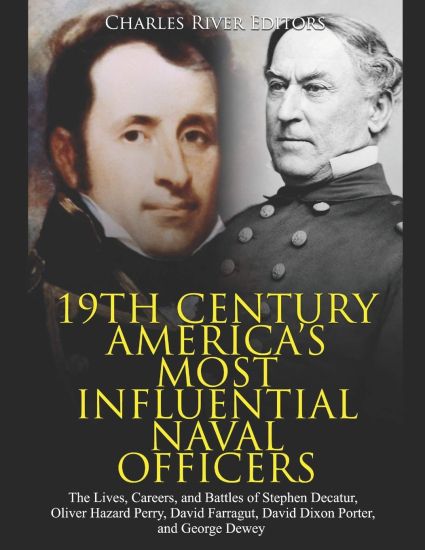
19th Century America's Most Influential Naval Officers: The Lives, Careers, and Battles of Stephen Decatur, Oliver Hazard Perry, David Farragut, David
*Includes pictures*Includes excerpts of contemporary accounts"We have met the enemy and they are ours." - Oliver Hazard PerryAmericans had few things to celebrate during the Barbary Wars or the War of 1812, but one of them was the growing prestige of the U.S. Navy, and among those who were instrumental in its development, few were as influential as Stephen Decatur Jr. Decatur had an impact on nearly every war America fought in between the 1780s until his death in 1820, and his stardom ensured that he was a fixture among Washington, D.C.'s elite in his own lifetime. As with John Paul Jones during the American Revolution, Decatur's activities helped instantly associate his name with the fledgling country's success at sea.One of the only major victories the Americans won throughout the War of 1812 came at the Battle of Lake Erie in September 1813, and that action made Oliver Hazard Perry, a veteran of the Barbary Wars and commander of the USS Lawrence, a legend whose name has endured for over 200 years. Perry was so instrumental in the victory that British historian C.S. Forester noted "it was as fortunate for the Americans that the Lawrence still possessed a boat that would float, as it was that Perry was not hit." As one of the biggest naval battles of the war, the results meant that America maintained control of Lake Erie, an important location from which they could recover Detroit and be better positioned to confront the British and Shawnee leader Tecumseh's confederacy. For his part, Perry would forever be remembered as the "Hero of Lake Erie," even as he and compatriot Captain Jesse Elliot would feud over their respective actions during the battle for the rest of Perry's life.Despite his experiences throughout the Civil War, Farragut's name has become almost universally associated with a famous quote attributed to him during the Battle of Mobile Bay, when his flotilla encountered mines while trying to subdue the Confederacy's last major open port. After one of the ships hit a mine and sank, the others began to pull back, only for Farragut to urge his forces forward, yelling, "Damn the torpedoes " The ensuing victory earned Farragut another promotion in rank, and by the time Farragut died in 1870 at the age of 69, he had served in the U.S. Navy for nearly 60 years, ensuring that he would forever be remembered as one of his country's most important naval officers. Porter was recognized throughout the Civil War for his service, even as he was subjected to the kind of politicking that marked the war effort in Washington, and he became just the second man in the history of the U.S. Navy to attain the rank of Admiral. He would also have a distinguished career after the war as he helped reform the Navy. The Spanish-American War was famously labeled a "splendid little war." by John Hay, U.S. Ambassador to the United Kingdom, in a letter to Theodore Roosevelt, and while it is often overlooked today due to its brief and one-sided nature, the conflict produced one of the most popular military heroes in American history. While many are familiar with Roosevelt and his Rough Riders, the naval exploits of George Dewey were seemingly nothing short of miraculous. A former veteran of various naval engagements in the Civil War, Dewey managed to find himself in charge of the Asiatic Squadron, and in its most famous battle at Manila Bay, Dewey scored a decisive victory that destroyed Spain's Pacific fleet and subdued Manila's shore batteries while suffering just one American death. While he would never enjoy political success, his distinguished naval career resulted in a promotion to Admiral of the Navy, the equivalent of a six-star admiral. Dewey remains the only American to ever attain that rank, and he became the benchmark by which future naval officers measured themselves, especially during the 20th century's cataclysmic world wars.
19th Century America's Most Influential Naval Officers: The Lives, Careers, and Battles of Stephen Decatur, Oliver Hazard Perry, David Farragut, David
*Includes pictures*Includes excerpts of contemporary accounts"We have met the enemy and they are ours." - Oliver Hazard PerryAmericans had few things to celebrate during the Barbary Wars or the War of 1812, but one of them was the growing prestige of the U.S. Navy, and among those who were instrumental in its development, few were as influential as Stephen Decatur Jr. Decatur had an impact on nearly every war America fought in between the 1780s until his death in 1820, and his stardom ensured that he was a fixture among Washington, D.C.'s elite in his own lifetime. As with John Paul Jones during the American Revolution, Decatur's activities helped instantly associate his name with the fledgling country's success at sea.One of the only major victories the Americans won throughout the War of 1812 came at the Battle of Lake Erie in September 1813, and that action made Oliver Hazard Perry, a veteran of the Barbary Wars and commander of the USS Lawrence, a legend whose name has endured for over 200 years. Perry was so instrumental in the victory that British historian C.S. Forester noted "it was as fortunate for the Americans that the Lawrence still possessed a boat that would float, as it was that Perry was not hit." As one of the biggest naval battles of the war, the results meant that America maintained control of Lake Erie, an important location from which they could recover Detroit and be better positioned to confront the British and Shawnee leader Tecumseh's confederacy. For his part, Perry would forever be remembered as the "Hero of Lake Erie," even as he and compatriot Captain Jesse Elliot would feud over their respective actions during the battle for the rest of Perry's life.Despite his experiences throughout the Civil War, Farragut's name has become almost universally associated with a famous quote attributed to him during the Battle of Mobile Bay, when his flotilla encountered mines while trying to subdue the Confederacy's last major open port. After one of the ships hit a mine and sank, the others began to pull back, only for Farragut to urge his forces forward, yelling, "Damn the torpedoes " The ensuing victory earned Farragut another promotion in rank, and by the time Farragut died in 1870 at the age of 69, he had served in the U.S. Navy for nearly 60 years, ensuring that he would forever be remembered as one of his country's most important naval officers. Porter was recognized throughout the Civil War for his service, even as he was subjected to the kind of politicking that marked the war effort in Washington, and he became just the second man in the history of the U.S. Navy to attain the rank of Admiral. He would also have a distinguished career after the war as he helped reform the Navy. The Spanish-American War was famously labeled a "splendid little war." by John Hay, U.S. Ambassador to the United Kingdom, in a letter to Theodore Roosevelt, and while it is often overlooked today due to its brief and one-sided nature, the conflict produced one of the most popular military heroes in American history. While many are familiar with Roosevelt and his Rough Riders, the naval exploits of George Dewey were seemingly nothing short of miraculous. A former veteran of various naval engagements in the Civil War, Dewey managed to find himself in charge of the Asiatic Squadron, and in its most famous battle at Manila Bay, Dewey scored a decisive victory that destroyed Spain's Pacific fleet and subdued Manila's shore batteries while suffering just one American death. While he would never enjoy political success, his distinguished naval career resulted in a promotion to Admiral of the Navy, the equivalent of a six-star admiral. Dewey remains the only American to ever attain that rank, and he became the benchmark by which future naval officers measured themselves, especially during the 20th century's cataclysmic world wars.
Secrets Under the Parking Lot: The True Story of Upper Arlington, Ohio, and the History of Perry Township in the Nineteenth Century
Pleasant Litchford and his family traveled as freed slaves from Virginia, who settled in Franklin County, Perry Township, Ohio, in the years between 1829-1830. The family struggled alongside other pioneers to establish a home in the Ohio wilderness. By the time of the Civil War, Pleasant was the fourth-largest landowner in Perry Township. He was a staunch advocate for the anti-slavery movement and a strong figure in the Underground Railroad. Pleasant and his family were also founders of the Second Baptist Church in Columbus in the 1840s. This church is still a vibrant part of the community. Pleasant Litchford had a 1/2 acre of his land set aside for a family cemetery on one of his many landholdings. Early in the twentieth century, there was a social shift in the community that mirrored the national climate. Policies were put in place in Upper Arlington by the Thompson brothers, to exclude people of color from landownership in attempts to create an all-white country club community. In 1955, the Litchford Cemetery was removed to build the Upper Arlington High School. Some of the remains were removed, but many were left behind. Those removed ended up in a far back part of Union Cemetery with no markers. They were left there to be forgotten. The rest of the Litchford Cemetery lies beneath the parking lot of the Upper Arlington High School. Since the publishing of the first edition, much has come to light. We need to honor those who settled the harsh wilderness of Ohio. Many residents are working hard to make sure that Pleasant Litchford's story continues. Acknowledging the truth of history and finding ways to make amends to those who have not been provided the respect they deserved, in life and in death.
Confabulating With the Cows: Wit, Whimsy, and Occasional Wisdom from Perry County, Indiana: 1992-94
These newspaper columns by a southern Indiana writer and teacher cover a range of human experience from the absurdist and whimsical to the more earnestly philosophical and socially aware. Whether or not, like the author, you have ever stood (or contemplated standing) in fields confabulating with the cows, you are bound to find many thoughts worth chewing on in these engaging essays.
History Of That Part Of The Susquehanna And Juniata Valleys, Embraced In The Counties Of Mifflin, Juniata, Perry, Union And Snyder, In The Commonwealth Of Pennsylvania (Volume Ii)
History Of That Part Of The Susquehanna And Juniata Valleys, Embraced In The Counties Of Mifflin, Juniata, Perry, Union And Snyder, In The Commonwealth Of Pennsylvania (Volume Ii) has been considered by academicians and scholars of great significance and value to literature. This forms a part of the knowledge base for future generations. So that the book is never forgotten we have represented this book in a print format as the same form as it was originally first published. Hence any marks or annotations seen are left intentionally to preserve its true nature.
Graphic illustrations of abortion and the diseases of menstruation; Consisting of Twelve Plates from Drawings Engraved on Stone, and Coloured by Mr. J. Perry, and Two Copper-plates from the Philosophical Transactions, Coloured by the Same Artist. the Whole
The book "" Graphic illustrations of abortion and the diseases of menstruation; Consisting of Twelve Plates from Drawings Engraved on Stone, and Coloured by Mr. J. Perry, and Two Copper-plates from the Philosophical Transactions, Coloured by the Same Artist. the Whole Representing Forty-five Specimens of Aborted Ova and Adventitious Productions of the Uterus, With Preliminary Observations, Explanations of the Figures and Remarks, Anatomical and Physiological. "" has been considered important throughout the human history, and so that this work is never forgotten we have made efforts in its preservation by republishing this book in a modern format for present and future generations. This whole book has been reformatted, retyped and designed. These books are not made of scanned copies and hence the text is clear and readable.