Kirjojen hintavertailu. Mukana 12 016 292 kirjaa ja 12 kauppaa.

Kirjahaku

Etsi kirjoja tekijän nimen, kirjan nimen tai ISBN:n perusteella.

1000 tulosta hakusanalla Random House Disney

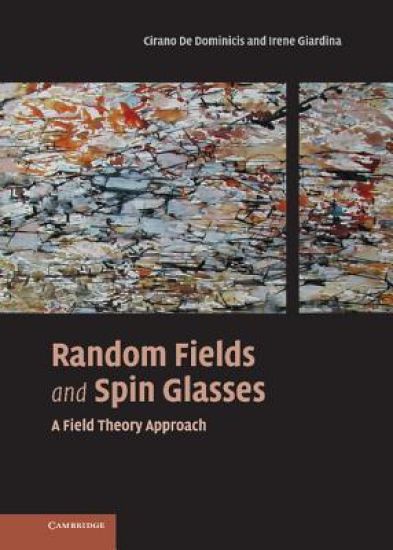
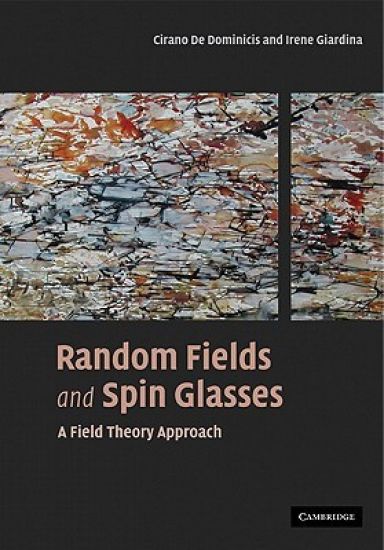
Random Fields and Spin Glasses

Random Fields and Spin Glasses

Cirano De Dominicis; Irene Giardina

Cambridge University Press
2010
pokkari
Disordered magnetic systems enjoy non-trivial properties which are different and richer than those observed in their pure, non-disordered counterparts. These properties dramatically affect the thermodynamic behaviour and require specific theoretical treatment. This book deals with the theory of magnetic systems in the presence of frozen disorder, in particular paradigmatic and well-known spin models such as the Random Field Ising Model and the Ising Spin Glass. This is a unified presentation using a field theory language which covers mean field theory, dynamics and perturbation expansion within the same theoretical framework. Particular emphasis is given to the connections between different approaches such as statics vs. dynamics, microscopic vs. phenomenological models. The book introduces some useful and little-known techniques in statistical mechanics and field theory. This book will be of great interest to graduate students and researchers in statistical physics and basic field theory.
Random Graph Dynamics

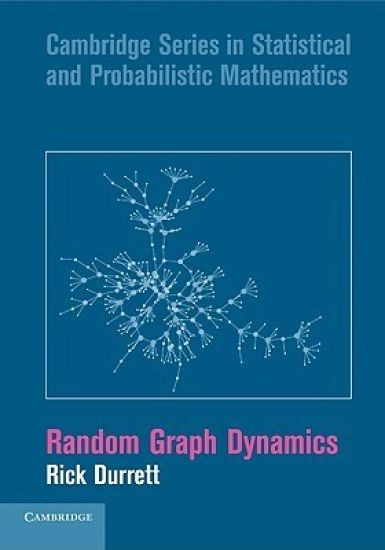
Random Graph Dynamics

Rick Durrett

Cambridge University Press
2010
pokkari
The theory of random graphs began in the late 1950s in several papers by Erdos and Renyi. In the late twentieth century, the notion of six degrees of separation, meaning that any two people on the planet can be connected by a short chain of people who know each other, inspired Strogatz and Watts to define the small world random graph in which each site is connected to k close neighbors, but also has long-range connections. At a similar time, it was observed in human social and sexual networks and on the Internet that the number of neighbors of an individual or computer has a power law distribution. This inspired Barabasi and Albert to define the preferential attachment model, which has these properties. These two papers have led to an explosion of research. The purpose of this book is to use a wide variety of mathematical argument to obtain insights into the properties of these graphs. A unique feature is the interest in the dynamics of process taking place on the graph in addition to their geometric properties, such as connectedness and diameter.
Random Matrix Models and their Applications
Random matrices arise from, and have important applications to, number theory, probability, combinatorics, representation theory, quantum mechanics, solid state physics, quantum field theory, quantum gravity, and many other areas of physics and mathematics. This 2001 volume of surveys and research results, based largely on lectures given at the Spring 1999 MSRI program of the same name, covers broad areas such as topologic and combinatorial aspects of random matrix theory; scaling limits, universalities and phase transitions in matrix models; universalities for random polynomials; and applications to integrable systems. Its stress on the interaction between physics and mathematics will make it a welcome addition to the shelves of graduate students and researchers in both fields, as will its expository emphasis.
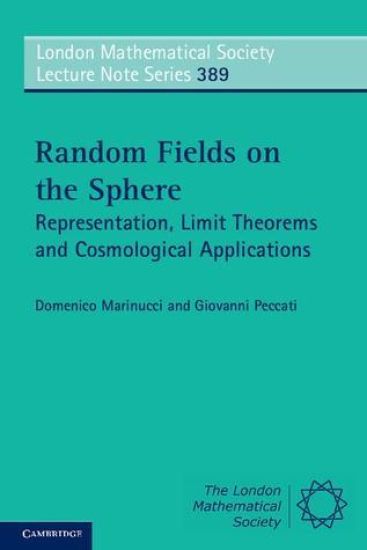
Random Fields on the Sphere

Random Fields on the Sphere

Domenico Marinucci; Giovanni Peccati

Cambridge University Press
2011
pokkari
Random Fields on the Sphere presents a comprehensive analysis of isotropic spherical random fields. The main emphasis is on tools from harmonic analysis, beginning with the representation theory for the group of rotations SO(3). Many recent developments on the method of moments and cumulants for the analysis of Gaussian subordinated fields are reviewed. This background material is used to analyse spectral representations of isotropic spherical random fields and then to investigate in depth the properties of associated harmonic coefficients. Properties and statistical estimation of angular power spectra and polyspectra are addressed in full. The authors are strongly motivated by cosmological applications, especially the analysis of cosmic microwave background (CMB) radiation data, which has initiated a challenging new field of mathematical and statistical research. Ideal for mathematicians and statisticians interested in applications to cosmology, it will also interest cosmologists and mathematicians working in group representations, stochastic calculus and spherical wavelets.
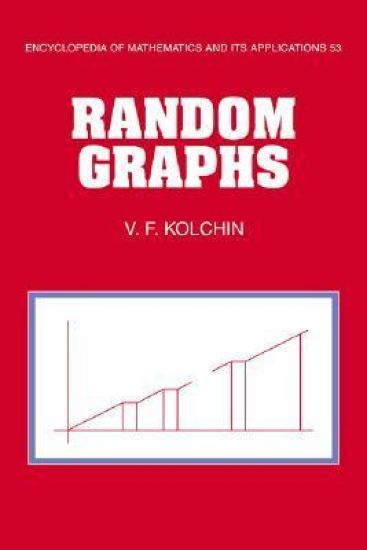
Random Graphs

Random Graphs

V. F. Kolchin

Cambridge University Press
1998
sidottu
This book is devoted to the study of classical combinatorial structures such as random graphs, permutations, and systems of random linear equations in finite fields. The author shows how the application of the generalized scheme of allocation in the study of random graphs and permutations reduces the combinatorial problems to classical problems of probability theory on the summation of independent random variables. He concentrates on recent research by Russian mathematicians, including a discussion of equations containing an unknown permutation and the first English-language presentation of techniques for solving systems of random linear equations in finite fields. These new results will interest specialists in combinatorics and probability theory and will also be useful in applied areas of probabilistic combinatorics such as communication theory, cryptology, and mathematical genetics.
Random Walk: A Modern Introduction

Random Walk: A Modern Introduction

Gregory F. Lawler; Vlada Limic

Cambridge University Press
2010
sidottu
Random walks are stochastic processes formed by successive summation of independent, identically distributed random variables and are one of the most studied topics in probability theory. This contemporary introduction evolved from courses taught at Cornell University and the University of Chicago by the first author, who is one of the most highly regarded researchers in the field of stochastic processes. This text meets the need for a modern reference to the detailed properties of an important class of random walks on the integer lattice. It is suitable for probabilists, mathematicians working in related fields, and for researchers in other disciplines who use random walks in modeling.
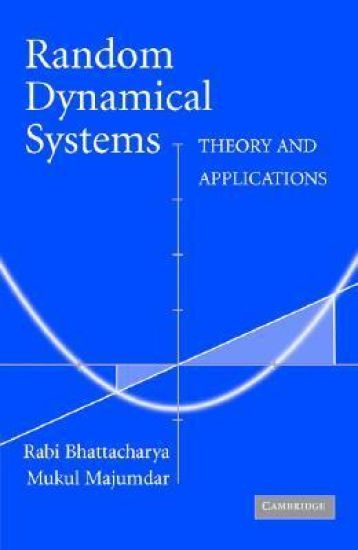
Random Dynamical Systems

Random Dynamical Systems

Rabi Bhattacharya; Mukul Majumdar

Cambridge University Press
2007
pokkari
This treatment provides an exposition of discrete time dynamic processes evolving over an infinite horizon. Chapter 1 reviews some mathematical results from the theory of deterministic dynamical systems, with particular emphasis on applications to economics. The theory of irreducible Markov processes, especially Markov chains, is surveyed in Chapter 2. Equilibrium and long run stability of a dynamical system in which the law of motion is subject to random perturbations is the central theme of Chapters 3-5. A unified account of relatively recent results, exploiting splitting and contractions, that have found applications in many contexts is presented in detail. Chapter 6 explains how a random dynamical system may emerge from a class of dynamic programming problems. With examples and exercises, readers are guided from basic theory to the frontier of applied mathematical research.
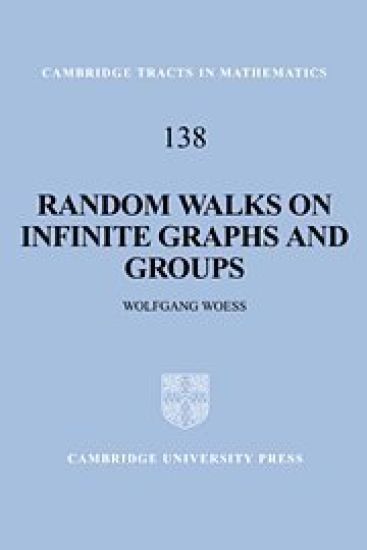
Random Walks on Infinite Graphs and Groups

Random Walks on Infinite Graphs and Groups

Woess Wolfgang

Cambridge University Press
2000
sidottu
The main theme of this book is the interplay between the behaviour of a class of stochastic processes (random walks) and discrete structure theory. The author considers Markov chains whose state space is equipped with the structure of an infinite, locally-finite graph, or as a particular case, of a finitely generated group. The transition probabilities are assumed to be adapted to the underlying structure in some way that must be specified precisely in each case. From the probabilistic viewpoint, the question is what impact the particular type of structure has on various aspects of the behaviour of the random walk. Vice-versa, random walks may also be seen as useful tools for classifying, or at least describing the structure of graphs and groups. Links with spectral theory and discrete potential theory are also discussed. This book will be essential reading for all researchers working in stochastic process and related topics.
Random Variables and Probability Distributions

Random Variables and Probability Distributions

H. Cramer

Cambridge University Press
2004
pokkari
This tract develops the purely mathematical side of the theory of probability, without reference to any applications. When originally published, it was one of the earliest works in the field built on the axiomatic foundations introduced by A. Kolmogoroff in his book Grundbegriffe der Wahrscheinlichkeitsrechnung, thus treating the subject as a branch of the theory of completely additive set functions. The author restricts himself to a consideration of probability distributions in spaces of a finite number of dimensions, and to problems connected with the Central Limit Theorem and some of its generalizations and modifications. In this edition the chapter on Liapounoff’s theorem has been partly rewritten, and now includes a proof of the important inequality due to Berry and Esseen. The terminology has been modernized, and several minor changes have been made.
Random Matrix Models and their Applications
Random matrices arise from, and have important applications to, number theory, probability, combinatorics, representation theory, quantum mechanics, solid state physics, quantum field theory, quantum gravity, and many other areas of physics and mathematics. This 2001 volume of surveys and research results, based largely on lectures given at the Spring 1999 MSRI program of the same name, covers broad areas such as topologic and combinatorial aspects of random matrix theory; scaling limits, universalities and phase transitions in matrix models; universalities for random polynomials; and applications to integrable systems. Its stress on the interaction between physics and mathematics will make it a welcome addition to the shelves of graduate students and researchers in both fields, as will its expository emphasis.
Random Graphs

Random Graphs

Béla Bollobás

Cambridge University Press
2001
sidottu
In this second edition of the now classic text, the already extensive treatment given in the first edition has been heavily revised by the author. The addition of two new sections, numerous new results and 150 references means that this represents a comprehensive account of random graph theory. The theory (founded by Erdös and Rényi in the late fifties) aims to estimate the number of graphs of a given degree that exhibit certain properties. It not only has numerous combinatorial applications, but also serves as a model for the probabilistic treatment of more complicated random structures. This book, written by an acknowledged expert in the field, can be used by mathematicians, computer scientists and electrical engineers, as well as people working in biomathematics. It is self-contained, and with numerous exercises in each chapter, is ideal for advanced courses or self study.
Random Dynamical Systems

Random Dynamical Systems

Rabi Bhattacharya; Mukul Majumdar

Cambridge University Press
2007
sidottu
This treatment provides an exposition of discrete time dynamic processes evolving over an infinite horizon. Chapter 1 reviews some mathematical results from the theory of deterministic dynamical systems, with particular emphasis on applications to economics. The theory of irreducible Markov processes, especially Markov chains, is surveyed in Chapter 2. Equilibrium and long run stability of a dynamical system in which the law of motion is subject to random perturbations is the central theme of Chapters 3-5. A unified account of relatively recent results, exploiting splitting and contractions, that have found applications in many contexts is presented in detail. Chapter 6 explains how a random dynamical system may emerge from a class of dynamic programming problems. With examples and exercises, readers are guided from basic theory to the frontier of applied mathematical research.
Random Fields and Spin Glasses

Random Fields and Spin Glasses

Cirano De Dominicis; Irene Giardina

Cambridge University Press
2006
sidottu
Disordered magnetic systems enjoy non-trivial properties which are different and richer than those observed in their pure, non-disordered counterparts. These properties dramatically affect the thermodynamic behaviour and require specific theoretical treatment. This book deals with the theory of magnetic systems in the presence of frozen disorder, in particular paradigmatic and well-known spin models such as the Random Field Ising Model and the Ising Spin Glass. This is a unified presentation using a field theory language which covers mean field theory, dynamics and perturbation expansion within the same theoretical framework. Particular emphasis is given to the connections between different approaches such as statics vs. dynamics, microscopic vs. phenomenological models. The book introduces some useful and little-known techniques in statistical mechanics and field theory. This book will be of great interest to graduate students and researchers in statistical physics and basic field theory.
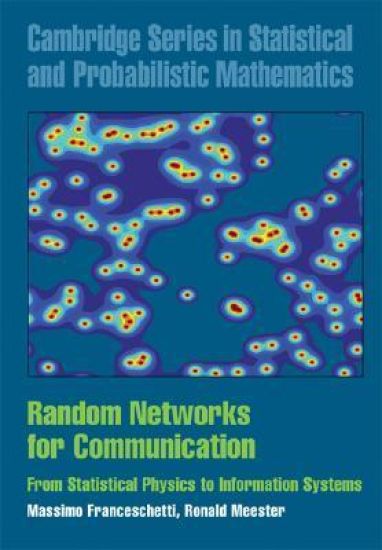
Random Networks for Communication

Random Networks for Communication

Massimo Franceschetti; Ronald Meester

Cambridge University Press
2008
sidottu
When is a random network (almost) connected? How much information can it carry? How can you find a particular destination within the network? And how do you approach these questions - and others - when the network is random? The analysis of communication networks requires a fascinating synthesis of random graph theory, stochastic geometry and percolation theory to provide models for both structure and information flow. This book is the first comprehensive introduction for graduate students and scientists to techniques and problems in the field of spatial random networks. The selection of material is driven by applications arising in engineering, and the treatment is both readable and mathematically rigorous. Though mainly concerned with information-flow-related questions motivated by wireless data networks, the models developed are also of interest in a broader context, ranging from engineering to social networks, biology, and physics.
Random Fragmentation and Coagulation Processes

Random Fragmentation and Coagulation Processes

Jean Bertoin

Cambridge University Press
2006
sidottu
Fragmentation and coagulation are two natural phenomena that can be observed in many sciences and at a great variety of scales - from, for example, DNA fragmentation to formation of planets by accretion. This book, by the author of the acclaimed Lévy Processes, is the first comprehensive theoretical account of mathematical models for situations where either phenomenon occurs randomly and repeatedly as time passes. This self-contained treatment develops the models in a way that makes recent developments in the field accessible. Each chapter ends with a comments section in which important aspects not discussed in the main part of the text (often because the discussion would have been too technical and/or lengthy) are addressed and precise references are given. Written for readers with a solid background in probability, its careful exposition allows graduate students, as well as working mathematicians, to approach the material with confidence.