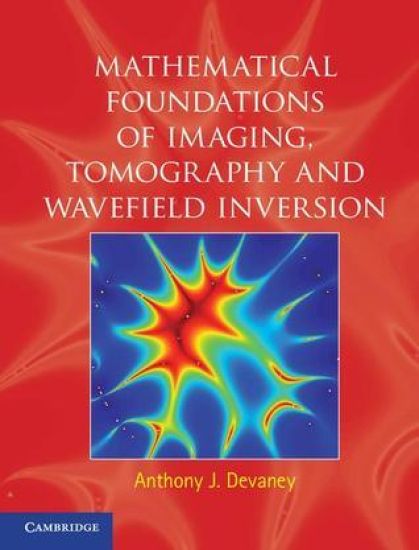
Inverse problems are of interest and importance across many branches of physics, mathematics, engineering and medical imaging. In this text, the foundations of imaging and wavefield inversion are presented in a clear and systematic way. The necessary theory is gradually developed throughout the book, progressing from simple wave equation based models to vector wave models. By combining theory with numerous MATLAB based examples, the author promotes a complete understanding of the material and establishes a basis for real world applications. Key topics of discussion include the derivation of solutions to the inhomogeneous and homogeneous Helmholtz equations using Green function techniques; the propagation and scattering of waves in homogeneous and inhomogeneous backgrounds; and the concept of field time reversal. Bridging the gap between mathematics and physics, this multidisciplinary book will appeal to graduate students and researchers alike. Additional resources including MATLAB codes and solutions are available online at www.cambridge.org/9780521119740.
Es posible que hayas o do hablar de los fondos de cobertura a trav s de lo que los pol ticos est n discutiendo, o tal vez s lo los conoces en base a las cosas que has le do en la prensa. A pesar de lo que has o do, es posible que hayas tenido problemas para entender lo que realmente son, cuestionando si son tan malos como todo el mundo dice.Existe la creencia com n de que alguien que es rico puede tener acceso a un fondo de cobertura que est protegido, mientras que un individuo menos afortunado podr a tener que valerse por s mismo, no tan protegido como ese individuo original. Desafortunadamente, esta idea no podr a estar m s lejos de la verdad cuando se trata de fondos de cobertura.Un fondo de cobertura puede definirse mediante una inversi n privada de alcance limitado en cuanto a qui n puede participar en esa inversi n. Los factores que diferencian este tipo de inversi n de los regulares son que es privada, y que s lo hay ciertas personas calificadas para invertir en el fondo. Si bien es posible que hayas tenido ideas err neas antes, podr s aprender acerca de la verdad y los beneficios a lo largo de este libro. No esperes a leer.En el libro, usted descubrir Por qu la comercializaci n de fondos de cobertura es inicialmente dif cilLa mentalidad que implica tener un fondo de cobertura exitosoC mo comercializar su propio fondo de coberturaLa comercializaci n de fondos de cobertura m s exitosaC mo puede beneficiarse de su sistema de marketing de fondos de coberturaSegmentaci n de inversores de fondos de coberturaHacer trabajo de marketing en l neaQu no hacer con su fondo de coberturaNo dudes en aprender la verdad sobre algo que podr a ayudarte a hacerte una tonelada de dinero. Haga clic en "a adir a la cesta" para leer m s.
The nuclear shell model has had much success when describing nuclear structure. It is able to describe the single-particle states of nuclei, and gives understanding as to how nuclear structure evolves as the number of nucleons changes in a nucleus. This led to the discovery of the so-called magic numbers, which designate particularly stable configurations of protons and neutrons in nuclei.With the advent of radioactive ion beams, it has become possible to probe exotic nuclei to test current theories of nuclear structure. These investigations have led to the discovery of exotic nuclear phenomena, with structures different to those found in stable nuclei. One of these is the N=20 island of inversion, where configurations that appear in stable nuclei become less bound than more exotic particle-hole configurations across a shell gap. Another is the weakening of the magic N=20 shell gap to N=16 as the number of protons is reduced in this isotonic chain.Of particular interest are the magnesium isotopes, which exhibit a swift transition into the island of inversion with 29Mg lying outside and 31Mg lying inside. In addition, 29Mg lies one neutron outside N=16, so is also able to give insight on the weakening of the N=16 shell gap. Mapping this region of the chart of nuclides helps in the understanding of the evolution of this nuclear structure. A useful probe for this task is single-particle transfer reactions. However, these reactions have been hindered by low yields from radioactive ion beams, as well as suffering from kinematic effects that obscure the states that need to be observed. The ISOLDE Solenoidal Spectrometer (ISS), that measures these transfer reactions in a solenoidal magnetic field, was designed to counteract these effects. With the high-yield radioactive ion beams at ISOLDE, CERN, these transfer reactions became viable.Therefore, the nuclear structure of 29Mg was probed using the d(28Mg,p) reaction using this device. This work marks the first measurement using the ISOLDE Solenoidal spectrometer and the first time that a solenoidal spectrometer has been used at an ISOL radioactive beam facility. The measurements highlight the interplay of nucleon-nucleon interactions and the geometry of the nuclear potential in driving observed trends in single-particle structure, in particular the changes in closed shells towards doubly magic 24O
The nuclear shell model has had much success when describing nuclear structure. It is able to describe the single-particle states of nuclei, and gives understanding as to how nuclear structure evolves as the number of nucleons changes in a nucleus. This led to the discovery of the so-called magic numbers, which designate particularly stable configurations of protons and neutrons in nuclei.With the advent of radioactive ion beams, it has become possible to probe exotic nuclei to test current theories of nuclear structure. These investigations have led to the discovery of exotic nuclear phenomena, with structures different to those found in stable nuclei. One of these is the N=20 island of inversion, where configurations that appear in stable nuclei become less bound than more exotic particle-hole configurations across a shell gap. Another is the weakening of the magic N=20 shell gap to N=16 as the number of protons is reduced in this isotonic chain.Of particular interest are the magnesium isotopes, which exhibit a swift transition into the island of inversion with 29Mg lying outside and 31Mg lying inside. In addition, 29Mg lies one neutron outside N=16, so is also able to give insight on the weakening of the N=16 shell gap. Mapping this region of the chart of nuclides helps in the understanding of the evolution of this nuclear structure. A useful probe for this task is single-particle transfer reactions. However, these reactions have been hindered by low yields from radioactive ion beams, as well as suffering from kinematic effects that obscure the states that need to be observed. The ISOLDE Solenoidal Spectrometer (ISS), that measures these transfer reactions in a solenoidal magnetic field, was designed to counteract these effects. With the high-yield radioactive ion beams at ISOLDE, CERN, these transfer reactions became viable.Therefore, the nuclear structure of 29Mg was probed using the d(28Mg,p) reaction using this device. This work marks the first measurement using the ISOLDE Solenoidal spectrometer and the first time that a solenoidal spectrometer has been used at an ISOL radioactive beam facility. The measurements highlight the interplay of nucleon-nucleon interactions and the geometry of the nuclear potential in driving observed trends in single-particle structure, in particular the changes in closed shells towards doubly magic 24O
Warum sehen wir Filme an? Weil sie uns Geschichten erz hlen, die spannend sind, die begeistern, die ber hren und die uns fesseln. Dabei sind wir gewohnt, dass uns die Handlung kausal-logisch von vorne nach hinten erz hlt wird. Wir wissen um Zeitraffungen und Flashbacks, erkennen Traumsequenzen - der medial sozialisierte Zuschauer hat damit keine Probleme. Doch seit einigen Jahren findet der bewusste und beabsichtigte Bruch mit Konventionen wie Chronologie und Linearit t vermehrt Einzug ins Filmschaffen. Sp testens mit PULP FICTION ist das Aufbrechen der Zeit ein gro es Thema. Epidsodenfilme, episodisches Erz hlen, Puzzle-artige Filme, Filme, die es darauf abgesehen haben, den Zuschauer zu verwirren - das Feld ist gro und spannend.Aber was passiert, wenn Filme dieses Ph nomen auf die Spitze treiben? Wenn ein Film mit dem Ende beginnt und mit dem Anfang endet? K nnen wir das auch noch verstehen und nachvollziehen? Wie verhalten sich dann Narration, Chronologie und Linearit t? MEMENTO, IRR VERSIBLE und 5 X 2 sind solche Filme, und sie faszinieren und schockieren gleicherma en. Indra Runge wirft den Blick hinter die Geschichten, deckt absichtliche T uschungen ber erz hlte Inhalte auf und stellt zurecht die Frage nach dem Sinn dieses formalen Spiels: Sind MEMENTO, IRR VERSIBLE und 5 X 2 innovative oder konventionelle Filme? Was ist das Andere und das Besondere?