Kirjahaku
Etsi kirjoja tekijän nimen, kirjan nimen tai ISBN:n perusteella.
1000 tulosta hakusanalla Alfred Gudeman

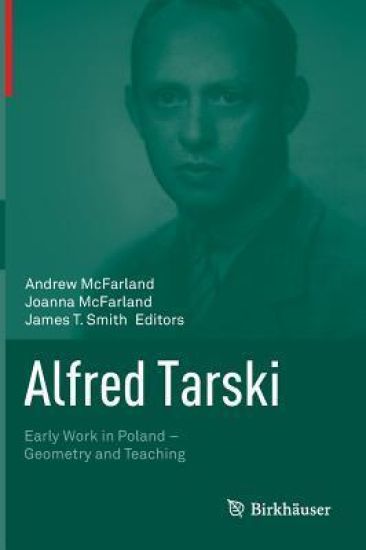
Alfred Tarski (1901–1983) was a renowned Polish/American mathematician, a giant of the twentieth century, who helped establish the foundations of geometry, set theory, model theory, algebraic logic and universal algebra. Throughout his career, he taught mathematics and logic at universities and sometimes in secondary schools. Many of his writings before 1939 were in Polish and remained inaccessible to most mathematicians and historians until now.This self-contained book focuses on Tarski’s early contributions to geometry and mathematics education, including the famous Banach–Tarski paradoxical decomposition of a sphere as well as high-school mathematical topics and pedagogy. These themes are significant since Tarski’s later research on geometry and its foundations stemmed in part from his early employment as a high-school mathematics teacher and teacher-trainer. The book contains careful translations and much newly uncovered social background of these works written during Tarski’s years in Poland.Alfred Tarski: Early Work in Poland serves the mathematical, educational, philosophical and historical communities by publishing Tarski’s early writings in a broadly accessible form, providing background from archival work in Poland and updating Tarski’s bibliography.A list of errata can be found on the author Smith’s personal webpage.
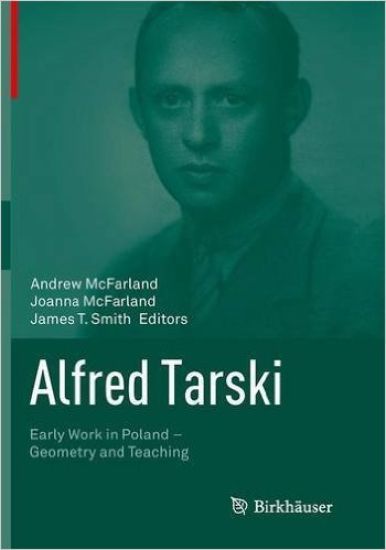
Alfred Tarski (1901–1983) was a renowned Polish/American mathematician, a giant of the twentieth century, who helped establish the foundations of geometry, set theory, model theory, algebraic logic and universal algebra. Throughout his career, he taught mathematics and logic at universities and sometimes in secondary schools. Many of his writings before 1939 were in Polish and remained inaccessible to most mathematicians and historians until now.This self-contained book focuses on Tarski’s early contributions to geometry and mathematics education, including the famous Banach–Tarski paradoxical decomposition of a sphere as well as high-school mathematical topics and pedagogy. These themes are significant since Tarski’s later research on geometry and its foundations stemmed in part from his early employment as a high-school mathematics teacher and teacher-trainer. The book contains careful translations and much newly uncovered social background of these works written during Tarski’s years in Poland.Alfred Tarski: Early Work in Poland serves the mathematical, educational, philosophical and historical communities by publishing Tarski’s early writings in a broadly accessible form, providing background from archival work in Poland and updating Tarski’s bibliography.A list of errata can be found on the author Smith’s personal webpage.


A Field Marshal's Memoirs: From the Diary, Correspondence and Reminiscences of Alfred, Count Von Waldersee
Alfred Count Von Waldersee; Frederic Whyte
Literary Licensing, LLC
2013
nidottu


Campaign Addresses of Governor Alfred E. Smith: Democratic Candidate for President, 1928
Alfred E. Smith
Literary Licensing, LLC
2013
nidottu
Progressive Democracy: Addresses and State Papers of Alfred E. Smith
Alfred E. Smith
Literary Licensing, LLC
2013
nidottu

""The Holy Grail"" is a poem written by Alfred Lord Tennyson, published in 1869. It is a part of his larger work, ""Idylls of the King"", which is a collection of twelve poems that retell the legend of King Arthur and his knights. ""The Holy Grail"" is a narrative poem that tells the story of Sir Galahad, one of the knights of the Round Table, who is on a quest to find the Holy Grail, a sacred cup believed to have been used by Jesus Christ at the Last Supper.The poem is divided into four parts, each of which describes a different stage in Galahad's journey. In the first part, Galahad is summoned by King Arthur to undertake the quest for the Holy Grail. He sets out on his journey accompanied by a group of other knights, including Sir Bors and Sir Percivale.In the second part, Galahad and his companions encounter a hermit who tells them about the perils they will face on their quest. They continue on their journey and arrive at a castle where they are welcomed by the Fisher King, who is suffering from a mysterious illness. The Fisher King tells them that the Holy Grail is kept in his castle and that only a pure and worthy knight can retrieve it.In the third part, Galahad is the only knight who is deemed pure enough to enter the chamber where the Holy Grail is kept. He sees a vision of the Grail and is filled with a sense of divine purpose. However, he is unable to take the Grail with him and is transported back to Arthur's court.In the final part, Galahad dies and is taken up to heaven by angels. The other knights realize that they were not pure enough to see the Holy Grail and vow to live more virtuous lives.""The Holy Grail"" is a poem that explores themes of purity, faith, and the quest for spiritual fulfillment. It is written in a lyrical and evocative style that captures the mystical and otherworldly atmosphere of the Arthurian legend.This Is A New Release Of The Original 1887 Edition.This scarce antiquarian book is a facsimile reprint of the old original and may contain some imperfections such as library marks and notations. Because we believe this work is culturally important, we have made it available as part of our commitment for protecting, preserving, and promoting the world's literature in affordable, high quality, modern editions, that are true to their original work.

Four Songs of Life: Two Voices of Faith and Two of Doubt by Matthew Arnold, John Greenleaf Whittier, William Ernest Henley, Alfred Lord Te
Alfred Tennyson; John Greenleaf Whittier; Matthew Arnold
Literary Licensing, LLC
2014
nidottu