Kirjojen hintavertailu. Mukana 12 083 983 kirjaa ja 12 kauppaa.

Kirjahaku

Etsi kirjoja tekijän nimen, kirjan nimen tai ISBN:n perusteella.

1000 tulosta hakusanalla Carlo Gozzi

We Two at Monte Carlo.

We Two at Monte Carlo.

Albert Dresden Vandam

British Library, Historical Print Editions
2011
pokkari
Title: We Two at Monte Carlo.Publisher: British Library, Historical Print EditionsThe British Library is the national library of the United Kingdom. It is one of the world's largest research libraries holding over 150 million items in all known languages and formats: books, journals, newspapers, sound recordings, patents, maps, stamps, prints and much more. Its collections include around 14 million books, along with substantial additional collections of manuscripts and historical items dating back as far as 300 BC.The FICTION & PROSE LITERATURE collection includes books from the British Library digitised by Microsoft. The collection provides readers with a perspective of the world from some of the 18th and 19th century's most talented writers. Written for a range of audiences, these works are a treasure for any curious reader looking to see the world through the eyes of ages past. Beyond the main body of works the collection also includes song-books, comedy, and works of satire. ++++The below data was compiled from various identification fields in the bibliographic record of this title. This data is provided as an additional tool in helping to insure edition identification: ++++ British Library Vandam, Albert Dresden; 1890. iv. 224 p.; 8 . 012631.e.15.

The Sack of Monte Carlo

The Sack of Monte Carlo

Walter Frith

British Library, Historical Print Editions
2011
pokkari
Title: The Sack of Monte Carlo: an adventure of to-day, etc.Publisher: British Library, Historical Print EditionsThe British Library is the national library of the United Kingdom. It is one of the world's largest research libraries holding over 150 million items in all known languages and formats: books, journals, newspapers, sound recordings, patents, maps, stamps, prints and much more. Its collections include around 14 million books, along with substantial additional collections of manuscripts and historical items dating back as far as 300 BC.The FICTION & PROSE LITERATURE collection includes books from the British Library digitised by Microsoft. The collection provides readers with a perspective of the world from some of the 18th and 19th century's most talented writers. Written for a range of audiences, these works are a treasure for any curious reader looking to see the world through the eyes of ages past. Beyond the main body of works the collection also includes song-books, comedy, and works of satire. ++++The below data was compiled from various identification fields in the bibliographic record of this title. This data is provided as an additional tool in helping to insure edition identification: ++++ British Library Frith, Walter; 1897. 298 p.; 8 . 012625.k.18.
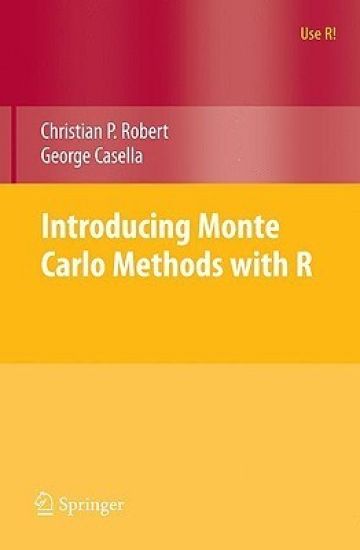
Introducing Monte Carlo Methods with R

Introducing Monte Carlo Methods with R

Christian Robert; George Casella

Springer-Verlag New York Inc.
2009
nidottu
Computational techniques based on simulation have now become an essential part of the statistician's toolbox. It is thus crucial to provide statisticians with a practical understanding of those methods, and there is no better way to develop intuition and skills for simulation than to use simulation to solve statistical problems. Introducing Monte Carlo Methods with R covers the main tools used in statistical simulation from a programmer's point of view, explaining the R implementation of each simulation technique and providing the output for better understanding and comparison. While this book constitutes a comprehensive treatment of simulation methods, the theoretical justification of those methods has been considerably reduced, compared with Robert and Casella (2004). Similarly, the more exploratory and less stable solutions are not covered here. This book does not require a preliminary exposure to the R programming language or to Monte Carlo methods, nor an advanced mathematical background. While many examples are set within a Bayesian framework, advanced expertise in Bayesian statistics is not required. The book covers basic random generation algorithms, Monte Carlo techniques for integration and optimization, convergence diagnoses, Markov chain Monte Carlo methods, including Metropolis {Hastings and Gibbs algorithms, and adaptive algorithms. All chapters include exercises and all R programs are available as an R package called mcsm. The book appeals to anyone with a practical interest in simulation methods but no previous exposure. It is meant to be useful for students and practitioners in areas such as statistics, signal processing, communications engineering, control theory, econometrics, finance and more. The programming parts are introduced progressively to be accessible to any reader.
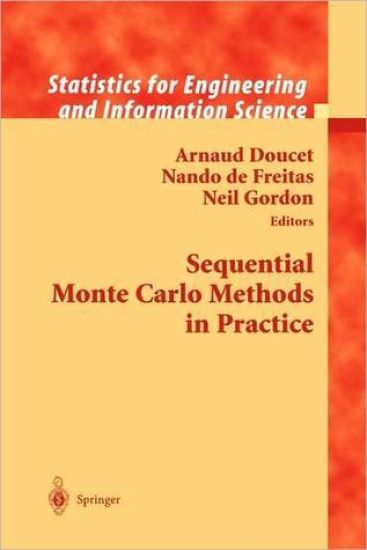
Sequential Monte Carlo Methods in Practice

Sequential Monte Carlo Methods in Practice

A. Smith

Springer-Verlag New York Inc.
2010
nidottu
Monte Carlo methods are revolutionising the on-line analysis of data in fields as diverse as financial modelling, target tracking and computer vision. These methods, appearing under the names of bootstrap filters, condensation, optimal Monte Carlo filters, particle filters and survial of the fittest, have made it possible to solve numerically many complex, non-standarard problems that were previously intractable. This book presents the first comprehensive treatment of these techniques, including convergence results and applications to tracking, guidance, automated target recognition, aircraft navigation, robot navigation, econometrics, financial modelling, neural networks,optimal control, optimal filtering, communications, reinforcement learning, signal enhancement, model averaging and selection, computer vision, semiconductor design, population biology, dynamic Bayesian networks, and time series analysis. This will be of great value to students, researchers and practicioners, who have some basic knowledge of probability. Arnaud Doucet received the Ph. D. degree from the University of Paris- XI Orsay in 1997. From 1998 to 2000, he conducted research at the Signal Processing Group of Cambridge University, UK. He is currently an assistant professor at the Department of Electrical Engineering of Melbourne University, Australia. His research interests include Bayesian statistics, dynamic models and Monte Carlo methods. Nando de Freitas obtained a Ph.D. degree in information engineering from Cambridge University in 1999. He is presently a research associate with the artificial intelligence group of the University of California at Berkeley. His main research interests are in Bayesian statistics and the application of on-line and batch Monte Carlo methods to machine learning.
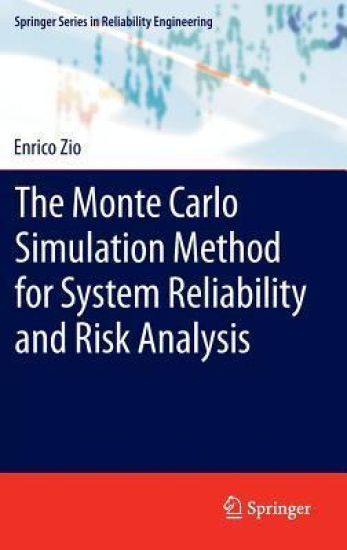
The Monte Carlo Simulation Method for System Reliability and Risk Analysis
Monte Carlo simulation is one of the best tools for performing realistic analysis of complex systems as it allows most of the limiting assumptions on system behavior to be relaxed. The Monte Carlo Simulation Method for System Reliability and Risk Analysis comprehensively illustrates the Monte Carlo simulation method and its application to reliability and system engineering. Readers are given a sound understanding of the fundamentals of Monte Carlo sampling and simulation and its application for realistic system modeling. Whilst many of the topics rely on a high-level understanding of calculus, probability and statistics, simple academic examples will be provided in support to the explanation of the theoretical foundations to facilitate comprehension of the subject matter. Case studies will be introduced to provide the practical value of the most advanced techniques. This detailed approach makes The Monte Carlo Simulation Method for System Reliability and Risk Analysis a key reference for senior undergraduate and graduate students as well as researchers and practitioners. It provides a powerful tool for all those involved in system analysis for reliability, maintenance and risk evaluations.
The Monte Carlo Simulation Method for System Reliability and Risk Analysis
Monte Carlo simulation is one of the best tools for performing realistic analysis of complex systems as it allows most of the limiting assumptions on system behavior to be relaxed. The Monte Carlo Simulation Method for System Reliability and Risk Analysis comprehensively illustrates the Monte Carlo simulation method and its application to reliability and system engineering. Readers are given a sound understanding of the fundamentals of Monte Carlo sampling and simulation and its application for realistic system modeling. Whilst many of the topics rely on a high-level understanding of calculus, probability and statistics, simple academic examples will be provided in support to the explanation of the theoretical foundations to facilitate comprehension of the subject matter. Case studies will be introduced to provide the practical value of the most advanced techniques. This detailed approach makes The Monte Carlo Simulation Method for System Reliability and Risk Analysis a key reference for senior undergraduate and graduate students as well as researchers and practitioners. It provides a powerful tool for all those involved in system analysis for reliability, maintenance and risk evaluations.
A Monte Carlo Primer

A Monte Carlo Primer

Stephen A. Dupree; Stanley K. Fraley

Springer-Verlag New York Inc.
2012
nidottu
The mathematical technique of Monte Carlo, as applied to the transport of sub-atomic particles, has been described in numerous reports and books since its formal development in the 1940s. Most of these instructional efforts have been directed either at the mathematical basis of the technique or at its practical application as embodied in the several large, formal computer codes available for performing Monte Carlo transport calculations. This book attempts to fill what appears to be a gap in this Monte Carlo literature between the mathematics and the software. Thus, while the mathematical basis for Monte Carlo transport is covered in some detail, emphasis is placed on the application of the technique to the solution of practical radiation transport problems. This is done by using the PC as the basic teaching tool. This book assumes the reader has a knowledge of integral calculus, neutron transport theory, and Fortran programming. It also assumes the reader has available a PC with a Fortran compiler. Any PC of reasonable size should be adequate to reproduce the examples or solve the exercises contained herein. The authors believe it is important for the reader to execute these examples and exercises, and by doing so to become accomplished at preparing appropriate software for solving radiation transport problems using Monte Carlo. The step from the software described in this book to the use of production Monte Carlo codes should be straightforward.
Strategies for Quasi-Monte Carlo

Strategies for Quasi-Monte Carlo

Bennett L. Fox

Springer-Verlag New York Inc.
2012
nidottu
Strategies for Quasi-Monte Carlo builds a framework to design and analyze strategies for randomized quasi-Monte Carlo (RQMC). One key to efficient simulation using RQMC is to structure problems to reveal a small set of important variables, their number being the effective dimension, while the other variables collectively are relatively insignificant. Another is smoothing. The book provides many illustrations of both keys, in particular for problems involving Poisson processes or Gaussian processes. RQMC beats grids by a huge margin. With low effective dimension, RQMC is an order-of-magnitude more efficient than standard Monte Carlo. With, in addition, certain smoothness - perhaps induced - RQMC is an order-of-magnitude more efficient than deterministic QMC. Unlike the latter, RQMC permits error estimation via the central limit theorem. For random-dimensional problems, such as occur with discrete-event simulation, RQMC gets judiciously combined with standard Monte Carlo to keep memory requirements bounded. This monograph has been designed to appeal to a diverse audience, including those with applications in queueing, operations research, computational finance, mathematical programming, partial differential equations (both deterministic and stochastic), and particle transport, as well as to probabilists and statisticians wanting to know how to apply effectively a powerful tool, and to those interested in numerical integration or optimization in their own right. It recognizes that the heart of practical application is algorithms, so pseudocodes appear throughout the book. While not primarily a textbook, it is suitable as a supplementary text for certain graduate courses. As a reference, it belongs on the shelf of everyone with a serious interest in improving simulation efficiency. Moreover, it will be a valuable reference to all those individuals interested in improving simulation efficiency with more than incremental increases.